Monday, October 12, 2026
Home Blog Page 1487

In contentious meeting, UA regents approve path to single accreditation

By KOBE RIZK

In an 8-3 vote and after hours of discussion, the University of Alaska Board of Regents directed UA President Jim Johnsen to pursue a single-accreditation model for the UA system. The plan to implement single accreditation would presumably eliminate much of the administration at UA’s individual campuses and centralize system administration at one yet-to-be-determined location.

The detailed plan for implementation, which Johnsen will present to the board in September, will likely also include consolidating academic programs and schools (such as engineering, education, and business) and ramping up the university’s focus on online education.

Regents met in Anchorage Tuesday morning to continue discussions of the university’s future in the face of a 41 percent reduction of unrestricted general funds from the state of Alaska, amounting to a 17 percent to the system’s budget overall. Today’s meeting was the regents’ third special meeting to be held this month.

While the possibility of the Alaska Legislature partially restoring funding to the university remains, the governor’s veto power looms and university administrators had previously outlined to regents the increasing severity of cuts required with each passing month of inaction.

The university system’s three chancellors presented on option 2, a so-called “consortium model” between the three main campuses (UAA, UAF, and UAS) that would rely on inter-campus collaboration for cost-saving. In this model, the three main campuses would maintain their own separate accreditations as well as administrators such as vice-chancellors, provosts, and deans. A “leaner” statewide administration would have less control in the day-to-day operations of the system’s campuses.

While regents ultimately elected not to adopt this plan, they directed Johnsen to “work with the chancellors” to implement the new single-accreditation model.

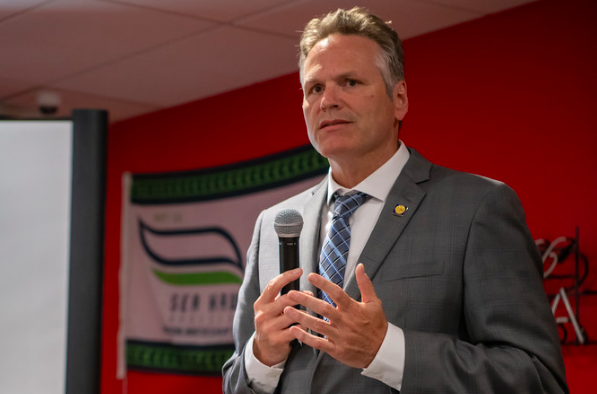
Gov. Michael Dunleavy telephoned into the regents’ meeting in the midst of their budget and structural discussions. Dunleavy recalled his personal connection to the university (he received his master’s degree at UAF) and affirmed his support for the institution despite his veto of over $130 million in state funding.

The governor’s Office of Management and Budget Policy Director Mike Barnhill presented at length to the board about a proposed “step-down” deal in which this year’s reduction would be spread over two years, with an approximately $85 million reduction for FY20. Barnhill recommended that the board work to decrease “administrative overhead” across the system and only making reductions of academic programs as a last resort. It is unclear if the regents accepted that offer.

The regents’ next scheduled meeting is Sept. 12-13 in Juneau, though it is possible that another special meeting is held before that time.

PR nightmare – Student rep pushes anti-oil message during budget talks

BEGGING FOR MONEY WHILE DISSING INDUSTRIES THAT PAY THE BILLS?

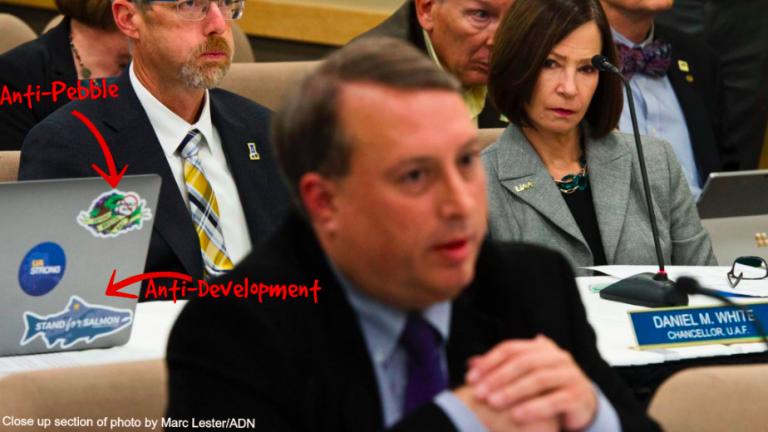
Union of Students representative Alex Jorgensen’s computer was the unfortunate photo-bomb during Office of Management and Budget Mike Barnhill’s presentation to the University of Alaska Board of Regents.

Jorgensen’s laptop was decked out in anti-development stickers as he sat through the presentation with Dr. Daniel White, chancellor of University of Alaska Fairbanks, and Dr. Cathy Sandeen, both visibly stressed at the thought of losing 17 percent of the university’s system’s funding.

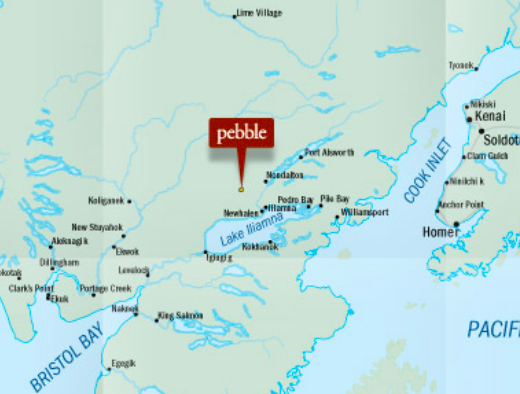
State funding for the university system comes from revenues from oil, which the Stand for Salmon voter initiative targeted in a failed ballot campaign in 2018. The sticker above the salmon has a clear anti-Pebble Mine message.

The ironic photo by staff photographer Marc Lester appeared in the July 30 online edition of the Anchorage Daily News.

Report: Green New Deal would cost Alaskans $63,000 to $100,000 annually

8

A newly published report says the Green New Deal, a series of policies pushed by far-left Democrats, would cost a typical Alaska family $100,000 the first year implemented, $73,000 for each of the next four years, and more than $67,000 each year thereafter.

The report comes from the Competitive Enterprise Institute and Power the Future, two pro-business groups with missions of influencing public policy. Power the Future has an Alaska coordinator, Rick Whitbeck of Anchorage.

The expansive set of policy changes would cost the American economy six times the world’s current gross domestic product, Whitbeck said.

The Green New Deal was introduced in the 116th Congress as House Resolution 109 and Senate Resolution 59. It has its genesis with the Green Party, with Green Party candidate Jill Stein championing it as early as 2012.

The Green New Deal would guarantee a job “with a family-sustaining wage, adequate family and medical leave, paid vacations, and retirement security.”

According to the Sierra Club, one of the Green New Deal’s proponents, the result would be:

  • Millions of family-sustaining jobs: Whether replacing lead pipes, weatherizing homes, expanding railways, or manufacturing wind turbines, millions of workers will lead the transition to a new economy. The jobs created must be high-road, union jobs: with family-sustaining wages and benefits, safe working conditions, and training and advancement opportunities.
  • Climate sanity: A Green New Deal would help us swiftly transition to a clean energy economy. By investing in smart grids for renewable energy distribution, encouraging energy-efficient manufacturing, and expanding low-emissions public transit, a Green New Deal would significantly reduce climate pollution.
  • Clean air and water: A Green New Deal would replace lead pipes, clean up hazardous waste sites, and reduce toxic air and water pollution from oil, gas, and coal. Those benefiting the most would be the communities of color and low-income families who today endure disproportionate exposure to toxins.
  • Lower costs: A Green New Deal would help working class families slash their energy bills and reduce their transit costs by offering more energy-efficient homes, access to affordable wind and solar power, and more reliable options for affordable public transportation.
  • Community resilience: Communities need greater resources to ensure safety and growth amid rising climate risks. A Green New Deal would help climate-exposed communities build bridges that can withstand floods, restore wetlands that buffer hurricanes, and shield coastlines from sea level rise.
  • Greater racial and economic equity: The disproportionate benefits of a Green New Deal would go to the working-class families and communities of color that have endured disproportionate economic and environmental hazards for decades. A Green New Deal must counteract systemic racism and economic exploitation by giving hard-hit communities priority access to new job opportunities, cost savings, pollution cleanup projects, and climate resilience initiatives.

The Green New Deal is more than just de-carbonizing the American economy, because it touches every social and economic aspect of American lives. But the only real measurable aspect of the deal is the cost of the energy conversion, which is the focus of the study that looked at projected costs in five states: Florida, New Hampshire, New Mexico, Pennsylvania, and Alaska. The states were chosen because they represent very different components of the U.S. and its economy.

  • Alaska: Remote, sparsely populated, and cold.
  • Florida: One of the largest states in terms of population and economy. An economic powerhouse of the Southeast in a warm climate.
  • New Hampshire: A small state well connected with larger economies in the region in a cold climate.
  • New Mexico: A small state in terms of population, but large geographically, is generally warmer, and is situated between significant large states by all metrics.
  • Pennsylvania: A large state in terms of geography, economy, and population in a mild-colder climate and well integrated with the largest regional economy in the United States.

[Review the entire study and its supporting documents at this link]

Dunleavy has a point: University of Alaska needs to reinvent itself

4

By RICHARD VEDDER
FORBES MAGAZINE

Governor Michael Dunleavy of Alaska caused quite a stir in American higher education when he used his line item budget power to reduce the appropriation of the University of Alaska (UA) by about $130 million, or about 40 percent. Since the university depends on those appropriations for about 40 percent of its budget, this was a brutal, severe cut, enough to compel a declaration of financial exigency and, with that, the likely dismissal of some tenured faculty.

The University’s State appropriation had already fallen by over $50 million between 2014 and 2019. Immediately the higher education establishment recoiled in horror, and the school’s regional accrediting agency, the Northwest Commission on Colleges and Universities, issued a thinly veiled threat that it might revoke the school’s accreditation if the cuts were not reversed. Moody’s significantly reduced the ratings on the UA’s $270 million in general revenue bonds.

My initial thoughts were: “This is too much. Universities are inefficient and probably need downsizing fiscally, but reductions of this size pose abrupt disruptions to people’s lives and severely damage the future of higher education in Alaska.”

I was inclined to agree with George Mason University economist Tyler Cowen, who opined in a Bloomberg opinion piece “Alaska is showing a depressing lack of commitment…”  Moreover, this seemed particularly true because the governor was trying to protect Alaska’s unique equivalent of a negative income tax — dividend payments to all citizens from its Permanent Fund — royalties derived from Alaska’s massive natural resources.

But then I explored things further and I think the governor had a point.

[Read the rest of this analysis at Forbes Magazine.]

EPA begins removing Obama-era ‘preemptive veto’ of Pebble Project

3

The Environmental Protection Agency has begun to reverse a preemptive veto made against the Pebble Project, which was put in place under former EPA Chief Gina McCarthy during the Obama presidency.

The EPA published its decision today to withdraw the proposed determination to restrict the use of certain waters in the South Fork Koktuli River, North Fork Koktuli River, and Upper Talarik Creek watersheds in southwest Alaska as disposal sites for dredged or fill material associated with mining the Pebble deposit.

[Read the EPA’s explanation and links to documents here]

“The EPA has decided that now is the appropriate time to complete the withdrawal of the Proposed Determination in light of developments in the record and the availability of processes for EPA to address record issues with the U.S. Army Corps of Engineers (Corps) prior to any potential future decision-making by EPA regarding this matter,” according to a document signed by Chris Hladick, Region 10 Administrator for the EPA.

“Finally, this Administration has reversed the outrageous federal government overreach inflicted on the State of Alaska by the Obama Administration,” said Pebble Partnership CEO Tom Collier.

[Read: EPA will resume work on Pebble]

“The preemptive veto was an action by an Administration that sought to vastly expand EPA’s authority to regulate land use on state, private and Native-owned lands throughout the United States, and in doing so kill one of America’s most important mineral projects before a development plan was proposed or a comprehensive Environmental Impact Statement (EIS) permitting review was undertaken,” Collier said. “The Proposed Determination ordered to be lifted today was a preemptive veto that had never before been attempted in the 45-year history of the Clean Water Act – a fact acknowledged by the former Administrator’s senior staff.”

EPA’s Proposed Determination was not based on a development plan proposed by the Pebble Partnership, but on‘hypothetical mining scenarios’ prepared by EPA itself, and assessed in a study known as the Bristol Bay Watershed Assessment.

Following extensive hearings in the House Committee on Science, Space and Technology, the study was determined to be both a result of an abuse of due process and an unfortunate attempt on EPA’s part to justify its pre-determined intent to kill the Pebble Project before a development plan was proposed or a fair, science-based regulatory review was undertaken, Collier said.

Collier thanked Alaska Governor Michael Dunleavy for his leadership in encouraging EPA to withdraw its Proposed Determination.

“As Governor Dunleavy clearly recognizes, major companies will not invest in resource development in Alaska if projects can be vetoed before they receive a fair review. Alaska has needed this kind of leadership for years. Governor Dunleavy appears to be fulfilling his pledge to make sure the world knows Alaska is open for business, and supports responsible resource development,” Collier said.

The formal withdrawal of EPA’s Proposed Determination is one of a series of important milestones that Pebble believes demonstrate it is progressing steadily toward a positive Record of Decision.

The Pebble Project is expected to generate tens of millions of dollars in State government revenues each year at a time when the State of Alaska is facing a fiscal crisis. It is also expected to support some 2,000 Alaska jobs, with average compensation for mine workers in excess of $100,000/year.

Critics say it will do irreparable harm to the world’s last great salmon fishery in Bristol Bay, by introducing mining byproducts into the watershed.

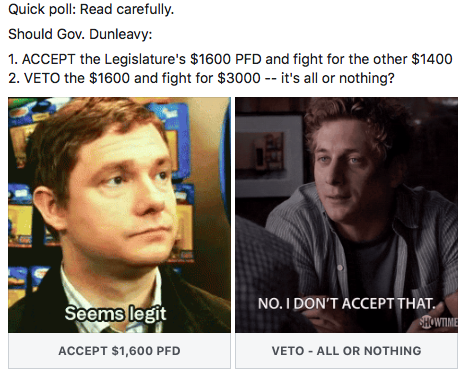
Take the poll: Should the governor veto the $1,600 PFD?

Take the Must Read Alaska poll linked below.

Because it is a Facebook poll, this is a binary question boiled down to what appears to be the choice that Gov. Michael Dunleavy has before him:

Should Gov. Dunleavy:

1. ACCEPT the Legislature’s $1600 PFD and fight for the other $1400?
2. VETO the $1600 and fight for $3000 — it’s all or nothing?

The poll ends on the morning of July 31, 2019. Results will be at the @MustReadAlaska page on Facebook.


Bernie Sanders stands with IBU ferry strike, (yet is accused of union busting)

The National Labor Relations Board is investigating U.S. Sen. Bernie Sanders’ Iowa campaign for allegedly cracking down on union organizing activities and refusing to bargain in good faith.

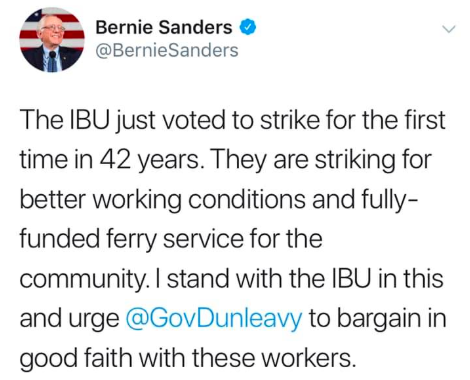
News of it came on the same day Sanders issued a statement supporting the Inland Boatmen’s Union in its strike against the Alaska Marine Highway System. The strike is going into its seventh day on Tuesday, leaving thousands stranded.

On Twitter, Sanders urged Gov. Michael Dunleavy to “bargain in good faith” with these workers.

According to the Des Moines Register, the NLRB allegations say Sanders’ campaign officials in Iowa fired one or more employees because they either joined or supported unions, or engaged in other protected activities, such as discussing wages and other conditions of employment.

In other news, Sanders, who supports a $15 minimum wage, also recently said he is cutting  his staffers’ hours in order to afford paying them a $15 an hour.

[Read the story in the Des Moines Register]

Governor: ‘This is a dark day for the PFD’

SENATE REPUBLICAN CAUCUS FRACTURING?

Gov. Michael Dunleavy today indicated he will veto some or all of the State spending add-backs that have come from the House and Senate in the appropriation bill that passed the Senate today.

Dunleavy hasn’t said how much he’ll veto. He simply said that expects to get the bill soon, and he intends to work it over.

His message during today’s press availability was to supporters of the Permanent Fund dividend: He is disappointed. The passage of a $1,600 dividend this year, instead of the statutory calculation of $3,000, has turned the dividend program into more of a social welfare line-item, rather than an actual dividend coming from oil production.

That means, without some significant change, the dividend will be gobbled up as government takes more and more of it each year to make up for a spending imbalance.

Dunleavy said the Legislature’s actions could also invite a voter backlash. Voters cannot appropriate via initiative so it’s unclear what action they might take, other than replacing legislators in 2020.

“A few years ago, no politician would have thought of putting their hands on the PFD,” he told reporters. “Alaskans never got upset about the size of the PFD because it was a rules-based system.”

But this is the fourth year the statute has not been followed. The Legislature has not acted to change the statute, nor sent a change of the PFD calculation to a vote of the people, something Dunleavy proposed in legislation this year — legislation that has gone nowhere.

MORE SPENDING, LESS PFD

The Senate today added another $70 million in spending into House Bill 2001.

Of the governor’s $444 million in vetoes of the Operating Budget, only $23 million remain, with $421 million in add-backs by the House and Senate and a Permanent Fund dividend that has been reduced by nearly half.

An unanswered question is whether Dunleavy will veto the $1,600 dividend or simply cut his losses and accept the smaller dividend, since the Legislature appears to be in no mood to fund a $3,000 dividend.

Whatever he decides to do, the state budget still has a massive structural problem. Even with his original vetoes, the State budget was only halfway to balancing. Earlier this year, Dunleavy said that balancing the budget would have to take two or more years, since he didn’t have the support of enough legislators to get there in one year.

Dunleavy praised the passage of the Capital Budget, which passed the House earlier in the day. He said he was glad to see the funding for Power Cost Equalization and state scholarships restored, along with the other items that he had proposed for funding in his original budget.

SENATE’S BINDING CAUCUS MAY REORGANIZE, BECOME BIPARTISAN

The Senate Republican Majority will likely soon be taking a vote on whether it will allow the conservative Republicans who didn’t vote for the HB 2001 (PFD/spending bill) to remain in the caucus.

Sen. Lora Reinbold was the only recorded vote against the bill, and she explained on the floor of the Senate that although she didn’t agree with all of the governor’s vetoes, the amount set for the Permanent Fund dividend is breaking the law, and she wasn’t willing to do that. She will almost certainly be removed from the caucus.

Sens. Shelley Hughes and Mike Shower, from the conservative Mat-Su Valley, asked to be excused from the floor and watched the votes from their offices.

They were hoping that by being excused they would not be thrown out of the caucus. They may have also been hoping to  prevent giving Senate President Cathy Giessel a handy excuse to form a bipartisan power coalition with Democrats. But it’s unclear whether the caucus will give them a pass.

Sen. Mia Costello, who has already been removed by Giessel as Majority Leader, voted in favor of the spending measure, which passed 17-1. She has been iced out of the Republican caucus informally after she went with other conservative legislators to the Wasilla special session called by the governor. Others who went to Wasilla for the session voted for the bill today, including Sens. David Wilson and Peter Micciche.

The binding rules for the Senate Republican caucus, which are private to the caucus, have possibly changed and now include not only voting with the caucus on the the operating budget, but on all appropriations.

Capital Budget done; PFD remains in play

Uncomfortable about delaying critical road funding for next year, two of the most conservative members of the House of Representatives voted with the Democrat-led Majority to pass the capital budget Monday, agreeing with a “reverse sweep” to fix funding for programs the Legislature neglected to fund in the Operating Budget.

On day 195 of the Legislative season, and on a third vote in a week, the Capital Budget was not a hill these conservatives needed to die on, as they know the governor has the veto pen and can X-out any items in the budget that were added back, should he choose.

The Capital Budget passed 31-7, with Reps. Dave Talerico and DeLena Johnson voting in favor of it. Only one of their votes was needed to access the Constitutional Budget Reserve. Senate Bill 2002 had passed the Senate earlier this month.

The bill will now head to the Governor’s Desk, where he can approve or veto items such as Power Cost Equalization, funding to pay for the new tough-on-crime legislation, college scholarships or the WWAMI program, a medical education program that allows students from Alaska to study at the University of Washington Medical School.

The Capital Budget is primarily a road bill. It brings millions of dollars in federal funds for road and other infrastructure projects around the state, projects that will start next year.

The Senate is taking up the Permanent Fund dividend bill on Monday. It’s a bill that also has had hundreds of millions of dollars worth of add-back spending in it, as legislators try to undo the governor’s vetoes of the Operating Budget.