Tuesday, July 14, 2026
Home Blog Page 1446

Ambler Road project analysis open for public comment

1

The Draft Environmental Impact Statement  for the proposed Ambler Mining District industrial access road is available today on the Bureau of Land Management Alaska’s website.

Alaska Industrial Development and Export Authority proposes an industrial access road connecting the Dalton Highway to the Ambler mineral belt in the Kobuk Valley potentially facilitating resource development and economic opportunities for Alaska.

AIDEA estimates an annual average of approximately 486 jobs to be created during the road construction period and up to 68 full-time jobs for road operations and maintenance over the life of the road.

The proposed 211-mile, all-season road would serve to further mineral exploration in the area and facilitate increased mine development.

The road would cross 61 percent state lands, 15 percent Alaska Native corporation lands, and 24 percent federal lands managed by the BLM and the National Park Service in the Gates of the Arctic National Park and Preserve.

Access for surface transportation purposes across the Gates of Arctic National Park and Preserve was identified in the Alaska National Interest Lands Conservation Act (ANILCA) and the Secretary is authorized to permit access in accordance with the Act. The ANILCA also requires all appropriate federal agencies outside the National Park Service to work cooperatively on a single environmental analysis and concurrently issue a decision on the proposal.

“The BLM conducted extensive public outreach for this project and visited many remote communities that would be most affected by the road,” said BLM Alaska State Director Chad Padgett. “I realize the importance of this project to the State of Alaska and for the state’s ability to develop its resources and as such, I am committed to ensuring a thorough and comprehensive analysis. This can’t be done without substantive input from stakeholders.”

Public meetings about the Draft EIS are scheduled in Alatna, Allakaket, Ambler, Anaktuvuk Pass, Anchorage, Bettles, Coldfoot, Evansville, Fairbanks, Hughes, Huslia, Kiana, Kobuk, Kotzebue, Noatak, Noorvik, Selawik, Shungnak, Stevens Village, Tanana, Wiseman and Washington, D.C. The dates, times and locations of the meetings will be announced in advance through public releases and the BLM Alaska website and social media.

The Draft EIS will publish in the Federal Register on Aug. 30, 2019, which officially starts a 45-day public comment period.  Comments on the Draft EIS will be accepted through Oct. 15, 2019, and should be specific to the document itself, commenting on sections or pages. Comments can be submitted in the following ways:

  • Online at https://www.blm.gov/AmblerRoadEIS
  • By mail to Ambler Road DEIS Comments, BLM Fairbanks District Office, 222 University Avenue, Fairbanks AK  99709
  • By hand to BLM, 222 University Avenue, Fairbanks, Alaska 99709

Documents pertinent to this proposal may be examined at the BLM Alaska State Office, BLM Alaska Public Information Center, 222 West 7th Avenue, Anchorage or at the BLM Fairbanks District Office, 222 University Avenue., Fairbanks.

EDITOR’S NOTE: The National Park Service (NPS) has prepared a Draft Environmental and Economic Analysis for the portion of the proposed Ambler Road that crosses NPS lands. The document is available at https://parkplanning.nps.gov/Ambler for a review period current with the BLM draft EIS.


EPA gets it right for Alaska with return to rule of law

13

By TOM COLLIER
PEBBLE PARTNERSHIP

The Los Angeles Times recently published an inflammatory and inaccurate perspective about the Pebble Project. While they dedicated significant editorial space for their unbalanced report, they have not been receptive to a response. For broader perspective, PLP CEO Tom Collier explains why the EPA’s decision to reject a preemptive veto was the correct decision for Alaska:

One of the reasons Alaska sought statehood in the 1950s was to reject the notion that “outsiders” should dictate decisions about what was best for Alaska. There was a strong feeling in Alaska that many in the rest of the country did not fully understand what life was like in Alaska and that they were ill informed about the range of issues facing the state. Over the course of this young state’s history, this notion has been proven true time and again.

A recent LA Times editorial presented a master’s thesis validating this premise with its wildly off base views about the Pebble mine project in Alaska, and the recent decision by the Environmental Protection Agency to return to the rule of law.

To begin, Pebble is a controversial project in Alaska. It is on land owned by the state of Alaska that is open to and identified for mineral exploration and mining. It is being extensively reviewed by the federal regulatory agencies and when they conclude their work it will be up to the state to begin its reviews. Alaskans are proud of their ability to balance decisions between resource development and environmental protections. Please come visit and see for yourself rather than relying on information from special interest groups like the Natural Resources Defense Council.

There is an important point that most have missed in the coverage about the EPA’s action to reject the preemptive veto at Pebble, and it is this: The EPA has not given up one iota of its regulatory authority regarding our project. Period. Full stop.

Right now, the U.S. Army Corps of Engineers is leading the crafting of an environmental impact statement following the rules prescribed by the National Environmental Policy Act. The EPA is fully participating in this process as a cooperating agency. They have a seat at the table for this environmental review and published a constructive comment letter about their views to date on the Corps process. When the Corps is finished, the EPA still retains the authority to initiate a veto of the Corps decision about the Pebble project.

The recent decision by the EPA was to remove its pre-permitting block on the Pebble project – a preemptive veto and an action widely condemned by a range of groups that understood the long-range impacts this would have on development in the United States. A preemptive action had never been initiated by the EPA since the Clean Water Act was passed and the EPA was created. As a result of behind-the-scenes collusion between EPA staff and environmental organizations, the Pebble project was singled out for this unprecedented step. Where was the outrage from the LA Times when a government agency went rogue and overstepped its legal authority? Because it was against a developer, most of us in the industry know the answer.

The Pebble Partnership took the EPA to court in 2014 over this preemptive action and won a preliminary injunction from a federal district judge in Alaska. This meant that the judge thought we had a reasonable chance of the case prevailing. Fast forward to the waning days of the Obama administration where we reached a settlement only to have it cancelled as the November election grew near. After a new administration took office, we renewed our settlement discussions to correct this unprecedented regulatory overreach. The issue has never been about reducing environmental requirements for mineral development at Pebble. It has been about restoring fair access to the U.S. permitting system.

Ironically, the Natural Resources Defense Council calls the NEPA process the magna carta of environmental law and endorses it for all projects in the U.S. – except the Pebble Project. It begs the question of why have groups like the NRDC fought so hard to prevent the Pebble Project from entering the NEPA process unfettered. Perhaps it is because we have undertaken one of the most extensive environmental and technical studies for a mining project in the U.S., and have designed a project that will meet the nation’s high standards for development. The Pebble Project can be developed safely and can be done without harming the fish and water resources in Southwest Alaska.

The LA Times editorial also took an unnecessary and uninformed view about the mining industry in the United States. Mining, like other resource development industries, is subject to some of the highest standards in the world. This is not the industry of 50 years ago. We must post reclamation bonds before work can begin to ensure state taxpayers are not responsible for clean-up costs should an operator go insolvent. We must demonstrate to state regulators how we will close the mine before we get a single permit to begin operating. In Alaska, we must meet some of the highest standards for water discharge in the world. Mining is an important, safe and environmentally responsible industry.

Additionally, the products of mining are required for maintaining our modern way of life. Want a lower carbon future? All green energy – wind, solar, electric cars? These products can only be developed with mined materials. You cannot have a green future without responsible mining. Determining how this can be done is exactly what the NEPA process is all about.

Tom Collier was appointed CEO of the Pebble Partnership in February 2014. Prior to this role, Tom had a 40-year legal career with Steptoe and Johnson with a specialty for guiding companies through the federal environmental permitting process. He has worked on several Alaska resource projects including the reauthorization of TAPS, Alpine oil development, and the CD-5 bridge issue. In addition to his legal career, Tom has worked for the U.S. Department of the Interior as Chief of Staff for former Secretary Bruce Babbitt and at the U.S. Department of Housing and Urban Development. Collier has a law degree from the University of Mississippi where he graduated first in his class. He moved to Anchorage in 2014.

Dunleavy declares disaster for McKinley, Deshka Landing, Kenai wildfires

2

Gov. Michael Dunleavy issued a disaster declaration for the Matanuska-Susitna Borough and Kenai Peninsula Borough for impacts from the McKinley, Deshka Landing, and Swan Lake wildfires.

The wildfires have damaged or destroyed an estimated 83 structures, resulted in mandatory evacuation of approximately 400 residents, and caused intermittent travel delays along the Sterling and Parks Highways and for rail traffic along the Alaska Railroad. The scope of the damage is not yet fully realized due to active fire suppression efforts. Substantial damage to private homes, public facilities, and communications and utility lines are anticipated.

The response to the wildfires has been hampered by conditions affecting the entire southcentral portion of the state, such as drought and record dry fuels, strong winds, and low humidity.

“In a short amount of time, these wildfires have already cost dozens of Alaskan families everything they own. Many homes, personal belongings, and businesses are completely gone, and the disruption brought to their lives is unimaginable,” said Dunleavy.

The declaration frees up financial assistance to help the victims of these devastating fires begin to rebuild their lives as quickly as possible by activating Alaska’s Public Assistance, Individual Assistance and Temporary Housing programs.

Brig. Gen. Torrence Saxe, Commissioner of the Department of Military and Veterans Affairs, said the Alaska National Guard, and all of DMVA, will continue to support the firefighting efforts.

The State of Alaska Public Assistance program is designed to help communities, government organizations, and certain non-profits make repairs to utilities, public buildings, roads, bridges, and other critical infrastructure damaged by the declared event.

The State of Alaska Individual Assistance program is designed to provide grant funding to individuals and families for damages to their real property and personal property, as well as medical expenses that are a direct result of the disaster event. In addition, the Individual Assistance program can provide temporary housing to individuals and families that cannot return to their homes.

Residents and affected business owners will be notified of how and where they can apply for assistance in the upcoming days.

Alaska State Fair and Parade is ‘recall’ battleground

TRYING TO REVERSE THE RESULTS OF THE ELECTION IN THE HEART OF DUNLEAVY COUNTRY

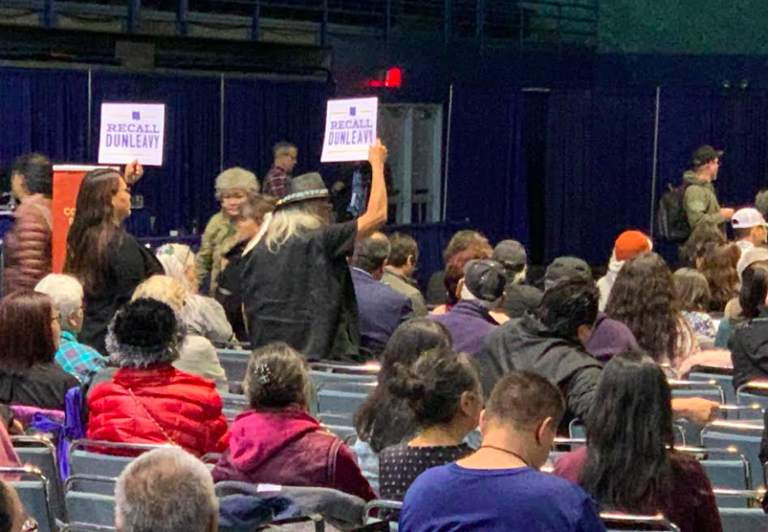
The Recall Dunleavy group will be out and about on Saturday at the Alaska State Fair Parade in Palmer, with a parade entry that will march right by the governor, who is being seated as a guest of honor on the grandstand. The parade begins at 11 am.

It could be awkward as they attempt to gather recall signatures to reverse the election results while the governor looks on.

A separate grassroots group, catching wind of the recall group parade entry, plans to gather as well, wearing their Dunleavy support shirts and hats, across from the grandstands and throughout the spectator areas.

The pro-Dunleavy folks will be getting their seats and spots near the grandstand at 10 am and said they welcome supporters. The group, which has no name, was getting a couple dozen “Dunleavy – The People’s Governor” shirts printed on Friday but said supporters of the governor should dig out their old Dunleavy shirts and hats and come prepared to show support.

“We need for a LOT of people to show up in Dunleavy T-shirts and hats to surround the grandstands and keep them [the recall group] at bay,” wrote Judy Eledge, president of the Anchorage Republican Women’s Club.

The recall group also has a booth at the fair staffed by three volunteers and has people wandering the lanes in “recall” t-shirts, possibly trying to gather signatures on the recall application. But on Friday the recall booth was a lonely spot, with few visitors. One passerby noticed it and remarked, “Well that is (F-expletive) ridiculous.”

The recall group already has enough to submit the application to the Division of Elections but wants to keep gathering signatures. It is a form of data mining for the next general election cycle, if nothing else.

But over at the Mat-Su Republican women’s Club on the Purple Trail at the Denali Trail, Dunleavy supporters have a letter of support that people can sign. They are taking a more low-key approach at this point.

At the Mat-Su Democrats booth, there was no recall paraphernalia, and no one was stopping to chat.

Alaska Life Hack: How to make a hornet trap

1

Hornets and yellow jackets are out in force right now and Alaskans are complaining about being dive-bombed and stung by the aggressive winged creatures that are especially mean at this time of year. Hornets are a type of wasp, and in late August they dive-bomb with a vengeance.

Whether its mowing your lawn or trying to work on a ladder, hornets can be dangerous even is you are not getting stung by one. They can surprise you while you’re operating equipment or balancing, and cause accidents.

Alaskans have reported watching them dive-bomb their windows lately, and having them get caught in their hair as they work in the yard.

Older Alaskans are more at risk of having an allergic reaction, and visits to the emergency room go up at this time of year for those who are stung, especially those who are allergic to stings. Unlike bees, wasps and yellow jackets can sting numerous times.

You can make your own hornet trap with a few simple items and ingredients. It’s a good project to do with the kids:

  • plastic soda bottle
  • scissors
  • string for hanging
  • tape
  • bait (balsamic vinegar, flat soda, fruit, beer, wine, or fruit juice)
  • a few drops of dish soap

The instructions for putting the trap together can be found at this link: DIY Naturals.

McKinley Fire: Evacuation possible for three miles of Parks Highway

0

MCKINLEY FIRE

A “Level 2 – Set” notification has been issued for those in the area of Parks Highway Mileposts 79 to 81.5. The general area of concern is north of Hatcher Pass and south of Montana Creek Campground.

A “Level 2 – Set” means having your items ready and being prepared to leave within minutes of a notification to evacuate. Stay aware of the latest news and info on the fire.  “Level 3” means it’s time to go.

Also, there is a “Level 1 – Ready” notification for those in the area of Mileposts 76 to 79.

SWAN LAKE – STERLING HIGHWAY DELAYS
Meanwhile, both lanes of traffic between Sterling Highway between Milepost 75 and Milepost 53 are closed intermittently due to helicopter operations and for firefighter safety along the highway. This is anticipated to be a temporary closure on Friday, Aug. 23.As a reminder, drive with your lights on and be courteous and do not block private driveways when you are delayed along the side of the road.

LEVELOCK FIRE

Persistent, dry conditions are keeping the Levelock Fire active near the community of Levelock. Firefighters continued mopping up and improving firelines on Thursday that were put in to protect the village and airstrip. Smokejumpers, with the help of Alaska emergency firefighter crews from Hooper Bay and Chevak, are conducting tactical firing operations north and south of town and along the airstrip. By burning off from their control lines, firefighters are removing the fuel between the village and the main fire. The control line is a combination of hand and dozer line, as well as natural features such as sloughs and lakes.

Sullivan takes surprise call from Trump at Kenai gathering

7

Sen. Dan Sullivan was talking to a group of Alaskans on the Kenai on Thursday when suddenly Sen. Roger Wicker of Mississippi handed him a phone — it was President Donald Trump on the line for him.

Sullivan took the call and then put it on speaker so the crowd could hear Trump as he talked about the King Cove Road, ANWR, how great Gov. Dunleavy is, and how his own grandfather spent time in the Yukon.

Sullivan had just spent time at the firefighting center in Soldotna and was at a fundraiser at the Davis house when the call came in.

As he spoke to the president, Sullivan was with the other hand fending off an attack of late-season, mean-spirited hornets that were dive-bombing him, adding a bit of humor and tension to the entire situation.

The gathering of Alaskans enjoyed watching the multi-tasking senator and Marine colonel both talk on the phone and swat at winged attackers at the same time.

MRAK Almanac: State Fair in Palmer, corn hole tourney in Fairbanks

1

8/23: Work session for the Anchorage Assembly regarding on-site marijuana consumption ballot proposition. 1:30 to 3 pm at City Hall Assembly Conference Room 155. On-Site Marjiuana ​Ordinance No. AO 2019-103, an ordinance of the Anchorage Municipal Assembly submitting to the qualified voters of the Municipality of Anchorage at the Regular Municipal Election April 7, 2020, a ballot proposition asking whether to allow on-site consumption of marijuana by smoking or inhalation at retail marijuana establishments with a license endorsement for such on-site consumption; and, should the proposition be approved, providing for conforming amendments to Anchorage Municipal Code Chapters 10.80, Licensing and Regulation of Marijuana Establishments, and 16.65, Secondhand Smoke Control Ordinance.

8/23: Kenai Borough Assembly candidates meet and greet in Sterling, 5:30-7:30 pm, Stinson Drive, Sterling.

8/24: Alaska State Fair parade in downtown Palmer kicks off at 11 am.

8/24: BP Family Day at the Alaska State Fair – kids 12 and under get in free

8/24: Battle of the Boards corn hole tournament to benefit the UAF Nanooks hockey team. 1-4:00 pm, Growden Memorial Park, 201 Wilbur St.

8/24: Fall outdoor gear sale at NOLS Alaska, 7 am until 1 pm at 5805 N Farm Loop Rd, Palmer.

Look ahead:

8/29: Alaska Republican Party District 30 meeting, Paradisos Restaurant, 811 Frontage Rd, Kenai, 6-8 pm.


There’s fake news, then there’s hyper-fake news when it comes to Pebble

23

CNN could not help itself. This is just how it does things.

Someone from inside the EPA — likely a disgruntled environmentalist — sent the news agency a suggestion that Gov. Michael Dunleavy had met with President Donald Trump while the president was winging his way to Asia. And the next thing that happened, lo and behold, the Environmental Protection Agency lifted its preemptive veto of progress on the Pebble Project permit.

“Aha!” implied CNN. “Gotcha! This is proof that Dunleavy, onboard Air Force One for a chit-chat, asked the president to lift the veto.”

[Read on MRAK: EPA begins to life preemptive veto of Pebble]

“The EPA publicly announced the reversal July 30, but EPA staff sources tell CNN that they were informed of the decision a month earlier, during a hastily arranged video conference after Trump’s meeting with Gov. Mike Dunleavy. The governor, a supporter of the project, emerged from that meeting ‘saying the president assured him that he’s ‘doing everything he can to work with us on our mining concerns,'” CNN reported.

“The news came as a ‘total shock’ to some top EPA scientists who were planning to oppose the project on environmental grounds, according to sources. Those sources asked to remain anonymous for fear of retribution,” CNN reported. (Italics added by MRAK.)

And then, as fact, CNN reported this gem:

“The copper-and-gold mine planned near Bristol Bay, Alaska, known as Pebble Mine, was blocked by the Obama administration’s EPA after scientists found that the mine would cause ‘complete loss of’ the bay’s fish habitat.” (Italics added.)

The mine is one of the most controversial projects in Alaska, to be sure. And it has been pummeled by fake news for years.

During its construction, it would employ about 2,000 people, and 1,000 during its estimated 20-year life. For environmental industry types, the Pebble Mine is right up there with the Amazon rainforest, and it’s easy to raise money by stoking fear. Opponents of the mine fear it will take out the last great salmon run in the world.

It’s a reasonable concern, but to not even allow Pebble to present its case for mine safety? That was an unprecedented action during the Obama presidency.

Soon the rest of the media was reporting that CNN was reporting this pair of events and all the other speculation, and it became fact across the news landscape for the next week:

Across the land, reporters and news agencies reported on a report that had nothing but conjecture to support it.

CNN, tipped off by the environmental community and opponents of Pebble inside the EPA, led the news pack down the path of speculative journalism. This is Exhibit A for how the environmental industry and the mainstream media concoct stories that become articles of faith that are then repeated as fact.