It was a dark and stormy night when disaster fell on one of the most popular literary genres in America — romance novels.
In the unforgiving light of Christmas Eve, the bodice-ripping writers of consumable libido fuel are now having to pass the ever-changing test of the politically correct.
A former board member of the Romance Writers of America was suspended from the organization this month after she referred, in a bitter, raw voice, to a rival romance novelist’s work as “a fu#*ing racist mess” on Twitter.
Courtney Milan, the pen name for Heidi Bond, is a prolific writer of historical romance such as The Duchess War (The Brothers Sinister series).
And she is an advocate for tackling racism in the romance writing industry.
But as sure as the black flames lick the night sky, Milan’s complaint about Kathryn Lynn Davis’ 1999 novel, “Somewhere Lies the Moon,” led to Davis and author Suzan Tisdale filing a formal complaint with the Romance Writers of America — and to Milan being suspended by unanimous decision of the board.
Milan, who is Chinese-American, has a loyal following on Twitter. On Christmas Eve, the phrase #IStandwithCourtneyMilan was trending in popularity, often peppered by vulgarities condemning the Romance Writers of America.
The supporters of the writers organization remained silent. After all, Twitter wars can lead to one being “cancelled” in today’s “cancel culture.”
In other words, Milan, with her shapely, supple body and wholesome good looks, barely concealed her savage distain of her rival author, all the while longing for the loving Tweets of her admirers, as she lightly fingered the loose tendrils of hair that courted her warm and inviting neck.
(Must Read Alaska invites comments written with a nod to the genre, which you can do by stringing together phrases from The Romance Writer’s Phrasebook, which can be scoured at this link. Just remember, you might get cancelled by the “cancel culture,” and so we advise a pen name. That’s what the pros use.)
The past is the past. What a cruel reality for a mother of eight children who had been unable or unwilling to keep any of them.
On this late September morning in 2017, long before the sun would rise, addicted to methamphetamine and 32 weeks pregnant, she could think of nothing beyond filling a syringe with a caustic mix of chemicals that she would soon push into her vein.
The past is the past, she must have thought, knowing her history would never be rewritten, her story would never be remade, her life would never be reimagined. For her, life at its end, when it came, would be as ugly and reckless and shot through with despair as all of it had been. What was the point, she thought to herself; hope was for dreamers. Somewhere within that act of surrendering must have been the place where every bit of what makes us human was washed away.
The needle had barely delivered the drug, the familiar rush just beginning to inflict its euphoric destruction to mind, body and womb when rhythmic contractions signaled an induced labor.
She knew the feeling all too well by then, and dreaded the pain that would disrupt her morning. Soon her contractions rapidly merged into one long, continuous, dull ache that threatened to consume her.
A second syringe seemed a good idea. This time it would be heroin. As the mother recounted her story, she believed the baby was unlikely to survive so premature, especially without medical care…and maybe that would be all the easier in the end. Maybe the heroin would allow her to feel nothing of it. She could not remember who among her friends prepared the heroin and eased it into her arm.
The labor of methamphetamine addicted mothers is often induced by a fresh dose of the drug. In an extremely fast process known as “precipitous labor” the baby came quickly. When it did, the mother faced more choices than just seeking medical care or allowing her child to die. Warrants for her arrest for past crimes were active. In her own words, she feared prison time if the authorities came looking around. Losing a baby was the easier choice.
She birthed in a bathtub at a friend’s house, a house frequented by other addicts and those who prey on them. Someone tied off the umbilical cord with string and helped wrap the baby girl in some clothing. The mother held the tiny, unresponsive package and waited.
Hour after hour passed. The baby was struggling to survive, its breathing shallow and irregular. The apnea was a result of undeveloped lungs, the absence of any intervention to clear them, and a bloodstream laced with marijuana, opiates, methadone, amphetamines, cocaine, and benzodiazepines.
At some point during the day the husband arrived at the house. He was not the baby’s father but no one would know this until much later.
The story gets less sure here, and it’s uncertain who among them, as the evening wore on, was advocating for life and some measure of medical intervention. An ambulance coming, with all those people in uniforms asking names and writing them down, was out of the question. At some point arguing ensued. Those pushing for medical care prevailed.
Just after 10 pm a taxi arrived at the hospital carrying the husband, one of his friends, and a small package. From all accounts the ER was brimming with activity. The code called out… “Pediatric emergency” was anything but typical. A premature newborn brought in hours after birth is an unusual occurrence.
Still blue and having great difficulty breathing, the four-pound, two-ounce greyish blue bundle of weakly heaving humanity was given every ounce of the emergency room staff’s cool-headed expertise. The tiny baby girl was stabilized. She was given a fighting chance to make of it what she could.
The State of Alaska’s Office of Children’s Services was alerted and took custody that very day. She belonged to all of us now.
The week that followed was a tough one. Battling withdrawals of multiple drugs is especially challenging for premature newborns. In a struggle for life, the baby would lose 15 percent of her body weight, dropping to three pounds, eight ounces before real recovery began.
That same week a call went out from the OCS to an Anchorage couple that had for some time been waiting for an adoption opportunity. They were invited to come meet the baby girl, on the books as patient number 175, a baby girl that was, for all intents and purposes, a “hospital surrender,” a phrase that doesn’t fit anywhere in the mind’s quick process of making sense of strings of words.
The couple visited the hospital. Covered in dark hair from head to toe as a result of prematurity, the blue in her face was gone, replaced now by a life affirming blush. She had eyelashes that could grace the cover of a glamor magazine and they outlined her exceptionally large brown eyes in a storybook perfect way. The young couple immediately fell in love. Over the next few weeks they would visit the baby many times in the hospital. They quietly named her Isabelle Grace but kept this to themselves. They went home and started making a room for their first child. For the first time in their lives they talked about “family” plans.
The road to adoption is often long and complex, an emotional maze that can only be navigated by leading with your heart. During the next two years of foster parenting by the young couple, the biological mother was given several chances to kick her addictions and regain control of her child, but a severe and crippling drug overdose ended all of that. The next sharp curve in the road was the husband discovering through DNA testing that he was not the father.
The State of Alaska undertook a months-long search for the biological father, then more DNA testing, then a new father was confirmed, this time with interested grandparents and a drug habit of his own, and more chances for him to get clean and get it all right, and more hearings and calendars littered with promises broken and deadlines missed.
Each time, each new gut-wrenching turn, was another chance to lose the baby back into the vice infested abyss from which she had just barely emerged.
Steadily through the storms the couple kept their focus on the only thing that mattered. Isabelle Grace would have her day in court. It would be a day of certainty in a process that had been remarkable in its uncertainty.
It didn’t matter that the morning of Dec. 4, 2019 in Palmer was tightly bound with fog so dense you couldn’t see three city blocks ahead. The pall of greyness would suppress nothing of what was about to happen in Court Room 6. Though all courtrooms in Alaska see their share of adoptions, only Palmer has an official “Adoption Day,” a day dedicated to the business of giving official legal status to minors and parents who ask for it.
On this still, cold December morning, the adoptions of 43 children would be attended to by four judges in four courtrooms. In hearings that are often back to back, new parents are peppered with questions about what it means to take on responsibilities that will surely change their lives.
The young couple seemed to hold their own during their turn in front of Judge Stohler, maintaining at least a veneer of composure as a list of questions put to them by their legal counsel examined the weightiness of the promises being made and to whom, words that would frame a lifetime of commitment to this child who would finally, and forever, be named Isabelle Grace.
All emotions were on display, the sum of two long years where the couple had put their hearts in the hands of others and trusted that their souls would not be crushed. In the long list of questions asked of the couple, one in particular seemed to move the ground beneath them: “…have bonds of love and affection formed between you and she, does she look toward the two of you as her parents or the people who will be taking care of her from here on out?”
With tears streaming down the new mother’s face and her husband appearing not much better, Isabelle was assured by her new parents that a life that began in such darkness and peril could be full of hope.
That day in Courtroom 6 they made promises to Isabelle that would last her lifetime, promises that the story of her life would be remade and reimagined, and that her past would never be her future.
Bob Lacher, a Palmer author, shares his thoughts about his new granddaughter, Isabelle Grace. He is the author of Alaska Raw, a true-adventure book, the first chapter of which ran as a series in Must Read Alaska earlier this year. The book is available at local bookstores, Barnes & Noble, and Amazon.
Mayor Ethan Berkowitz and the Anchorage Assembly are planning a series of town hall meetings to talk about “new revenue options” to address the city’s fiscal situation.
The “options,” of course, are taxes: A 5 percent retail alcohol sales tax that would raise as much as $15 million annually and a 3 percent across-the-board sales tax to generate something like $375 million over five years for capital projects.
On the municipal website, the Assembly says:
“State funding to the MOA has dropped by $100M since 2005. As state aid to communities continues to decline, and the need and cost for maintaining local government services and facilities continues, the Municipality is looking to other possible revenue streams to bridge the gap.”
Each tax measure, it should be noted, requires that voters at the same time also approve an exemption to the city charter’s provision requiring a 60 percent vote for adoption of a sales tax. The proposed taxes already are set for a public hearing and vote at the regular Assembly meeting of Tuesday, January 14.
To get on the ballot, each proposal would require “yes” votes from eight Assembly members.
The town halls are scheduled: Jan. 7, 6:00 p.m.-7:30 p.m. at the Loussac Library, Wilda Marston Theatre; Jan. 8, 6:00 p.m.-7:30 p.m. at the Chugiak High School Auditorium; and, Jan. 9, 6:30 p.m.-8:00 p.m. at the Girdwood Community Room in Girdwood.
It is bothersome that barely eight months after voters nixed the idea of changing the charter and imposing a 5 percent retail alcohol sales – despite outright bribery offers to the hospitality industry by some members of the Assembly – some on the Assembly are willing to try again. It is even more bothersome that the overall sales tax is being pushed by a shadowy group that – like the Recall Dunleavy effort – has not disclosed its backers or its funding and may never have to.
It is funny that in the talk about decreased state aid, and the “need and cost” of maintaining government services there is something glaringly missing:
Making spending equal revenues. Not much discussion about that. That is something Anchorage residents could bring up at the town halls.
Winter solstice in Fairbanks was Dec. 21. By Dec. 25, Fairbanks will have gained 1.25 minutes of daylight off the 3:41:38 minutes of the winter solstice.
Videographer Eric Muehling shot this time-lapse video looking south toward the Alaska Range a couple of days prior to the shortest day:
Here is the video that he shot in 2009 in Fairbanks, different vantage:
The Hill newspaper continues its inquiry into who in the Senate will be pivotal in the trial of President Donald J. Trump.
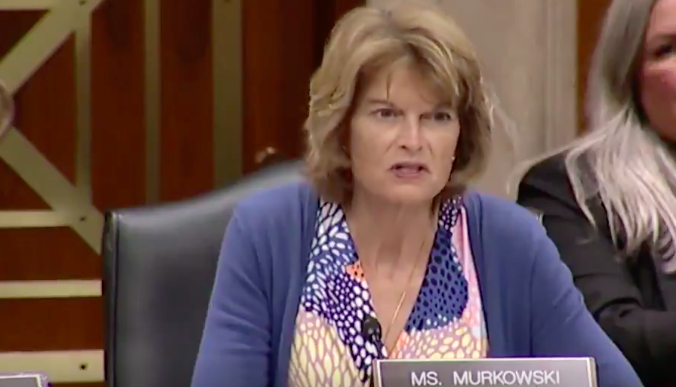
And the newspaper keeps coming back to Sens. Susan Collins of Maine and Lisa Murkowski of Alaska. But now, more focus is on Collins, who is up for reelection in 2020, and is also in line for the chairmanship of the Appropriations Committee. If she votes to convict Trump, she may have a better shot at reelection. Murkowski is not up for election until 2022.
“A Democratic senator who requested anonymity said the Democratic caucus is most focused on Collins and Sen. Lisa Murkowski (R-Alaska),” the newspaper wrote.
“Susan Collins and Lisa are key. Everyone is watching them because Susan is up for reelection and we all know what the party did to Lisa, so she has an interest in being independent,” the anonymous senator told the newspaper.
In 2010, Murkowski lost the Republican Senate primary to challenger Joe Miller, but won the general election as a write-in candidate who depended on Democrats and moderates, and that event split the Alaska GOP into factions that to this day have not reconciled.
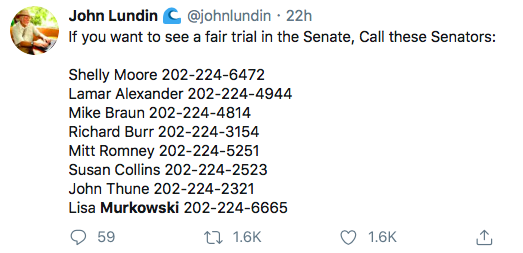
On Twitter, Murkowski’s and Collins’ office numbers are being published repeatedly with leftists imploring people to call their offices, as well as other offices of senators seen as sympathetic, such as Mitt Romney. An anti-Trump environmental activist’s Twitter posting is one of thousands of a similar nature that are appearing on the social media platform, which is dominated by progressive activists:
ANALYSIS: MAG EDITOR’S SWAN SONG IS CLASSIC ‘FIT OF PIQUE’
The Donald is a deeply flawed man. He had an unusual, not particularly happy or normal upbringing. He’s an imperfect president. Sometimes he is annoying.
If you like him, Donald Trump’s Twitter habit is hilarious. If you hate him, he’s a demon.
Trump is as different from most of his base as he can be — they are working class, maybe even the “silent majority,” while he is a multi-millionaire with a big mouth.
Americans knew this in 2016. And yet, evangelical Christians and millions of others — 63 million American voters in all — chose him anyway. They overlooked his failings and decided he represented good policy for restoring sanity and strength to our country.
Not all Republicans voted for him. Some recoiled; they wrote in John Kasich or another person. Others reasoned that Trump would be a far-better cry than having Hillary and Bill Clinton back in the White House. Those voters held their nose and voted for him.
And there were plenty who were on the Trump train from the beginning — they were the true believers. They didn’t need convincing that he was the right person for the job at this time in our nation’s history. They are his biggest cheerleaders today.
In a Must Read Alaska poll on Facebook this week, 94 percent of 2,900 respondents said the impeachment vote in the House of Representatives makes them more likely, rather than less likely to vote for Trump in 2020. Most who take part in MRAK polls are Alaskans, and most are conservatives. But not all. The polls make their way around liberal groups on Facebook, where they get plenty of reach.
Only 171 participants over the course of the 48-hour poll said they are less likely to vote for Trump because of the impeachment proceedings:
What are these Alaskans seeing in the impeachment proceedings that Christianity Today does not see?
They’re seeing the naked political ambition of partisan Democrats, “resist” radicals, pink-pussy-hatted hate-mongers, screaming liberals, and Antifa infiltrators taking over the Democrats’ party, and the news media growing more partisan by the day.
Last week, Christianity Today joined MSNBC, CNN, the New York Times, and the “Democracy Dies in Darkness” Washington Post in saying it is time to remove this president.
Christianity Today editor-in-chief Mark Galli published an editorial that is “so devoid of any pretense of understanding the Constitution I am genuinely embarrassed for evangelicals (of which I am a member). Christians must hold the publication accountable and call this out promptly and directly,” according to constitutional attorney Jenna Ellis, writing in the Washington Examiner.
In 11 months, (10, if you count absentee and early voting) Americans will have a chance to do exactly what Christianity Today hopes they’ll do at the ballot box: Vote for anyone but Trump.
By the time the Senate completes its trial of President Donald J. Trump, there will be but 10 months (or 9 months for early voters) before the election. Joe Biden will, by then, be the likely choice on the other ticket. He still leads the pack for the Democrats.
Will any evangelical actually vote for Biden, now that Christianity Today has declared Trump unfit? Doubtful. Neither will they vote for Elizabeth Warren, or Mayor Pete.
Editor Galli jumped into the fray as he had one foot out the door, leaving the magazine to pick up the pieces, even as evangelical leader Franklin Graham admonished the publication for getting it wrong.
The nation remains conflicted about Trump, but he has won over support from some who did not vote for him the first time around. Why? Because he is just himself in a dangerous and unpredictable world, where despots and criminals rule, where our borders have become a sieve through which traffickers and terrorists pass. He’s not afraid to take on the corrupt leaders of other nations.
The fact that other leaders across the world do not like Donald Trump is refreshing. They also didn’t like George W. Bush. They don’t like “strong defense” American presidents, while those in other countries fawned over Barack Obama, and still pine for him today.
Democrats miss the Obamas. Who can, after all, forget about the limit of chicken tenders allowed American school children under Michelle Obama’s lunch program, while her own daughters dined like princesses at the exclusive Sidwell Friends prep academy?
All the while, in the post-Obama era, the American economy is growing again and prosperity is spreading across the land. The president has restored our military strength, and taken on the Deep State, is putting reasonable judges on the courts and is unwinding the Obamacare disaster.
Did most Americans vote for Trump? No, 65 million cast their fate with Hillary Clinton, who ran on a theme of her extensive political experience (who can forget her “reset” with Russia?), who denounced Trump and his base of support as bigots (“basket of deplorables”), who promised an expansion of President Barack Obama’s socialistic policies, such as Obamacare and open borders. She promised free college tuition. She promised to restrict gun ownership.
Trump, on the other hand, had no actual political experience. He is from a hardball, tough world of business deals, some of which succeeded, others that ended poorly. He’s been married three times. He’s the ultimate wheeler-dealer who broke all the conventional political rules going into the 2016 general election, surviving a field of 17 Republican candidates, many of whom had a lot more experience than he had, and a lot fewer ex-wives.
He wasn’t supposed to win; the smarties of the chattering class predicted that Clinton would sweep him off the map.
There are flawed leaders throughout history in every nation, but this impeachment is ultimately about the Constitution, not about moral failings or personal distaste.
Christianity Today’s retiring Editor Mark Galli once authored the book, “Jesus, Mean and Wild.” It’s about how the meek and mild “nice guy” Jesus is mythical. Instead, he presents him as a militant Messiah, unmanageable and a reflection of an untamable God.
While in Galli’s world view, Jesus could be mean and wild, he’s not giving that same latitude to human leaders that make him sick with hatred.
He wrote that Trump’s failings will “crash down on the reputation of evangelical religion and on the world’s understanding of the gospel. And it will come crashing down on a nation of men and women whose welfare is also our concern.”
M-Kay. Galli conveniently forgets that we live in an insane world, and that Trump has handled foreign and domestic affairs masterfully in his three years.
Trump is not the president all of us would want to spend Christmas with. He is coarse and urbane. He’s a certain kind of person, informed by his own experience of the world. He’s a bit of an oddball. He’s not your classic Christian … or is he? There is nary a Christian reading this today who can clear the moral high jump of pro-abortion, anti-Second Amendment Nancy Pelosi.
With the unrelenting attacks of the vitriolic Left, Trump is more like the president this country needed to keep in check our constitutional rights and secure our nation’s fundamental underpinnings. To the extent that Congress has let him, he has delivered on his promises, including the recent complete overhaul of NAFTA with the US-Mexico-Canada Agreement.
The question will be to voters — evangelicals, women, African American, disaffected, young, old, rich, and poor — to decide if we still need this kind of president for four more years.
What Christianity Today last did was merely to give comfort to Trump’s political enemies and the media, (but we repeat ourselves) at a time when the Democrats needed that kind of boost. They’re losing ground as Trump gains support. The magazine provided just noise, and the noise did not have the effect intended.
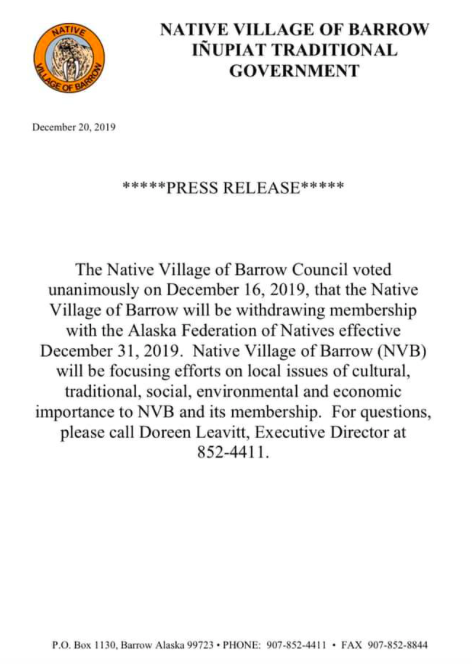
The Native Village of Barrow is the latest major Native entity to withdraw from the Alaska Federation of Natives.
In an announcement on Friday, the village council said it took a vote on Dec. 16, and the outcome was unanimous.
“Native Village of Barrow will be focusing efforts on local issues of cultural, traditional, social, environmental and economic importance to NVB and its membership,” the council said.
The decision comes after Arctic Slope Regional Corp. said it would leave AFN at the end of this year.
Doyon, another Native Corporation, is said to have also chosen to sever its membership, and Calista and Koniag are is also leaning toward leaving, Must Read Alaska has learned.
The Native Village of Barrow is a separate entity from the City of Utqiaġvik, formerly known as the City of Barrow, which is the largest community on the North Slope.
The Native Village of Barrow is a federally recognized Alaska Native Inupiat “tribal entity.” Its president is Muriel Brower, and Arnold Brower Jr. is Vice President.
The ACLU has sent a “Don’t make us sue you” threat to Gov. Mike Dunleavy over his not rehiring an exempt agency employee who worked at the Alaska State Council on the Arts. The former employee had made disparaging remarks on social media about the Dunleavy Administration, and now she wants her job back.
One of my fonder memories of my days with State labor relations was then-Marine Engineers and Confidential Employees representative Greg O’Claray sidling up to me, usually out on the eighth floor smoking area of the Juneau State Office Building, where he handed me a copy of a grievance or unfair labor practice filing and said: “Don’t make me do this to you.”
This tactic is usually just a shakedown and I usually said, “Make my day,” or words to that effect — but more colorful.
Sometimes Greg was right, and sometimes we could make a deal. Greg was one of the last of the old-time union reps; if he gave you his word, he was good for it. But if you just thought you had his word, something bad was going to happen.
The ACLU is trying to do something like this to the governor, who has already demonstrated that when the lefties start screaming that they’ll huff and puff and blow his house down, he’ll run out the back door. I can’t blame them for trying again; it has worked several times. They got to “count coup” on me, but there will be another day.
Readers should understand what the American Civil Liberties Union really is. Once upon a time to be a member of the American Bar Association, America’s only closed-shop union, you had to take an oath that you were not a member of the Communist Party and did not support the overthrow of the U.S. government.
That meant lawyers who were Communist Party members or open sympathizers couldn’t practice law. So, the ACLU was formed of lawyers who had sympathies for the Communist Party, but no direct ties to the party; the common terms are “fellow travelers” or “progressives.”
These were the lawyers who could practice and who could defend Communist agents and apparatchiks in U.S. courts. They wrap themselves in all sorts of “virtuous” causes, but that is the essence of their being.
So now, they’re defending the “First Amendment rights” of public employees, mostly loud-mouth leftist public employees. Public employees, as public employees, don’t have First Amendment rights; when you walk in the office door or use your title, you’ve checked constitutional rights at the door because you have become the government.
The controlling authority is, somewhat ironically, a Ninth Circuit case involving Los Angeles District Attorney Gil Garcetti. Garcetti fired an assistant district attorney for statements he made in his official capacity. It went to the Ninth and the Court held that in his official capacity, the AAG was the government and his speech didn’t have First Amendment protection. The Constitution doesn’t protect the government; it protects you from the government.
If you are a public employee, you can express a personal opinion so long as you make it clear that the opinion is your own, and not an opinion rendered in your official capacity. If you’re far enough up the food chain to be recognizable, your personal opinion cannot be distinguished from government opinion, so you must explicitly offer a disclaimer.
Those of you who know me from my Juneau days know that I could be both a loudmouth and a smartass, but I was always careful to provide the disclaimer that the opinion was my own, not that of the government I worked for.
I don’t agree with some of the Administration’s actions about exempt service employees. I really don’t think they’ve gotten good advice from Law, whether by competence or design. I never much trusted the Department of Law; your mileage may vary.
The controlling authorities in federal law are some Chicago cases involving the Daley Machine. The Supreme Court held that to “serve at the pleasure” of an elected or appointed official an employee had to have policy level authority.
In labor law the term is “formulate or effectuate” management policy and the test is something like that. A lot of State employees in the partially exempt and fully exempt services don’t have policy level authority, so it is a risk to just ask for their resignation or treat them as “serve at the pleasure” employees.
Some years ago the Alaska Supreme Court held that all employment contracts in Alaska contain an “implied covenant of good faith and fair dealing.” That is legalese for saying that a judge gets to substitute his/her judgment for yours if you’re a governor who fires a public employee. If that judge is a Democrat, a Republican governor’s action is likely to violate the “covenant of good faith and fair dealing.”
There are some serious and undecided issues regarding the rights of exempt and partially exempt State employees. Kevin Jardell, then a deputy commissioner, and I, then a division director, once threatened late in the Murkowski Administration to form “Art and Kevin’s Union” of all Murkowski appointees. We weren’t serious but we posed a serious question; there was nothing in the law that would have prevented us from doing it, and Tony Knowles or Sarah Palin would have had one helluva time firing us and replacing us with their friends.
I don’t know who there is in State government who can actually think seriously about this, but the State really needs to clarify its rights and duties in dealing with these employees. The Dunleavy Administration started all this by just asking the Division of Personnel for a list of all “at will” employees, whose resignations they demanded. Well, the right answer is that there are no “at will” employees, as that term has common meaning. The question needs a subtle and nuanced answer, which the Administration has not received.
Art Chance is a retired Director of Labor Relations for the State of Alaska, formerly of Juneau and now living in Anchorage. He is the author of the book, “Red on Blue, Establishing a Republican Governance,” available at Amazon.