
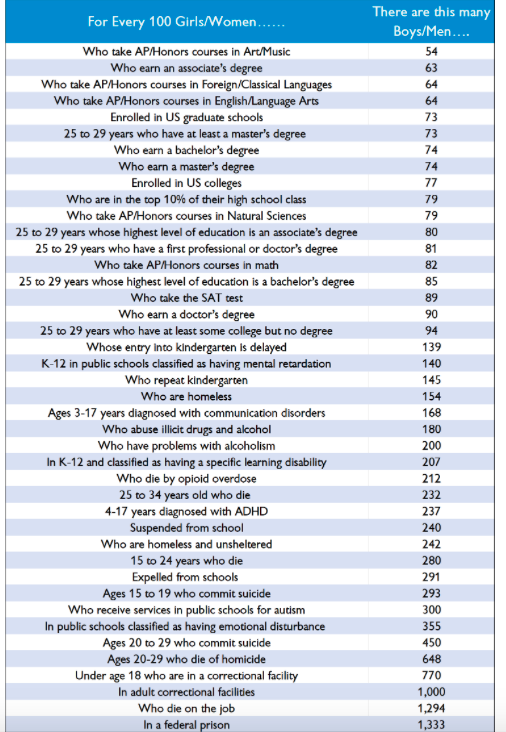
From American Enterprise Institute scholar Mark J. Perry, and his economics blog “Carpe Diem,” comes this analysis showing that boys and men have much higher rates of suicide, murder, violent crimes, incarceration, job fatalities, and homelessness. But despite these risk factors and outcomes, girls and women continue to receive disproportionate attention, resources, and financial support. Women’s commissions, women’s resource centers, and women’s studies programs flourish on campuses across the country, but no similar men’s commissions, resource centers or men’s studies programs exist, he writes.
Dunleavy creates BP-Hilcorp oversight committee

Gov. Mike Dunleavy has created an oversight committee relating to the sale of BP assets in Alaska to Hilcorp. The committee is made up of seven senior level members of the Dunleavy cabinet, including:
- Commissioner or designee of the Department of Natural Resources (Chair)
- Commissioner or designee of the Department of Environmental Conservation
- Attorney General or designee of the Department of Law
- Commissioner or designee of the Department of Fish & Game
- Commissioner or designee of the Department of Labor and Workforce Development
- Commissioner or designee of the Department of Commerce, Community, and Economic Development
- Commissioner or designee of the Department of Revenue
- Governor’s Office Director of Policy & Communications
The committee will advise the governor on whether regulatory and statutory requirements are being satisfied, inform him on comments from the public and the Alaska Legislature, and brief the governor on proceedings related to the transfer in the state’s quasi-judicial agencies.
Revak raises campaign cash with ‘more cowbell’ humor

CANDIDATES ARE LOOKING FOR THOSE 2019 CONTIBUTIONS
All candidates in Alaska are hoping people will shake loose a bit of help or them before the calendar turns over. Alaska law says individuals may give no more than $500 to a candidate in a single year.
That means $500 this year, and $500 next year, if you are really getting behind a candidate, for a grand total of $1,000 for an election cycle.
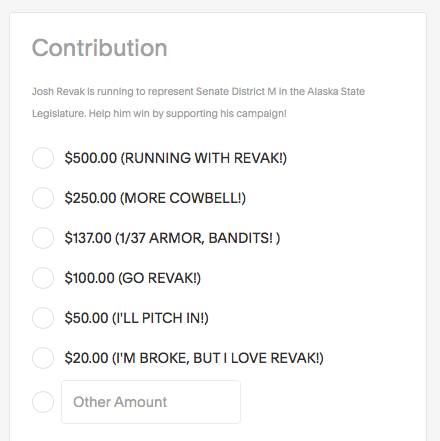
Most use the cut-and-paste templates that come with payment software, but not Sen. Josh Revak. He’s got donation categories that show a bit more of his personality, his generation, and his military history — categories that include the “MORE COWBELL” level of $250, which refers to a classic Saturday Night Live skit, and the “I’M BROKE, BUT I LOVE REVAK!” level for $20.
Revak is running for Senate Seat M, Anchorage hillside, which he won by appointment this fall after Sen. Chris Birch passed away. He previously served as a representative for District 25, a seat he won in 2018.
Alaskans have until midnight on Dec. 31 to make that 2019 contribution.
Sen. Dan Sullivan goes for a run at -20 in Fairbanks
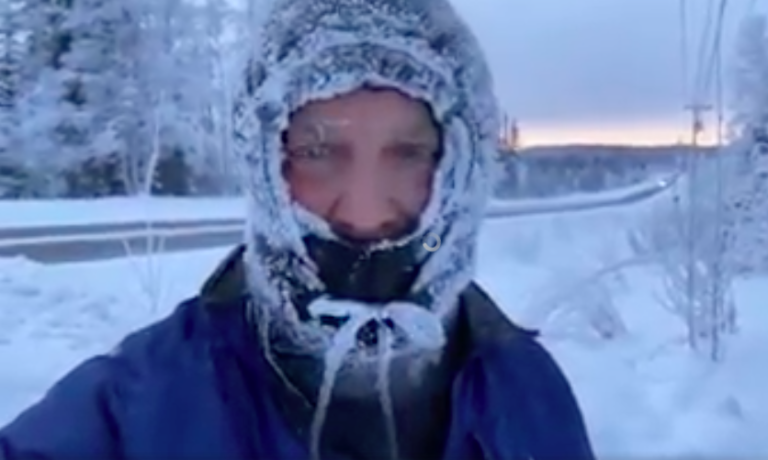
Sen. Dan Sullivan, who is also a colonel in the U.S. Marine Corps Reserves, decided to burn off some Christmas calories by going for a run on a brisk Fairbanks day, an experience which he describes in this video as “magic”.
Law Department alleges $9 million Medicaid fraud over addiction testing

Criminal charges have been filed against Dr. John Zipperer, Jr. MD and his corporation Zipperer Medical Group for fraud against the state Medicaid program.
The State Department of Law alleges that Dr. Zipperer filed millions of dollars worth of claims for fraudulent laboratory urine tests performed from August of 2013 to August of 2015 and that his company, ZMG, performed over one million medically unnecessary laboratory tests on patients’ samples at a Tennessee lab he owned, billing Medicaid for those tests.
Zipperer practices “interventional pain” medicine. He is a graduate of Medical College of Georgia School of Medicine and specializes in pain and addiction treatment.
He opened a clinic in Wasilla in 2012 and expanded clinics across the state in Anchorage, Eagle River, and Fairbanks. In 2013, he opened a testing facility in Tennessee.
The State alleges ZMG would see patients as often as once every three day and would often require them to submit urine samples for testing, which would be done at the lab he owned.
The State says Zipperer would order dozens of unnecessary and duplicative tests on each urine sample and then bill Medicaid, private insurance companies, or cash-paying patients personally, at rates ranging from $3,000-$8,000 per urine sample.
The red flag came after Zipperer was reimbursed about $9 million for laboratory testing between August 2013 and September 2015, an amount 10 times greater than the combined total of all other providers in the Alaska Medicaid system for laboratory test codes billed during the time period, according to the Law Department.
The case triggered a formal state audit review in 2018. Throughout 2019, the state says Zipperer “failed to respond to repeated requests for supporting documentation for the millions of dollars worth of claims he submitted in response to agency requests. This refusal itself is a criminal offense under Alaska law.”
In 2015, Zipperer closed his methadone clinic in Wasilla after saying he was unable to adequately staff the clinic, in part because of an FBI investigation into the clinic practices. Methadone is a replacement to narcotics that suppresses withdrawal symptoms and helps wean people off of opioids. Treatment with methadone can last for years.
The charging document may be found on the State of Alaska, Medicaid Fraud Control Unit.
The charges against Zipperer carry a possible sentence of up to 10 years in prison, a fine of up to $100,000 and restitution to the State of Alaska Medicaid program. The charges of medical assistance fraud against the corporation carry a possible maximum sentence of up to $5 million, and a potential restitution order.
Any person who may have information about Dr. Zipperer or facts related to this case are encouraged to contact the State of Alaska, Medicaid Fraud Control Unit at (907) 269-6279.
Mustang Project default puts AIDEA in tough spot

IT ALL STARTED WHEN GOV. WALKER MADE BROOKS RANGE A DEAL
The State-owned Alaska Industrial Development Authority to the list of creditors for Caracol/Brooks Range Petroleum, which owes AIDEA tens of millions of dollars on a loan for the Mustang Project.
Although the exact amount owed to Alaska’s publicly owned development agency is hard to calculate from the outside, what is known is that since October, the company hasn’t paid the $3.1 payment due on the note. It’s in default. Brooks Range is supposed to pay $3.1 million per quarter.
Brooks Range has produced a small amount oil from the project — about $500,000 worth. But there are creditors to the tune of $15 million that it took to produce that bit of oil. The company is now in “warm storage,” and if the creditors don’t get some money, they won’t likely keep the small crew on staff that monitors the generators. Creditors, if not paid by end of 2019, could very well put the company into bankruptcy.
HOW AIDEA GOT THERE
A series of missteps by former Gov. Bill Walker relate to Brooks Range Petroleum’s financial peril:
Misstep one: Walker ordered a conversion of AIDEA’s equity position in the project to a loan in 2018. The company never made a payment.
Misstep two: Walker vetoed the tax credits and ordered the Department of Revenue to essentially lend money to Brooks Range, while all other players suffered (i.e. Furie going bankrupt), as they were counting on those tax credits.
Misstep three: The loan from the Department of Revenue was paid off by AIDEA, during the restructuring of the equity deal.
Under Gov. Bill Walker, AIDEA sold off its interests in the holding companies and road and pad infrastructure associated with the Mustang field. The state-owned agency instead financed the purchase by Caracol for $52.5 million for the Mustang processing facilities and $8.5 million for the road and pad operating company, and other associated costs.
Under the restructuring, there were no payments due until Oct. 1, and there was a 30-day grace period for Caracol, which has also passed. In the loan agreement, that means AIDEA could call in the entire note as due.
Decisions made during the Walker Administration were done behind closed doors with consultants to Walker, such as Mark Gardiner, the Portland consultant paid $400,000 a year, who met with Walker in Juneau behind closed doors without anyone from AIDEA present.
Unfortunately, the chickens are coming home to roost under AIDEA now that Walker is no longer in charge and the board must decide what to do with a Walker loan agreement that appears to have gone bad.
Alaska job count rises, while unemployment is lowest ever

IS THE WALKER RECESSION OVER?
Alaska’s employment rose by 1,110 jobs from November 2018 to 2019, and the unemployment rate fell to 6.1 percent, the lowest in history since unemployment was first measured in the 1970s.
In April of 2018, employment was down by 1,200 over the previous April. By November of 2018, overall employment was down 1,300 jobs. During the recession, the state lost an estimated 12,000 jobs since late 2015, shortly after Gov. Bill Walker came into office and started destabilizing the oil and gas sector.
Oil and gas sector has gained back the most jobs (400) this year, the first year of the Dunleavy Administration. Tourism was up by 300 jobs and health care jobs also gained 300. Retail lost 200 jobs and information technology jobs are down by 100.
According to the Department of Labor, the State has shed 600 state government jobs, primarily due to budget cuts at the University of Alaska. In local governments, the job count stayed flat, and the federal workforce increased by 100, in part because the U.S. Census Bureau has been hiring short-term workers for the 2020 Census. These are temporary jobs that will be in the “loss” category after the Census.
The lowest unemployment rate in the state was in government-rich Juneau, 4.4 percent, just above the national unemployment rate of 3.7 percent.
Sitka has a 4.6 percent unemployment rate and Anchorage has 4.8 percent unemployed.
Alaskans looking for work in the summer might try Skagway and Denali Boroughs, where tourism jobs are plentiful and in June and July the unemployment rates drop below the national average. By November these areas have some of the highest unemployment, 16.9 percent and 18.2 parent respectively.
Eight other areas also exceed 10 percent: Kusilvak Census Area, Bristol Bay Borough, Bethel Census Area, Northwest Arctic Borough, Yukon-Koyukuk Census Area, Hoonah-Angoon Census Area, Haines Borough and the Valdez-Cordova Census Area.
The challenge for Alaska job creators is whether former Gov. Bill Walker’s law partner Robin Brena will keep the oil and gas investments on the sideline, while the Brena oil tax hike is pending as a ballot initiative. Walker, a foe of the SB 21 legislation that stabilized taxes, joined forces with Brena after he left office, although he is not openly involved with the oil tax increase initiative called “Our Fair Share.”
‘Alaska PD’ premieres Jan. 1
SHOW FEATURES FAIRBANKS, KOTZEBUE, KODIAK, PETERSBURG
“Alaska PD,” a new show on the A&E Network, will bring the challenges of Last Frontier of justice to the rest of America on New Year’s Day, when “the line between civilization and lawlessness can be razor thin,” according to the A&E promotion.
The show will document some of short-handed police departments around the state, where local forces “must turn to officers from the Lower 48 to fighting a soaring crime rate.” Fairbanks, Kodiak, Kotzebue, and Petersburg are featured in the series.
“Alaska PD” premieres Jan. 1 at 10 pm Eastern Time. The series will then move to its regular time slot on Thursdays at 9 pm.
“They face numerous dangers found only in Alaska, not just from people who want to be free from the rules of society, but also from encounters with predatory animals roaming through town and sub-zero conditions that can be deadly and unrelenting,” A&E wrote. ” In a state where guns are carried as part of everyday life, officers often have to protect an entire town by themselves while enforcing laws many are unwilling to follow.”
[Read: Pirate has returned to Fairbanks,and some are concerned]
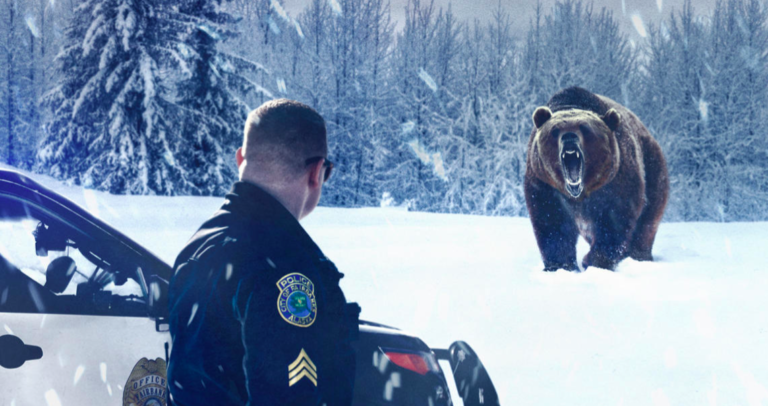
In Kodiak, a focus will be on nuisance bears, and in rural Kotzebue there is a federally declared law enforcement emergency and the U.S. Department of Justice is directing millions of dollars to bring law and order to violence-ridden villages.
While Kotzebue had a higher violent crime rate than any other Alaska community in 2018, Petersburg has a crime rate that is 1.5 times lower than the national average. But there are always Vikings to contend with.
The first episode features newcomer police officer Jamie Ramos of Virginia, who becomes Kodiak’s only female cop and quickly has her first encounter with a Kodiak brown bear. The episode also features Fairbanks Officer Gerrit Butler, a former mixed martial arts professional, who brings down a suspect who also knows a bit about martial arts.
[Watch the action-packed promotional video at this A&E link]
The show is following the successes of other Alaska-based reality series, such as “Alaska State Troopers,” which gained national popularity as a documentary series on Alaska the National Geographic Channel in 2009. “Gold Rush,” “Deadliest Catch,” “Alaska Bush People,” and “Men in Trees,” are others that have focused on the quirks and quacks encountered in Alaska.
“Alaska PD” is produced by Engel Entertainment and Noble Savages for A&E Network.
Watch video: Christmas party at Governor’s House

This short video of the Open House at the Governor’s House in Juneau on Dec. 10 says it all, and it’s full of Christmas goodwill:
The first open house was held 106 years ago by Territorial Governor Walter Eli Clark and his family. He invited the community to visit the Governor’s House on New Year’s Day 1913, the first New Year’s after the house had been completed in 2012.
It’s an annual tradition has been held every year since, with the exception of two years during World War II.
More than 15,000 cookies were prepared for the event, and more than 100 pounds of fudge and chocolate candies were served. Members of the governor’s cabinet couriered hot apple cider and holiday treats to guests waiting in line outside the residence, while entertainers from local community and school groups performed.

