The Bernie Sanders presidential campaign says it raised more than $34.5 million in the fourth quarter of 2019, likely more than any other Democrat candidate has raised in any quarter of last year.
Although the Federal Election Commission quarterly report is not due until Jan. 15, Sanders’ campaign released the strong numbers to show its candidate, who suffered a heart attack in October, is the leading contender for the Democrats.
Sanders received 900,000 individual donations in December alone, the campaign said, and has had over five million donors so far in 2019, with a total raised of more than $87 million.
Sanders is popular with Alaska Democrats, who strongly preferred him during the Democratic caucuses in 2016. In fact, Sanders’ second strongest state in 2016, after his home state of Vermont, was Alaska, where he won 80 percent of the caucus vote and 83 percent of state convention delegates.
He carried every borough and census area in the state by a wide margin over Hillary Clinton, the establishment candidate who went on to win the Democratic nomination, but his voters were disenfranchised by the Alaska Democratic Party during the scandal that was uncovered by Wikileaks.
During the fourth quarter of 2019, the most frequent donors to Sanders, an avowed Socialist, listed their job title as “teacher,” a trend that may worry conservatives already concerned about what increasingly radicalized teachers are instructing children in the classrooms of America.
According to the Sanders campaign, the top five most commonly listed employers of his donors are Amazon, Starbucks, Walmart, the U.S. Postal Service, and Target.
Sanders has been a harsh critic of Amazon and Walmart, as well as other corporations that do not pay the $15 an hour minimum wage that he wants as the federal minimum. Amazon does pay $15 an hour, as of last year.
Other campaigns that announced their fundraising amounts for the fourth quarter were Pete Buttigieg and Andrew Yang.
Buttigieg raised $24.7 million, while Yang says he raised $16.5 million.
Buttigieg’s campaign says he received over 700,000 individual donations.
Elizabeth Warren sent a letter to supporters late last week saying that she had raised just over $17 million so far in the fourth quarter. That’s a significant drop from the $24.6 million she raised in the third quarter. Her final number has not been announced for the fourth quarter, but will probably come in close to $19.5 million.
Joe Biden set a note to his supporters earlier this week, pushing for donations in the final two days of the year. In the third quarter he raised $15.7 million, far less than the $21.5 million he raised in the second quarter.
Sen. Amy Klobuchar raised $4.8 million in the third quarter and has not yet announced her fundraising totals for the fourth quarter.
Former New York Mayor Michael Bloomberg entered the race on Nov. 24, 2019, and has already spent at least $155.3 million on political ads as he tries to muscle his way onto the field. He has not announced his fourth quarter fundraising, but it’s likely to be insignificant, since he is self-funding his campaign.
The Democrats’ next debate is Jan. 14 at Drake University in Des Moines, Iowa. Hosted by CNN and the DeMoines Register, this seventh debate will be limited to those who secured 225,000 unique donors and earned 5 percent or more in four DNC-sanctioned national polls, or 7 percent in two DNC-sanctioned “early state” polls.
Those qualifying for the debate so far are Biden, Sanders, Warren, Klobuchar, and Buttigieg.
On Thursday, Julian Castro dropped out of the race. The former Housing and Urban Development Secretary made his announcement in a video published by the New York Times, saying, “With only a month until the Iowa caucuses and given the circumstances of this campaign season, I’ve determined that it simply isn’t our time.”
As for the president, the Donald Trump campaign raised $46 million in the fourth quarter. Although that is more than any individual Democrat candidate, the large Democrat field as a whole will have raised more than $80 million in the fourth quarter.
Jerod Alexander had a rough last decade, and the next one isn’t shaping up to be any better.
He had been on the lam for months, after absconding from a halfway house in Anchorage.
Then came New Year’s Eve, and some type of altercation between a small group of men in a Russian Jack neighborhood. Someone pulled a gun, shots were fired, and a man ended up shot in the arm, knee, and hip.
It started at 1:25 am Tuesday morning when police were called to the scene near 8400 5th Avenue in the Russian Jack neighborhood, where responders tried to sort the stories out, talk to witnesses, and get the gunshot victim to the hospital, where he was in surgery on Tuesday afternoon.
There were .45-caliber shell casings on the ground, bullet holes in the house, and blood on the porch.
One of the suspects, Alexander, was already known to police as someone who had a warrant for his arrest since July. He fled the scene, but police arrested 27-year-old Cody Heanu, who was remanded at the Anchorage Jail on multiple charges including Assault I, Firing a Weapon at a Dwelling, and Misconduct Involving Weapons II. It’s Heanu’s first brush with the law.
Alexander wasn’t coming in so easy. All the while, the snow began falling and piling up in drifts, the temperatures quickly dropped, and the hours were ticking by. By the time police got to Alexander in the Fairview neighborhood on Wednesday morning, the snow was blowing, and the temperatures were in the teens, as a blizzard moved through, the same one that closed Seward Highway near Girdwood.
And all this, plus regular bursts of fireworks across the hood.
By 6 am on New Year’s Day, police were cordoning off an area around an apartment building on East 4th Street and calling in the SWAT. Neighbors were warned there may be tear gas in use. The police said they might use a drone. Police asked the public to not post on social media any pictures of the situation, so as to protect the officers.
After a standoff, Alexander was taken into custody. His arrest, just a few blocks from the Anchorage Jail, brought to an end his six-months of living on the run. He was remanded on multiple charges, including Assault I, Misconduct Involving Weapons, Trespassing, and Resisting.
Alexander’s rap sheet started with underage drinking in 2008 and a list of other misdemeanor charges. In 2012, the Drug Enforcement Agency seized property of his worth $16,679, as a result of it being involved in drug trafficking.
A felony arrest warrant had been issued for Alexander after he walked away from the Cordova Center, a halfway house, in July. He had been sent there after being charged with Resisting Arrest and Escape.
That is how 2019 ended and how 2020 began with violent crime in Anchorage.
REFLECTIONS ON A WONDROUS JOURNEYFROM RURAL GEORGIA
By ART CHANCE
On Jan. 1, 2020, I enter my ninth decade on this rock. Depending on how you count it, it could be called the last year of my eighth — remember all the controversy about when the new millennium started? Anyway, I have the “three score and ten” I was promised.
A decade ago I was a front page contributor on the Red State conservative political blog, one of the most heavily viewed conservative blogs.
Art Chance
I wrote this around my 60 birthday and it stayed on the front page of Red State for a good while. I’m resurrecting it because another decade has passed and the world has changed. We endured Comrade Obama. We entered Donald Trump’s world. We survived George Soros’ attempt to continue the coup d’etat that installed Comrade Obama.
I can’t see what will happen next; but the Left has taken our children. If you’re under about 40, you see AOC as the future. That’s a future I’m happy to miss, but I regret that my children and grandchildren will have to deal with it. I’ll secretly tell them where I “lost” my guns. A decade ago, I was fairly optimistic; these days, not so much.
Three Score Years Ago, My Parents Brought Forth – Me
Sept. 3, 1949: 10 years after Germany invaded Poland, a little less than four years after the war ended, the same year the hydrogen bomb was invented. The H-bomb and I had a good run together. I came into the world dirt poor but I didn’t know it for a long time. In rural Georgia in those days heritage and social status meant a lot more than material wealth.
Those with ostentatious wealth got it after the war from the cotton lands they bought from widows and from the timber boom of the 1890s; being able to rattle off what company and regiment in General Lee’s Army your grandfather or great-grandfather served in meant a whole lot more for your social status. That all changed when the Yankees came again.
Rural Georgia of the 1950s was differentiated from rural Georgia of the 1850s by gasoline and electricity, and nobody had much of either. I saw some pretty good arguments between my mother and father over whether it was necessary for the single 30-watt light bulb in the living room to be on. The only really ugly fight I ever remember them having was over the fact that my father simply could not comprehend how she could have managed to spend $12 for her weekly trip to the grocery store.
Generally, if we didn’t grow it or kill it, we didn’t have it; the grocery store was for stuff like sugar, coffee, tea, flour, and meal, though we often had our own meal ground. Doc and Betty, the mule and the horse, did the heavy work until we finally got a tractor in 1954 – a Farmall Cub. My grandfather did most of the farming and my dad helped, but also worked for wages at Rosenberg’s department store in town. Old Martin, who lived across the branch in Price’s Quarter, did most of the handyman work and after my grandfather was probably my greatest youthful influence.
Blacks did not come in through the front door or eat with whites except in the fields in those days, so in an irony not lost on me even in my youth, Old Martin always came in through the back door and ate dinner – the meal in the middle of the day – in the fairly fancy dining room, while we ate at the kitchen table. Like the medieval world described in Manchester’s “A World Lit Only By Fire,” thus it was and thus it shall ever be; Southern farming life was eternal and unchanging – or so they thought.
In some ways it was an idyllic world; nothing changed, everyone knew everyone, people lived all right as we understood all right to be. If you didn’t know any better, it was good. We were cultured and well-educated; I knew which fork to use. My great grandfather was a teacher. My grandfather and father had some college. My grandmother was also a teacher. She could speak, read, and write Latin and read Greek. She told me that if I couldn’t do that, I’d always be a barbarian; she was right. She could rattle off long passages of Caesar’s Gallic Wars in Latin or whole Acts of Shakespeare’s plays. The skill that has served me best professionally is my ability to memorize and I attribute it to her constantly demanding it of me and to the Sunday School ritual of always having to recite a Bible verse at the beginning. “Jesus Wept” was my best friend.
That said, they and thus I were abysmally ignorant of the world. I don’t mean we didn’t know what was going on. My earliest memory of anything political – one of my earliest memories of anything – was sitting with my grandfather and father listening to the Republican convention on the old tube-type radio in 1952. I don’t remember anything about it except the doing of it; just my grandfather, my father, and me sitting in the kitchen in the dark – no need to waste electricity – and the reason it is memorable is they included me.
By the time I started grade school, leaders in the South were doing everything they could to get Southerners off the north end of southbound mules. In my little town, we started to get “plants.” Plants that don’t grow out of the ground were pretty much a foreign concept in the rural South, as was being anywhere other than school, church or court at a particular time. Getting a Geogia farm boy to actually show up at eight o’clock every day and do what somebody not related to him told him to do was a major cultural transition. And that’s when we began to see it. The Yankee plant managers demanded their modern houses. They drove new cars and their wives had station wagons.
In about 1958 we got a TV, and everything it changed. Nobody I knew lived like Beaver and Wally or David and Mary Stone. Fast forward through it all; Kennedy’s assassination, the civil rights movement, the riots, the long, hot summers, the Klan, the Freedom Riders, having a dream, Martin Luther King Jr.’s assassination, the war in Vietnam.
The world I started grade school in in 1955 had ceased to exist by the time I heard “Pomp and Circumstance” in 1967. By the time the principal thrust that piece of paper in my drunken hand, I didn’t believe a single word coming from parent, pulpit, lectern, or stump. When I got to college, I was a Marxist professor’s dream; I’d believe anything that was contrary to what I’d been brought up to believe. So, by the early 1970s I was a long-haired, dope-smoking, FM radio-listening liberal Democrat. Then I got mugged.
Atlanta in the early ’70s taught me all I needed to know about liberal policies. I sold out and packed Wife 1.0, kid, and dog into a Toyota LandCruiser and struck out for Alaska. I had no airspeed or altitude, but I did have ideas. I’ve sold suits, cleaned floors, drove trucks, and most anything else I could find to make money. What I liked most about Alaska was that nobody asked what your daddy did and if they asked where you went to school, they didn’t follow up with a question about what fraternity you belonged to. Hell, I was barely willing to admit to belonging to the human race; belong to a fraternity?
Anyway, I’ve led a charmed life, lived the American dream. I have a God-given right to be working for the minimum wage in the lawnmower factory in Swainsboro, Georgia; that’s what any of my teachers and civic leaders would have told me I could look forward to – and they were proud of their accomplishment of making that possible. There was always farming.
In those 60 years that also parallel the Pax Americana, I’ve never been hurt badly except by my own doing, I’ve never been sick since childhood, I’ve never really wanted for anything that I actually needed. As someone said, “I’ve been rich and I’ve been poor; rich is better.”
But in this Country, even poor as most of us understand it ain’t bad. I know the worst off I’ve ever been is scrounging the sofa cushions for cigarette money. And now, I’ve even given up the cigarettes after 40 years of Winstons and Marlboros; probably too late, but at least I did it.
So, to sum this up; generations of my forebears dug up the dirt to make my life possible. My life has been beyond the wildest imaginings of my forebears. Their efforts and sacrifices made a life of money, power, and relative luxury possible for me. And to bring this back to a political theme, ain’t nobody taking that away from me unless they’re prepared to pry it from my cold, dead fingers.
I don’t know how this plays out; maybe the stupid children win, maybe not. I tried to leave a better world to my kids; don’t know if I succeeded. When this decade ends, not many of us will be around. None of my male ancestors made it into their Eighties. I’ve had far better medical care than they did, but I also smoked cigarettes for 40 years and drank a lot of Scotch whiskey. We’ll see if there is another decade to write about.
Art Chance is a retired Director of Labor Relations for the State of Alaska, formerly of Juneau and now living in Anchorage. He is the author of the book, “Red on Blue, Establishing a Republican Governance,” available at Amazon.
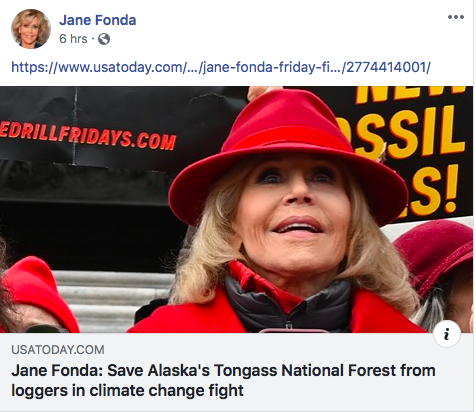
Gov. Mike Dunleavy took to social media this week to take on the notorious grande dame of the Hollywood elite: Jane Fonda, who was published in USA Today defending the Roadless Rule for the Tongass National Forest.
Dunleavy wrote: “Jane Fondayou fail to mention how the ill-advised Roadless Rule for the Tongass has killed thousands of jobs and prevents use of the forest by many people, not just logging. It seems you are just another special interest outsider hell-bent on turning Alaska into a national park.”
Dunleavy came to Alaska and worked in at the Gildersleeve logging camp in Southeast Alaska in 1983, before becoming a school teacher in the Arctic.
Fonda, whose birth name is Lady Jayne Seymour Fonda, grew up in a Hollywood dynasty entertainment family, studied art in Paris, and was a model in New York before starting her career as a starlet in films, notably Barbarella, but also such films as Coming Home, a Vietnam veteran themed film.
She became known as Hanoi Jane by members of the military and other patriots after she travelled to North Vietnam during the Vietnam War in 1972 and consorting with the Viet Cong, while denouncing U.S. foreign policy. Veterans have not forgiven her for what many saw as treasonous activities.
Now, the actress has returned to her activist roots, taking her inspiration from the teenage climate activist Greta Thunberg of Sweden. She’s been traveling to Washington, D.C. each week to protest climate change and to get arrested. It has become her cause du jour.
The governor doubled down on his message on Twitter: “If @JaneFonda is truly concerned about global issues, she needs to understand that #Alaska and #America do resource development and timber more responsibly than any other place in the world. The demand for timber is not going away.”
Even the Ninth Circuit Court of Appeals was not willing to take away the rights of Alaskans to manage wildlife through predator control in the 16 wildlife refuges in the state. On Monday, the judges decided against the radical environmentalists, and for the hunters.
The case had been brought by the Center for Biological Diversity. It challenged the Congressional Review Act that gave Congress a way to review and disapprove regulations made during the waning days of the Obama Administration.
One of those regulations that was rescinded was a rule that prevented Alaska from applying certain state hunting regulations and game management practices on federal wildlife refuges.
The Center for Biological Diversity sought to force the Department of Interior to reinstate the rule against Alaska. The lower court had dismissed the lawsuit, and the CBD appealed it to the Ninth Circuit, which is the most liberal appeals court in the nation.
But a panel from the Ninth Circuit found invalid the Center’s arguments that Congress violated a constitutional balance of power.
“Because Congress properly enacted the joint resolution, and therefore validly amended Interior’s authority to administer national wildlife refuges in Alaska, Congress did not prevent the president from exercising his constitutional duty to faithfully execute the laws,” U.S. Circuit Judge Sandra Segal Ikuta wrote. “Indeed, the president now has the constitutional obligation to execute the joint resolution.
“Congress’s efforts to exercise oversight of federal administrative agencies by means of the CRA are consistent with the ‘structure of this government, and the distribution of this mass of power among its constituent parts,’” she wrote on behalf of three judges.
The rule that was rolled back pertained to predator control. The Center for Biological Diversity characterize it as using bait to kill grizzly bears or killing wolf pups in their dens. Indeed, Alaska state game managers do use predator control to ensure healthy populations across the board. There are an estimated 53,500 grizzly bears in Alaska, or about one bear for every seven humans.
When President Barack Obama took over wildlife management of federal wildlife refuges, his regulations created a patchwork of management practices for wildlife — animals that moved freely between those state and federal jurisdictions.
In 2017, the Republicans in Congress overturned those federal rules. The Center for Biological Diversity was challenging the right of Congress to overturn those 11th hour regulations that occurred under Obama. The Center will likely not appeal the ruling to the U.S. Supreme Court, since they have lost in the most liberal court in the land.
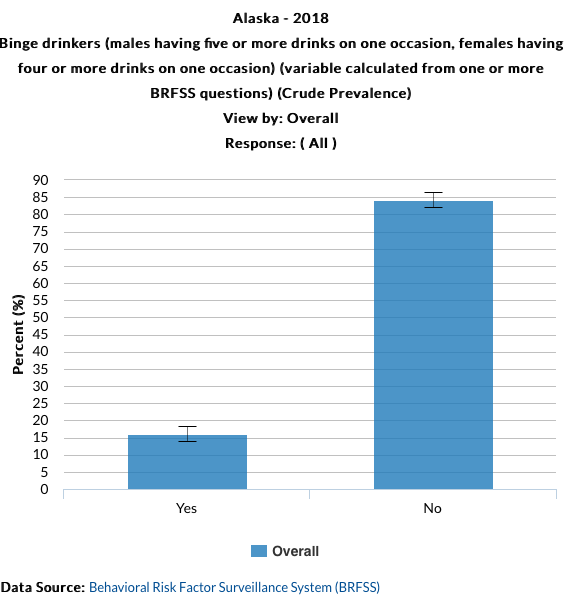
The percentage of adult Alaskans who report to have binged on booze has stayed relatively steady over the past decade. In 2008, some 16.1 percent of Alaskans admitted to binge drinking, while in 2018, 15.9 percent say they overdid it, according to federal CDC data (or 16.4 percent, according to the State’s data.) The survey question refers to the “past 30 days.”
That’s lower, at least, than in 1994, when nearly 25 percent of Alaska adults said they enjoyed more than five alcoholic beverages for men (four for women) in one occasion. And it’s heading in the right direction, even if the federal and state statistics don’t fully align.
A fact to keep in mind before raising a glass to the sobriety of Alaskans: Alaskans in general are getting older. Alaska has a senior population growing at a faster rate than any other state. And the older they get, the less likely Alaskans are to binge drink. After age 64, the number of admitted binge drinkers drops to 6.2 percent.
Old-timers, unsurprisingly, are less likely to binge drink than any other adult age group.
As for other demographic breakdowns, Asians have lower levels of binge drinking prevalence (6.2 percent), while Alaska Natives, once anchoring the high end for binge drinking (28 percent in 1991), appear to have made the greatest strides, and are now at the statewide binging average of 15.9 percent, according to the State’s data.
Men report more binge drinking than women — 21.1 percent compared to 11.5 percent.
Only 15.9 percent of Alaskans admit to binge drinking during the past 30 days.
Alaskans stating that they have binged in the past 30 days is only slightly higher than the median for the United States, which was 16.2 percent in 2018.
These are all self-reported behaviors, which may skew the numbers lower than what is actually occurring.
AND THEN THERE’S NEW YEAR’S EVE
It’s a safe bet the alcohol survey wasn’t conducted in January, when Alaskans would have had to report their most recent New Year’s Eve celebratory uncorking.
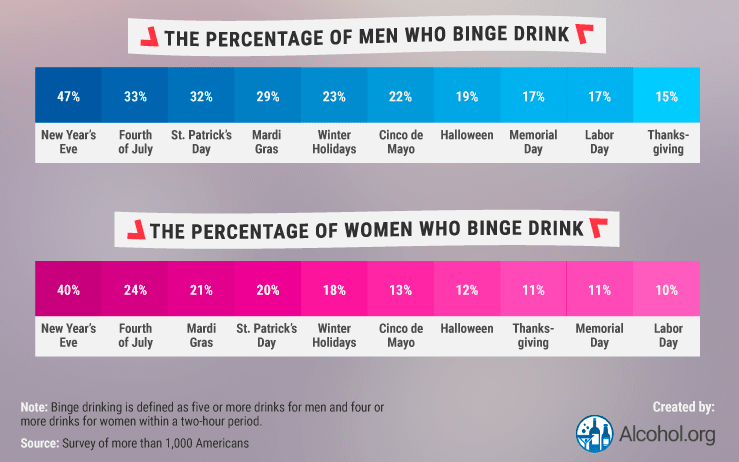
Alaskans’ chance of encountering a binge drinker goes up substantially on this day — 47 percent of men and 40 percent of women admit to binging on booze as they welcome the New Year.
According to Alcohol.org, New Year’s Eve also had the highest percentage of both men and women reporting a previous blackout while celebrating the beginning of a new year. Of those surveyed by the organization, 27.3 percent of men and 16.7 percent of women said they had imbibed enough to have “difficulty recalling their celebration.”
What do people drink most on New Year’s Eve?
Champagne is far-and-away the most popular drink, followed by tequila and vodka – liquors that can lead to blackouts more quickly than beer due to their higher alcohol content.
On average, men drank 5.1 drinks, while women drank 3.7 on New Year’s Eve. Men aged 40- 44 were the heaviest drinkers for New Years Eve, while middle age women in that age group drank the least of all age groups, according to the website.
So be careful out there. It’s likely that more than half of the vehicles on the road on New Year’s Eve will be operated by someone who has had at least one drink.
Alaska State Troopers will be out in force, as part of a stepped-up effort over the past three weeks to combat impaired driving.
Their focused enforcement through Dec. 23 had resulted in:
20 misdemeanor DUI arrests.
20 drivers with suspended or revoked license.
16 REDDIs reports and five drivers contacted (all were determined not to be DUI).
Of the 525 citations issued, 243 were for speeding and 13 were for seatbelt violations.
Monday is the final day of Hanukkah; this year so much of the eight-day celebration has been marred by fear among Americans of Jewish faith and heritage — and disturbing attacks on Jews in New York and Jersey City.
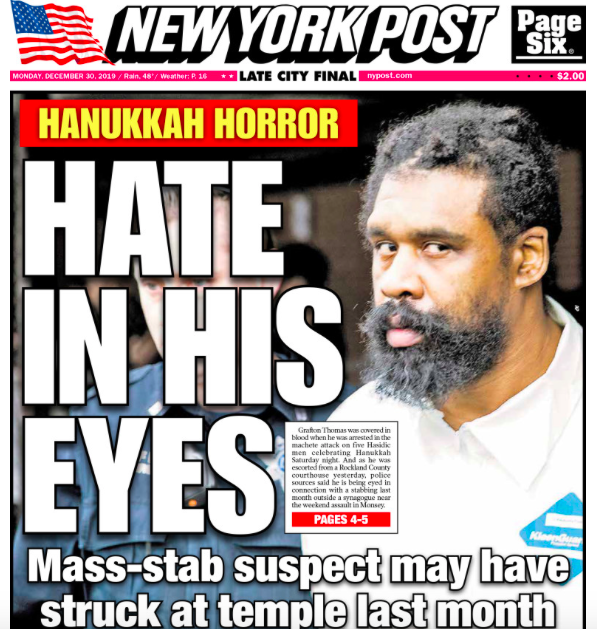
The most recent involved a knife attack at a rabbi’s house by a man politicians say is a terrorist. The man’s family says he is mentally ill.
CNN’s Jake Tapper, while interviewing Oren Segal of the Anti-Defamation League Center, remarked on Sunday that the anti-Semitic attacks carried out in New York City are largely not being committed by white supremacists, but by “people of color.” The attackers do not fit the liberal narrative that dominates the media these days.
What does not advance the public dialogue is when liberals make every crime or every insult into a “hate crime.” We’re seeing more of that tactic used in the public realm, where people are claiming anti-Semitism for every imagined slight, and then they call for the “cancel culture” to slice and dice the target, usually a conservative, such as Ben Shapiro, who is a practicing Jew and who doesn’t suffer fools on the Left.
It becomes more difficult to judge which crimes are hate crimes, and which are just crimes, when the Left uses these incidents for political gain.
Yet religious and ethnic intolerance cannot be ignored by conservatives.
It was good to see Gov. Mike Dunleavy at the Hanukkah menorah lighting in Palmer at the Depot on Sunday night, where they lit the giant menorah and observed traditions such as potato latkes, and Hanukkah crafts.
Christians must stand in solidarity with Jews — and people of all faiths — in rebuking hatred and violence of any sort. And they should do so with urgency from the pulpit when it comes to defending people of other faiths.
Also on Sunday, Christians were attacked as they worshiped in a Fort Worth suburb. The parishioners were armed, of course, and they took down the gunman. Two parishioners died, and the attacker died as well, shot by the church security detail. This was not described as a hate crime by the media; the perpetrator was described as a transient. We don’t know his motive and it is too dead to tell us.
But the incident reminds us of what presidential candidate Joe Biden said, just this past September, about the Texas law that allows gun owners to carry in places of worship: He said it is “irrational.”
New York doesn’t allow churches and synagogues to protect themselves against armed intruders. In fact, New York doesn’t allow citizens to protect themselves at all. That’s what Joe Biden calls rational.
MILLENNIALS ARE IN CHARGE, WILL SHAPE THE GENERATIONS TO FOLLOW
In 1920, the Greatest Generation was coming into the world squalling and kicking, as babies do. They had no idea what was ahead of them.
The generation that earned the name “Greatest” grew up during a time when soldiers came home from World War I. The kids went to school during the Roaring Twenties, felt hunger during the Great Depression, went to war in World War II, and some returned home to rebuild the nation.
They are all but gone now; the average lifespan for a male born in 1920 was 58.8 years, for a female it was 60.6 years.
On Wednesday, Jan. 1, the calendar turns to the next decade — the 2020s, and a very different generation will emerge.
Millennials? No, those are yesterday’s kids who are now heading into their 40s and shaping public policy and life as they become grandparents and hit their career stride during a time of unprecedented national prosperity.
The children being born now don’t have a code-name identifier, such as the Silent Generation, Baby Boomers, Gen X, or Gen Z. Today’s generational personality won’t be settled upon until marketers observe how events unfold for these youngsters, and how they typically respond.
What we can predict about the babies born today is they are emerging into a world light years away from that of the Greatest Generation, and even far from that of their Millennial grandparents.
They will be a diverse lot. The babies born today already represent no clear racial or ethnic majority, according to Census Bureau population estimates.
These children will navigate a complicated world. They’ll be taught that climate change is settled science, but gender is choice. They’ll compete in the workforce against robots and automation.
There are similarities, of course. As it was in 1920, America is starting out this decade with an economic boom unlike any other, a time of immense prosperity and growth. These newbie Americans inherit that promise of prosperity.
Under the presidency of Donald Trump, America has gone from being one-fifth of the world’s economy to one-fourth — in three short years.
Back in 1920, fascism was on the rise in Germany and Italy. And, in spite of capitalism driving innovation and wealth accumulation in the United States, socialism was beginning to be fashionable. A robust manufacturing sector in America gave rise to unions, and unions hitched their wagons to communism.
Socialism, the experiment that stifled progress and resulted in the deaths of millions, had all but faded as a fashion by the 1980s. Few talked about it as a viable economic model for America.
But today, Socialism has become part of everyday dialogue in post-Obama America, a time when Democrats long for an even bigger government footprint in their lives. A declared socialist — Bernie Sanders — could very well be the Democrats’ nominee for president.
Those who lived through the Roaring Twenties saw the economy come tumbling down around them in a stock market crash, and resulting Depression. The sudden reversal of fortunes was a result of unregulated markets, when people borrowed money to invest it.
Today’s newborns are entering an America where markets are soaring more and more people are coming off of welfare. Nearly everyone who wants a job can get one. Hispanics, African Americans, women, and blue-collar workers are thriving under the policies of the Trump presidency in ways they have never before succeeded.
Economic events of today’s Trump economy will shape the perceptions of today’s newest Americans:
The economy has added 6 million jobs in the past three years.
Unemployment rate dropped to 3.6 percent, the lowest level in 50 years.
Economic growth rate is 2.1 percent. The ideal growth rate is between 2-3 percent.
Median household income has reached $65,976 – an all-time high and up more than 8 percent in 2019 dollars under the Trump presidency
Middle-class incomes, after adjusting for inflation, have surged by $5,003 since Donald Trump became president in January 2017.
The poverty rate and food stamp rolls declined 15 percent.
Stock prices rose: The S&P 500 index was up 29.8 percent.
The number of murders dropped 6.9%.
The FBI’s annual crime report, shows violent crime rate dropping 4.6 percent since President Trump took office, reversing an uptick in violent crime that occurred under the last two years of President Barack Obama.
Making America Safe Again.
The 1920s was also a decade of technological advancements. By the end of the decade, there was one car for every household in America, and families had radios and telephones.
Today, the pace of technological change happens so fast that babies born into this 2020 generation will experience reality in a way unimaginable to the Greatest Generation. Artificial intelligence is baked into their every transaction and surveillance tracks their movements from the moment their parents put a crib monitor on the wall of the nursery.
Just as likely, the children born today will not be able to easily distinguish what is real from what is fake, as information and the warping of it comes at them more quickly than their human brains can assimilate.
Will peace prevail during these children’s formative years during the 2020s? Will lifespans increase for today’s toddlers, who are predicted to live until past the year 2100? Will prosperity continue to lift up the poor?
America has yet to see the end of the current Trump economic expansion. It could go another five years, or it could come to a screeching halt in November, 2020. Much of it will depend on the biggest voting bloc: Millennials.
Thus, 2020 and the decades that follow will be the era Millennials fully shape and control. The 71-million-and-aging Baby Boom generation is handing over the reins to the 76 million Millennials. Boomers are transferring wealth to them, some $30 trillion in personal wealth in these next few years, likely be the greatest wealth transfer in history.
Whether Millennials lean toward free markets or embrace Socialism will shape the world for babies born into the New Roaring Twenties. And how Millennials vote this coming election cycle will say a lot about the future of the American experiment. It will be an election year for the ages.
Haines and Homer bans on single-use plastic bags start New Years Day, 2020.
Homer city voters approved Proposition 1 in the Oct. 1 General Election. That mandated that, with just a few weeks to prepare, retailers will not provide single-use plastic bags for shoppers starting Wednesday. The ban affects grocery stores, convenience stores, general merchandise, liquor stores, restaurants, and temporary retailers such as farmers market and fair vendors.
Homer enacted a bag ban via ordinance in 2012, but it was repealed the next year by a ballot initiative from rebellious voters. This time, it passed the vote with 946 in favor, 497 opposed.
Haines Borough enacted a bag ban by ordinance in May, to go into effect Jan. 1, 2020, when it will be illegal for businesses to provide single-use plastic shopping bags.
Haines and Homer join other Alaska communities so far to ban carryout bags that are less than 2.5 mils thick:
Anchorage, September 15, 2019
Unalaska, January 1, 2019
Palmer, January 1, 2019
Soldotna, November 1, 2018
Wasilla, July 1, 2018
Kodiak, April 22, 2018
Cordova, October 1, 2016
Hooper Bay, September 1, 2010
Bethel, September 1, 2010
Are cotton tote bags actually better for the environment? The jury is undecided, but the evidence doesn’t look good for cotton bags.