Paul O’Neill, who was dismissed after a tumultuous two years as President George W. Bush’s Treasury secretary, died on Saturday at the age of 84, according to the Wall Street Journal.
He was born in St. Louis, but was raised on the base at Fort Richardson in Anchorage, and graduated from Anchorage High School in 1954. His high school jobs included delivering newspapers and working as a clerk in a convenience store, the Journal obituary stated.
O’Neill attended Fresno State College, but was bored by his studies and dropped out to become a highway surveyor in Alaska. He also supervised construction of communication towers for the military. He married Nancy Jo Wolfe, who he had met in high school, the Journal reported.
He returned to school and received a bachelor’s degree in Economics from Fresno State, studied economics at Claremont Graduate University, and received a Master of Public Administration from Indiana University.
Later, he went into federal service, working for the Veterans Administration and the Office of Management and Budget. He joined the Bush Administration in 2001 and was fired in 2002.
O’Neill was the CEO of Aluminum Co. of America (Alcoa), and also the CEO of the Rand Corp.
“As Treasury secretary, he wanted to make tax cuts conditional on targets for limiting federal debt. He also wanted more aggressive measures to counter global warming. Those positions put him at odds with Mr. Bush and some of his closest political advisers,” the Journal stated. “Mr. O’Neill loved to delve into the minutiae of policy initiatives and hash out the pros and cons with people of all political stripes. A lifelong pragmatist, he loathed ideologies.”
O’Neill died of complications from lung cancer at his home in Pittsburgh, Penn. The Journal obituary made it clear he did not die of the COVID-19 coronavirus.
A Federal District Court judge dismissed a case brought by environmental groups opposed to the Pebble Project. The groups had challenged a decision by the Environmental Protection Agency that reversed an earlier preemptive denial of the Pebble Project before the project proponents could even apply for permits.
Pebble CEO Tom Collier called the decision by Judge Sharon Gleason a major victory for Pebble, the State of Alaska, and the rule of law.
“For years, we have sought basic fairness for the Pebble Project to be fully vetted under the regular permitting process and to block attempts to preempt that fundamental right. Once again, a coalition of anti Pebble groups including national environmental groups like the Natural Resources Defense Council have been proven wrong in their ad hominem attacks on Pebble. This time a Federal District Judge in Alaska has ruled that their most recent attack did not even state a cause of action that required review by the court. Therefore, their lawsuit against EPA was dismissed for lack of jurisdiction,” Collier said.
“We have long held that the preemptive veto against Pebble was poor public policy and that decisions about the merits of developing a mine at the Pebble Prospect should be made through the traditional permitting process. The preemptive veto was brought against the project by the Obama era EPA and before a single permit to develop had been filed with a regulatory agency. The current administration made the correct decision to withdraw the preemptive veto and allow the project to be reviewed in the normal state and federal permitting process.” Collier said in a statement.
The U.S. Army Corps of Engineers schedule calls for the Final Environmental Impact Statement and the Record of Decision for the project to be issued by mid-year.
“We see no reason why this schedule will not be met, especially now that this meritless litigation has been dismissed,” Collier said.
However, the environmental groups calling themselves The Defense Alliance are well-funded, motivated, and lawyered-up, and might be expected to pursue the case to the Ninth Circuit Court of Appeals. The groups stated on Friday that they are considering all legal options.
The Defense Alliance members are the Bristol Bay Native Association, United Tribes of Bristol Bay, Bristol Bay Regional Seafood Development Association, Bristol Bay Reserve Association and Bristol Bay Economic Development Corporation.
Those of us who’ve been in Alaska longer than the day before yesterday remember when the Permanent Fund was cast as a “Rainy Day Fund.”
What informed most of the political discussion about establishing the Permanent Fund was a simple question: “What happened to the $960 million?” Back in the 1960s, the State budget was barely over $100 million a year. Then one day we chartered a jet to take a check(s) for $960 million to New York. That was what Alaska got paid for the Prudhoe Bay oil leases.
Most Alaskans don’t realize what a truly scruffy place Alaska was back then. Our economy was mostly based on washing each other’s clothes and working on Federal projects. Alaska had some lawyers, doctors, and merchants, but the drivers of the Alaska economy were the guys wearing Carhartts and Helly Hansens.
Art Chance
Back then Anchorage was bigger, but Juneau was much richer, (still is actually). The money wasn’t made from government but rather from gold. Juneau had the government because it had the gold, and was probably the richest city in the world during the height of Alaska-Juneau Mine production.
After the Prudhoe Bay leases, The New Yorker sent some reporters to Alaska and they concluded that, “the people who built Anchorage, Alaska should never be allowed to build anything ever again.” A lot of the stuff the Noo Yawk snobs complained about is still here.
Then came the pipeline boom. I was one of the long-haired, bearded guys wearing Levi shrink-to-fits who invaded Alaska looking to get by and high; Alaska was a very druggy place in the mid-Seventies. And we got rich! When the oil began to flow, we became the “blue-eyed Arabs.” We had fabulous dreams of domed capital cities and huge Soviet-style hydroelectric dams. Everybody who knew a legislator had some project he or she wanted funded. A lot got funded; almost all failed.
We had a helluva party in the early eighties; if you didn’t have a Porsche in the parking lot and a gold coke spoon on a chain around your neck, you were a nobody.
And then it all ended. What nobody in Alaska considered was that U.S. policy was to flood the market with Alaska oil, along with British and Norwegian North Sea oil, to collapse the OPEC oil price paradigm. The strategy succeeded, and the price of oil collapsed in the mid-eighties.
We went from $billion capital budgets to a few million to meet the federal match requirements in a year or so.
I won’t tell you stories of what it was like to deal with that because the world has changed, but we’re once again dealing with US policy collapsing the price of oil.
So, here we are again; the price of oil is lower in real dollars than it was in the mid-80s and early- 90s. We’re barely above the cost of production and transportation, and Alaska has almost no oil revenue. The first of the big producers, BP, has abandoned us and left us to the scavenger producers.
The brutal fact we must face is that the Trans-Alaska Pipeline is at or below the limit of economic viability. What most Alaskans don’t seem to grasp is that when that pipeline is no longer viable and gets shut down because there is no money to be made from the oil, the pipeline as a matter of law has to be disassembled, removed, and the right of way restored. At that moment, Alaska returns to the economy of 1967, but with a whole lot less federal defense spending.
Right now, the unions and the healthcare industry own the Legislature. I dealt with this conundrum in the 1980s. What we had to decide was whether we should lay off a lot of State employees so the money could be sent into the economy or whether we kept them working so we didn’t add more foreclosed houses and repossessed cars to the faltering economy.
I don’t know that we got it right by preserving the State workforce and making them able to make their mortgage payments and car payments. Actually the only things that got us through it were the economic boost of the Exxon Valdez clean-up followed by the Gulf War, which ticked oil prices up significantly.
Right now, we have a perfect storm. The price of oil is swirling in the drain because of the price war between the US, Russia, and Saudi Arabia. Added to the price war is the fact that oil product demand is in the toilet because of trade and travel restrictions.
Then, we have all the port closures that have ended our tourism industry added to the Canadian government’s restrictions on travel through Canada to Alaska.
We only have an economy based on washing each other’s clothes. In short, Alaska is broke and bankrupt.
Now with all due respect to my “pay the full Permanent Fund dividend” friends, and my ideas and yours aren’t mutually exclusive, we have to change our ideas about the fund; the rainy day is here. The whole idea of the fund and the dividend was to be able to build it so there would be enough money in it for this day.
I could take a sharp pencil to an organizational chart and cut the State government by at least 30 percent and no citizen would lose any government service.
That said, the 30 percent I would cut pays a rent or mortgage, makes a car payment, and does all the things that support a consumer economy. So when I make that cut I take one helluva chunk out of the consumer economy. These are people who patronize your favorite restaurant, your mechanic, your grocery store, your clothing store. If I take them out of the economy, I take them out of the economy that you’re a part of, too.
It is a delicate balance. If you sit on the 10th Floor of the SOB in Juneau or the 3rd Floor of the Capitol, the only people who have more power over the Alaska economy than you are in Washington, DC and in boardrooms in London, Riyadh, and Houston.
The rainy day we anticipated in the 1970s is here. I went through it in the 1980s and 90s; we could have avoided most of the serious economic consequences of those times if we’d used the Permanent Fund as it was intended to be used. Back then I likened it to the farmer who lived in poverty to pass his land on to his kids who sold it to become millionaires.
I’m not defending the legislators who are whoring for their sponsors, but the real issue is that we have the rainy day the people of 40 or 50 years ago anticipated and we need the State government and the Permanent Fund to protect us from the rain.
Art Chance is a retired Director of Labor Relations for the State of Alaska, formerly of Juneau and now living in Anchorage. He is the author of the book, “Red on Blue, Establishing a Republican Governance,” available at Amazon.
Nine new cases of COVID-19 have been diagnosed in three Alaska communities – Anchorage (7), Kenai (1), and Juneau (1). This brings the total case count in Alaska to 309.
However, 128 people have recovered in Alaska. That leaves 181 active cases of the Wuhan coronavirus that are known about in the state. Nearly half of all diagnosed cases are in Anchorage.
Of the new cases, two are male and seven are female. Two are aged 10-19; one is aged 20-29; two are aged 30-39; one is aged 40-49; one is aged 50-59; and two are aged 60-69.
There have been a total of 36 hospitalizations and nine deaths; this includes the one new hospitalization and no new deaths reported yesterday.
Total cases that have been diagnosed in Alaska, (including recovered and deaths):
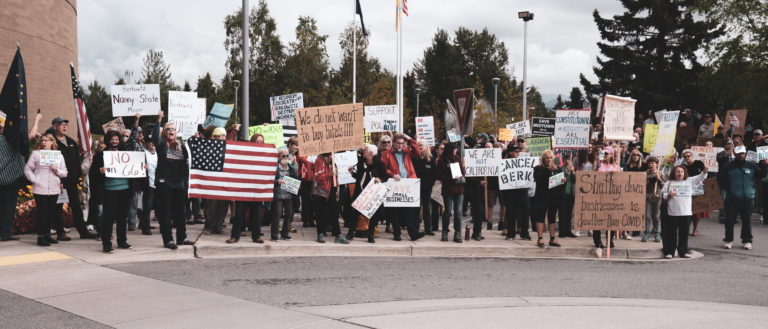
The vagrants, addicts, and lawless people living on the bluff at 3rd Avenue and Ingra Street in Anchorage staged a counter protest to the group called the Third Street Radicals, who have been trying to get the mayor to clean up the unsafe conditions and nearly continuous drug dealing that is going on at the location.
Things got a bit dicey with police showing up to keep a fight from breaking out. Caution: Language is not safe for work or appropriate for children:
The riled-up campers were upset with the two dozen protesters nearby who want the camps cleaned up and the drug dealing to stop:
State government remains too big, and too expensive; we are faced with tough choices.
Government needs to make the tough decisions to reduce spending to a sustainable level, to promote a strong private sector economy, which creates jobs for a more stable future in Alaska.
Alaska remains at the top of the nation, #1 in spending per capita, and spends 2.3 times the national average on state government, according to the Kaiser Foundation. I have said for years: Fix government first, before you take the Permanent Fund dividend, and before you tax Alaskans.
There have been many claims of “deep budget cuts” but the data shows a different story. In fact, the Governor and Legislature have made little progress reducing State spending. The chart below shows spending for the past 5 years for the State Operating budget, the Capital budget and PFDs. Alaska’s Operating budget, including both Agency and Statewide Operations (debt service, retirement, etc.) has increased to $9.2 Billion dollars, in total funds, for FY 2020. During the same period, Capital budgets and PFDs have been reduced. Research has shown reducing Capital budgets and the PFD has the most negative impacts on the economy.
What drives Alaska’s big budgets? Simply put: Too many programs, too many employees, and too many special interests with their hands out, coupled with the governors’ & legislators’ inability to say no. Alaska has one of the highest rates of public employees in the nation, working 37.5 hours a week with healthy union contracts and automatic annual pay increases.
Rural Alaska depends heavily on state funding, with virtually no local tax base to support their communities. Health and Social Services is the largest budget, approaching $3.5 Billion annually, with almost 250,000 Alaskans on the public health system.
Unlike other states, Alaska’s budget is controlled by a few members in legislative leadership using a system of rewards and punishments, and a “binding caucus rule,” where they require legislators to pledge their vote to a budget, before it is constructed.
As an example of the punishment by leadership, I was stripped of the Labor and Commerce chairmanship for voting against a bill that reduced the Permanent Fund dividend and increased the budget.
The chairmanship was given to union loyalist, Sen. Click Bishop and two of my committee assignments were rewarded to newly appointed Sen. Josh Revak, a caucus loyalist.
In addition, lobbyists and special interests drive the budget up and thrive in Juneau’s isolated environment.
State savings accounts are being drained. Since Fiscal Year 2013, government has spent almost $20 billion from the Constitutional Budget Reserve and the Statutory Budget Reserve, leaving these accounts almost empty.
In addition, almost $6 billion has been spent from the Permanent Fund Earnings Reserve on state government. Traditionally, this fund was only used to payout PFDs and inflation proof the Permanent Fund.
Since 2018, the Legislature and governors have been using the Earnings Reserve Account to fund state government, at the expense of the PFD program. Continuing on the path of big government is the greatest threat to the PFD program, and has pulled billions of dollars out of the private sector economy. For years, I have voted no on unsustainable budgets. I warned against using the Permanent Fund Earnings in a 2016 op-ed, “Budget Cuts are Missing, Don’t Touch the Permanent Fund.”
The data tells a compelling story that Alaska has a spending problem. What are some potential solutions?
After conducting audits, the State Legislature and governor must eliminate poor performing programs and prioritize programs based on constitutional requirements.
Move the Legislature to the road system, where there is greater access and accountability.
Dwindling state funds should be appropriated only to programs with the best outcomes and strict accountability.
The binding caucus rule must be abolished, as it is often used to coerce legislators to vote for leaderships priorities.
A spending cap must be established.
Everyone must realize there is no such thing as a “government funded” program; the private sector ultimately pays the bills.
Alaska’s economy is fragile, especially during the COVID-19 crisis; the private sector should not be burdened unnecessarily with additional taxes to sustain big government. Dependency on state dollars must be discouraged.
My allegiance to the Founding Father’s principles, sound economic practices and keeping my promises to the people in my district, will always be stronger than any allegiance to a caucus. It’s time to talk to your legislator and the governor, as they need your encouragement and support to reduce government spending.
Born and raised in Alaska, Republican Sen. Lora Reinbord serves Eagle River, Chugiak & JBER, and is a former State House representative for Eagle River, 2013-18.
Earlier this month, Gov. Mike Dunleavy announced this year’s budget reductions, following through with what fiscal conservatives have said must happen if Alaska is to stay afloat during these challenging times. We cannot continue to operate as if we have an unlimited amount of money. We don’t.
In the midst of a public health crisis – especially one where the closing of most businesses is apparently warranted – we cannot spend our precious state dollars on items and programs that a.) will be covered by incoming federal stimulus dollars, or b.) do not assist economic recovery in Alaska.
Without a serious and swift economic recovery, Alaskans will have no choice but to either leave the state, face unimaginable levels of taxation, or suffer in poverty until our leaders figure out what their priorities should be.
For several years now, Alaskans have been deprived of their statutory permanent fund dividend checks. More and more, it appears as if this year, of all years, will be no different.
One of the governor’s vetoes was $1.5 billion that legislative leaders in the House and Senate had tried to tuck back into the Permanent Fund, in an attempt to keep it out of the hands of the dividend program. This was the wrong move by legislative leaders and the right move by the governor.
A member of the House Majority recently accused Alaskans of being “very quick to have their hands out,” as justification for why no additional dividend funds or economic stimulus payments should be made.
Should anyone be surprised that Alaskans, many of whom are only unable to work because of the mandates imposed by the government, might have an itch to access the money that lawfully belongs to them?
As people suffer more – and they will, the longer this virus remains in Alaska – the worse our future will look.
Anchorage Rep. Lance Pruitt wrote a letter to Gov. Dunleavy asking him to direct the Department of Revenue to issue PFD checks as soon as possible, rather than waiting until October. Of course, I support this idea, and I encourage Gov. Dunleavy to follow through on it.
But I also know that the dividend authorized by Senate President Cathy Giessel and Speaker Bryce Edgmon is only $1,000. Yes, it would help families and stimulate the economy for a week or two, but it’s a severe slap to the face, especially when $1.5 billion is sitting there ready to go – ready to help Alaskans weather this storm.
Times like these are why we have the Permanent Fund. Not to pay for government programs, not to enable governments to spend more money without making cuts. The fund exists so that when the unexpected happens – as it has – that we can keep people afloat with their money.
This isn’t borrowed from a bank or from China – it’s Alaskan money, earned on the backs of Alaskans. It’s time to put that money to work, get people through this tough time, and follow the law.
Jesse Sumner is a candidate for State Representative in District 10 (Wasilla), and a member of the Mat-Su Borough Assembly. Learn more about Jesse at SumnerForAlaska.com.
ConocoPhillips is curtailing spending and production, cutting 225,000 barrels a day from its North America wells, as the price of oil drops and as the world is running out of places to store it.
Alaska North Slope crude oil traded under $16.65 a barrel, reaching lows not seen since 2002. North American producers have seen a 30 percent drop in demand and nearly a 70 percent drop in prices since January.
For Alaska, the announcement means the company will cut back another $200 million in planned investment.
Today’s announced actions include these points made by the company in a news release on its website:
An additional reduction in 2020 operating plan capital expenditures of $1.6 billion, bringing the current estimate to $4.3 billion. Including our previously announced reduction of $0.7 billion, this represents a total reduction in operating plan capital expenditures of $2.3 billion, or approximately 35 percent, compared to the 2020 announced guidance. These reductions are sourced from across our global portfolio, primarily focused on Lower 48, Alaska and Canada areas where we have the highest levels of flexibility.
A reduction in operating costs of approximately $0.6 billion, representing roughly 10 percent of the initial 2020 guidance. This brings the current estimate to $5.3 billion. These reductions were sourced from lease operating expenses, general and administrative costs and foreign exchange impacts.
The company’s share repurchase program has been suspended.
On a combined basis, the cumulative capital, operating cost and share repurchase actions represent a reduction in 2020 cash uses of over $5 billion versus original operating plan guidance.
The company also announced it will elect to curtail production in Canada and the Lower 48 regions until market conditions improve.
At Surmont, the company is currently cutting back production due to low Western Canada Select prices. By May, the company expects to reduce production by approximately 100,000 barrels of oil per day (BOD) gross to 35,000 BOD gross.
In addition, beginning in May, the company plans to begin curtailing production across its Lower 48 region. Initially, the company expects to curtail about 125,000 BOD gross. Curtailment decisions will be made on a month-to-month basis, and are subject to operating agreements and contractual obligations.
These announced curtailments represent approximately 200,000 barrels of oil equivalent per day (BOED) net to the company.
Given ongoing uncertainty, continued market volatility and the potential for both voluntary and involuntary curtailments over the coming months, the company’s previous 2020 guidance items should not be relied upon and further guidance will be suspended.
The announcement came about a week after the company announced it was demobilizing some of its drilling rigs and crews in response to the COVID-19 pandemic.