Saturday, April 11, 2026
Home Blog Page 1303

‘Win the Wilderness’ is latest Alaska-based reality show

Six British couples competed to see which had what it takes to survive in the Alaska wilderness and win ownership to a remote Interior Alaska that had been built and owned by Duane and Rena Ose.

That’s the hook for the latest Netflix “competition reality” TV series, which was filmed at the Lost Lakes Boy Scout Camp last summer. The BBC2-produced show, which premiered April 22, follows the couples as they compete for the ownership of the log A-frame-style home. The series showed in Great Britain in January.

“How far would you go to escape the demands of modern life?” begins narrator Nicholas Tennant, as the camera sweeps majestic landscape from Lost Lake.

The series has all the cheesy set ups and dramatic lead-ins of all of the competition reality shows in circulation, but Duane and Rena only agreed to do the show if it wasn’t over-the-top cheesy. That may make it a little boring for most Americans, but Alaskans will relate to the Oses.

So what ever happened to the couple who actually won the little slice of Interior Alaska paradise?

We found out, but we’ll not spoil the fun. This story will tell you who won and whether or not they are actually living in the cabin they won.

Or watch the episodes of Win the Wilderness for free with a 30-day trial of Netflix.

Your Alaska-informed comments and critiques are welcome below.

COVID-19 update: 3 cases

The Alaska Department of Health and Social Services on Sunday announced three new case of COVID-19 in Alaska. The cases were from Anchorage (2) and Kenai Peninsula (1).

This brings the total case count in Alaska to 368.

Recovered cases now total 262, including eight new recovered cases recorded since Friday. A total of 21,578 tests have been conducted. 

This reflects data from 12 a.m. until 11:59 p.m. on May 2 that posted at Sunday on the DHSS Coronavirus Response AK COVID-19 Cases and Testing Dashboard.

No additional hospitalizations or deaths have been reported. There have been a total of 36 hospitalizations and nine deaths among Alaskans who have been infected with the Wuhan coronavirus. There are currently 12 Alaskans hospitalized with the illness.

The death rate in Alaska from COVID-19 stands at 2.44 percent. As for hospitalizations, nearly 10 percent of those who have gotten the virus have had to be hospitalized.

Globally, about 3.4% of reported COVID-19 cases have died.

Small businesses and municipalities wait for Legislature to act

BUSINESSES BEGIN TO FOLD AS KEY COMMITTEE STALLS FUNDS

Municipalities and businesses bearing the brunt of the COVID-19 pandemic and its economic impact are waiting for money that the federal government has sent to the State of Alaska to distribute as economic aid.

But the Legislature is taking its time getting the money out the door to its intended recipients.

After over 10 days of delay, the Legislative Budget and Audit Committee met on Friday, but only approved funding for state programs.

Small businesses — the ones that have struggled to qualify for federal loans — are in limbo because of legislative inaction and business closures have begun: In Juneau, the Art Sutch Photography studio is closing, and in Anchorage, the Last Frontier Bar has closed for good. In Soldotna, it took a GoFundMe campaign to save Ammo-Can Coffee Shop.

Nonprofits are also shaking money out of the sofa to help the tens of thousands of Alaskans who are out of work.

After the funds arrived in the State Treasury in two tranches two weeks ago, the Dunleavy Administration was ready with a plan, one that he quickly put in front of legislators within two days.

Some of the details included $586 million for communities; $290 million for small business loans; $50 million for nonprofits, $10 million for homeless interventions, and $337 million for public health. There’s also $29 million for public transit; $32 million for Anchorage and Fairbanks airports, and $100 million in aid for fisheries.

But it is up to the Legislature to make the needed appropriations.

The LB&A committee on Friday funded $125 million — a sliver of the monies the federal government sent. for schools, transportation, and public safety items. Funding went to State programs, and none was sent to the rest of the economy — none for municipalities, none for nonprofits, and none for the struggling small businesses.

The bulk of the funding is waiting for action, while legislative leaders first tried to convene and take control of the funds through an appropriations process, and then asked the governor to split out the municipal appropriations into 120 separate “RPL” items– one for each community.

Now, LB&A won’t meet again until Wednesday to take up those items.

Meanwhile, Gov. Mike Dunleavy on Friday begged the committee to act quickly. He wants the funding out where it was intended, according to the plan submitted to the federal government. He’s especially concerned about small businesses that don’t have much, if any, cushion left.

If the Legislature does not act because of political tangles over the distribution of the funds, the governor would have to wait 45 days to release the money in accordance with his plans, which were crafted in cooperation with the Legislature, municipal leaders and nonprofit organizations. That’s how the Revised Program Legislative (RPL) process works.

COVID-19 update: One case

The Alaska Department of Health and Social Services on Saturday announced one new case of COVID-19 in Alaska, in the community of Fairbanks.

This brings the total case count to 365. Recovered cases now total 261, including seven new recovered cases recorded Friday. A total of 21,399 tests have been conducted.

This reflects data from 12 a.m. until 11:59 p.m. on May 1 that posted at noon Saturday on the DHSS Coronavirus Response AK COVID-19 Cases and Testing Dashboard.

The new case is a male, aged 60-69.

No additional hospitalizations or deaths have been reported. There have been a total of 36 hospitalizations and nine deaths among Alaskans who have been infected with the Wuhan coronavirus. One new hospitalization was recorded yesterday, but it offset another hospitalization that was listed but was not verified.

Bomb threat closes Anchorage airport, but none found on Taiwan-bound jet

Law enforcement officials in Anchorage responded to a bomb threat to a China Air cargo flight on Saturday.

The plane had been diverted to Ted Stevens International Airport after taking off from Seattle en route to Taipei, Taiwan after a bomb threat was called in to the Port of Seattle.

Officials temporarily closed the airport. The cargo jet was searched in a secure, remote section of airport property and no explosive device was found.

Meanwhile, flights bound for Anchorage were diverted to Fairbanks International Airport. The Anchorage airport it has since been reopened.

Investigation at the airport was completed and the FBI does not believe there is any continuing threat, although the investigation into the source of the threat continues, according to a law enforcement statement.

Cargo flights from Asia are not allowed to pull up to airport gates, and are parked on the tarmac remotely as they have not cleared customs. They land in Anchorage for refueling and are in quarantine before they leave — only flight crews leave the aircraft and overnight at a nearby airport.

In this case the flight was from Seattle going direct to Taipei and was probably not carrying a full load of cargo, which is why it was not originally scheduled to stop in Anchorage for fuel.

At this time the FBI is releasing no further information, as the investigation is ongoing.

Alaska flunking U.S. Census, only 37% responding, compared to 54% in U.S.

CONGRESSMAN DON YOUNG SAYS WE NEED TO STEP IT UP

The state of Alaska may have had a drop in population, but looking at the data from the U.S. Census, one could wonder if there’s been a biblical-level exodus.

That’s because less than 37 percent of Alaskans have responded to the 2020 Census, the inventory of Americans that takes place every 10 years. Nationwide, the response rate is is currently at 55.6 percent. Alaska is considered the state with the worst response, so far.

In fact, Alaska has long been known as the hardest-to-count state, but this year it’s noticeably worse. At the rate Alaska is going with the Census, it could end up looking like the state with the lowest population. Right now, Alaska is third from the bottom in population, with only Wyoming (572,831) and Vermont (627,180) with fewer residents than Alaska (731,007).

During the 2010 Census, the final count was 731,545 Alaskans. Since then, the population has risen as high as 737,000 and has dropped during the recent recession. But by how much it has dropped is a moving target.

Congressman Don Young is concerned that too few people are taking part, and that could hurt federal funding that is often divided up among states based on population.

The fewer people who respond to the online option usually equates to a lower count overall, and that can end up harming Alaska at a time when it needs its full share of federal dollars.

The timeline for the Census has been extended due to the COVID-19 coronavirus; the new deadline is Oct. 31.

Field offices have been closed until June 1, and the door-to-door count, to attempt to count those who are not responding to their online option, will not start until August.

The current plan is to have Census staff drop off an invitation to participate to 29.7 percent (or 93,742) housing units in Alaska. The packet will include a paper version of the census questionnaire, as well as online instructions and a unique ID for online response. Householders can submit their census information either online or by phone, or by mailing back the questionnaire. 

If householders do not respond, the Census Bureau will send reminder mailings to fill out the questionnaire. Finally, the Census takers will visit about 9.6 percent of households to try to enumerate them in person. That equate to 30,178 homes being visited by census-takers from August to October.

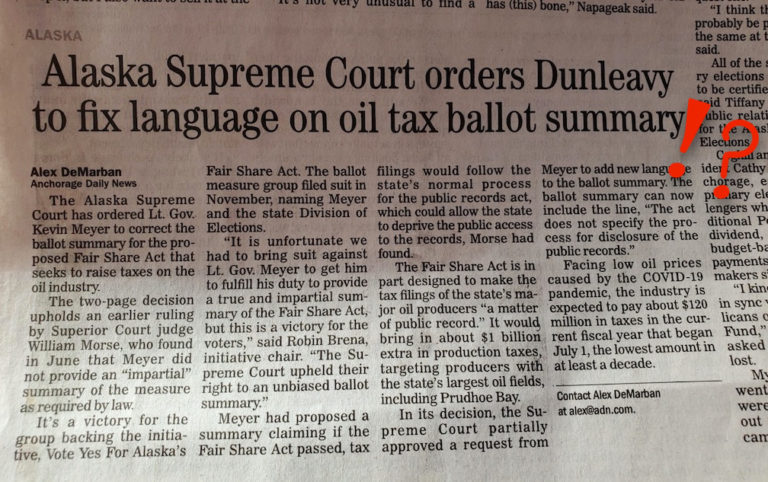
AG says it doesn’t matter if ‘Our Fair Share’ broke law, oil tax hike goes to ballot

The Attorney General of Alaska said it is not important that signatures were gathered illegally on the oil tax initiative that is heading for the November ballot. What matters is that enough people signed the petition, and that is good enough for the State of Alaska.

Alaska law prohibits ballot proponents from paying signature gatherers more that $1 per signature.

In the case of Vote Yes on Our Fair Share, a lawsuit claims that the Robin Brena-funded group hired an Outside signature-gathering company, which paid people handsomely to travel to Alaska and get the required signatures to put the measure on the ballot. Brena has been pushing for higher oil taxes for a decade and is the law partner of former Gov. Bill Walker. Attorney General Kevin Clarkson is also a former law partner of Brena.

[Read the ballot language summarizing the new tax.]

The lawsuit, brought by a consortium of business groups in Alaska, including the Alaska Chamber of Commerce, named the State Division of Elections, the Lieutenant Governor, and the sponsors of the ballot measure known as 19OGTX.

The groups allege that the petition circulators working for an out-of-state company Advanced Micro Targeting provided false affidavits in support of the petition booklets, and therefore the booklets are invalid, because the signature gathering company broke the law to get the signatures.

In layman’s terms, the signature-gathering company lied, the lawsuit alleges. It also appears that money went to another signature gathering company and was possibly moved to Advanced Micro Targeting for the purpose of beefing up the bonuses for signature gatherers.

The Attorney General’s position is that it’s a waste of judicial resources to take the case forward, because “otherwise valid signatures should not be invalidated solely because of petition circulators’ violation of the payment limitation in AS 15.45.l10(c). Although the Division shares the plaintiffs’ concern with the possible violation of Alaska’s limitation on the payment of signature gatherers, a remedy that would thwart voters’ constitutional right to propose and enact initiatives through no fault of their own is inappropriate. The plaintiffs correctly note that this litigation will have to proceed on an extremely expedited schedule in order for the factual issues to be resolved at a trial before the initiative appears on the ballot in November.”

The AG has asked that the case be dismissed and states that signature gathering is a core part of the First Amendment of the Constitution.

Read the state’s response to the lawsuit at this link:

PFD online applications hit all-time high last month

Roughly 604,000 Alaskans filed for their Permanent Fund dividends online this year, an all-tine high for online filers.

The Dunleavy Administration had extended the deadline for applications from March 30 to April 30 due to the COVID-19 coronavirus emergency.

State PFD offices have been closed to the public since mid-March due to the COVID-19 coronavirus, which prompted the governor to extend the deadline.

Online applications do not tell the whole story, because there are paper applications that some Alaskans filed, which are not included in this count. That number is usually available several weeks after the application deadline.

Last year’s total number of applicants was 668,588. Of those, 631,000 were actually eligible for the annual share of the state’s oil royalty.

Some 670,759 applied in 2018, and of those 639,247 were eligible.

The state’s population was thought to be about 736,000, in 2018, but has likely dropped in the past two years. The State Department of Labor estimates it to be just over 731,000 this year.

The number of people applying for the dividend has likewise dropped for several years after reaching a high in 2012 of 679,633.

This year’s dividend will be $1,000, as set by the House and Senate majorities. It’s the same amount as the first dividend was back in 1982, when it was issued in June of that year.

Today’s $1,000 has purchasing power of $366, compared with 1982.

For this year’s dividend to have the purchasing power that $1,000 had in 1982, the dividend would need to be $2,675.

Last year, the Legislature set the dividend at $1,600, while the statutory amount that should have been paid to Alaskans was $2,910. This year’s statutory amount was close to $3,000, and much controversy exists in Alaska about whether the full amount should be paid, or the $1,000 that the Legislature ended up appropriating.

COVID-19 update: Zero on Wednesday, 9 on Thursday

After a day without any COVID-19 cases being diagnosed in Alaska, the brief respite was broken with nine cases diagnosed on Thursday, according to the state report from the Department of Health and Social Services.

No new hospitalizations or deaths were reported. There are 101 known active cases of the coronavirus in Alaska at this time. Another 254 Alaskans have recovered from the illness, and nine have deceased from conditions associated with COVID-19. There are currently 25 Alaskans hospitalized who have the coronavirus.

Six of the latest cases were in Anchorage, two on the Kenai Peninsula, and one in the Fairbanks/North Star Borough area.

20,325 tests on Alaskans have been completed.