
Wednesday, June 17, 2026
Home Blog Page 1242

Alaskans can send principled policy champions to Juneau

0

Alaskans have an unbreakable spirit. A global pandemic may have changed our daily lives, but it has not, and cannot break Alaskans’ indomitable spirit. We’ve faced challenges before. We’ll face more in the future.  

To help us weather these challenges, we need leaders in Juneau who will fight for policies that will put our economy on track, ensure quality and affordable health care for everyone, and get Alaskans safely back to work. We need to elect leaders who will stand on principle — even when those principles are politically inconvenient — and make it possible for us to get back on our feet. 

That’s why Americans for Prosperity Action Alaska is endorsing Lance Pruitt, Sarah Vance, James Kaufman, and Kevin McKinley this election. These individuals earned the support of AFP Action Alaska for their principled dedication to tackling Alaska’s toughest challenge. They have demonstrated their dedication to supporting a constitutional spending cap that will get government spending under control and get our economy on track.

These candidates have shown they’ll fight to make sure Alaskans have every opportunity to live their American dream in The Last Frontier. 

Lance Pruitt, District 27

Lance Pruitt understands that if hardworking Alaskans have to live within their means, so should the government. He supports a meaningful spending cap that would get Alaska’s economy back on track.

Sarah Vance, District 31

Sarah Vance is a champion for fiscal restraint and will work to make sure the legislature passes a meaningful constitutional spending cap. Additionally, she has a track record of working to make sure every child in Alaska has access to the education that fits their unique needs.

James Kaufman, District 28

James Kaufman supports a meaningful spending cap to ensure Alaska has a strong fiscal future. He is a champion for regulatory reforms that will spur economic growth and enable more Alaskans to find fulfilling work. 

Kevin McKinley, District 5 

As a business owner, Kevin McKinley understands our government must exercise fiscal restraint to ensure a bright fiscal future for our state. He will fight for regulatory reforms that will help more Alaskans find fulfilling work, enable our businesses to thrive, and bring back our jobs.

This is a pivotal election for our nation – but especially for Alaska. The COVID-19 pandemic and economic shut down has radically changed our daily lives and brought into sharp focus the need for principled leaders who are fixing the issues that matter most.

We encourage Alaskans to vote for these principled policy champions. A vote for these candidates is a vote for a prosperous Alaska where everyone has the opportunity to thrive. 

Paid for by Americans for Prosperity Action – Alaska, 431 W 7th Ave., Anchorage, AK 99501. Ryan McKee, Chair, approves this message. The top contributors are AFP Action, Arlington, Virginia, Trina Johnson of Anchorage, AK and Dan Kennedy of Wasilla, AK. This NOTICE TO VOTERS is required by Alaska law. I certify that this communication is not authorized, paid for, or approved by the candidate. AS 15.13.135.

Judge rules governor has no authority to veto Alaska Court System’s budget

COURT IS SUPREME IN APPROPRIATIONS, SUPREME IN VETOES

In a decision that critics say guts democracy, Anchorage Superior Court Judge Jennifer Henderson ruled Friday that a veto by Gov. Mike Dunleavy of a small part of the court system’s budget was unconstitutional.

Dunleavy had vetoed $334,700 from the court system in 2019 and again in 2020. He said in his veto explanation that it was equal to the amount that the courts have forced the State of Alaska to pay in Medicaid abortions.

In her decision, the judge noted that after the veto, the Legislature convened in special session but failed to override the veto. Her decision effectively, if it stands, overrides both the governor and the Legislature on money coming to her department.

The American Civil Liberties Union filed the lawsuit on behalf of Bonnie Jack, a political activist from Anchorage.

Henderson, who is up for retention this Nov. 3, addressed the separation of powers issue, but oddly quoted the late Justice Antonin Scalia when he wrote that the separations issue is a “structural safeguard rather than a remedy.” Scalia had been writing on a completely unrelated matter involving past court decisions and whether they should be reopened.

Henderson said the court “that the undisputed facts demonstrate that the governor’s exercise of his veto power to reduce the appellate courts’ budget in fiscal years 2020 and 2021 expressly undermines the Alaska Constitution’s commission of judicial powers to the judiciary, as well as the structural independence of the judiciary, and thus violates the doctrine of separation of powers embodied in the Alaska Constitution.”

Henderson’s interpretation of the law is that the governor can only veto the court system’s budget if Henderson approves of the reason.

There is no limitation on the constitutional authority of the governor’s vetoes in the Alaska Constitution, Article II, Section 15: “The governor may veto bills passed by the Legislature. He may, by veto, strike or reduce items in appropriation bills. He shall return any vetoed bill with a statement of his objection to the house of origin.”

Additionally, Article II Section 16, Action Upon Veto states “Bills to raise revenue and appropriation bills or items, although vetoed, become law via affirmative vote of three fourths of the membership of the Legislature.”

The Alaska constitution specifically discusses how the executive handles vetoes and how the legislature handles vetoes, and the Constitution makes no mention of judicial review or authority over appropriation bills or vetoed items.

Henderson on Friday opened the door for the judiciary to set its own budget and approve its own budget because appropriation power of the Legislature is no more protected than the veto power of the governor.

By her logic, failure to adopt the exact budget request of the Alaska Court System, or even increase taxes to pay for the desires of the Judiciary’s budget, would constitute an unconstitutional effort to influence the Judiciary.

Earlier this year, Henderson interfered in the elections by ordering the Division of Elections to stop printing ballots because candidate Alyse Galvin wanted to be identified in her own way on the ballot, rather than as the Democratic Party’s nominee for U.S. House of Representatives.

Henderson was appointed by Gov. Bill Walker in 2017 and faces her first retention vote.

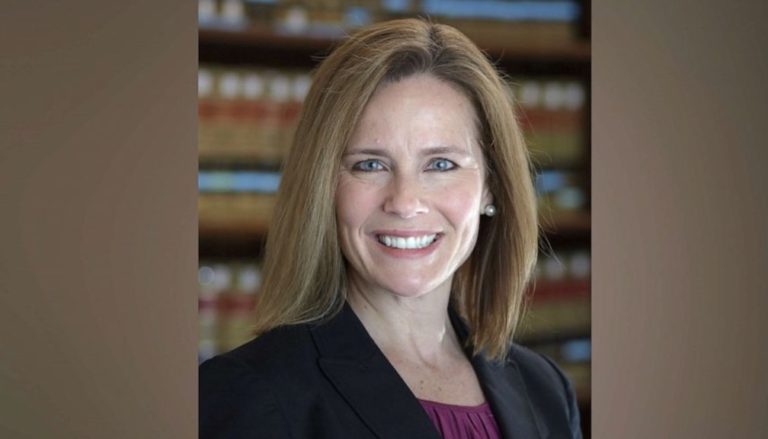
Murkowski hasn’t decided on Amy Coney Barrett for court

56

In spite of some media reports, Sen. Lisa Murkowski has not decided for or against the nomination of Amy Coney Barrett for the U.S. Supreme Court.

At least one news organization in Massachusetts has said otherwise, but a spokesperson for Murkowski said Alaska’s senior senator has not even had a chance to meet with Barrett.

She has said she will meet her soon, and out of respect will not be commenting until at least after that meeting. The date for the meeting has not been confirmed, the MRAK source said.

Today was the final day of the Senate Judiciary interview of Barrett, and a vote is expected on the floor of the Senate later this month.

Civics 101: How we elect our president with the Electoral College, Congress, and you

8

By SCOTT LEVESQUE

On Nov. 3, many Americans will be glued to their television or computer screens, watching the “results” of this year’s presidential election. They may be disappointed — and not just because of the outcome. The results could take weeks to be known this year.

Despite admonitions that the “final” results could take weeks to be known due to an overwhelming request for mail-in and absentee ballots, many Americans still do not fully understand the process of declaring a winner in the U.S. presidential election. 

The process to elect the president involves voting for electors, the Electoral College, and Congress.

The Senate, House of Representatives, and the National Archives all play an essential role in confirming the winner in a process that dates back to America’s adoption of the Constitution in 1788. 

The Founders designed this four-month process as a check and balance between the people and the government’s role in the election of its top leader.

Voters are voting for the president, but by voting for a candidate, they are actually are choosing a set of electors who will cast the actual vote.

After the 50 states and the District of Columbia have counted their in-person, mail-in, and provisional ballots, each state governor provides a list of electors. This list, called the Certificate of Ascertainment, is submitted to the head of the National Archives. 

The electors have been pre-selected by the political parties. Alaska has three electors for Republicans, and three for Democrats. California, on the other hand, has 55 electors.

The electors arrive at the state Capitol and cast their votes for president and vice president according to the will of the electorate, occurring on the first Monday and second Wednesday of December. If the Democrat nominee has won in Alaska, for instance, the Democrat electors will go to Juneau.

Donald Trump/Mike Pence are heavily favored to win Alaska and will get all three electoral votes. Alaska’s Republican electors are: John Binkley, Judy Eledge, and Randy Ruedrich.

Each elector finalizes a Certificate of Vote, which is mailed to the U.S. Senate, National Archives, and state officials. Once completed, the Electoral College has satisfied its duties. 

Across the country, there are 270 electoral votes needed to win the presidency.

Learn more at 270towin.com.

Some states have laws that require electors to reflect the will of the majority of the voters in that state. On July 6, the U.S. Supreme Court unanimously ruled that states have the power to require presidential electors to vote the will of the people.

The final step in the process happens on Jan. 6, 2021, when Congress convenes to count the electoral votes – officially certifying a winner. While ceremonial, this final step allows for potential objections to the Electoral College votes. There have only been two occurrences of this happening, 1969 and 2005.

This year’s presidential election promises to be one that bucks many conventional norms. Yet, it’s important to note the United States has elected every president using this exact method for 232 years. 

Gruening: When will our schools reopen?

6

By WIN GRUENING

If you haven’t bookmarked this website, you should:  CovidActNow.org.

It shows that while Alaska is experiencing increasing Covid risk levels, this is mostly due to surging case levels in selected areas.

Each Alaska school district determines its current Covid risk level.  A “one-size fits all” approach makes little sense when Covid-19 statistics vary widely among different regions and communities.

Yet, while Capital City risk levels have remained relatively low, classrooms have remained off-limits to most students for 7 months.  There has been little urgency to get students back.  This, despite CDC guidelines and mounting evidence that the damage to students far outweighs potential re-opening risks from coronavirus.

Some Alaska school districts recognized this, opening with in-person classes while allowing families to opt for distance learning if desired.

Initially, the Juneau School District announced starting school with a hybrid model – a mixture of in-person and distance learning.  Just weeks before school began, those plans were scrapped in favor of all-remote learning.

Juneau’s announcement explained their decision was made in consideration of evolving guidance from state education and city health officials.  Their plan, SMART START 2020, was “designed to be a moving scale with decisions made dependent on current conditions”.   It considers “many complicating factors and will continue to evolve as [it progresses] in the coming weeks.”

This week Juneau school officials began considering a re-opening plan. But, unlike other school districts that have re-opened, JSD’s plan contains no objective criteria for determining when in-person classes will resume.  This leaves parents and students at the whim of district officials who cannot articulate when it’s “safe” to return.

The 44-school Kenai School District re-opened their schools in September.  The district’s own Covid-19 dashboard monitors each community’s numbers across their district and objectively rates its risk environment based on case counts and trends.  

Kenai’s Covid numbers are higher than Juneau’s, however, mitigation measures keep students in classrooms whenever possible.  Occasionally, temporary school closures are necessary, but parents and students at least know why.

Juneau’s teachers union objects to returning to work until it’s absolutely safe. Does that mean when a vaccine is available, and students and staff have been inoculated? That’s unlikely to happen before the end of the 2020-2021 school year, at the earliest.

Can any district afford the damaging social, emotional, and economic effects of keeping students at home indefinitely?

Just this month, after a gathering in Massachusetts, The Great Barrington Declaration, authored by three noted infectious disease epidemiologists and public health scientists, has gained some 15,000 signatures from the world’s medical and health community.  The declaration calls for a smart alternative to lockdowns and social-distancing rules that are crippling our country and preventing our schools from opening.

This last week, The World Health Organization announced that it no longer recommends economic lockdowns to fight the novel coronavirus, effectively reversing its long-held position.

In Anchorage, where Covid-19 cases are surging and in-person classes have been postponed again, School Superintendent Deena Bishop delivered a passionate plea to the school board to consider the negative impacts on students. “We are not doing a good job of educating our young people with distance delivery,” she said.

Bishop said Anchorage likely won’t be at “medium-risk” for coronavirus spread for at least a year and “we cannot wait a year to educate our children in buildings.”  She became emotional when saying, “COVID is killing our children in more ways than one. And we need to stand for children today.”

Bishop’s comments underscore the difficulties inherent in virtual education.  Remote learning, especially for earlier grades, is a lousy substitute for in-classroom instruction. Younger children require monitoring and continuity of instruction as well as help navigating required technology. Parents forced to stay at home with their children are often ill-equipped to provide it.

Parents are finding that virtual instruction is, at best, disappointing, at worst, unacceptable.  

In Juneau high schools, teaching only four days of classes per week, the district may not reach the state-mandated 900 hours of academic year instruction.  Quality of instruction can vary widely depending on the experience and comfort level a teacher has with remote delivery.  Actual instruction may last only 20-30 minutes, after which students are on their own to continue studying.  Teachers sometimes read directly from textbooks, surmising many students won’t complete reading assignments.  Some students have yet to meet their teachers and some “hands-on” classes, like shop, may be just another “study period” with no instruction.

Lacking needed structure and teacher engagement, more students are failing classes.  Thus some families have opted for home schooling, private tutoring, or established correspondence courses. 

Bars, banks, restaurants, hairdressers, and grocery, liquor and marijuana stores are open, all apparently essential.  Even Juneau’s high school football team has been practicing.

Aren’t schools at least as essential as these activities?  

The success of the mitigation strategies of the communities that believe schools are essential demonstrates that students and teachers can be kept safe.  

The sooner we open our schools, the better.

Win Gruening retired as the senior vice president in charge of business banking for Key Bank in 2012. He was born and raised in Juneau and graduated from the U.S. Air Force Academy in 1970. He is active in community affairs as a 30-plus year member of Juneau Downtown Rotary Club and has been involved in various local and statewide organizations.

Court says this vote-rigging lawsuit has gone too far

14

Anchorage Superior Court Judge Andrew Guidi on Thursday denied left-wing litigants their demand that election officials must assist voters in correcting wrongly filled-out absentee ballots.

The Alaska Center for the Environment had sued to force the Division of Elections to make it go to great lengths to help voters correct a signature error, or other mistakes on their absentee ballots.

But Guidi said the Division of Elections is not required to let voters know they’ve made a mistake that would disqualify their ballot. Guidi pointed to state statute as the basis for his decision.

Last week, another judge ruled that absentee ballot votes don’t need to provide a witness signature on the outside of the ballot to increase election integrity.

In order for a vote to count, voters must sign the back of the absentee ballot envelope and provide a voter identifier, such as date of birth or driver’s license number.

The Division of Elections recommends that voters date their signature on the back of the envelope. Normally, the witness would date their signature, but since there is no witness requirement, the voter is encouraged (but not required) to fill this information in.

The left-wing litigants included the Alaska Public Interest Research Group and Floyd Tomkins of Sitka, the father of Democrat Rep. Jonathan Kreiss-Tomkins of Sitka.

Nearly 40 percent of the 80,017 registered Democrats in Alaska have requested an absentee ballot. As of October, Alaska has 594,474 registered voters thanks to automatic voter registration with Permanent Fund dividend applications. There are believed to be only 730,000 residents in the state with 182,000 of those Alaskans being under the age of 18, leaving a possibility of about 548,000 legitimate voters.

COVID on the uptick in AK

47

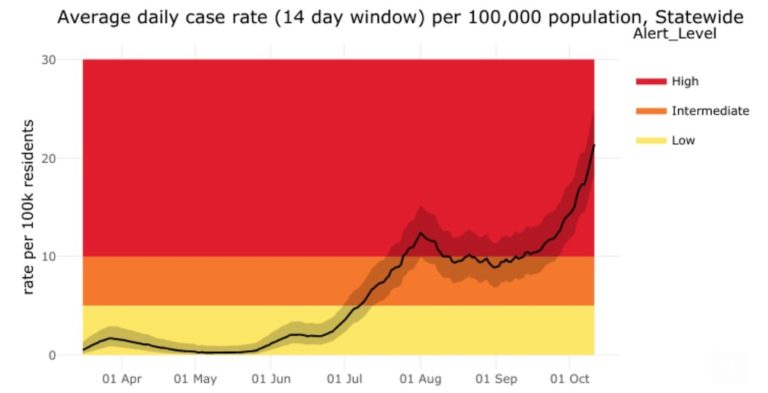
More cases of COVID-19 were reported in Alaska this week than any previous week, and by a lot — more than 40 percent than the previous high week earlier this month. 1,256 cases were reported, according to the state Department of Health and Social Services.

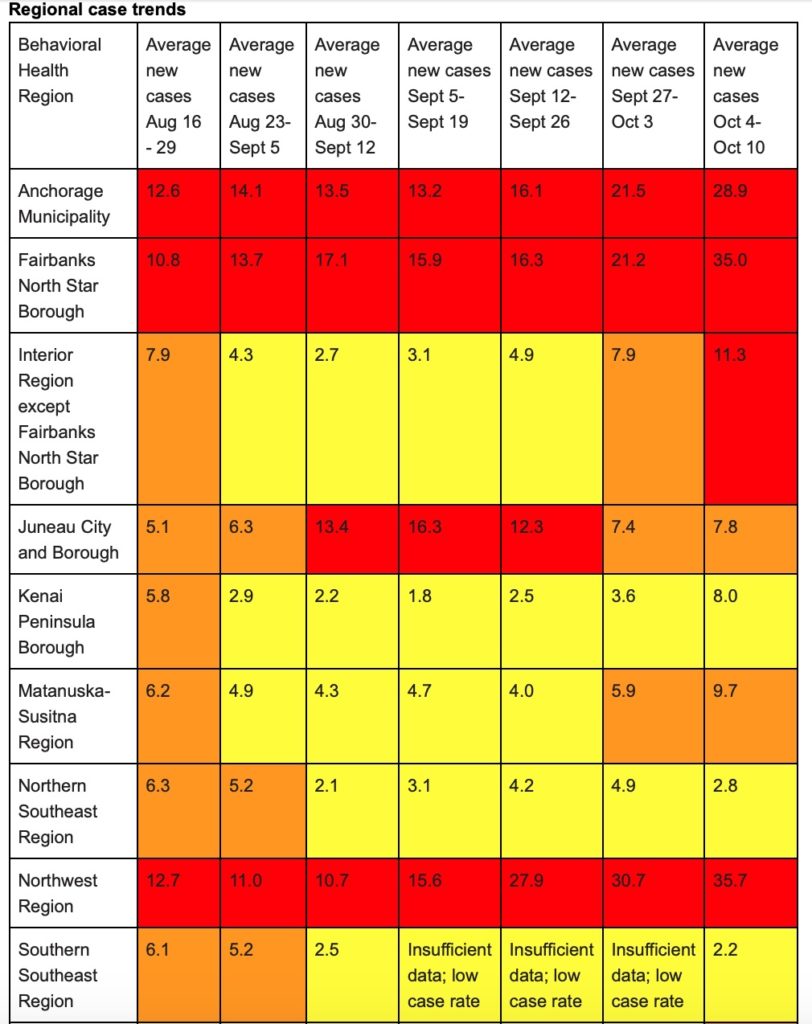
Alaska is experiencing a sharp increase in new reported cases, with most in the Yukon-Kuskokwim Delta Region, Anchorage Municipality and Fairbanks North Star Borough. The Northwest Region continues to have the highest two-week average case rate of any region of the state and saw increases this week. 

Compared to other states’ case rates, Alaska’s average case rate per capita over the last 7 days (25.5 average daily cases over the last week per 100,000) remains at the thirteenth highest of US states, just below Wyoming (27.3) and worse off than Missouri (24.4).

Alaska still has the lowest death rates in the country, but in terms of total numbers, more have died from the China virus in Alaska than in Vermont and Wyoming. 

Alaska is the 30th highest in average daily cases, just below Wyoming. Alaska is not alone in seeing a rise in cases: Nationally, cases have been rising since mid-September, the state said, with 26 states currently seeing 7-day average case rates over 15 per 100,000 and an additional 17 states with increases in their 7-day average case rate this week. 

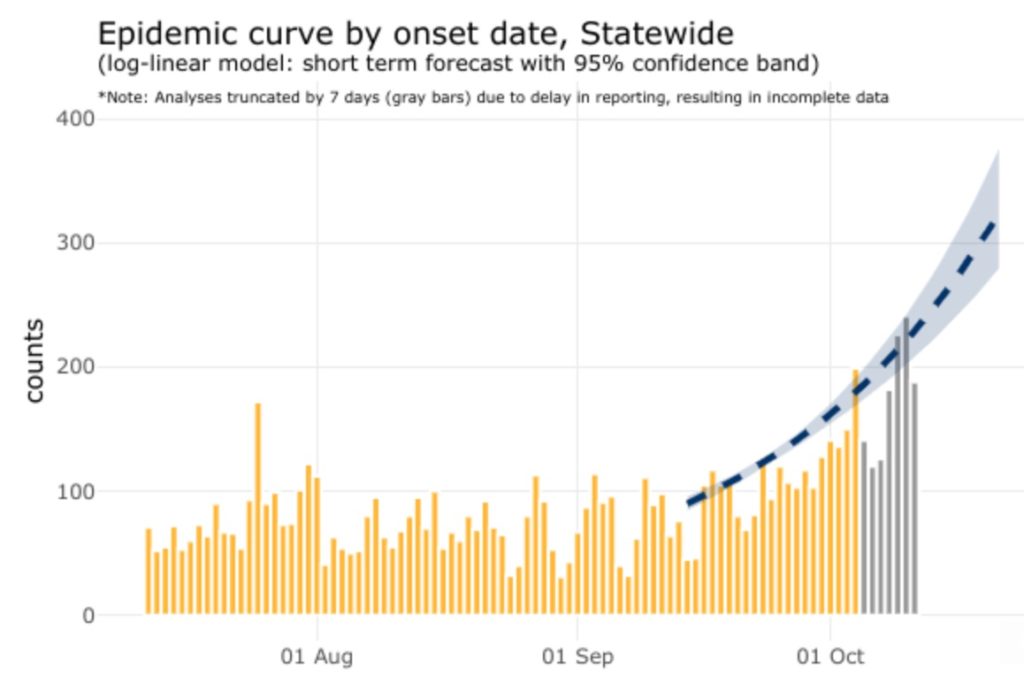
“An updated model epidemic curve predicts Alaska’s cases will continue to accelerate over the next week. Two weeks ago, cases were now expected to double every 105 days, with a daily projected growth rate of 0.66%. This projection has worsened, with cases now expected to double around every 20 days and a daily projected growth rate of around 3.5%,” according to DHSS.

To date, 10,323 Alaskans have contracted COVID-19, and 65 have died while affected by it. There are currently 50 Alaskans in the hospital who are infected with the coronavirus. Seven of those are on ventilators.

Al Gross keeps a $3.1 million mansion in California

MONEY MADE SUING ALASKANS FOR UNPAID MEDICAL BILLS?

U.S. Sen. Dan Sullivan has been subjected to an unrelenting air-bombing campaign by Al Gross, who is running as the Democrats’ candidate for Senate. But finally, Sullivan’s side is punching back.

In a new ad aired by the National Republican Senatorial Committee, it’s revealed for the first time that Gross owns a sprawling home in Santa Barbara, where he also got a medical license to practice.

It’s not just any home. He has a luxury, $2.6 million home, the NRSC says, and by Alaska standards, it is a mansion.

It’s also a mansion by Santa Barbara standards, where the average home assessment is $509,000.

The NSRC was charitable in that it underestimated the house value by quite a bit — it’s assessed at over $3.1 million — but the message is clear: Gross is Richey Rich-level wealthy.

View the Santa Barbara house property assessment here.

Gross makes over $100K in profit from the Santa Barbara house, which he currently rents out. His house in Anchorage is worth over $500,000.

Gross, who has attempted to portray himself as a camo-wearing, bear-killing, fish-slaying doctor, actually has quite a record for charging ungodly rates when he practiced in Juneau, where he spent 20 years doing surgery and where made his early millions. He’s attempted to make Sen. Sullivan look like an outsider, when it was Gross who left the state for several years to settle in California.

Al Gross’ luxury home in Santa Barbara.

While making his millions off of Alaskans, Gross sued numerous Alaskans for unpaid bills for as little as $11. CourtView contains a long list of Alaskans who were sued by Gross

Fagan: Governor breaks silence on ballot measures, Ethan Berkowitz

11

By DAN FAGAN

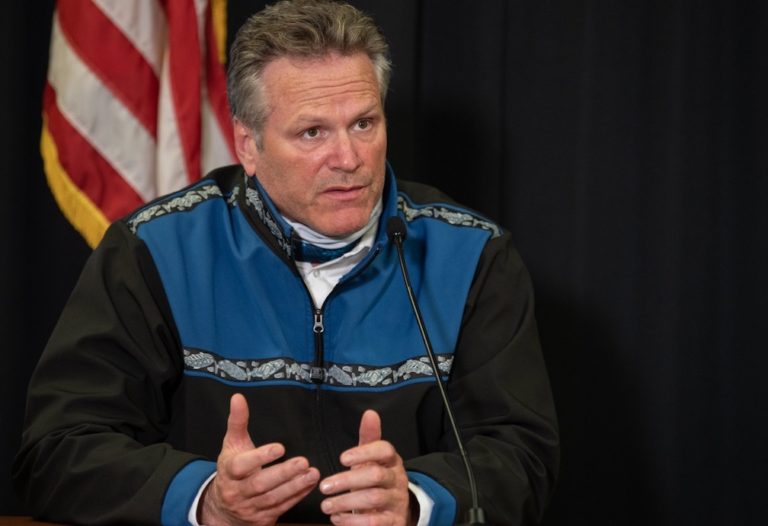
After months of virtual silence over major controversial issues facing Alaska, Gov. Michael Dunleavy finally came out from his basement. Dunleavy had put away and stored for safe keeping his bully pulpit, coincidently, at about the same time the recall effort targeting him surfaced.   

Yet the pressure on the absent governor must have grown so intense he decided to come out of hiding. 

What might have been the final straw is when Elizabeth Welsh, the founder of the widely popular and formidable Facebook group, Open Alaska, posted this on Wednesday: 

“Where is Dunleavy? Wake up! Anchorage is in turmoil and he is silent? Write him and call him today. Tell him to end emergency powers. And travel restrictions. Speak to Anchorage. Stand up for them. Keep the assembly accountable for the CARES act money. This hands-off approach is not standing tall for half of Alaska. The travel restrictions are crippling 1/3 of our industry. Villages in long term care facilities are prisons. He likes to say we’re open, but we are not open. “

Open Alaska’s 7,000 plus members are the heart and soul of Dunleavy’s base. They frequently post their frustration over Dunleavy’s sheepishness and reluctance to take on Anchorage Mayor Ethan Berkowitz and his hard Left, rubber-stamp majority enablers on the Assembly. Welsh’s grass roots post must have scared the fear out of Dunleavy and pushed him to act. 

Dunleavy was wise to heed the call of a homeschool mom with no experience in politics who has galvanized, energized, and motivated 7,000 plus people around an issue. 

Back in August, Anchorage Assembly member Jamie Allard, who is always courageous and Trump-like, also called out Dunleavy for remaining silent on the tyranny run rampant in Alaska’s most populated city. 

“Some folks believe you can lead from the rear which we know is not true. I prefer to lead from the front,” Allard said in August. “I can’t speak for the governor, I can only say what I would do and yeah, I wish he would have taken action a lot sooner.”   

Conservative firebrand Bernadette Wilson has been very outspoken on the governor’s silence. She, too, would like to see Dunleavy do more.

“Thousands of Alaskans have been left to battle their government on their own. They’ve sent hundreds of emails and spent thousands of hours attempting to educate themselves regarding the truth about COVID,” said Wilson. “They’ve testified on numerous occasions and have been left out in the cold for countless hours outside Assembly chambers with no one but themselves because Gov. Dunleavy refuses to take a hard line with the municipality of Anchorage and stand with the citizens. I would argue there are things the governor could do to help. At the bare minimum he needs to speak up and be just as vocal as the rest of us have and from the position of someone that has far more influence and reach. We have been standing tall. It’s time for the governor to stand with us.”   

I, too, have been hounding the governor over his silence on Berkowitz’s tyranny and Dunleavy’s refusal to take a stand on Ballot Measure 1 & 2.

Dunleavy advisor Dave Stieren and I got in a rather heated exchange on the radio recently over the governor’s reluctance to take on controversial issues. Stieren claimed it was his job, not the governor’s to take on controversies.  

Wednesday evening, I received a request from Stieren asking if the governor could appear on my show Thursday morning. Stieren added via Facebook message: “He’s breaking news on your show regarding the ballot measures. He’s coming out as a no on both. So, you win.”

You can hear my conversation with the governor regarding Ballot Measures 1 & 2 by clicking on the links below. 

Podcast: Dan Fagan Show/Dunleavy takes stand on Ballot Measure 1

Podcast: Dan Fagan Show/Dunleavy takes a stand on Ballot Measure 2

I also confronted Dunleavy on why he’s remained silent as Berkowitz has destroyed Anchorage’s private sector. 

You can hear that conversation by clicking here.

Some argue there’s nothing the governor could do about Berkowitz’s tyranny, at least not legally. Therefore, Dunleavy would be wasting his time calling the mayor out for ruining the city’s economy using COVID-19 as an excuse. 

But President Trump has been very vocal in calling out Democrat-run cities where mayors have allowed rioting and looting to go unchallenged. 

This is a new age where Leftists like Berkowitz and the majority on the Anchorage Assembly are so radical, dangerous, and destructive, it’s incumbent on all of us to call them out.

Whether it be Welsh, Allard, Wilson, or even “Big Mike.” 

Dan Fagan hosts the number one rated morning drive radio show in Alaska on Newsradio 650 KENI. He splits his time between Anchorage and New Orleans.