Sunday, June 14, 2026
Home Blog Page 1233

Bellwether counties: Where in America do voters nail it?

0

A few counties in America are known as the “bellwether counties”: Those locations that always end up voting for the candidate who ultimately wins in the presidential election.

Spoiler alert: Although Juneau is one of those, it’s Juneau County, Wisconsin, not the City and Borough of Juneau, Alaska. The top bellwether counties are, according to Wikipedia:

  • Valencia County, New Mexico – perfect record with the electoral college winner since 1952 (longest current perfect streak)
  • Vigo County, Indiana (county seat: Terre Haute) – has had 2 misses (1908, 1952) from 1888 on, and a perfect record since 1956. From 1960 to 2004, Vigo County has been within 3 percent of the national presidential vote every election. Vigo County is important, since Indiana declares early in the evening on Election Day, meaning it can be one of the first signs of a winner.
  • Westmoreland County, Virginia (county seat: Montross) – two misses since 1928 (in 1948 and 1960), perfect since 1964.
  • Ottawa County, Ohio (county seat: Port Clinton) – one miss since 1948 (in 1960), perfect since 1964.
  • Wood County, Ohio (county seat: Bowling Green) – one miss since 1964 (in 1976), perfect since 1980.
  • Kent County, Delaware – two misses since 1928 (in 1948 and in 1992).
  • Coös County, New Hampshire (county seat: Lancaster) – two misses since 1892 (in 1968 and 2004)
  • Essex County, Vermont – one miss since 1964 (in 1976), perfect since 1980.
  • Juneau County, Wisconsin – one miss since 1952 (in 1960), perfect since 1964.
  • Sawyer County, Wisconsin – one miss since 1952 (in 1960), perfect since 1964.
  • Sargent County, North Dakota (county seat: Forman) – one miss since 1948 (in 1988)
  • Blaine County, Montana (county seat: Chinook) – one miss since 1916 (in 1988)
  • Clallam County, Washington – two misses (1968, 1976) since 1920.
  • Stanislaus County, California (county seat Modesto) – one miss since 1972 (in 2016).
  • Ventura County, California – two misses since 1920 (in 1976 and 2016).[13]
  • Merced County, California (county seat Merced) – one miss since 1972 (in 2016).
  • Hidalgo County, New Mexico (county seat: Lordsburg) – one miss since 1928 (in 1968), perfect since 1972.
  • Bexar County, Texas (county seat: San Antonio) – two misses since 1932 (in 1968 and 2016).
  • Val Verde County, Texas – two misses since 1924 (in 1968 and 2016)
  • Hillsborough County, Florida (county seat: Tampa) – two misses since 1928 (in 1992 and 2016). Although its history as a bellwether is shorter than others, the fact that the county is in a swing state and recent demographic changes strengthen its importance.
  • Calhoun County, South Carolina – one miss since 1972 (in 1980), perfect since 1984.
  • Colleton County, South Carolina – one miss since 1968 (in 1980), perfect since 1984.
  • Darlington County, South Carolina – two misses since 1972 (in 1980 and 2008).
  • Washington County, Maine – one miss since 1972 (in 1976), perfect since 1980.

The list of other top-predicting counties is at Wikipedia, at this link.
ADN, which has missed 100 stories this year, goes after a rising legislator who was quarantined out of Juneau

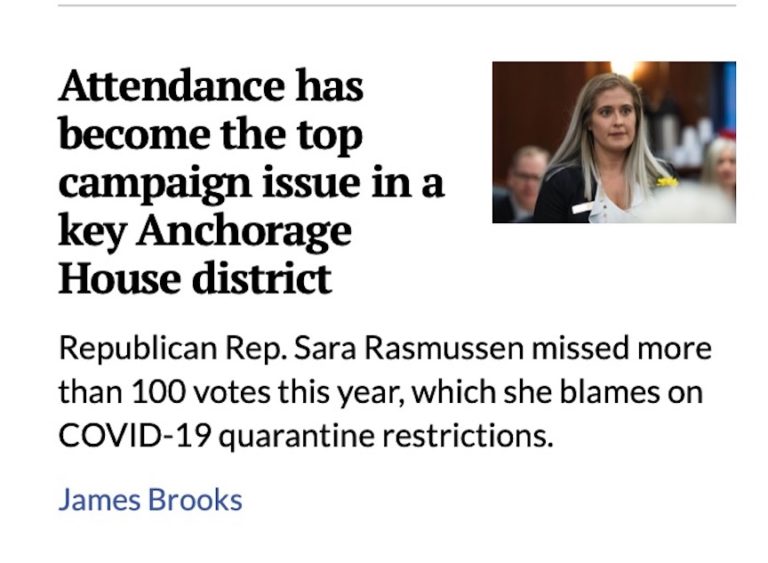
The Anchorage Daily News has decided that “attendance” is going to be the number one issue in the South Anchorage House District 22 race.

In what appears to be an editorial decision to help a liberal challenger to upend conservative Rep. Sara Rasmussen, the newspaper says attendance is the top issue.

Not budgets. Not Permanent Fund dividend. Not crime. It’s attendance during quarantine.

Rasmussen says that COVID-19 rules in place in late March and April prevented her from returning to the Capitol, as she was in quarantine after she had been out of town to attend her great-grandfather’s 100th birthday.

The Legislature set forth rules calling call for quarantine for members if they had been Outside the state, but not for in-state travel. Rasmussen had traveled to Utah.

During March and April, the Capital City and much of the state was in lockdown and the entire state was paralyzed by fear of the coronavirus.

“Juneau was freaking out because a single cruise ship was planning to dock there,” said one Capitol observer. “The fear in the Capitol building was so great, the public was locked out of the building for the first time in Alaska history.”

Rasmussen was caught in limbo — healthy enough to travel, but ordered to stay away.

Stephen Trimble and the groups supporting Trimble say that Rasmussen missed voting on the operating budget.

That’s not true, but this is campaign season, so much gets said.

What’s more unusual is that the daily newspaper in Anchorage has chosen the attack on a rising star in the Republican side of the House by declaring attendance the issue, yet offering no substantive proof other than the opposing camp says it is.

Readers of the ADN have become accustomed to editorializing in news articles. But this?

“It’s non-story. Attendance in a year when students aren’t even going to school? Where is the headline on ADN about Hunter Biden and the investigation into money laundering? Where is the headline story about tens of thousands of dollars being spent by the largest and most powerful unions in the state to mislead votes on behalf of Democrat candidates?” said Tuckerman Babcock, former chairman of the Alaska Republican Party.

The headline on the ADN story might have been “Challenger attacks lawmaker for following Legislature’s rules.” But then, that would be a different newspaper altogether.

Petition: It’s time to open schools before children are further harmed

14

By JODI TAYLOR

Concerned parents are asking that Anchorage School District begin in-class school immediately.  Not only are many schools across the U.S. and the world attending school in person, many of the districts throughout Alaska are now attending in person. 

Sign the petition at this link.

A recent Yale study tracking young children in all 50 states found there to be no difference of infection rate between children who stayed at home and children who went to daily childcare. ASD’s remote learning negatively impacts children (and their families).  For the following reasons, children in Anchorage are best served by attending school in person:

1.      Equal Education Opportunity.   

Low-income, special needs, minority, and foster children are adversely impacted by remote learning.  This is born out in data; nationwide, about 30 percent of Native families and about 20 percent of Black and Latino families do not have access to the internet or have it only through a smartphones, compared with 7 percent of White families and 4 percent of Asian families.  Where remote learning is often plagued with challenges in low-income families, higher income families have additional options for furthering their children’s education. 

Some families have opted to send their children to private schools, utilize private tutors in conjunction with Anchorage School District’s home schooling, hired private teachers, and even temporarily relocated using teleworking to enable grandparents or other family members to oversee their children’s education.  

Not all families can do that. The education gap that already exists in Anchorage is further exacerbated; contrast students with remote schooling for a year (with many students not attending) to those who have been privately tutored. The obvious disparity dictates immediate action.

2.      Emotional, Social and Physical Impacts.

Dr. Danielle Dooley, medical director of Children’s National Hospital and a pediatrician said, “I am really seeing the negative impacts of these school closures on children,” including: mental health problems, hunger, obesity due to inactivity, missing routine medical care and the risk of child abuse — on top of the loss of education.

This is also being seen on a local level.  A local nurse practitioner has seen children who have gained 40 pounds since COVID-19, children coming to the office with imagined worries just to see someone and have an emotional connection, children with severe mental health issues, and this nurse is very concerned about unreported abuse with children not in school. 

This is not just a problem for younger children but is especially prevalent among older students.

3.      Reasonable, Precautionary Measures.

The American Academy of Pediatrics has repeatedly recommended opening schools, and many districts have listened and have been able to fulfill their core mission of teaching students in a safe manner. Some families may deem it best for their family to remain in a remote learning model – perfect, as it’s already available.  ASD’s own survey has shown most families desire, desperately, to have their children back in full-time.  

It’s time for the ASD Board of Education, Assembly, and our Mayor to address that demand.   Let’s get our students back in school and learning.

Jodi Taylor is a mother of five ASD students, an ASD graduate, and believer that education is a great equalizer.

Mayor of Eagle says he does not support Verhagen for D-6

The mayor of Eagle, Alaska says he signed a letter of support for Elijah Verhagen without having considered the candidate more fully and because he was misled about who the incumbent, Rep. Dave Talerico, had endorsed.

Mayor Daniel Helmer is retracting that endorsement and is not endorsing in the District 6 race, whose winner will replace retiring Rep. Dave Talerico. Mike Cronk of Tok is the Republican in the race.

“I am not endorsing a candidate in the district 6 election. Besides being Mayor, I am a public employee, and my job prohibits me from endorsing or denouncing candidates for state or national office.      

“I signed a letter in support of Verhagen last week without fully knowing what was going on. I have since asked him to remove my name from the letter, and to not use my name in support of his campaign,” Helmer wrote to Must Read Alaska.     

“I was led to believe that Elijah was supported by Dave Talerico, and the only reason he was not a Republican, was because he missed the filing deadline to run in the primary,” Helmer explained.

“Signing Elijah’s letter was a mistake on my part. I should have looked into it more closely before agreeing to sign,” he wrote.

The mayor of Anderson has signed a letter endorsing Verhagen, who left the Republican Party and has no political team affiliation. Mayor Samantha Thompson is also a State employee; she is a deputy magistrate II in the court system. Thompson is a liberal who signed the recall petition against Gov. Mike Dunleavy.

John Moller: Lies about Sullivan must be answered with truthfulness

5

Lies and mischaracterization of Sen. Dan Sullivan by Alan Gross have prompted me to write this response.

I worked with Dan while he was Alaska’s Attorney General and while he was commissioner of the Department of Natural Resources.  

I traveled to many villages with Dan while he chaired the Rural Alaska Sub-Cabinet, seeking solutions to the complex and challenging issues faced by many Alaskans residing in rural Alaska — issues like fuel costs, transportation, unemployment, public safety, domestic violence, sexual assault, and many other difficult problems.  

What Dan experienced in these villages he took to heart and acted on.  As an example, Dan was instrumental in spearheading the “Choose Respect” initiative, taking on a dark subject few had the courage or character to tackle.  

I also worked with Dan on many projects. The most memorable was his determination to return Alaska Native allotments that once served as fish and hunting camps to Native families. Alaska Native allotment applications that were stuck in a bureaucratic limbo for decades were resolved under Dan’s watch. 

In our travels together, Dan sat for hours listening to beloved elders like Walter Soboleff and Sidney Huntington, seeking their wisdom and learning from their stories. 

Honesty and respect are core values of Alaska Native people, so for this Native Alaskan, Alan Gross’ lies are shameful and show his true character. 

John Moller is a fisherman who lives in Juneau.

Past due: No action from municipality on recall petition applications

10

Citizens who have a second recall petition request filed with the Municipal Clerk’s Office have received no response — not a yes, not a no.

And it’s now past the 30-day period for a response, as required by municipal charter.

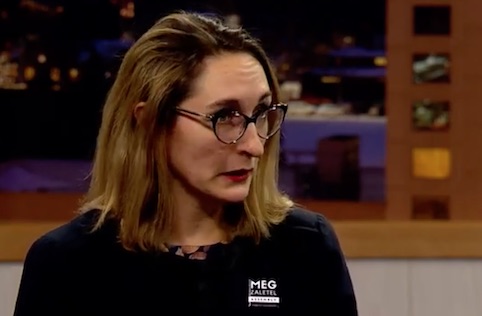
The citizen activists known as “Reclaim Midtown” signed the request for a recall petition; they want to hold an election to remove Assembly members Felix Rivera and Meg Zalatel.

Their first request — for a recall petition to remove Zalatel — was denied by the Municipal Attorney on the last of the 30-day period set forth by the municipal charter. That request denial is now being litigated, said Russell Biggs, one of the citizens.

But in the meantime, the group filed a second set of petitions — to remove Zalatel on additional grounds, and to also recall Assembly Chair Felix Rivera.

After the 30-day period passed on that petition request, Biggs is mystified. He sent a letter to Clerk Barbara Jones to ask for an explanation:

“It appears the municipal clerk’s office has failed to respond to the recall petition applications 2020-04 (Recall of Felix Rivera) and 2020-05 (Recall of Meg Zaletel) within the time frame defined in AS 29.26.360. 

“Both of these petitions were submitted and documented as received by your office on Sept 28, 2020 and are now overdue. 

“I am writing to inquire if this was an oversight, or if the municipality has taken the position that the time limits described in these statutes do not apply to the citizens’ initiative to remove these legislators in the manner provided by law.”

Must Read Alaska has also reached out to the Clerk’s office for a response.

Frank McQueary, president of Alaskans for Opens Meetings, said this is “another example of the Municipality being completely unresponsive to reasonable demands that it conduct the public’s business in a transparent way.”

Meanwhile, the initial recall petition request has been appealed to Anchorage Superior Court. The municipality doesn’t have to respond to the appeal at the court for 45 days, and has not, in fact, responded to the appeal, which was filed Sept. 30.

At least one of these cases will likely move forward via petition or through the courts, but it appears the municipality is slow-walking all of it through the system.

The recall petitions say that Rivera and Zalatel committed misconduct by participating in indoor gatherings of more than 15 people, in violation of the mayor’s emergency orders.

The allegation further says that Zalatel violated Alaska’s open meetings laws by not allowing public testimony inside the Assembly chambers, but then inviting just one person from the public to come inside the chambers to testify, after all others had been excluded.

Zalatel further allowed certain members of the public to remain inside the chambers and did not disclose this exemption to the public, disenfranchising the rest of the public.

That petition was rejected by the Municipal Attorney Kate Vogel.

The second petition to recall Zaletel and Rivera is similarly worded.

Reclaim Midtown is also the group that objects to former Mayor Ethan Berkowitz’ and the Assembly’s plan to purchase two hotels, an old Alaska Club building and Beans Cafe to launch a network of services for Anchorage vagrants and drug addicts. The plan involves the use of CARES Act funds that many in Anchorage believe are being misused.

“Our community effort to remove Meg Zaletel for her role in denying Anchorage citizens the right to participate in the most controversial piece of Assembly legislation in recent memory has been an important example of the methods of government overreach used by the Municipality’s administration to stifle free speech and the right to assemble,” Biggs told Must Read Alaska in September.

“Municipal Attorney Kate Vogel’s flawed legal arguments used to justify the denial has been rejected in no less than three prior Alaska Supreme Court rulings and flies directly in the face of both settled case law and the Alaska Constitution,” he said. “The decision is patently inappropriate and we will now turn to the courts for remedy.”

But at least there was a decision. This round of recall efforts has, so far, been met with stonewalled silence.

Buying friends: Galvin and Gross spent how much to get those ‘likes’ on Facebook?

8

DEMOCRATS’ NOMINEES PAY BIG MONEY TO GET EVERY ‘THUMBS UP’

If you’re an Alaskan voter, Democrat nominees Alyse Galvin and Alan Gross have spent a boatload of money to be your friend on Facebook. With millions of dollars from Outside donors, the two have shoveled it right back to Menlo Park, California to boost ads to your Facebook newsfeed.

And what they want most is a “thumbs up” to indicate you saw it and you like them.

Galvin and Gross are running against Congressman Don Young and Sen. Dan Sullivan.

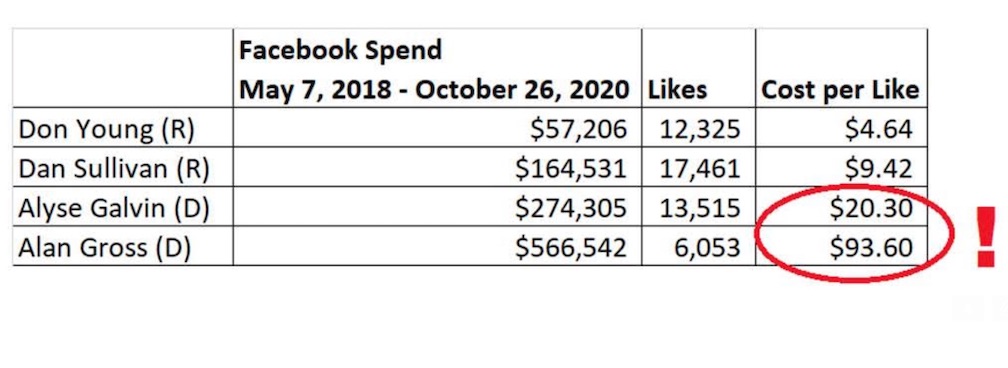
While all candidates use the social media platform to boost their views and persuade voters, Galvin and Gross have deluged their messaging to Alaskans’ Facebook feeds at a spend approaching $850,000. By the end of this week, it will likely top $900,000 for Facebook ads alone.

So far, it’s a cost of $20.30 per “like” for Galvin, and a whopping $93.60 per “like” for Gross.

Congressman Don Young’s campaign has not had to spend as much to get those thumbs up reactions — his cost is only $4.64 per “like.” He has slightly fewer “likes” than Galvin, but is spending far less than her. He’s been in office for decades, but in past years his campaigns haven’t focused as much on Facebook as it has this year.

Gross, who is taking on Sen. Sullivan, has a lot of Outside money burning a hole in his campaign pocket. But although he has spent $93.60 for every “thumbs up” he’s received on Facebook, he has the fewest likes of any of the four candidates — just 6,053 have given him a nod of approval. Maybe it’s because he killed a bear.

Sen. Sullivan has the most “likes” of the four candidates, and has spent one tenth of what Gross has spent on those boosted ads and posts.

Facebook has become a valuable property for candidates during this pandemic-ridden campaign cycle. There’s a lot less door knocking and a lot less baby-kissing going on, as candidates and voters keep their distance from each other.

Facebook is still a relatively new frontier for politics. This week the company put a halt to all new paid ads in the days leading up to and following the election in order to prevent false claims from being promulgated at the last minute. But savvy campaigns had already placed their ads before the Tuesday deadline, and are still running them at a feverish pace.

By the end of Tuesday, Nov. 3, the news feeds of Alaskans will return to something that resembles normal — recipes, vacations, and puppies — as all the political ads vanish into thin air.

More Alaska ‘1488’ Nazi prison gang members charged in killing

18

‘FILTHY FUHRER’ CASE OF KIDNAP, MURDER OF ‘STEAK KNIFE’

More charges have been brought in an indictment against members and associates of a white supremacist prison gang known as the “1488s,” according to U.S. Attorney Bryan Schroder.

The 1488s have been charged as a criminal organization that was involved in narcotics distribution, arson, obstruction of justice, and acts of violence including murder, assault, and kidnap.

Two new defendants were added to the recently unsealed superseding indictment.

Felicia King, 55, of Wasilla, Alaska, was charged with accessory after the fact for her role in the August 2017 beating, kidnapping, and murder of Michael Staton, aka “Steak Knife.”

Justin Eaton, aka “Skulls” 45, of Anchorage, Alaska, who had been previously charged as a felon in possession of a firearm, was charged with RICO (racketeering) conspiracy, kidnapping and assault for his role in April 2, 2017, beating of a former 1488 member.

Original defendants Filthy Fuhrer, (formerly Timothy Lobdell), 42; Roy Naughton, aka “Thumper,” 40; Glen Baldwin, aka “Glen Dog,” 37; Craig King, aka “Oakie,” 53; and Colter O’Dell, 26, were all charged in a RICO Conspiracy.

Fuhrer and Naughton also face additional charges for federal kidnapping, as well as kidnapping and Assault in Aid of Racketeering for incidents occurring in April and July of 2017.

In the original indictment, Fuhrer, Naughton, Baldwin, King, O’Dell, and Beau Cook, 32, were charged with murder in aid of racketeering, kidnapping in aid of racketeering, assault in aid of racketeering, kidnapping, and conspiracy to commit assault and kidnapping in aid of racketeering. 

Two other key members, Nicholas M. Kozorra, aka “Beast,” 29, and Dustin J. Clowers, 34, previously pleaded guilty to murder in aid of racketeering in unsealed court documents. 

Additionally, Cook has now pleaded guilty to kidnapping for his role in the Staton homicide.

According to the superseding indictment, the 1488s are a violent prison-based gang operating inside and outside of state prisons throughout Alaska and elsewhere. 

The 1488s employed Nazi-derived symbols to identify themselves and their affiliation with the gang.  The most coveted tattoo of 1488s members was the 1488s “patch” (an Iron Cross superimposed over a Swastika), which could be worn only by “made” members who generally gained full membership by committing an act of violence on behalf of the gang.

The 1488s members and associates allegedly engaged in illegal activities under the protection of the enterprise, including narcotics trafficking, weapons trafficking, and other illegal activities to promote the influence of the gang. 

The 1488s allegedly had an organizational structure, which is outlined in written “rules” widely distributed to members throughout Alaska and elsewhere. 

Members of the 1488s allegedly acted in different roles in order to further the goals of their organization, including “bosses” who had ultimate authority in all gang matters.

“Key holders” were allegedly responsible for all gang matters within penal facilities where 1488s had a presence, and in “free world” Alaska (outside of prison). 

“Enforcers” were allegedly responsible for enforcing the rules and performing tasks as assigned by higher-ranking gang members. 

“Prospects” for membership were required to familiarize themselves with Nazi-inspired white supremacist ideology.  Violence against law enforcement was also a means of gaining standing within the 1488s.  Female associates of the gang were referred to as “lady-eights”.

In or about 2016 Fuhrer became more aggressive in his efforts to impose disciple within the gang.

Fuhrer believed that members who were defying the 1488 code of conduct were diminishing the power and influence of the gang.  As outlined in the superseding indictment, this culminated in the kidnapping and assault of former members on April 2, 2017, and July 20, 2017, and the kidnapping, assault, and murder of Staton on Aug. 3, 2017.  These acts were ordered by leadership of the 1488s acting from within and from outside of the prison system.

The FBI’s Safe Streets Task Force, and the Alaska State Troopers, Alaska Bureau of Investigation, investigated this case in conjunction with the District of Alaska U.S. Attorney’s Office Organized Crime Division and the Criminal Division’s Organized Crime and Gang Section (OCGS).  Investigative Assistance was provided by IRS Criminal Investigation; the Bureau of Alcohol, Tobacco, Firearms and Explosives; the U.S. Postal Inspection Service, the U.S. Marshals Service, U.S. Immigration and Customs Enforcement’s Homeland Security Investigations, Anchorage Police Department, and the State of Alaska’s Department of Corrections. 

The charges of VICAR murder and kidnapping resulting in death are punishable by mandatory life sentences.

The joint investigation into the 1488 gang began in late 2017. To date, the investigation has yielded 14 additional federal indictments against members and associates of the gang. The charges have included: carjacking, narcotics conspiracy, weapons offenses, and mail theft.

The rock solid case against Ballot Measure 2

5

By JOHN STURGEON

“How are you voting on Ballot Measure 2?” 

It’s a question many Alaskans have yet to answer. You’ve probably heard it has something to do with ranking candidates and putting everyone into one big primary. But despite the millions spent by out-of-state billionaires to prop up Ballot Measure 2, they really haven’t explained much.

There’s a reason for that.

The truth is that the dangers of Ballot Measure 2 – all 25 pages and 74 sections – can’t be conveyed in 15-second soundbite.

What I’m about to tell you will take a few minutes to read, but it’s critical that you know why this initiative would be an unmitigated disaster for our democracy.

In 2016, Maine become the only state in the country to utilize ranked choice voting after 388,273 voters in a state of 1.3 million people approved the measure. What followed was a travesty. The very next election, a moderate congressman named Bruce Poliquin won his election by a margin of 2,632 votes. Unfortunately, the ranked choice computers didn’t agree with Maine’s voters. 

After nearly two weeks of chaos, the algorithms decided voters actually preferred Poliquin’s opponent, Jared Golden. But here’s where it gets crazy. Over 8,000 voters had their ballots thrown out because they didn’t want to rank candidates they didn’t like. Others simply made a mistake when filling out the 25-bubble ballot. This meant Golden was declared the winner with less than 50 percent of the vote. 

Just like that, ranked choice voting’s house of cards came crumbling down. No majority winner, the most attack ads in state history, a moderate candidate kicked out of office, and no reduction in partisanship. In fact, Poliquin called it the “nastiest” race of his career while Maine’s moderate governor deemed it “the most horrific thing in the world.”

Fast forward to 2020 where Susan Collins and Sara Gideon are locked in a drag-out brawl for a Senate seat in Maine. The race has set a new record in Maine for political spending at over $150 million, including $70 million in outside expenditures and $10 million in dark money. Maine’s primary TV market has seen $89 million in spending – more than both Chicago and Dallas. 

Much like war profiteers, political operatives are the only winners as Mainers tear each other apart.

Across the country, it’s more of the same. In 2010, a San Francisco supervisor’s candidate won with 4,321 votes after 9,503 votes were thrown out during 20 rounds of computerized runoffs. To put that in simpler terms, the winner claimed just 21 percent of the votes cast that day in a runoff between two candidates. 

This systemic problem has been politely termed “ballot exhaustion” by ranked choice backers.  Personally, I call it ballot fraud when an American shows up to cast a vote only to have it thrown in the garbage bin. I have a feeling most Alaskans agree.

The results in San Francisco and Maine are not an anomaly. University research shows a whopping 10 to 27 percent of ballots are thrown out in an average ranked choice election. Even California Governor Gavin Newsom, who won election under ranked choice voting in 2007, called criticized its false promise of greater democracy.

Then there’s the “spoiled ballots” – another fancy word for votes that don’t get counted. Remember how “butterfly ballots” cost Al Gore the 2000 presidential election when many voters struggled with a slight change in ballot design? Ranked choice is butterfly ballots on steroids. The victims? Older Alaskans, those in lower socio-economic brackets, and minorities who are not native English speakers. This isn’t theoretical – it’s exactly what university research found in San Francisco.

In Minneapolis, ranked choice voting had a direct impact on spoiled minority ballots while whites were unaffected. San Francisco saw a drop in minority turnout. The Kansas ACLU has claimed an 8 percent drop in turnout can be expected, especially among “new and casual voters.” Another peer-reviewed study found that ranked choice voting fails to achieve a majority winner 61 percent of the time – an incredible statistic that undermines the entire house of cards Ballot Measure 2 is built upon. 

Folks, this is politics at its worst. That’s why ranked choice voting has already been tried and repealed in cities across the country. In Pierce County, Washington, ranked choice voting was kicked to the curb only three years after implementation by an overwhelming 71 percent of voters. Burlington, Vermont’s rejection occurred after a mayor won election with only 29 percent of the first-place votes.

This isn’t about left, right, or middle. It’s about the trail of destruction left behind by ranked choice voting wherever it rears its sinister head.

It’s about the single mom working two jobs who doesn’t have time to research and rank 15 candidates just so that her vote doesn’t get thrown out. It’s about our elders and pioneers who expect to walk into that voting booth and pick their champion the same way they’ve done since statehood. It’s about the veterans who’ve lost friends and innocence fighting for our precious right to self-determination.

Most importantly, it’s about protecting your voice from a misguided experiment that is doomed to fail.

John Sturgeon is chairman of Defend Alaska Elections—Vote No on 2. He previously spent 12 years fighting to reverse federal intrusion on Alaska’s public lands, achieving victory at the U.S. Supreme Court twice.