Republican U.S. Sen. Dan Sullivan took to his Facebook fan page to do some bragging on Monday.
“Congressman Young, Sen. Murkowski and I were just recently rated as being among the top 10 most effective lawmakers in the last Congress,” posted Sullivan.
The swamp group, the Center for Effective Lawmaking, rated Alaska’s delegation in the top 10 percent of all delegations for effectiveness during the 116th Congress, which ended in January.
If Sullivan thought his Facebook fans would be impressed, they were anything but. The reaction was scathing.
“Sullivan is getting sucked into the swamp. Misplaced loyalty to Lisa Murkowski,” wrote Ryan.
“DC must be pleased but your constituents have much angst with you,” posted Ruth.
“You’re speaking with a forked tongue. You cannot support what is healthy and financially sound and at the same time promote Murkowski,” added Nancy.
“We didn’t send you there to win beauty pageants or to get along with others. We sent you there to represent our interests,” wrote Dennis.
“How the hell do you include Murkowski in the same sentence,” posted Tim.
Only a tiny fraction responded positively to Sullivan’s post. Keep in mind, these are Sullivan fans on his fan Facebook page.
Sullivan and his team clearly miscalculated the reaction he would receive from bragging about getting recognized by a swamp group praising he and Murkowski for being swampy.
Sullivan’s post and the reaction to it illustrates perfectly the divide within the Republican Party between the swamp and liberty-loving conservatives.
Anchorage Mayoral candidate Bill Evans is another example of someone who enjoys support from Republican establishment types, but not from conservatives.
Evans’ supporter Rebecca Logan was one of a very few reacting positively to Sullivan’s post.
“Thank you for all that both of you do for Alaska!!!” wrote Logan.
Sullivan has taken a considerable public relations hit recently among conservatives after saying he would support Murkowski if she ran again.
Murkowski is not popular with most Alaska Republicans and is practically loathed among conservatives.
A poll released this week from the highly regarded national polling company, Cygnal, found an astonishing 87% of Alaska Republicans view Murkowski unfavorably.
The poll also shows conservative challenger and Republican Kelly Tshibaka with a double-digit lead over Murkowski despite having very little in name recognition. The sentiment among Republicans seems to be anyone but Lisa.
Now you know why, with the help of Lower 48 Leftist billionaires, Murkowski gave us rank choice voting and did away with Alaska primaries.
It’s tough to win your party’s nomination when 87% of its voters don’t like you.
But Murkowski is also not liked among other Alaskans. 63% view Murkowski unfavorably.
Sullivan displayed real tone-deafness when he recently pledged his support for Murkowski if she runs again. He even described he and Murkowski as a good team.
Sullivan may assume voters will forget his allegiance with the highly unpopular Murkowski more than five years from now when he’s up for reelection.
Chances are Murkowski, with her dismal approval ratings, will be a long forgotten political figure when Sullivan faces reelection.
But voters should remember Sullivan stood with and supported Murkowski despite her being chief antagonist and agitator to President Donald Trump.
Her unflinching, consistent, and passionate support of Planned Parenthood and abortion should disqualify her for support from any pro-life conservative. Never mind the fact she singlehandedly saved Obamacare giving the need for more abortion funding as a reason.
If Sullivan has a conservative opponent five years from now, you can bet they will remind us all of his betrayal of the conservative movement by supporting the embodiment of a swamp creature, Lisa Murkowski.
Dan Fagan hosts the number one rated morning drive talk radio show on Newsradio 650 KENI.
Kelly Tshibaka, who is running against Sen. Lisa Murkowski, has a high approval rating in polling data released by Cygnal, a national polling company.
Tshibaka, who announced her candidacy one week ago, leads Murkowski with 33.6 percent, to Murkowski’s 18.8 percent. If Democrat Al Gross decides to run for the seat, he has about the same chance as Murkowski — 17.6 percent, according to Cygnal. Alaska Independence Party’s John Howe polls at 5.7 percent. That leaves 21.1 percent of voters undecided.
The data was gathered through a live calls, text messages and emails of 500 likely primary voters in Alaska, conducted in late March. It targeted all political parties in recognition of the new jungle primary that Ballot Measure 2 created in Alaska, after voters passed it in November.The margin of error is calculated at 4.37% at a 95% confidence interval.
“Kelly Tshibaka leads from the outset in a hypothetical primary ballot for US Senate, before any message testing,” Cygnal summarized. “Tshibaka’s ballot score peaks among Trump voters (61%), Republicans (61%), and conservatives (59%). Lisa Murkowski is in as weak of a position as an incumbent could possibly find themselves in. A strong Republican candidate is poised to defeat Murkowski. Kelly Tshibaka is that candidate.”
The polling data was first released to Politico, a Washington, D.C.-based political publication.
The survey found that voters disapprove of Murkowski’s nearly 20 years in the Senate. They disapprove of her vote to allow millions of illegal immigrants to stay in the country. Republicans disapprove of Murkowski for her vote to convict Trump in the impeachment trial, and the way she handled the confirmation of Justice Brett Kavanaugh to the U.S. Supreme Court (she voted “present” rather than yes or no.) Murkowski also voted against the repeal of the Affordable Care Act.
Cygnal describes itself as a national public opinion firm that pioneered multi-mode polling, peer-to-peer text collection, and “Political Emotive Analysis.” Cygnal was in 2018 named the #1 Republican private pollster by Nate Silver’s FiveThirtyEight, as well as the #1 most accurate polling and research firm in the country for 2018 by The New York Times. Its team has experience working in 47 states and countries on more than 1,500 corporate, public affairs, and political campaigns.
Cygnal did not reveal who its client was for the poll, but Tshibaka, who was recently a member of the Gov. Mike Dunleavy cabinet, has hired President Donald Trump’s campaign team, led by former Trump campaign manager Bill Stepien, deputy campaign manager Justin Clark, and battleground states director Nick Trainer. Her rapid rise to the national stage has caught the attention of Trump’s former campaign manager, Brad Pascale, who broadcast her announcement on Twitter.
I want to share my correspondence from various people around the world who expressed their feelings, voices and beliefs about the concept of “white privilege” and “systemic racism” in our country. I blocked names, residence and place of origin of these individuals in order to protect their privacy; and I also obtained their permission to publish these views and opinions:
From Juneau, Alaska—Thank you for your My Turn columns. I have a similar background to yours; I too am an immigrant. I was born in …, my family faced very similar struggles. We love this country and any of our successes are not a product of “white privilege,” but of hard work and dedication. We faced discrimination because we were foreign, but we overcame it and are not bitter against anyone. I agree the term “white privilege” is by definition racist. It’s really frightening that this fact is not patently obvious. But I am afraid these individuals are driven by pure activism—the “useful idiots.”
It’s also frightening that freedom of speech is under attack. It is fundamental that we protect freedom of speech, specially of those we disagree with. Otherwise, how can we ensure it be there for all? Like you, I escaped communism/socialism—first from… then from…. Never in my wildest dreams would I have imagined we would be facing suppression of freedom in this country. Take the Goya boycott, for example. And all the nonsense with “white privilege” that you have so eloquently addressed. It is incredible that the people promoting “white privilege” rhetoric don’t see how it is the very definition of racism.
What I find interesting is that the “white privilege” rhetoric is promoted largely by the “useful idiot” activists and economically disadvantaged people of color in the inner cities. I haven’t seen the average black professional or executive promulgating these ideas. And I don’t count the Hollywood types or professional athletes in the mix. There are many very successful individuals in the black community who don’t subscribe to the BLM ideals, and don’t believe they have been disadvantaged because of the color of their skin. I believe the disadvantage faced by people in the inner cities is the result decades of failure in leadership by their elected officials, most of who are liberal politicians.
From Bend, Oregon—The “useful idiots.” It is especially ironic that so many, if not most, of these idiots are highly educated people. I guess it just demonstrates how political ideology, especially combined with mass media propaganda, can so easily brainwash people, who actually participate in the brainwashing willingly. What we are seeing in this country is really amazing; but it’s also very frightening and very discouraging.
From Ottawa, Canada—Interesting discussion. I have often felt “grouped“ into categories like “female,” “white,” “privileged,“ “second generation immigrant,“ “invisible minority,” “feminist,” and “Jewish,“ as if they were mutually exclusive; as if I must belong to one and drink the Kool-Aid. As if “black lives matter,” one must not say “all lives matter.” If you’re a feminist you can’t also be a Zionist. If you’re white you can’t feel racial discrimination because of white skin. None of this is how I see the world.
My reality is not a package of beliefs imposed on me but rather it is exclusive to me and composed of many Complicated threads. I feel erased when skin color is made a dividing line. This is what I understand is “cancel culture” or “utopian socialism” as you call it. Aware that blacks and indigenous feel erased, but where do pogroms that sent our grandparents out of Russia fit into this?
Sasha [Alexander] I’d love to hear your view of what life was like for our forefathers who chose to leave and for those who chose to stay in Russia.
From Haines, Alaska—It’s really pretty amazing to me how so many, if not most, of the Jews in your synagogue have bought into the white privilege guilt trip, especially considering the history of the Jewish people and their intelligence. All I can figure is that it must involve having their identity wrapped up in the notion of being a “liberal progressive” (what a misnomer!) and a Democrat; and then simply following along with what they think that group believes and does. It must be part of a basic need to belong to a group, because any truly independent thinker must see the hypocrisy in their racism, the nonsense in their thinking, and the intolerance in their judgement of any ideas that differ from those of their group. Ironically, I’m sure that virtually all those people you know and who have responded to you, too, are truly well-intentioned people trying to be good citizens and members of their communities. But I think this “white privilege” b.s. is a logical outgrowth of the whole idea of “affirmative action,” which is another blatantly racist behavior that we have been living under ever since the 1960s. Affirmative action, based on the idea that reverse racism is the best way to make up for the sins of past racism, has been enshrined into our legal system by all 3 branches of government and has become accepted by all but a “right wing” conservative minority as totally OK and normal in this country. I think “white privilege” is a relatively small step from affirmative action; “reparations” will be next and coming soon. Personally, I’ve never been able to swallow affirmative action—I’ve always seen it as pure racism, directed at whites (especially white males), and totally unfair and against the ideals of the U.S. constitution. I’ve lived with its effects, especially in the federal government, my entire working life, and I believe it actually does an injustice to even those it supposedly serves. But anyway, I think this b.s. about “white privilege” and “cancel culture” and all the other identity politics that Democrat party leaders have believed serves their interests so well must be reaching a crescendo by now, and hopefully it’s finally going to become too much for the majority of Americans to swallow. At least, I hope so. But then I’ve been hoping that the Supreme Court would rule against affirmative action my whole adult life, and that sure hasn’t happened.
From Anchorage, Alaska—This is just a short note to say thank you for your letter to the editor today [Anchorage Daily News of July 16th]. It was an overdue statement to our community at large and I appreciate it. For that matter, I appreciate you.
As the son of a Norwegian immigrant, I can only say that the hard work for success you describe parallels the path of my grandfather and even my father as they struggled to make a living and to learn the language. Even though the whole family spoke Norwegian my grandparents insisted that the family speak English in the home to try to learn the language of their new country.
You can be rightfully proud of all you accomplished with your honest efforts towards success. You and I don’t know each other at all but may I say, “Well done!”
To summarize the above correspondence, people who focus on skin color alone are focusing on a very visually obvious factor but are ignoring the more important factor of intelligence, which is far more likely to have a causal relation than is skin color alone.
Indeed, the privilege many hard-working people have enjoyed in our country is because they applied themselves diligently regardless of their color, ethnicity or race. Today in America, opportunity is available to nearly everyone. Maybe not so true decades ago but certainly true in the U.S. today. But not according to some people who either want hand-outs for free or to provide hand-outs for free. None of them capable of understanding that personal success and accomplishments are much more rewarding than charity.
Alexander B. Dolitsky was born and raised in Kiev in the former Soviet Union. He received an M.A. in history from Kiev Pedagogical Institute, Ukraine, in 1977; an M.A. in anthropology and archaeology from Brown University in 1983; and was enroled in the Ph.D. program in Anthropology at Bryn Mawr College from 1983 to 1985, where he was also a lecturer in the Russian Center. In the U.S.S.R., he was a social studies teacher for three years, and an archaeologist for five years for the Ukranian Academy of Sciences. In 1978, he settled in the United States. Dolitsky visited Alaska for the first time in 1981, while conducting field research for graduate school at Brown. He lived first in Sitka in 1985 and then settled in Juneau in 1986. From 1985 to 1987, he was a U.S. Forest Service archaeologist and social scientist. He was an Adjunct Assistant Professor of Russian Studies at the University of Alaska Southeast from 1985 to 1999; Social Studies Instructor at the Alyeska Central School, Alaska Department of Education from 1988 to 2006; and has been the Director of the Alaska-Siberia Research Center (see www.aksrc.homestead.com) from 1990 to present. He has conducted about 30 field studies in various areas of the former Soviet Union (including Siberia), Central Asia, South America, Eastern Europe and the United States (including Alaska). Dolitsky has been a lecturer on the World Discoverer, Spirit of Oceanus, andClipper Odyssey vessels in the Arctic and sub-Arctic regions. He was the Project Manager for the WWII Alaska-Siberia Lend Lease Memorial, which was erected in Fairbanks in 2006. He has published extensively in the fields of anthropology, history, archaeology, and ethnography. His more recent publications include Fairy Tales and Myths of the Bering Strait Chukchi, Ancient Tales of Kamchatka; Tales and Legends of the Yupik Eskimos of Siberia; Old Russia in Modern America: Russian Old Believers in Alaska; Allies in Wartime: The Alaska-Siberia Airway During WWII; Spirit of the Siberian Tiger: Folktales of the Russian Far East; Living Wisdom of the Far North: Tales and Legends from Chukotka and Alaska; Pipeline to Russia; The Alaska-Siberia Air Route in WWII; and Old Russia in Modern America: Living Traditions of the Russian Old Believers; Ancient Tales of Chukotka, and Ancient Tales of Kamchatka.
On April 6, the Anchorage School Board will have its first formal readingof the new anti-racism and instructional equity policies.
This is the Critical Race Theory approach the school board is seeking to adopt, although the proponents are not calling it that.
The board is planning to put in place an overarching policy that will spin off administrative policies supporting the teaching that white people are inherently racist and the current curriculum itself is racist.
“The Board rejects all forms of racism. The Board acknowledges that racism has historically existed in our educational systems and is often compounded by other forms of discrimination including those protective classes referenced in BP 0410, Nondiscrimination,” the policy reads.
It says the work involves, “identifying, challenging, and changing the values, structures, and behaviors that perpetuate systemic racism, racial hatred, bias, and the oppression of marginalized groups,” and says the school district will work to end “the predictive value of race on students’ academic success and access to educational opportunities.”
In this approach, supported by the district’s own radical reading list, people are criticized for “thinking white,” and for teaching a curriculum from a Euro-centric perspective. Those promoting Critical Race Theory see the dominance of European literature, history, or math, reflects a curriculum that caters to white students.
As for overhauling the curriculum, “This is done on a cycle that we review, adopt, and we assess curriculum,” said Deena Bishop, the superintendent of schools.
“We’re going to look and the policies that the board passes and then we’ll take a step back and look [at how] we establish our administrative regulations. We’re going to see where are the places where we are meeting this policy that the board passes, and where we are not. And certainly if there are changes that need to be met, we would bring those to our curriculum team … There’s a formal process for curriculum to be able to be taught in school,” Bishop said.
The public would be included in the discussion, Bishop said.
According to the draft policy, the school board and superintendent will identify and redesign any racially inequitable policies and procedures that “limit academic opportunities.”
“Instruction should encourage critical thinking on the history of racism in Alaska, America, and around the world and the current structural, explicit, and unconscious biases toward people of different races,” the policy reads, making it nearly certain that this is a promotion of Critical Race Theory.
Two town halls last week held on the topics were well well attended via teleconference on Zoom. The public weighed in on both sides of the aisle.
“As the parent of mixed race kids I find the use of positive racial discrimination and institutionalizing oppressor / victim narratives horrifying,” said one parent. “Instructional Equity Policy or as it is known politically, Critical Race Theory, is an extension of political Critical Theory. What is it doing in our classrooms?”
He continued: “Critical Theory aims to set up permanent group conflict and it is working. How do we know? Because there is more inter-group attacks and divisiveness now than there ever has been. How do we know it is authoritarian and anti-Democratic? Because good and decent people have become too afraid to speak out against it. Have you noticed that the people who bring us the new ‘tolerance and inclusion’ also, strangely, happen to be the same people bullying, intimidating and terrorizing people who don’t agree with them? This is done a number of ways. If not outright physically attacked, the new tolerance and inclusion crowd seek to have people removed from their jobs, online platforms and otherwise discredited and canceled in all aspects of civil life simply for the crime of disagreeing with them. It does not sound inclusive or tolerant.”
His comments were echoed by dozens of others who spoke.
But a few disagreed:
“I am in strong support of this policy. We absolutely have a need for this. Our district is rife with racism –and anti-semitism and anti-muslim sentiment. This is not OK and creates a very unsafe environment for many students,” commented a parent.
Let’s take a look at this “free” money from the stimulus plan. The $1.9 Trillion American Rescue Plan is touted as what the American people want by both Democrats and Republicans. because the government is handing out “free” cash.
You have to ask: “How free is that cash?”
So far, the feds have spent $4 trillion on pandemic relief and rescue. There are 330,000,000 souls in the United states so that figures out to about $12,100 per capita. For those of you who received the $2,000 of “free” cash, it only cost you $12,100. Those of you who didn’t qualify for the stimulus money, well you still owe the $12,100.
Sorry about that.
Next, we need to think about where the government gets this money. It gets it from you either directly (income taxes) or indirectly by taxing businesses. Remember, when the government taxes Home Depot and Safeway, those companies pass the cost on, so you pay more for a pair of pliers or a can of beans.
Another nifty little fact is that when government extracts money from the private sector, it takes money from productive endeavors that produce wealth and puts it in the hands of politicians who don’t. In this case we have the feds handing out “free” money, financing pet projects, bailing out local and state governments, foreign aid, and lots of other “needs” that don’t produce anything but debt. This money has to be paid back and it is we, the private sector, who will have to come up with it. Government skims money we could have used to produce goods and services thereby creating more wealth.
When the central government extracts more and more money from the private sector, the economy contracts and wealth creation slows. History shows us that this scenario eventually results in economic collapse. Look at Cuba, the Soviet Union, China before 1990, and Venezuela. They embraced this economic model to their detriment.
Would the American people really want this stimulus plan if they knew what is really cost them? I think any loan shark would loan you $2,000 if you signed a note for $12,100. It would probably be a better deal in the long run.
It is time for our politicians to stop telling us what we want to hear and start acting in the best interests of the American people instead of paying for government boondoggles such as handing out “free” money. They should be doing what they can to encourage economic growth through support of the private sector. Create a more friendly regulatory environment, lower taxes, and just get out of the way.
If someone has a good paying job, he or she doesn’t need a stimulus check. The politicians need to quit trying to rescue us with our own money. You can earn a lot more votes by creating private sector jobs than by trying to deceive people into thinking you rescued them when, in fact, you are making their situation worse.
They say there is no such thing as a free lunch. Well, there is also no such thing as free government money.
Do you want to make a difference? Do you believe America is becoming a socialist nation complicit with support from big corporations pandering to the woke?
I, for one, am tired of big corporations making political statements that kowtow to the Left. Really, I don’t care about the political viewpoints of big corporations’ leadership. I buy products because of what they provide in the marketplace. I don’t want these big corporation muckity mucks trying to tell me what I should believe about our nation’s politics.
Maybe it’s time to take a stand against corporate big-wigs who think their intellectual brilliance provides them the superior moral ground to preach to us about politics. They need to shut up and simply provide the best product that makes me want to buy their merchandise or service.
This recent flashpoint about the Georgia legislature changing the voting requirements to become similar to 37 other states, which ensures voter integrity and reduces the potential for voter fraud, is an excellent example of corporate America’s arrogance and lack of understanding about the American form of government.
I’m disgusted by big companies like Coca Cola, Delta Airlines, and Major League Baseball, worth billions of deciding it’s a good financial strategy for their investors’ bottom line to have leadership speak out against American democratic voting integrity.
Apparently they believe our election system does not need to verify that voters in American elections are legitimately qualified. These companies, and others, have decided their superior position as multi-million dollar corporations gives them the moral right to determine what should be allowed and not allowed in our democratic government process.
Take for example the recent irresponsible statement from Delta Airlines CEO Ed Bastian: “Last week, the Georgia legislature passed a sweeping voting reform act that could make it harder for many Georgians, particularly those in our Black and Brown communities, to exercise their right to vote.” How so?
The new Georgia voter law does no such thing. Let’s be clear what it requires:
It increases the time for early voting in both primaries and general election.
State and local governments are now prohibited from sending out unsolicited absentee ballot applications.
Each county must now have at least one election ballot drop box.
It restructures the Georgia Election Board to provide more state control in the election process, as was intended by the United States Constitution.
It eliminates the signature-matching system used to use to check the identities of absentee voters. Instead, voters will have to provide their Georgia driver’s license number, the number on their state identification card, or the last four digits of their Social Security number, just like we do in Alaska. If they don’t have any of those, they can provide one of several alternative forms of identification, such as a copy of a utility bill, bank statement or government check.
So, let me ask Bastian, are you going to terminate service to all cities within the 34 states that already require voter ID? Of course not. You desperately want the revenues generated by a majority of Americans who live in these “fly-over” states that have voter ID requirements. You really just want our money! Careful now Ed, we may actually be paying attention to your woke political cheap shot. There are alternatives like United or American.
How about identification to get on your flights? Every time I fly on Delta, I must show an ID before I am issued a boarding pass. Are you going to eliminate the mandatory ID requirement when flying on Delta Airlines? Don’t give me the hollow excuse that it is a federal requirement; Delta has historically been at the forefront of lobbying Congress to require IDs when flying.
What about requiring Americans to have a passport when returning to our home? We haven’t heard Bastian preaching about the millions of illegal immigrants entering the US without passports. If they can enter without passports, why can’t I?
How about vaccination passports? Bastian has been quoted as saying he supports vaccination passports for international travel. Won’t that require some form of ID to confirm the person holding the vaccination passport is actually the traveler?
Since Bastian has such a high moral standard, I am confident Delta will be terminating all service to China. My mistake: Flying to China is a lucrative market, so Delta would never apply any political pressure on the Chinese Communists to change their policies. He has no problem with Uyghur concentration camps that have forced labor, organ harvesting, forced sterilization and abortions, etc. I guess human rights really aren’t as important to Bastian as Georgia’s voter ID laws.
Bastian is really nothing more than a pandering, hypocritical corporate suit trying to gain short term political advantage by riding the shirttails of a Leftist campaign to eliminate voter integrity in America.
Now just to be fair, Delta Airlines is pleased to accept an annual multi-million dollar fuel tax credit from the Georgia legislature and to receive millions in CARES Act funding from DC. So it’s obvious its corporation heads understand the value government provides to their corporate bottom line, so long as said government meets the moral criterion established by Bastian, except for China, of course.
I generally do not support boycotts, and don’t believe there should be one against Delta, despite their CEO’s blathering pontificating. Alaskans have always had nice alternatives to Delta Airlines. Whether it is Alaska Airlines, United Airlines, American Airlines summer service, or any of the other seasonal carriers, Alaskans have choices.
Alaska Airlines has joined the international airline Oneworld Alliance. They now have more service to places that Delta also services, like nonstop flights to Seattle, Minneapolis, Los Angeles, San Francisco, Las Vegas, and Phoenix. With the Oneworld Alliance, Alaska also has connection service to a tremendous number of domestic and international destinations.
Mark Twain once wrote, “It is better to keep your mouth closed and let people think you are a fool than to open it and remove all doubt.” If you want Ed Bastian to know how Alaskans feel about his stupid statement against the Georgia voter ID law, simply fly Alaska Airlines.
Craig E. Campbell served on the Anchorage Assembly between 1986 and 1995 and later as Alaska’s Tenth Lieutenant Governor. He was the previous Chief Executive Officer and President for Alaska Aerospace Corporation. He retired from the Alaska National Guard as Lieutenant General (AKNG) and holds the concurrent retired Federal rank of Major General (USAF).
The idea, apparently, is to find a way to replace our constitutional republic with an autocratic form of government that allows el presidente to order this and that without their quickly running into the court process.
The targets? So-called “ghost guns,” imported firearms, guns made on 3D printers, When you a Congress that is, at least, partially responsive to an angry public, doing end-runs to push anti-gun groups’ agenda, must look appealing to Biden and his minions. That is for now. What will make the “bad gun” list in the future is anybody’s guess.
We should be afraid of what this means for our constitutional republic. Afraid, indeed.
Wishing you a meaningful Easter Sunday. May you stay safe and walk on holy ground today and every day.
John 20:11 Mary was standing outside the tomb crying, and as she wept, she stooped and looked in. 12 She saw two white-robed angels, one sitting at the head and the other at the foot of the place where the body of Jesus had been lying. 13 “Dear woman, why are you crying?” the angels asked her.
“Because they have taken away my Lord,” she replied, “and I don’t know where they have put him.”
14 She turned to leave and saw someone standing there. It was Jesus, but she didn’t recognize him. 15 “Dear woman, why are you crying?” Jesus asked her. “Who are you looking for?”
She thought he was the gardener. “Sir,” she said, “if you have taken him away, tell me where you have put him, and I will go and get him.”
16 “Mary!” Jesus said.
She turned to him and cried out, “Rabboni!” (which is Hebrew for “Teacher”).
17 “Don’t cling to me,” Jesus said, “for I haven’t yet ascended to the Father. But go find my brothers and tell them, ‘I am ascending to my Father and your Father, to my God and your God.’”
18 Mary Magdalene found the disciples and told them, “I have seen the Lord!” Then she gave them his message.
19 That Sunday evening the disciples were meeting behind locked doors because they were afraid of the Jewish leaders. Suddenly, Jesus was standing there among them! “Peace be with you,” he said. 20 As he spoke, he showed them the wounds in his hands and his side. They were filled with joy when they saw the Lord! 21 Again he said, “Peace be with you. As the Father has sent me, so I am sending you.” 22 Then he breathed on them and said, “Receive the Holy Spirit. 23 If you forgive anyone’s sins, they are forgiven. If you do not forgive them, they are not forgiven.”
24 One of the twelve disciples, Thomas (nicknamed the Twin), was not with the others when Jesus came. 25 They told him, “We have seen the Lord!”
But he replied, “I won’t believe it unless I see the nail wounds in his hands, put my fingers into them, and place my hand into the wound in his side.”
26 Eight days later the disciples were together again, and this time Thomas was with them. The doors were locked; but suddenly, as before, Jesus was standing among them. “Peace be with you,” he said. 27 Then he said to Thomas, “Put your finger here, and look at my hands. Put your hand into the wound in my side. Don’t be faithless any longer. Believe!”
28 “My Lord and my God!” Thomas exclaimed.
29 Then Jesus told him, “You believe because you have seen me. Blessed are those who believe without seeing me.”
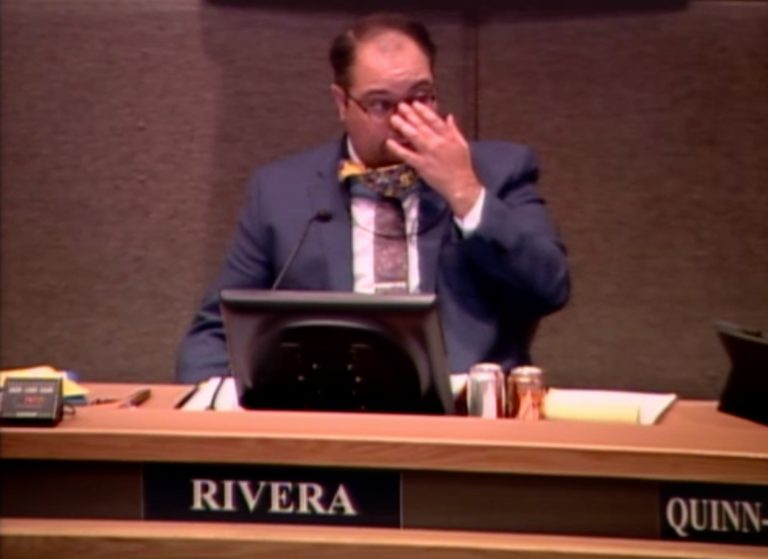
The low voter turnout so far in the Anchorage municipal race may have an effect on the attempt to recall Assemblyman Felix Rivera. So far, only 700 of the 2,700 people who signed the Recall Rivera petition have voted, and the group trying to recall the far-left assemblyman are up against a massive union-fueled campaign to save that seat for the candidate they’ve supported for the past four years.
The AFL-CIO has flooded the airwaves of television and radio with ads extolling the virtues of Rivera, who came onto the Assembly after serving as an aide to former Mayor Ethan Berkowitz, who resigned in disgrace after a sexting scandal. The AFL-CIO’s group is called Putting Alaskans First and it has spent $30,000 so far to pluck Rivera out of the frying pan. The group also backed him a year ago when he ran for re-election.
“Felix Rivera has led the Anchorage Assembly through the pandemic and is getting our city back on track!” the group states in its literature, a message almost identical to that offered by mayoral candidate and Assemblyman Forrest Dunbar. The union calls opponents of Rivera “bullies” on its Felix Rivera website.
“Ever since he was elected to the Anchorage Assembly, Felix has fought for a more prosperous city,” the AFL-CIO wrote.
Rivera led the effort to illegally spend Federal Covid CARES Act funds to buy and renovate the Golden Lion Hotel and other buildings, using a shell game to move money from fund to fund, according to the group trying to recall him. Last summer he said he would not support any use of the CARES Act funds for businesses unless there was an equity factor to favor minorities.
But in municipal races the most reliable voter has been the union-enrolled public employee, a voter type who can almost always be relied on to cast a ballot for big government.
The Recall Rivera campaign has sent out three mailings and has a few door knockers in the neighborhoods where voters have the recall question on their ballots.