Friday, June 5, 2026
Home Blog Page 1083

Alaska life hack: Canada to allow Americans through border starting Aug. 9

22

For nearly 16 months, Americans have not been able to cross the border into Canada, except for “essential travel” circumstances, and with very strict conditions for travel.

But beginning August 9, fully vaccinated Americans as well as permanent residents who live in the U.S. will be able to get through the border.

Canada closed its borders to all but essential travel from the U.S. in March of 2020, in order to slow the spread of the Covid-19 virus.

Travelers from other nations may also be allowed to enter Canada beginning Sept. 7, provided the “COVID-19 epidemiology remains favorable,” according to the Canadian government.

Deep dive into details of the opening of Canada:

Starting Aug. 9, Canada plans to begin allowing entry to American citizens and permanent residents, who are currently residing in the United States, and have been fully vaccinated at least 14 days prior to entering Canada for non-essential travel.

Subject to limited exceptions, all travellers must use ArriveCAN (app or web portal) to submit their travel information. If they are eligible to enter and meet specific criteria, fully vaccinated travelers will not have to quarantine upon arrival in Canada.

Transport Canada is expanding the scope of the existing Notice to Airmen that currently directs scheduled international commercial passenger flights into just four Canadian Airports: Montréal-Trudeau International Airport, Toronto Pearson International Airport, Calgary International Airport, and Vancouver International Airport.

Effective Aug. 9, international flights carrying passengers will be permitted to land at the following five additional Canadian airports:

  • Halifax Stanfield International Airport;
  • Québec City Jean Lesage International Airport;
  • Ottawa Macdonald–Cartier International Airport;
  • Winnipeg James Armstrong Richardson International Airport; and
  • Edmonton International Airport.

All travelers, regardless of vaccination status, will still require a pre-entry Covid-19 molecular test result. However effective Aug. 9, the Government of Canada is adjusting its post-arrival testing strategy for fully vaccinated travelers. Using a new border testing surveillance program at airports and land border crossings, fully vaccinated travelers will not need a post-arrival test unless they have been randomly selected to complete a Day 1 Covid-19 molecular test. There are no changes to the mandatory testing requirements for unvaccinated travelers.

“This strategy allows the Government of Canada to continue monitoring variants of concern in Canada and vaccine effectiveness. Using these layers of protection, the Government of Canada can monitor the COVID-19 situation in Canada, respond quickly to threats, and guide decisions on restricting international travel,” the government said.

The three-night government authorized hotel stay requirement will be eliminated for all travelers arriving by air as of 12:01 am EDT on Aug. 9. Fully vaccinated travelers who meet the requirements will be exempt from quarantine.

However, all travelers must still provide a quarantine plan and be prepared to quarantine, in case it is determined at the border that they do not meet the necessary requirements.

“While Canada continues to trend in the right direction, the epidemiological situation and vaccination coverage is not the same around the world. The Government of Canada continues to advise Canadians to avoid non-essential travel outside of Canada – international travel increases your risk of exposure to COVID-19 and its variants, as well as of spreading it to others. Border measures also remain subject to change as the epidemiological situation evolves. As Canada looks to welcome fully vaccinated travelers from the U.S., the federal government will continue to monitor the situation and provide updated travel advice to Canadians,” the Canadian government said.

Conspiracy polling: 20 percent of Americans think the Covid-19 vaccine comes with micro chip

27

A full 20 percent of Americans believe it’s likely the U.S. government is using the Covid-19 vaccine to microchip the population, according to a YouGov/Economist survey of 1,500 respondents. The poll showed that 65 percent of respondents said that the scenario is probably or definitely false, and 14 percent were unsure.

Broken down by political leanings, 8 percent of Biden voters believe it, while 29 percent of those who voted for Donald Trump believe somewhat or definitely in the microchip theory.

When asked whether the Covid-19 virus threat was exaggerated for political reasons, Biden voters overwhelmingly said it likely was not. 82 percent said it was probably not or definitely not exaggerated, while 13 percent said it was likely or definitely exaggerated.

Trump voters took a different view: 76 percent said the threat was probably or definitely exaggerated, and only 17 percent said it probably or definitely was not exaggerated.

That same poll found that liberals are quite familiar with the QAnon phenomenon. In the poll, 23 percent of respondents overall had heard a lot about QAnon, 43 percent had heard a little, and 34 percent were unfamiliar with the concept.

Liberals were much more familiar with QAnon, possibly because of the fixation of mainstream media on QAnon trends. 40 percent of Biden voters were very familiar with QAnon, 42 percent were somewhat familiar, and 18 percent were not familiar.

For conservatives, 15 percent of Trump voters were very familiar with the QAnon trend, 52 percent were a little familiar, but 33 percent had not heard of it.

QAnon is a message board on the internet that is described by Wikipedia as a discredited far-right conspiracy theory alleging that a cabal of Satan worshipers and pedophile/cannibals run a global sex trafficking ring and conspired against President Donald Trump. The mainstream media used the online message board as a boogeyman during the 2020 election cycle. No one knows how many people pay attention to the various QAnon theories that are occasionally spun.

Associated Press describes it: “Loosely tying these movements together is a general distrust of a powerful, often leftist elite. Among them are purveyors of anti-vaccine falsehoods, adherents of Trump’s “Big Lie” that the 2020 presidential election was stolen and believers in just about any other worldview convinced that a shadowy cabal secretly controls things.”

Taking the QAnon question further, 88 percent of Biden voters had a negative opinion of the QAnon trend, while only 46 percent of Trump voters held a negative position on the matter.

73 percent of Biden voters didn’t know anyone who adheres to QAnon, but 14 percent of Biden voters know someone who does believe QAnon. 78 percent of Trump voters didn’t know anyone associated with QAnon, and only 8 percent said they know someone who is.

When asked the question if they believe millions of illegal votes were cast in the 2020 general election, 90 percent of Biden voters said probably or definitely not, while 83 percent of Trump voters said probably or definitely yes.

YouGov describes itself as an international research data and analytics group.

Read the entire YouGov/Economist poll results at this link.

Breaking: Kendall, Lindemuth, and AFN sue over Power Cost Equalization Fund transfer

The Alaska Federation of Natives, using Recall Dunleavy attorneys Scott Kendall and Jahna Lindemuth, have sued the Dunleavy Administration over the status of the Power Cost Equalization Fund, which provides financial relief to rural communities to help with high cost of power.

Kendall and Lindemuth worked for the administration of Gov. Bill Walker; Kendall was his chief of staff and Lindemuth was Attorney General. They have collaborated to oppose the Dunleavy Administration in court at several turns during the past three years after they were removed from office by voters. Kendall, who was Lisa Murkowski’s campaign manager and who generally attacks Republicans, is especially active in trying to get a recall of Dunleavy on the ballot, an effort that has apparently lost steam.

The lawsuit challenges the governor’s decision to transfer more than $1 billion in the Power Cost Equalization Endowment Fund, a fund located in the Alaska Energy Authority, to the Constitutional Budget Reserve. The lawyers say this sweep violates the Alaska Constitution and upsets the Legislature’s power of appropriation.

“I have authorized my administration to pursue an expedited judgement on the future of the Power Cost Equalization Endowment Fund,” said Gov. Mike Dunleavy. “This issue is too important to delay any further. A decision by the court will help clarify what is in the General Fund and what is not to determine what gets swept into the Constitutional Budget Reserve to repay it. In order for us to fulfill our constitutional duties, both the executive and legislative branches need to know if the PCE is subject to the sweep.”

Dunleavy has proposed protecting the Alaska Permanent Fund, the Permanent Fund Dividend, and Power Cost Equalization in the Alaska Constitution through his Constitutional Amendments, SJR 6 and HJR 7. The next opportunity for the legislature to meet is on Aug. 2, in a special session called by the governor.

This story will be updated. Check back.

Judicial poppycock

By ANCHORAGE DAILY PLANET

Here is some bad news for elected office-holders in Alaska who thought they could be recalled only for serious infractions. It turns out, they can be recalled on simply a whim, or a policy disagreement, a philosophical difference or, well, just because. Alaska now has “standardless” recalls.

Most of the Alaska Supreme Court says so.

The court upheld a Superior Court ruling that allowed the Recall Dunleavy initiative to go forward because its allegations against Gov. Mike Dunleavy – as flimsy as they were – jibed with Alaska statutes.

But one justice, now-retired Justice Craig Stowers dissented from the ridiculous decision. He said the court’s action was an overreach and a breach of the Alaska Constitution.

“I urge every legislator to carefully consider the court’s opinion today. The opinion opens the door to standardless recall petitions,” he wrote. “The court repeatedly says that Alaska courts are to apply the ‘prima facie’ standard to recall petition allegations and, accepting the allegations as true, if any logical connection can be made between an allegation and a statutory ground for recall, the petition must be found to be legally sufficient. 

“I urge the legislature to, at the least, provide specific statutory definitions for the recall grounds to decrease the opportunity for judicial involvement in what is best done by the legislature — that is, legislating. This is not a partisan issue. The greatly expanded access to recall created by the court’s decision today can and will be used not to actually seek to recall an elected official for cause, but instead to seek to recall an elected official because of disagreements over policy. And in Alaska, disagreement over policy or political philosophy is not a proper subject for recall.”

The Division of Elections had refused to certify the recall application, saying its four allegations against Gov. Mike Dunleavy were not legally or factually sufficient for recall.

The Recall Dunleavy Committee went to the Alaska Superior Court, which sided with the recall initiative backers. The state appealed, but lost, and the high court offered a summary judgment while at the same time saying it would explain later how the committee’s recall application satisfied the legal requirements. What Alaskans got instead was judicial poppycock.

In response to the court’s “explanation,” Dunleavy said:

“The Alaska Supreme Court today issued an opinion that creates a standardless recall process, subjecting elected officials at every level, and across the political spectrum, to baseless, expensive, and distracting recall elections by their political opponents. The court has made it clear that even plainly false allegations of wrongdoing can trigger this process, undermining our election process, and prevents our elected officials from focusing on the many serious issues facing Alaskans.”

What we now have is recall effort targeting Dunleavy, financed by shadowy, anonymous figures and allowed to go forward on laughably flimsy grounds. What we will have in the future, courtesy of the state high court’s innate wisdom, is more of the same if the Legislature does not act.

Our deepest respects to Justice Stowers, a guy who clearly has read and understands the Alaska Constitution, for his clear and reasoned view of the mess.

Read more at Anchorage Daily Planet.

Recall Zaletel petition picking up steam

11

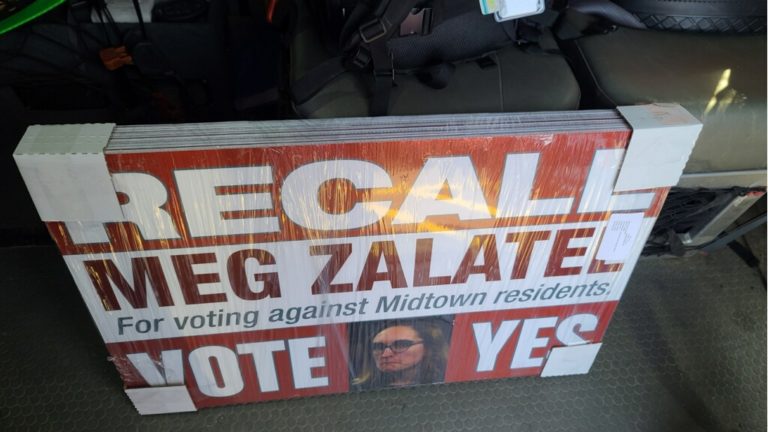
A petition to recall Anchorage Assemblywoman Meg Zaletel is closing in on enough signatures to take the matter to a public vote in a special election this fall.

The group pushing for the recall, led by Reclaim Midtown’s Russell Biggs, needs to have nearly 2,500 signatures, plus a good percentage beyond that number just to make sure that enough of the signatures are valid and from the district Zaletel represents.

The discontent with Zaletel began with her push to allow former Mayor Ethan Berkowitz to purchase several buildings around Anchorage to create a homeless industrial complex.

Residents of Midtown Anchorage were outraged to learn drug and alcohol rehabilitation centers for vagrants would be placed adjacent to their neighborhoods. Decisions were made during Assembly meetings that were closed to the public, but during those same meetings the Assembly leaders permitted special invited guests of proponents of the mayor’s plan to be in the chambers. All who protested the plan were banned from the Assembly meetings.

Zaletel and then-Assembly Chair Felix Rivera were targeted for recall.

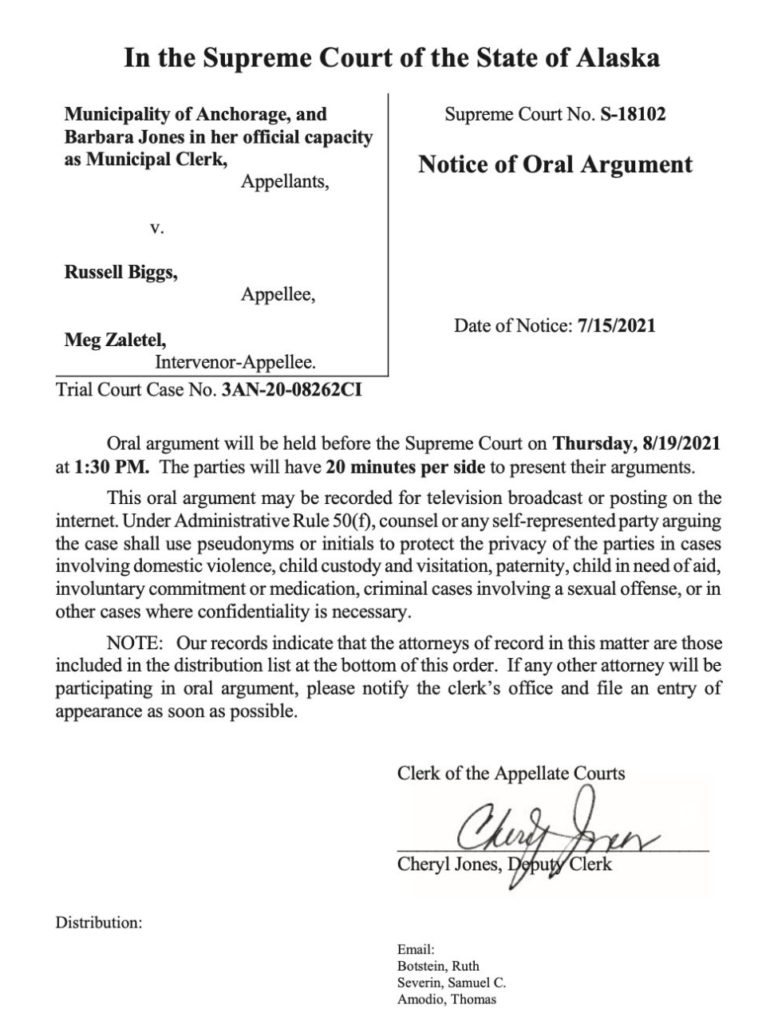
Rivera survived his recall in April. But the Municipality fought the Zaletel petition in court. The Superior Court judge Kevin Saxby sided with Biggs, but the Anchorage Municipal Attorney Kate Vogel, now gone from the city payroll, appealed the decision to the Supreme Court. The oral arguments for the appeal is Thursday, Aug. 19 at 1:30 pm, during which each side will be allowed 20 minutes to argue the case.

 Most of the signatures on the petition are being gathered at the Carrs grocery story on Abbott Road, Biggs said, although there is some effort being made to go door to door in the District 4 neighborhoods. The progress is heartening, he said.

Meanwhile, the Alaska Supreme Court has decided that just about anything goes with recall petitions and that will probably bode well for Biggs to win in court.

Read Justices explain decision on Recall Dunleavy

Alexander Dolitsky: Neo-Marxism and utopian Socialism in America

By ALEXANDER DOLITSKY

What practical lessons can we learn from history? There is no simple answer to this question because history is a complex subject. History is not simply a recording of facts and events; and it is not only a logical classification of the collected data in a chronological order.

History is a social process, the development and evolution of mankind from the past through present and to future. History forms a picture of all things that happened to mankind from its origin upon the earth to the present moment.

History is functional in the sense of meeting the need that society has to know itself and to understand its relationship with the past and to other societies and cultures. History explains a pattern of nations’ emergence and growth, intellectualizes facts, and searches for causes of historic events. It is also poetic in the sense that there is inborn in every individual a curiosity and sense of wonder about the past.

So, what is the relevance of the lessons of history for America today? The historic patterns of so-called progressive movements in America today strikingly resemble the utopian socialist and Marxist movements of the 19th century in Europe. This is especially the case for the new popular rhetoric of “white privilege,” “systemic racism,” “Black Lives Matter,” and “critical race theory.”

Utopian socialists of the 19th century, namely Charles Fourier and Claude Saint-Simon of France and Robert Owen of England, believed that it was possible to organize ideal communities of pre-arranged size. These communities would be composed of farmers, industrial workers, artists, and, in some cases, capitalists. According to the utopian Socialists’ hypothesis, these communities would be stable and self-sustaining, insuring all communal members an adequate livelihood—a remarkably naïve utopia of a harmonious and cohesive human society (e.g., CHAZ or CHOP in Seattle in 2020).

The communist who grasped the revolutionary nature of the 19th century was Karl Marx. Rejecting utopian socialism in favor of what he coined “scientific communism,” Marx claimed that changes in the economic structure of society of his time were the result of class conflicts or class struggles between the capitalists (bourgeoisie)  and the workers (proletarians).

In his book Manifesto of the Communist Party published in 1848, Marx stated: “The history of all hitherto existing society is the history of class struggles. Freeman and slave, patrician and plebeian, lord and serf, guild-master and journeyman, in a word, oppressor and oppressed, stood in constant opposition to one another, carried on an uninterrupted, now hidden, now open fight, a fight that each time ended, either in a revolutionary reconstitution of society at large, or in the common ruin of the contending classes.”

In other words, Marx was not seeking natural or moral laws for guidance; he was turning to the lessons of history and revolutionary uprising against ruling class of the time.

Thus, what is a connection and similar patterns between Marxism of the 19th century and so-called neo-Marxism in America today? Evidently, “white privilege” and “critical race” doctrines are an ideological platform and guidance for other neo-Marxist rhetoric of “systemic racism,” “BLM” and today’s “Antifa.” The “white privilege” and “critical race” doctrines claim an existence of a social division in the society that is based on race conflictrace struggle, race warfare and race advantages between naturally born white people and other people of color.

The rhetoric and missions of “systemic racism,” “BLM” and today’s “Antifa” are a logical and direct outgrowth from the “white privilege” and “critical race” doctrines, with the purpose to threaten opposing ideologies, politics and lifestyles. They are the tactics and methods designed to implement “white privilege” and “critical race” doctrines and “systemic racism” notion into our system of governing and to undermine our constitutional freedoms –especially that all races being treated equally.

To promote “white privilege” and “critical race” doctrines and “systemic racism” notion, neo-Marxists advocate for a complete destruction of the system of oppression — Capitalism.

In the summer of 2020, the Juneau Assembly approved Black Lives Matter protesters’ demands to investigate instances of the so-called “systemic racism” in town. The Juneau Assembly’s radical social agenda is a clear example of neo-Marxist ideology that aims to quietly penetrate our political, educational, social and cultural systems. Eventually, unless it’s opposed and reversed, this radical development will cause a complete breakdown of our core cultural and morals values.

George Washington in his farewell address stated: “Virtue or morality is a necessary spring of popular government.” In other words, if a society is to remain free, self-government must be referred to individual citizens governing their own behavior. This is the most critical foundation of American exceptionalism from its inception. 

As a prominent American sociologist Charles Murray noted in his book Coming Apart: “America will remain exceptional only to the extent that its people embody the same qualities that made it work for the two centuries of its existence. The founding virtues are central to that kind of citizenry.”

It is absolutely shocking to me, as a person who was born, educated and raised in the Socialist country of the former Soviet Union, to witness so many intelligent and educated people in our country being influenced by such dangerous ideological rhetoric as “white privilege” and “critical race” doctrines.

This radical Socialist rhetoric is the main cause of violent unrests and riots in our country today, and it threatens a possible partitioning and division of our great nation in the future. Americans should resist this Socialist progressive movement in our country and unite in preventing a spread of the neo-Marxist pandemic, including “white privilege” and “critical race” doctrines, into our American culture.

Alexander B. Dolitsky was born and raised in Kiev in the former Soviet Union. He received an M.A. in history from Kiev Pedagogical Institute, Ukraine, in 1977; an M.A. in anthropology and archaeology from Brown University in 1983; and was enroled in the Ph.D. program in Anthropology at Bryn Mawr College from 1983 to 1985, where he was also a lecturer in the Russian Center. In the U.S.S.R., he was a social studies teacher for three years, and an archaeologist for five years for the Ukranian Academy of Sciences. In 1978, he settled in the United States. Dolitsky visited Alaska for the first time in 1981, while conducting field research for graduate school at Brown. He lived first in Sitka in 1985 and then settled in Juneau in 1986. From 1985 to 1987, he was a U.S. Forest Service archaeologist and social scientist. He was an Adjunct Assistant Professor of Russian Studies at the University of Alaska Southeast from 1985 to 1999; Social Studies Instructor at the Alyeska Central School, Alaska Department of Education from 1988 to 2006; and has been the Director of the Alaska-Siberia Research Center (see www.aksrc.homestead.com) from 1990 to present. He has conducted about 30 field studies in various areas of the former Soviet Union (including Siberia), Central Asia, South America, Eastern Europe and the United States (including Alaska). Dolitsky has been a lecturer on the World Discoverer, Spirit of Oceanus, andClipper Odyssey vessels in the Arctic and sub-Arctic regions. He was the Project Manager for the WWII Alaska-Siberia Lend Lease Memorial, which was erected in Fairbanks in 2006. He has published extensively in the fields of anthropology, history, archaeology, and ethnography. His more recent publications include Fairy Tales and Myths of the Bering Strait Chukchi, Ancient Tales of Kamchatka; Tales and Legends of the Yupik Eskimos of Siberia; Old Russia in Modern America: Russian Old Believers in Alaska; Allies in Wartime: The Alaska-Siberia Airway During WWII; Spirit of the Siberian Tiger: Folktales of the Russian Far East; Living Wisdom of the Far North: Tales and Legends from Chukotka and Alaska; Pipeline to Russia; The Alaska-Siberia Air Route in WWII; and Old Russia in Modern America: Living Traditions of the Russian Old Believers; Ancient Tales of Chukotka, and Ancient Tales of Kamchatka.

Biden begins reversing eased-up, Trump-era shower head regs

27

The Biden Energy Department has begun the process of reversing yet another rule from the Trump Administration. This time, it involves shower heads.

The new regulations being discussed will likely go back to the Obama-era limits of no more than 2.5 gallons flowing through a shower head per minute, regardless of how many nozzles it has. There will be a public hearing on the rules change in August.

The National Energy Act, prior to Trump’s action, required that shower head manufacturers installs flow restrictors in shower heads. For those living in areas with low water pressure, the flow restrictor can end up leaving a mere drizzle of water foaming from the shower head. People can remove those restrictors if they know how.

The previous shower head rule was an example of government over-regulation that annoyed former President Donald Trump. In his administration’s set of regulatory rollbacks, energy standards for clothes washers and dryers were also relaxed. Those rules were just finalized in December.

The Department of Energy will hold a webinar on the proposed change on from 1-4 pm on Aug. 31.

Homer woman says traffic stop fits pattern of harassment that began with FBI raid over Nancy Pelosi laptop computer

IS MARILYN HUEPER BEING GASLIGHTED BY LAW ENFORCEMENT?

Marilyn Hueper, whose Homer inn and spa was raided by federal agents in late April, as they searched for House Speaker Nancy Pelosi’s stolen laptop computer, spent the night in the Homer jail last Thursday.

She was released the next morning, but the experience has made her question everything she ever thought was possible regarding the criminal justice system and the U.S. Constitution.

Hueper was leaving the Homer Spit in her car, after having stopped to get a gelato dessert at Carmen’s Gelato, next to Captain Pattie’s, a favorite restaurant. The Spit is a straight stretch of highway that leads to a small commercial and fishing area at the end of the 4.5-mile road into the middle of Kachemak Bay. Hueper was driving about 10 miles under the 45-mile-per-hour speed limit, eating gelato and enjoying the sunset on her way home, when the bright flashing lights of a police car came from behind. She pulled over.

According to Hueper, the officer would not tell her why she had been pulled over. Hueper asked the officer for the reason, but got no reply. Instead, the officer asked for backup, and when a second officer arrived, she was handcuffed and taken to jail for a driving under the influence charge.

Hueper had not been drinking alcohol at all that day and had not been speeding. She says she tends to hug the right side of the road at night, just to give everyone room who might want to pass her. And she was enjoying her gelato.

But Hueper refused to blow into a Breathalyzer, and she also refused a blood test for alcohol, not because she was afraid of the results but because she was not provided access to an attorney or the magistrate. With the experiences she has had since she went to Washington, D.C. on Jan. 6 to watch President Donald Trump speak, she’s gotten a lot more wary of the ways and means of justice.

Read: Homer couple’s home raided by FBI in search of Nancy Pelosi’s laptop

Hueper, refusing to cooperate on the Breathalyzer, said she would not give up one of her rights (a lawyer) in order to access her other rights (her freedom). She was told she could not have an attorney or speak to the magistrate until she tested for alcohol. That was a bridge too far for her.

Under Alaska law, the refusal of a Breathalyzer test can be as serious as a conviction for a DUI. People can lose their license for refusing to take the test, if and when an officer demands it. It’s part of the “implied consent” law that states if you are lawfully arrested for probable cause of DUI, you automatically consent to taking the test.

Hueper said she does not think she was lawfully arrested, and that there was no probable cause, but thinks she was being harassed by local law enforcement. She has a video tape of much of her discussion with police, which she says proves she was lucid, not slurring her words, and not being combative. She believes the stop was unlawful and her constitutional rights were violated.

Read: Rep. Jim Jordan to FBI Director Wray: Why did you take the Huepers’ copy of the Constitution?

But Alaska law says licensed drivers have “consented” to taking a preliminary breath test, even if they are not arrested yet. Law enforcement officials may require a blow test for those who have broken a traffic law, or who are in a collision, or if there is an open container of alcohol in the vehicle. The first offense for refusing the test is three days in jail, fines of up to $1,500 and a mandatory ignition interlock device that won’t allow the vehicle to start unless the driver blows into the testing component

Hueper says the officer could not provide her with any reasonable rationale for why she was stopped. After her experience with the FBI, Capitol Police, and other federal agents breaking down the door to her home in April, holding her and her husband and guests in handcuffs for hours, and after she and her husband were, as a result of being in Washington, D.C. on Jan. 6, put on the special-screening list for the Transportation Security Administration and are now searched repeatedly when they travel, she can’t assume she’s not being targeted.

Read Homer couple says travel is now a lot harder, as they are pulled aside by TSA repeatedly

“It was disturbing but was a great dive into deep-end training. And if a few more people get trained to do what I did I think we’d have some great law enforcement “auditors,” which are much needed, and ways to challenge unlawful laws and actions. You need to have a good tolerance for walking in honor even when being threatened and bullied…and know the difference between legal and lawful and how to stand on your rights. We need a lot less bullying and maybe we can even win our law enforcement back to the people’s side,” she said.

Hueper says the Breathalyzer law, denying people a right to counsel, is an example of an unconstitutional statute that needs to be challenged and changed.

Dan Fagan: Joe Biden’s hidden tax is hitting Alaska hard

By DAN FAGAN

If you live in Anchorage and it seems like things are getting more expensive, it’s not your imagination. 

Inflation is expanding faster in Anchorage than the waistline of a customer piling on extra helpings at the Golden Corral buffet. 

According to the U.S. Bureau of Labor Statistics, the price of consumer goods rose in Anchorage in the past year more than they have in 30 years. They’re up almost a full percentage point over the national average. 

When the villain currently occupying the White House ran for president, he promised no new taxes for those earning under $400,000.  

But as Biden and his special interest catering swamp creatures continue to spend at unprecedented levels and then print money, the value of the dollar you earn shrinks. It’s a hidden tax.  

Biden ironically campaigned as a champion for the little guy, and yet his highest-in-30-year inflation explosion hits the poorest the hardest. 

It will cost you an additional 42% to fill your gas tank in Anchorage than it did a year ago. For a low-wage earner working in Anchorage’s service industry, that’s a devastating blow to a monthly budget.  

It is now considerably more expensive to get around in Anchorage than it was this time last year. Transportation costs overall are up 27%. 

If you need to buy a car in Anchorage, you’ll really feel the pain of the Biden-induced inflation. The cost of used vehicles in Anchorage skyrocketed 47% in the past year. 

The price of meats, chicken, fish, and eggs rose more than 7% in Anchorage in the past 12 months. 

Overall, the cost of buying all things in Anchorage shot up an average of 6.2% in the last year. 

“The 6.2% is the highest we’ve seen since 1990, over 30 years ago. It’s pretty significant,” said Neal Fried, economist with the Alaska Department of Labor.  

China Joe Biden, like most Democrats, is laser focused on destroying the private sector and growing government dependents. This is how they will usher in a government-controlled, socialist-based economy where they can punish the successful and reward the lazy by redistributing wealth. They do it all in the name of equality. 

Hyperinflation caused by out-of-control government spending is one of the fastest ways to kill a capitalist-based, free-market oriented economy. 

“As Joe Biden’s inflation crisis rages, he just can’t stop fueling it with more reckless government spending, “ said Republican Florida Sen. Rick Scott. 

“On the same day that the consumer price index report showed that inflation has grown every month under Biden’s presidency, Democrats are out with a new plan for a $4.1 trillion spending spree,” Scott said.

Biden’s assault on Alaskans’ paychecks through hyperinflation is bad enough. Then he launched an all-out war on the state’s resource development economy by appointing rabid anti-oil and gas zealot Deb Haaland as Secretary of the Interior. An appointment oddly enough approved by Alaska’s two senators, Lisa Murkowski and Dan Sullivan. 

One of Haaland’s first act as secretary was to shut down all activity in ANWR. Haaland then closed off development on 28 million acres of federal land in Alaska. 

Unlike Murkowski and Sullivan, Republican Gov. Mike Dunleavy fought back and sued Haaland and the federal government over the move. 

“This is a methodical effort by the Biden administration – more than just the bureaucratic foot dragging to leave these lands locked up as de facto parks,” said Dunleavy. “This is another federal attempt to deny Alaska the full realization as a state promised under our Statehood Compact, and it should not stand.” 

Dunleavy has been very vocal in criticizing Biden’s anti-Alaska ways. He hit back hard after China Joe recently ended the federal government’s exemption for Alaska to the roadless rule, a move that will end any potential revitalization of Southeast Alaska’s timber industry. 

“The Forest Service has already conducted a thorough analysis and determined that an Alaska-specific exemption from one-size- fits-all roadless rule was fully justified,” said Dunleavy. “Narrow election results and political donations from environmental groups do not justify this federal agency policy flip flop.” 

It’s important to note we went from one of the most pro-Alaska presidents in history with Donald Trump, to China Joe Biden. The cost to Alaskans of this dramatic change in the White House is considerable and growing each day. 

Dan Fagan hosts the number one rated talk show in Alaska weekday mornings on Newsradio 650 KENI.