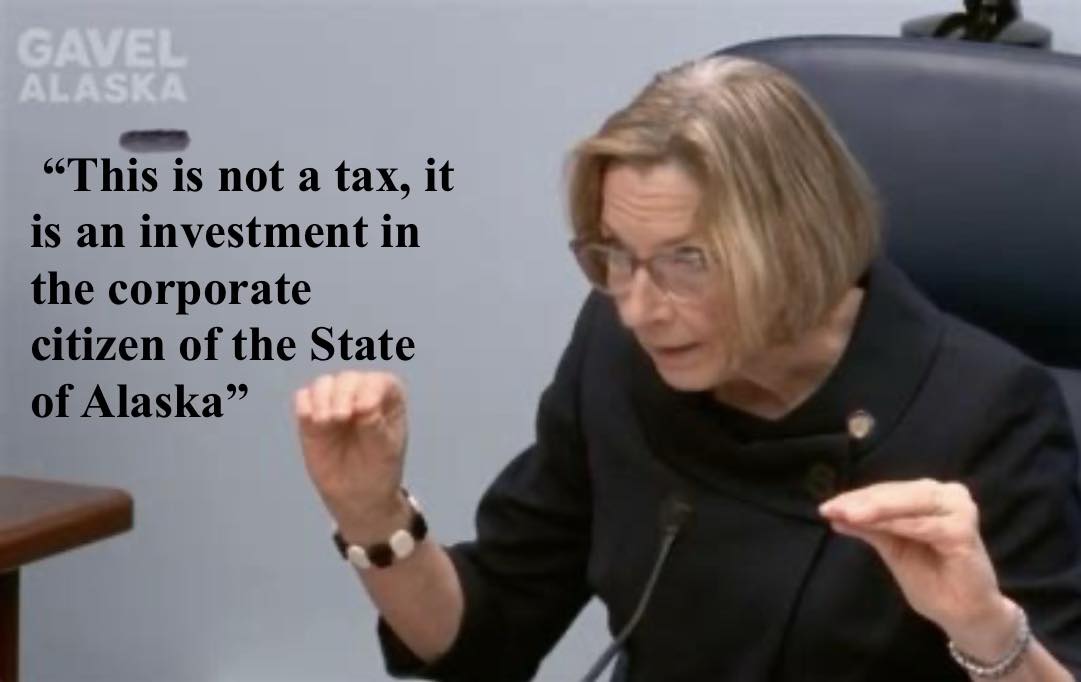
During discussions regarding the taxation of S-corps involved as passthrough companies in the AK LNG project, Senators Cathy Giessel (R-Anchorage) and Bill Wielechowski (D-Anchorage) referred to corporations who pay State income taxes as “good corporate citizens.”
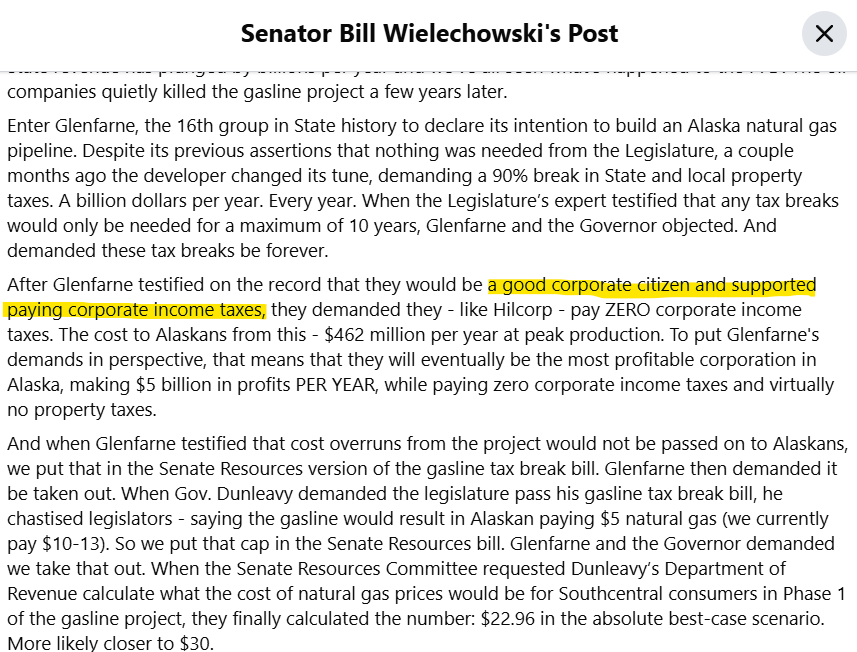
Assuming the words to have more than a rhetorical purpose, Giessel and Wielechowski are making two major philosophical claims that have dangerous political consequences: 1) that a corporation as a whole is a kind of citizen, and 2) that a good citizen pays State income tax.
The first claim that a corporation is a citizen is either political nonsense or it is the attempted creation of a new class of citizens.
First, a citizen is a person belonging to a country, not a state. Alaskans are citizens of the United States of America and residents of the State of Alaska. Currently, a corporation cannot claim citizenship status in the United States of America. The individuals that are part of the corporation may claim citizenship, but not the corporation as a whole. But, what if a corporation could?

Let’s take Giessel and Wielechowski’s claim that a corporation is a citizen to be true. Their next claim is where it gets dangerous. They say that a “good corporate citizen” pays State income tax. Now, here is what that does: it either sets the ground for the argument that a good Alaskan pays State income tax, or it creates a new class of citizens subject to unequal treatment.
If we acquiesce that a good corporate citizen pays State income tax, and if we wish to maintain the equal treatment of all citizens, then a good individual citizen also pays State income tax.
However, if a good corporate citizen pays State income tax, but a good individual citizen does not have to pay State income tax, then we have created a system where one class of citizens is considered lesser than another class of citizens. In this philosophical framework, the corporate citizen is lesser than the individual citizen, so the State may take from the corporate citizen via an income tax and redistribute the wealth, supposedly to the benefit of the individual citizen. This is not a new philosophical framework. This is socialism.
So, what do Giessel and Wielechowski want? Do they want to argue for a State income tax on all Alaskans? Do they want a socialistic system that redistributes corporate wealth? Or are they simply using a rhetorical phrase to convince Alaskans that an income tax on S-corps is a good thing?
Thankfully, no Senator has the power to create a new class of citizens. As discussed earlier, citizenship is a federal matter, not a state matter. A corporation is simply not a citizen, no matter how much Giessel and Wielechowski would like them to be.
Giessel and Wielechowski may very well be trying out a heavy-on-rhetoric, light-on-logic strategy to make their S-corp income tax policy appealing to Alaskans. But if they mean what they say, a far more insidious plot is revealed.
The plot thickens when researching this strange concept of “corporate citizenship.” Corporate citizenship is a term decisively tied to left-wing politics that push ESG (Environment, Social, Governance), which is “a shorthand for a growing movement of corporations committing to environmental, social justice, and governance standards as a part of their business practices, and of investors increasingly holding corporations accountable not only for shareholder profits but also for the way they treat employees, customers, and the communities where they do business.”
In the article “What Does It Mean to Be a Corporate Citizen?” published in Harvard Magazine, ESG is openly identified with left-wing idealogy: “The growing threat of climate change is perhaps the biggest and best-known driver of the rise in ESG investing, but the movement encompasses a vast range of real-world concerns, including LGBTQ and women’s rights, workplace diversity, racial injustice, pollution, and environmental injustice.”
The Harvard Law School Forum on Corporate Governance also published an article on “corporate citizenship,” but attempted a more ideologically balanced approach. In the article are several examples of good corporate citizenship that the author believes can be agreed upon by the right and the left. Among the examples is “paying expected taxes and refusing to engage in tax arbitrage to avoid school and other taxes as a condition to keeping or locating operations.” However, the article does not say that a corporation should be forced to pay a new income tax specifically targeting that corporation’s industry, which is what Giessel and Wielechowski are trying to do with the S-corp tax.
Here is another article exploring what it means to be a “good corporate citizen:” Corporate Citizenship: How to be a good corporate citizen and contribute to the common good – FasterCapital. This article claims good corporate citizenship is all about corporate ethics, but the stated ethics focus heavily on leftist ideas regarding environmental justice and social justice.
The idea of corporate citizenship is not logical. It is not conservative. It is not new. It is simply another way of rebranding socialism and selling left-wing ideology that impedes industry, raises the cost of living, and generates State revenue to grow government.