Editor’s Note: This story was updated on 6/8/2026 to correct a calculation error.
The Alaska LNG project is the star of the show during the legislature’s current 30-day special session. The second regular session of the 34th Legislature saw a simple 7-page bill introduced to the Senate by Governor Dunleavy transformed into a colossal 52-page mess that proposed four different taxes on the oil and gas industry.
Now, the Senate is restarting with a new 22-page bill introduced by the Governor at the start of the special session. According to Dunleavy, this bill — SB 2001 — “builds on the bill transmitted earlier this year and reflects the most recent negotiated framework developed during the regular session.”
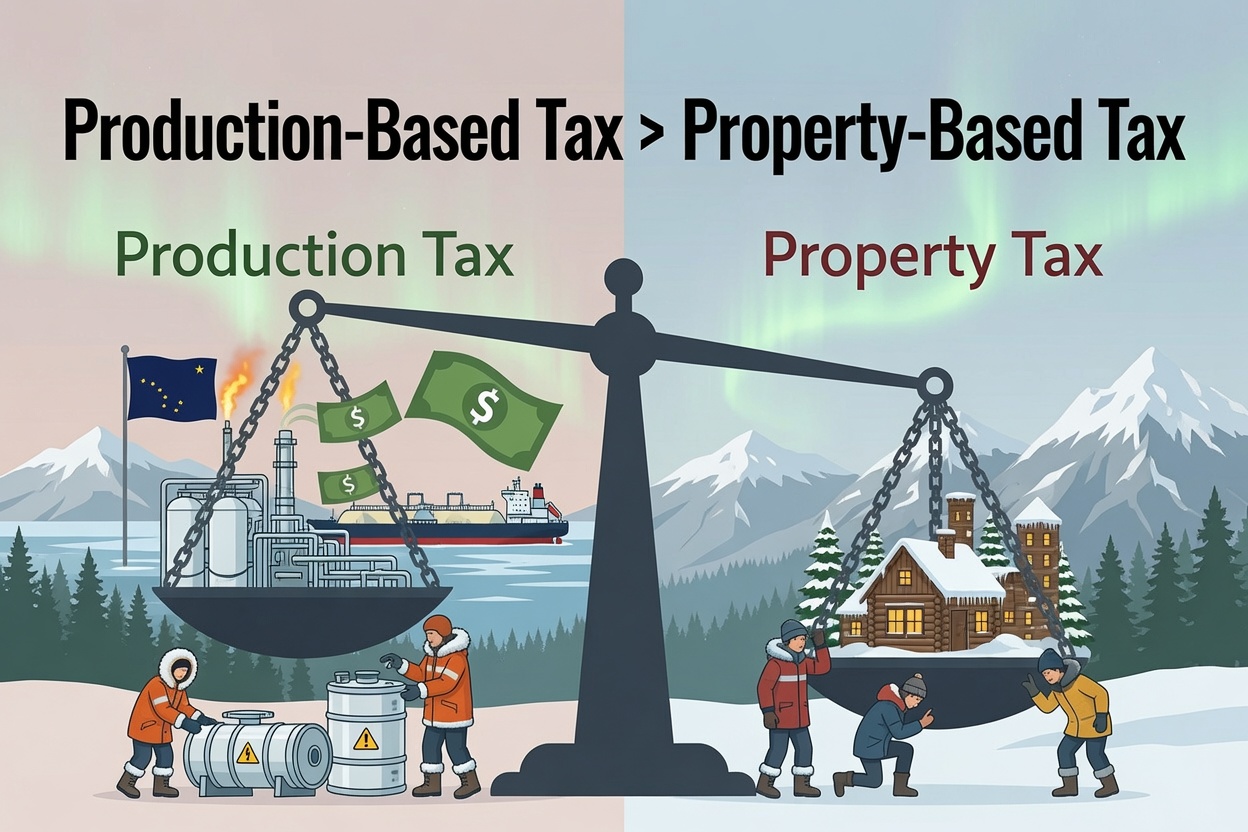
Dunleavy continues: “It preserves the central purpose of the original proposal: replacing a property-tax structure that creates front-end costs and uncertainty with a volume-based tax structure that is tied to project performance, whole adding provisions intended to address local community impacts, revenue allocation, labor stability, and in-state energy access.”

AVT’s Significance in the Property Tax Discussion
Currently, the discussion is focused on whether or not the project’s producers should pay property taxes. When the property tax abatement is looked at on its own, the debate polarizes between those who think a property tax abatement unfairly advantages corporate oil and gas companies versus those who think maintaining the current property tax structure burdens the oil and gas companies to the point of making the project uninvestable.
Nicholas Fulford, Senior Director at GaffneyCline, the Senate’s hired LNG consultant, testified in a House Finance Committee meeting, May 26, that a property tax abatement is critical for attracting investors. Some disagree with Fulford’s claim, arguing that the abatement request reflects corporate greed rather than honest negotiating.
However, the bill does not propose only a property tax abatement, but it also proposes a new alternative volumetric tax (AVT). The intention is not to abate taxes to the sole benefit of corporate producers; the intention is to replace the current tax structure with a tax structure that pushes the project forward so that it can benefit Alaskans.
Furthermore, despite Senator Bill Wielechowski’s claim that the Governor “demanded these tax breaks be forever,” the property tax abatement provided in SB 2001 (which was introduced by the Governor) has a clear cut off. SB 2001 currently states that the abatement will end either when the project achieves a throughput of 500,000,000 cubic feet of natural gas a day, calculated as a rolling average over a consecutive 30-day period, or after five years of the project’s commencement (whichever happens first). Considering ENSTAR’s current natural gas demand averages 260,000,000 cubic feet on a winter’s day, the project is more likely to hit the five-year sunset than the production sunset. This means that after the first five years, the producers will be required to pay property taxes according to the current tax structure.
In addition to the resumed property taxes, producers will be required to pay AVT, which starts as soon as production starts. According to SB 2001, the AVT tax rate would be $0.06 for a gas pipeline component, $0.12 for a gas treatment plant and carbon capture facility component, and $0.12 for a liquefied natural gas plant component. A unit of component throughput is defined as 1,000 cubic feet of natural gas.
Within the first five years, the property tax would not kick in until a daily production of 500 million cubic feet of natural gas. However, the AVT kicks in immediately upon the first 1,000 cubic feet produced. This means producers would still pay up to approximately $60,000 per day ($21.9 million per year) in taxes during the property tax abatement period.
However, unlike property tax, AVT is directly tied to the project’s actual performance. If the project produces less, it will be taxed less. If it produces more, it will be taxed more.
Corporate producers make money through production, so they will be working to produce as much as possible. With AVT, the more they produce, the more Alaska benefits.