Friday, June 5, 2026
Home Blog Page 1074

Mask outrage at school board meeting: Many parents testify they will pull students from Anchorage schools, some will move

Over 100 people testified at the Anchorage School Board on Tuesday, and most stated that their children’s social, psychological, physical, and emotional health was being put at risk by the superintendent’s mask mandate for the coming school year. Another 914 parents sent emails to the school board on the matter of the masks.

Many said they will pull their children out of the public schools as a result. Most who spoke said that the parents’ rights need to be restored and they won’t send their children to school in masks.

A few noted it was apparent the board had already decided to back Superintendent Deena Bishop on her decision to enact universal mask mandates.

“What happens to the children who choose not to comply?” Kim Paulson asked the board. Would they be expelled? she asked.

Suicides outnumber covid deaths in children and further interventions with masks are a net harm, said one parent. At least two parents said they are now considering moving to the Lower 48, due to the masking of children in the public schools in Anchorage.

Corinthian Wiley said the U.S. prides itself on individual rights, and the mandates are a step toward totalitarianism.

The mask question was treated as an action item on the agenda, but in fact it was a non-action item. The board simply supported the ruling of the superintendent without a vote.

Board member Dave Donley asked the rest of the board if they would agree to ask the superintendent reconsider her plans to accommodate the many parents’ concerns and the testimony given Tuesday night. But his motion died for lack of a second.

Read: Kenai will not mask school children

Read: Anchorage will mask the kids this fall

At several times during the meeting, Board President Margo Bellamy cautioned the crowd to stop clapping, cheering, or yelling, or “next time” she would clear the room. The attendees were generally polite but supportive of each others’ testimony.

Read: Enrollment explodes at no-mask Anchorage Christian Schools

Cycle of delay: Biden continues war on Alaska energy projects in 1002 Area of ANWR

On Day One of the Biden Administration, Joe Biden shot the Arctic National Wildlife Refuge Coastal Plain Oil and Gas Leasing Program dead.

Now, his administration is going to make sure it stays dead.

The Bureau of Land Management, a division of the Department of Interior with vast authority over Alaska federal lands, today announced a 60-day “public scoping period to assist in the preparation of a supplemental environmental impact statement for the Arctic National Wildlife Refuge Coastal Plain Oil and Gas Leasing Program.”

The translation for that is: The Biden Administration is giving environmental extremists one more chance to kill any oil and gas development on the 1002 Area of ANWR, the coastal plain that was set aside for oil and gas.

In June, Secretary of Interior Deb Haaland took the January moratorium and turned it into a suspension of all activities related to the Coastal Plain Oil and Gas Leasing Program, which had already been approved by the Trump Administration.

Governor Mike Dunleavy today reacted strongly:

“This announcement is another example of the Biden Administration attempting to shut down Alaska’s primary industry to appease radical environmental groups determined to turn our state into one big national park,” Dunleavy said.

“A supplemental EIS only serves to void the results of the environmental study that was already completed and found that oil and gas development in the 1002 area of ANWR, an area set aside for oil and gas exploration, can take place without harming the environment. Alaska is America’s energy warehouse and we can develop the resources in ANWR while protecting the refuge, because no one is more protective of our land and waters than Alaskans,” Dunleavy said.

All three members of Alaska’s congressional delegation were also highly critical of the move, which is designed to appease environmentalists.

Mask mandates driving enrollment higher at Anchorage Christian Schools

The mask mandates at Anchorage Public Schools have led to an explosion in new enrollees at Anchorage Christian Schools since the final day of classes in late May.

Anchorage Christian Schools, on the campus of Anchorage Baptist Temple in East Anchorage, never enacted a mask mandate last year.

With a study body of about 550, another 140 have applied to attend this fall, after the school absorbed about that many more at the beginning of last year’s classes. The school can accommodate up to 900.

CEO Calvin Hoffman says he expects even more will apply as the Anchorage School District’s mask policy becomes more publicized.

Anchorage Christian Schools has hired former East High School Principal Sam Spinella as the new principal. Spinella left the high school recently after serving as East principal since 2002.

Hoffman said there is still plenty of room for new students, and welcomes applications from parents who want a high-quality learning environment in a Christ-focused setting.

The application is simple, and is at the top of the school’s website. Typically, parents hear back within 48 hours and can have an interview and walk-through schedule within a couple of weeks.

The Anchorage School Board will, during this evening’s scheduled meeting, hear from Superintendent Deena Bishop about her plans to have all students and staff masked this year to prevent the spread of Covid-19.

Read: Children will be masked in Anchorage schools this fall, superintendent says in letter

The school board meeting begins at 6 pm after a scheduled work session.

School Board meeting documents and meeting links can be found here.

Read: Kenai schools won’t require masks this fall

Ninth Court decision on $500 limit on campaign donations factors in Bronson’s response to APOC complaint

If the $500 limit on campaigns is illegal, as it has been determined to be by the Ninth Circuit Court of Appeals, then what happens to the proposed fine that the Alaska Public Offices Commission staff is recommending to the commission for the Bronson for Mayor campaign?

Bronson’s treasurer missed a few important deadlines in the APOC financial reporting process, including logging one $500 donation into the 2021 year, when it should have been logged into the 2020 year. That donation was made at 11:16 pm on Dec. 31, 2020 but was recorded on Jan. 1 because of a difference in time zones on a computer.

Mistakes like that can be costly. The fine can be $500 a day, which is how the Bronson campaign ended up with a proposed fine from the APOC staff of $39,600. The commission itself makes the final call, and often reduces the fines proposed by staff.

But in the meantime, the Ninth Circuit Court threw out the $500 limit altogether last week, saying Alaska’s law is unconstitutional.

That leaves the possible fine from APOC against the Bronson campaign in limbo.

Normally, the commission reduces fines by as much as 90 percent of what could potentially be levied against a campaign, but with this new ruling on constitutionality, should the fine be thrown out entirely since the $500 limit is illegal?

The Bronson campaign thinks any complaint regarding an over-limit contribution should be dismissed by the commission.


“…the Commission cannot assess penalties for a violation of an unconstitutional statute,” the Bronson campaign lawyer wrote in a response to the commission.

APOC staff, responding to complaints from the Forrest Dunbar campaign, found three over-$500-limit contributions that were not returned to the donors in a timely way.

Four other complaints against the Bronson campaign by the Dunbar campaign were recommended for dismissal by the staff of APOC.

“The Bronson campaign acknowledged to the commission that it has some errors in reporting but does not agree they amount to something major and disputes the APOC staff recommendation that the fine not be reduced,” attorney Stacey Stone wrote.

“In doing so, staff asserts that the respondent has a poor reporting history, and therefore is not entitled to any reduction. However, that position does not meet with the spirit of the regulations, ignores pertinent facts, and fails to acknowledge precedent,” she wrote.

“First, the Commission has great discretion with regard to reductions in civil penalties. The pertinent regulation, 2 AAC 50.865, does not say that the Commission ‘shall’ act, but says ‘may’ act in a certain fashion. Specifically, 2 AAC 50.865 provides that the Commission ‘may’ increase the penalty to the maximum if a person has a poor filing history, but in doing so, the Commission must consider several factors. However, in its report, the staff has only considered one of those four factors. In asserting that the respondent has a poor filing history, the staff cites to two penalties. However, one is currently being appealed due to a computer discrepancy that resulted in a one-minute delay, i.e. the report was filed at 12:01 AM. Therefore, respondent contends it is incorrect to base a poor filing history on this one minute delay. Finally, when considering APOC precedent, a reduction of over 90 percent is appropriate, and therefore, the penalty must be reduced to an amount between $396 and $3,960.”

Even if the commission agrees with the staff of APOC about a maximum fine for late reporting, the staff calculations were off, according to Stone, who came up with a discrepancy of about $1,100:

  1. The year-start report was due on Feb. 16, 2021. The report was late as of Feb. 17, 2021. Feb. 17 through May 17, 2021 is a period of 90 days. The maximum violation totals $4,500.
  2. The 30-day report was due on March 8, 2021. The report was late as of March 9, 2021. March 9, 2021 through May 17, 2021 is a period of 70 days. The maximum violation totals $3,500.
  3. The 7-day report was due on March 30, 2021. The report was late as of March 31, 2021. March 31, 2021 through May 17, 2021 is a period of 48 days. The maximum violation totals $24,000.
  4. The 7-day runoff report was due on May 4, 2021. The report was late of May 5, 2021. May 5, 2021 through May 17, 2021 is a period of 13 days. The maximum violation totals $6,500.

The Bronson campaign has asked that the maximum penalty be reduced from the current $39,600 down to $38,500, and has asked that entire fine to be reduced by 90 percent to $3,850.

Kenai schools won’t have mask mandate

The Superintendent of the Kenai Peninsula Borough School District said masks will be optional in schools when they open this fall.

Schools, which open Aug. 17, will continue with a “symptom-free” protocol (don’t go to school if you are sick), enhanced cleaning, air handling, and other measures, but will not force masks on children or staff.

The school board heard from about 140 parents who wrote emails on the topic, and more than a dozen who spoke at Monday’s night’s school board meeting. The board left it for Superintendent Clayton Holland to decide how best to mitigate the spread of Covid-19, the contagious virus that is raging across the globe.

“Human connection is vital to our students,” Holland said, and masks interfere with that connection.

Observers of the meeting said there is an overall change of tone for the better at the school district.

“They are at least listening to conservatives now,” one parent said.

Holland said that where there is local authority, such as tribal authority, he will leave the decision to the local school leaders.

He cited that when the district had mask mandates last year, not a single student in the Russian “Old Believer” schools attended school, Holland said. Holland said he would allow those decisions to be made locally in remote communities.

The previous Kenai superintendent John O’Brien favored the mask mandate.

Anchorage Superintendent Deena Bishop has said students and staff in Alaska’s largest city will have to wear masks when school starts. The same policy is in effect in Juneau, where they are masking.

Racist? Felix Rivera attacks white males for running and winning political office

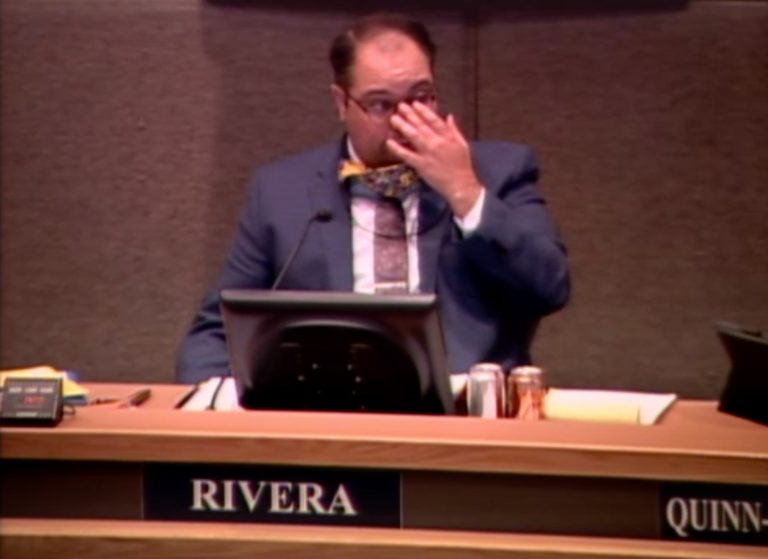
Felix Rivera, fair-skinned hispanic gay Assembly member in Anchorage, raised eyebrows last month when he stated, during a forum on The Alaska Black Caucus Facebook page, that there are too many white males in office.

“I really think our political establishments need to get over this idea that only a certain typecast of individual can run for office, because when you do that, you’re typically going to go to someone who is white and someone who is male, and we need to get beyond that very rigid thinking in our political establishments.”

It is a racially tinged statement, and curious because the Anchorage Assembly of 11 has at least two hispanics, one Alaska Native, and several gay and lesbian members, some whom are public about their sexual preference, others who are not. The Assembly also has at least two Jewish members, and one veteran.

It’s a very diverse group except for one thing: Five of the 11 Assembly members do not have children: Austin Quinn-Davidson, Forrest Dunbar, Pete Peterson, Chris Constant, and Felix Rivera are all childless. Four have never been married.

In many respects, it can be argued that the Assembly actually does not represent the community at large.

Rivera’s statement may come back to haunt him, as Stephanie Taylor, a black candidate, last week filed to run against white incumbent Forrest Dunbar on the Assembly for East Anchorage. Rivera, wanting more minorities in office, may be asked to host a fundraiser for Taylor, a Republican running for the nonpartisan seat.

Read: Stephanie Taylor files for office against Forrest Dunbar

“Systems and particularly the systems of government that we are so concerned about aren’t going to change on their own. They don’t want to change on their own. In fact, they’ve, frankly, brainwashed people into thinking they are perfect, which is how we get people saying there is no racism,” Rivera said. He went on to say that systems need to be deconstructed.

The BIPOC (Black, Indigenous, People of Color) forum featured minorities who are running for office, such as Troy Wuyts-Smith, running for Assembly in Juneau, who said that people of color have long been prevented from getting a good education or participating in political life.

“These are times of the past and we still face that oppression today,” said Wuyts-Smith, who is a stylist who runs his own pageant business, Crowned, under the name Troy Michael. Wuyts-Smith is the former “Mr. Gay Iceland.”

Wuyts-Smith said during the forum that he proposes carving out grants specifically for minority businesses in Juneau, specifically “black-owned businesses.”

George Martinez, an Anchorage former mayoral candidate who also participated, said working on political literacy is important, as is voter registration.

Barbara Blake, a candidate in Juneau for Assembly, said racism is felt every day by Natives in Juneau.

The Alaska Black Caucus was recently given a grant by the Anchorage Assembly to purchase a building, where presumably the group can continue to do political work. The money came from the federal CARES Act, funds intended to help those who suffered economic harm by the pandemic policies of 2020.

Read Alaska Black Caucus gets grant from Anchorage to buy a building

 Watch the online forum on Facebook here.

Lessons from the Goths for what’s happening at the U.S. southern border

By ART CHANCE

Those of us who’ve had Western Civilization courses know “The Goths” as a group of Germanic tribes and clans that pressed against the northeastern border of the Western Roman Empire from the Second Century CE.   

After the First Century, the Romans didn’t try to expand the Empire’s northern border beyond the Rhine and Danube Rivers, although they made forays into Germanic, Persian, and other lands if threatened or attacked.   

The Romans considered all non-Romans to be barbarians (foreigners), but after centuries of contact with the Romans the “barbarians” near the borders of the Empire were as “Roman” as the Romans, both culturally and commercially.  

Ultimately, the Romans extended citizenship to many who had once been considered barbarians. Despite movie mythology, the barbarians didn’t come into Roman territory to destroy it; they came to own it or take its valuable goods. As the Western Empire weakened in the Fourth and Fifth centuries the invasions did become occupations as the Romans became less and less able to hold and defend their provinces.

All the various Germanic tribes that threatened the Roman Northern frontier can generally be grouped into the Ostrogoths and the Visigoths, the eastern and western Goths.   “Goths” is a lot simpler than trying to remember all those tribal and territorial names. Over a couple of centuries the relationship varied from cooperation and assimilation to outright warfare, as aggressive leaders rose to the fore among the Goths.   

The Goths traded with the Romans and provided troops for the Roman armies. Gothic armies fought alongside Roman armies to defeat Attila the Hun, and that brings us to the root of this story; as the Huns pushed against the Goths, the Goths moved into Roman territory.  

The Romans resisted and the Goths rendered them some humiliating defeats, notably at Adrianople in northern Greece where they killed a Roman Emperor.  Ultimately, the Goths rebelled against Roman authority and conquered much of Gaul (France), effectively all of Hispania (Spain and Portugal), and all of Roman Africa.   

Finally, they invaded Italy itself and conquered and sacked Rome, which had been inviolate for almost a millennium.   The loss of Roman Africa, the bread basket of Rome, is what ultimately led to the economic and administrative collapse of the Western Roman Empire.

How does the history of the Roman northeastern border, the Rhine and the Danube relate to the U.S. southern border today?

We have had a long and often contentious relationship with Mexico. We have fought two open wars with Mexico. Although the war for Texas independence wasn’t legally a war between the U.S. and Mexico, the combatants were mostly U.S. settlers living in Mexican Texas and the Mexican Army. 

We fought a real state v. state war with Mexico in the 1840s, in which we took most of what is now the Western U.S. from them. As late as the early 20th Century, we invaded them with large U.S. military units. Along the way we traded with them, married and interbred with them, allowed, and even enticed them into the U.S. to work. We vacationed with them, and many of them assimilated into our culture and became citizens or permanent, if illegal, residents.

Now, at the invitation of the Democrats, we’re being invaded by them, and you’re a horrible xenophobe if you cry foul.  

Well, I’ll be the xenophobe and say it: We are being invaded.

It is a leftist mantra that we need immigrants because “there are jobs Americans won’t do.”   The reality is that there are jobs that Americans won’t do because they pay less than welfare or unemployment because the competition for those jobs from illegal labor keeps the wages very low. 

You might note that when President Donald Trump tamped down illegal immigration, wages in the U.S. rose and minority unemployment fell. In case you’ve forgotten in these heady days of “no more bad orange man,” the US had the most robust economy in modern times before the scamdemic struck. 

I’m not denying the reality of the COVID-19 epidemic, but I am denying the scientific basis of the U.S. response to it; that was totally political and it worked. That said, Covid-19 was a miracle virus in that it almost completely eliminated influenza and pneumonia as causes of death.

There is, however, one job that not enough Americans will turn out to do: Vote Democrat. The Coastal Elites deplore the mostly white denizens of “flyover country” and they have determined to replace them. They are flooding the country with illegal immigrants, literally making no attempt to stop illegal border crossings. 

This is an archetypal Cloward-Piven strategy; they intend to overwhelm the law enforcement and social services infrastructure of the US with illegal aliens. Then, the only solution will be to give as many of them as they can get away with citizenship rights. 

President Lyndon Johnson’s boast that the 1964 Civil Rights Act would guarantee black votes for Democrats for 100 years started to unravel under President Trump. Now Democrats need to naturalize illegal aliens to secure Democrat power for another hundred years.

Unlike the black and brown people who have been in the U.S. for centuries, the black and brown people being imported have no experience with democratic government. Even though most black and brown Americans have historically been deprived of some of the rights and privileges of our democracy, they have enjoyed some of its benefits, and in recent years almost all of its benefits.   

The people pouring into our country have never known anything but autocracy, oligarchy, or outright dictatorship.   They know nothing of the legitimate expectations of a free citizen of a republican democracy. They will do whatever for whoever provides “free stuff.”  It’s the new version of LBJ’s promise about the black vote.

The Romans thought they could make use of the Goths at little cost; they only saw cheap labor in the form of dispensable troops for their legions.

Ultimately, the Goths revolted and conquered the city of Rome, much of Gaul, Hispania, and Roman Africa. The last Western Roman emperor, another Romulus, abdicated to a Gothic leader in 476.

The Democrats have managed to control the black population in much the same way the Nazis controlled the Jews; they recruited members of the Jewish community to exercise authority on behalf of the Nazis, and there were always Jews who wanted to be the last ones killed, they were called the Kapos.   

The brown population in America is already at least twice the size of the black population; it is going to take a lot more than a few Kapos to control them.   

While the brown population has not had the benefits of republican democracy they do know how to work in order to prosper; they haven’t had the poison of American culture teaching them to resent work.

The U.S. Left has spent the last half-century wishin’ and hopin’ for their “Helter-Skelter,” a black revolution and a race war that would propel them to never-ending power. It was and remains inconceivable to them that they could lose that war.   

Now they’ve given up on the blacks; the blacks keep trying to escape the Democrat plantation, and many are turning conservative. The Democrats have set their sights on importing a whole new crop of undocumented Democrats. This won’t have a happy ending.

Art Chance is a retired Director of Labor Relations for the State of Alaska, formerly of Juneau and now living in Anchorage. He is the author of the book, “Red on Blue, Establishing a Republican Governance,” available at Amazon. 


Spending: Murkowski releases list of infrastructure projects for Alaska

The massive infrastructure bill that has been in negotiations for several weeks is now before the Senate for consideration.

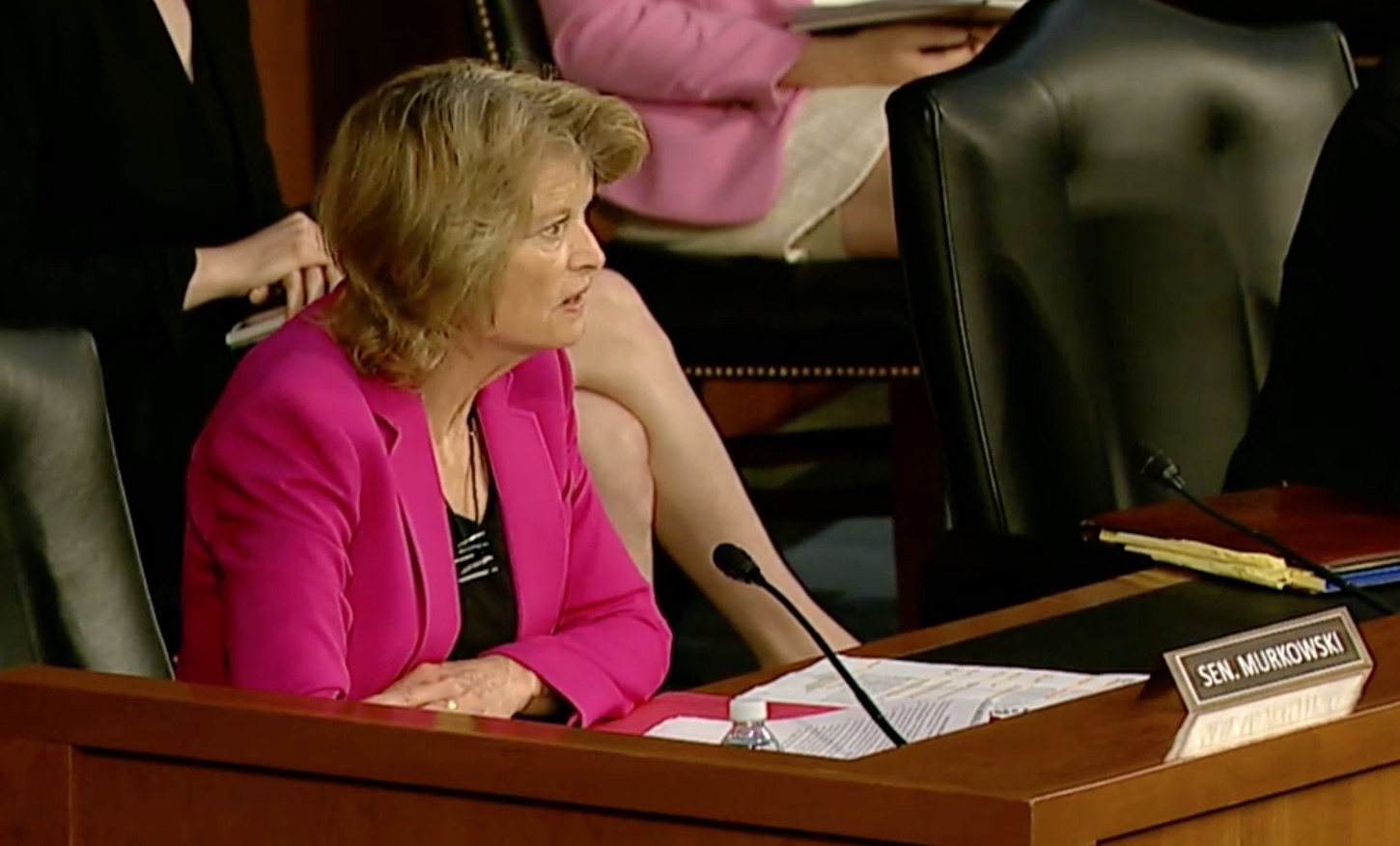
As one of the key negotiators of the bill, Sen. Lisa Murkowski issued the list and a statement about the win for Alaska:

“Sunday night, Senator Murkowski and her colleagues unveiled the text of their bill, which is now before the full Senate for consideration. The bipartisan bill provides $550 billion in new federal funding without raising taxes—including for roads, bridges, rail, transit, ports, airports, energy, water systems, and broadband. Due to Senator Murkowski’s dedicated work over the last few months, Alaska has an opportunity to benefit from these substantial and generational investments. 

“I’m proud of this historic funding and the significant impact it will have in Alaska. Whether it’s rebuilding existing infrastructure, driving innovative technology, or addressing the lack of basic infrastructure in rural communities, this bill will create economic opportunities and improve the lives of Alaskans across the state. In drafting this legislation with my colleagues on both sides of the aisle, I worked hard to stand up for Alaska’s unique infrastructure needs—taking into account that when we think of infrastructure, it’s not just roads and bridges. This bill prioritizes our marine highway system and ports that are so vital to connecting communities off the road system, invests in critical water infrastructure to bring clean water to families, supports an all-of-the above portfolio of energy projects to make energy cleaner, more reliable and affordable, and bolsters our nation’s mineral security. We also include provisions to strengthen broadband, which is so important for a rural state like Alaska. Funding to improve access to high-speed internet will translate to improved telehealth, commerce, and tele-education. This legislation is the result of compromise and good-faith efforts from across the aisle, and will create a stronger, brighter future for our state.”

Alaska Highlights in the Infrastructure Investment and Jobs Act

*Note: numbers are nationwide program funding.

Roads/Bridges:

·         Authorizes $273 billion in Federal-aid highway formula funding that will provide roughly $3.5 billion in highway funding for Alaska over five years to construct, rebuild, and maintain its roads and highways.

·         Provides $40 billion in funding for bridge construction, maintenance and repair. Of that, $27.5 billion will be apportioned by formula to ensure every state’s bridges are provided with needed resources, and Alaska should get $225 million to address more than 140 bridges considered to be “structurally deficient”. 

·         This includes $1 billion for the replacement of culverts, like the Schoenbar Creek culvert in Ketchikan.

·         There is an additional $11 billion for highway and pedestrian safety programs, including significant investment in the Safe Streets program, which aims to prevent death and serious injury to cyclists on roads and streets.

·         Authorizes funding for reconstruction of the Shakwak Highway, the Alaska Highway from the Alaska border at Beaver Creek, Yukon Territory, to Haines Junction in Canada and the Haines Cutoff Highway from Haines Junction in Canada to Haines, Alaska, in support of the U.S.’s agreement with Canada.

Airports:

·         $15 billion in formula funding for the FAA Airport Improvement Program which supports projects such as planning, installing and expanding runways, gates, and taxiways and improving runway lighting and navigation.

·         $5 billion for FAA’s Facilities and Equipment Program, which includes funding for FAA-owned Air Traffic Control facilities and contract towers. Alaska, with so many of its communities accessible only by air, depends on safety in the skies.  

·         $5 billion in grants for a new Airport Terminal Improvement Program, which includes set asides for small hub airports, nonhub, and nonprimary airports, ensuring airports in communities of all sizes, whether it be in Bethel or Utqiagvik, benefit.

Buses/Ferries: 

·         $1 billion for a new program that establishes an essential ferry service to support rural communities. This program, which was proposed by Senator Murkowski, will provide funding to the Alaska Marine Highway System. 

·         $250 million for an electric or low-emitting ferry pilot program, with at least one pilot to be conducted in the state with the most Marine Highway System miles—Alaska, which has 3,100 miles of Marine Highway, much of which is in Southeast Alaska.

·         $337 million for the Construction of Ferry Boats and Ferry Terminal Facilities program, of which Alaska should receive $73 million. Provides an authorization for recipients of funding under the program to spend on ferry “operating costs”. Alaska operators who previously received formula funds under this program in FY20 were the Alaska Marine Highway System, Ketchikan Gateway Borough, Inter-Island Ferry Authority, and Seldovia Village Tribe.

·         Authorizes Federal-aid highway funds to the Alaska Marine Highway System to be spent on operation and repair.

·         $5 billion to change out diesel school buses for electric or low-emitting buses across the nation. Communities, including Juneau, are beginning to adopt lower-emitting and electric buses.

·         $5.25 billion for the Low or No Emission Vehicle Program that supports the purchase of zero-emission and low-emission transit buses and construction of supporting facilities –important to communities such as Juneau.

Railroads:

·         $5 billion for the Consolidated Rail Infrastructure and Safety Improvement (CRISI) program to assist the Alaska Railroad with critical capital projects and rail safety technologies.

Water:

·         Provides more than $180 million over five years for water and wastewater projects in Alaska through the Clean Water State Revolving Fund (CWSRF) and Drinking Water State Revolving Fund (DWSRF) programs.

·         $3.5 billion for Indian Health Services sanitation facilities. This will provide significant resources for rural Alaska villages in need of water and sanitation. Thirty-two of the 190 rural Alaska Native communities are still unserved and lack access to in-home water and sewer. This unprecedented investment in sanitation infrastructure will clear all known project needs.

·         $10 billion for states to address PFAS contamination through Clean Water and Drinking Water programs, with a focus on small and disadvantaged communities. 

·         Modifies the tax treatment of financial contributions in aid of construction for water and sewerage providers, to assist water and sewerage utilities in Alaska, so the costs aren’t passed on to consumers.

Broadband:

·         Provides $42 billion in grants to states for the deployment of broadband, with a minimum allocation of $100 million for each state.

·         There is a dedicated carve out for high-cost areas for broadband deployment and $600 million for states to issue private activity bonds for deployment in rural areas.

·         Additional $2 billion for tribes through the Tribal Broadband Connectivity Grant program and $1 billion for Middle Mile Broadband Infrastructure grants.

·         Allows the Denali Commission to provide the required matching funds for grant recipients.

Denali Commission:

·         Provides $75 million for the Denali Commission. 

Permitting:

·         Permanently authorizes the FAST-41 permitting dashboard, which has saved infrastructure projects more than a billion dollars by substantially reduced permitting timelines for covered projects. This includes projects like the Alaska Gasline, the Liberty Project, and the Kake to Petersburg transmission line. 

·         Expands the eligibility of FAST-41 projects for infrastructure projects sponsored by Alaska Native Corporations regardless of size.

·         FAST-41 has already reduced the environmental impact statement process for covered projects from 4.5 years to 2.5 years and this new reauthorization will require the permitting council to create the goal of further reducing these timetables to two years or less.  

·         Includes legislation authored by Senator Murkowski to improve the timeliness and efficiency for the permitting of critical mineral projects, like the proposed development of graphite near Nome, cobalt in the Ambler region, or rare earths in Southeast. 

Ports:

·         $2.25 billion for the Port Infrastructure Development Program which provides critical support to ports big and small throughout Alaska.

·         Provides $250 million for remote and subsistence harbor construction. This will go toward building ports in rural areas, many of which are not connected to a road system and in need of a port—a lifeblood to rural communities in Alaska.

·         Includes $465 million for U.S. Army of Corps of Engineers Continuing Authorities Program authorities, which will help smaller communities across the country.

·         Funds $429 million on the Coast Guard’s unfunded priority list and for childcare development centers. This funding will support our Coast Guard personnel in Kodiak, Sitka, and Ketchikan.

Resilience:

·         Tribal Climate Resilience: $216 million is included over five years for tribal climate resilience, adaptation, and community relocation planning, design, and implementation of projects which address the varying climate challenges facing tribal communities across the country. Of that, $130 million is for community relocation and $86 million is for climate resilience and adaptation ​​projects. 

Energy and Natural Resources:

·         Includes $355 million for the Energy Storage Demonstration Projects and Pilot Grants Program which ensure more efficient energy storage infrastructure.

·         $3.21 billion for Advanced Reactor Demonstration Project, which will allow more headroom for micro reactors, an extremely promising technology for deployment in Alaska.

·         Provides $146.4 million to carry out hydropower and marine energy research. Funding from this program is used by the Alaska Hydrokinetic Energy Research Center (AHERC) at the University of Alaska Fairbanks, and works to assess the feasibility and deployment of hydrokinetic resources in Alaska.

·         Includes $264 million in funding for geothermal, wind, and solar energy projects. This will help the deployment and expansion of renewable energy resources in Alaska.

·         Removes barriers for participation by Indian Tribes and Alaska Natives in programs that are part of the bill’s Energy Infrastructure Act. 

·         Includes more than $4.7 billion for orphaned well cleanup, including Alaska’s legacy wells in the NPR-A.

Grid Infrastructure and Resiliency

·         Includes a set-aside for Small Utilities of 30 percent of program funds aimed toward preventing outages and enhancing resilience of the electric grid. Most Alaska utilities would qualify for this set-aside. Fifty percent of program funds will go to States or Indian Tribes. 

·         Provides $1 billion specifically for rural or remote areas (populations not more than 10,000 inhabitants) to improve the resiliency, safety, reliability, and the availability of energy. This funding will help Alaskan communities and Native villages to improve overall cost-effectiveness of energy generation, transmission or distribution systems, providing or modernizing electric generating facilities and developing microgrids.

·         Directs $250 million in grants for the Rural and Municipal Utility Advanced Cybersecurity Grant and Technological Assistance Program in competitive grants for small and rural utilities to upgrade cybersecurity capabilities.

·         Includes Senator Murkowski’s bill, S. 1400, the PROTECT Act, which enhances the electric grid by incentivizing electric utilities to make cybersecurity investments and makes available $250 million in grants and technical assistance for small utility providers that are not regulated by FERC, which includes many of the cooperatives and municipal utilities across Alaska.

Supply Chains for Clean Energy Technologies

·         Includes over $825 million to strengthen our nation’s mineral security.

·         $23 million is provided for the National Geological and Geophysical Data Preservation Program, which sustains Geologic Materials Center in Anchorage.

·         Includes $320 million for the Earth Mapping Resources Initiative that will help us better understand the quantity, type, and location of mineral resources in Alaska, like the Yukon-Tanana uplands.

·         Reauthorizes the National Cooperative Geologic Mapping Program through 2031, which identifies mineral deposits and helps Alaskans map geologic hazards such as landslides, volcanoes, and earthquakes.

·         Provides over $6 billion for battery processing and manufacturing, including grants for commercial-scale battery materials processing facilities. This could benefit firms who are looking to produce and refine battery materials such as graphite and rare earth elements in Alaska. 

·         Makes critical mineral development projects eligible for DOE’s Title 17 Loan Guarantee to receive financing. To date, over $25 billion has been distributed through the Title 17 program.

Fuels and Technology Infrastructure Investments

·         Provides over $34 billion for carbon capture and storage and related programs, hydropower funding, clean hydrogen, and civil nuclear credits. All of these technologies have enormous consequence for Alaska.

·         Supports Alaska’s enormous potential for hydropower— which could provide communities with renewable, affordable, and clean energy—by including incentive payments to upgrade hydropower facilities.

·         Secures $100 million for the Bureau of Reclamation to establish a program for small water storage projects, including in Alaska and Hawaii.

·         Repeals an outdated limitation on $18 billion in loan guarantees that has been set aside for an Alaska gasline, thus ensuring the gasline can access the funds.

Energy Efficiency and Building Infrastructure

·         Over $6 billion included for energy efficiency measures across the whole bill, including $250 million for loan fund capitalization grants, $3.5 billion for Weatherization Assistance Program, $550 million for energy efficiency and Conservation Block Grants, and $225 million for efficiency and resiliency code implementation. These programs will help Alaskans reduce their energy costs, put money back into their pockets, and help mitigate the impacts of climate change.

Natural Resources-Related Infrastructure, Wildfire Management, an Ecosystem Restoration

·         Provides $250 million for decommissioning, road and trail repair and maintenance and removal of fish passage barriers, which is significant for restoring salmon and other fish habitat in Alaska’s national forests.

·         Includes more than $3.3 billion to conduct mechanical thinning, controlled burns, fuel breaks and other activities to reduce wildfire risk on Interior and Forest Service lands, including in Alaska. The fuel breaks implemented on the Kenai, in particular, are credited with saving communities during the Funny River Fire. The bill also includes pre-commercial thinning important for subsistence resources and improving growth of young growth stands in Alaska on the Tongass.

·          Provides over $2.1 billion for the Department of the Interior and the Forest Service to restore the ecological health of Federal lands and waters and of private lands, through voluntary efforts, via a variety of programs, including through partnering with States.  Alaska will qualify for all of these restoration programs and projects.

·         Includes specific carve out of $20 million for construction, reconstruction, operation and maintenance of recreation public use cabins. There are more than 155 of these cabins in the Tongass and another 50 in the Chugach in Alaska.

·         Includes $100 million for workforce training for firefighting and vegetation management that specifically includes Native village fire crews.


Political kill shot? Assembly to grill Health Department appointee David Morgan

The Anchorage Assembly has scheduled a work session on Tuesday, Aug. 3 to continue the confirmation hearings for some of Mayor Dave Bronson’s department head nominees.

The session is scheduled from 10 am to 1 pm, and it’s clear that the liberal Assembly is saving the last person, to dedicate an hour for David Morgan, which the majority of the Assembly has zeroed in on, with an eye for turning down the nomination. They’ve allowed one half hour for all other hearings, but a full hour for Morgan.

The Assembly moved up Morgan’s hearing; it was originally scheduled for late August. He is the first appointee to have an hour set aside for him.

The hearings can be observed on YouTube at the following times and links:

Adam Trombley as Director of Office of Economic & Community 8/3/2021 10 AM  View on YouTube 
Saxton Shearer as Director of Maintenance 8/3/2021 10:30 AM  View on YouTube 
Lance Wilber as Director of Public Works 8/3/2021 11 AM  View on YouTube 
Christina Hendrickson as Director of Real Estate 8/3/2021 11:30 AM  View on YouTube 
David Morgan as Director of Health Department8/3/2021 12 PM  View on YouTube 

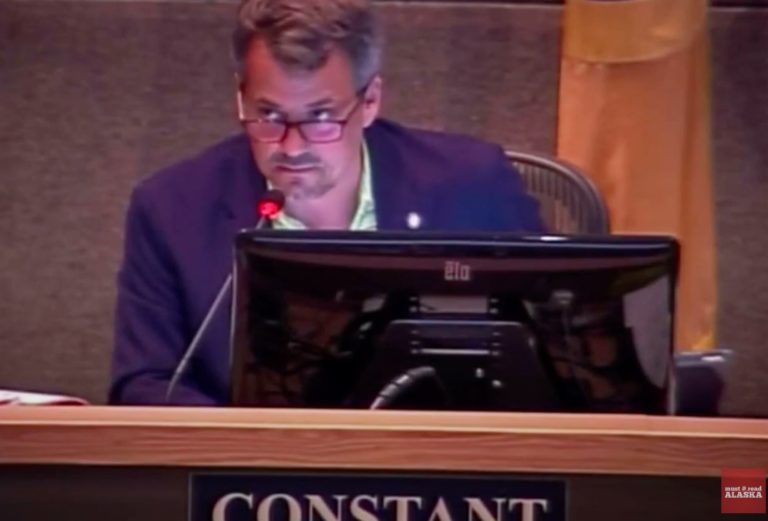
Vice Chair of the Assembly Chris Constant has been quoted saying he is concerned about remarks Morgan has made about the Covid-19 pandemic.

Morgan, on a television news show, said, “Pandemic is an adjective that describes a situation.”

Morgan later clarified that, “I was concentrating on the concept of an emergency and, because we were talking about policy stuff. It is, it is a pandemic, if you’re unvaccinated. I will, I feel that way — my understanding of my experience in health care. If you’re unvaccinated … you are in a pandemic.”

Those are the words also used by President Joe Biden last month, when he said, “Look, the only pandemic we have is among the unvaccinated.”

Morgan has a vast resume of managing health bureaucracies, such as Native health organizations; he has also served as a consultant nationally to governments. He worked at Southcentral Foundation for decades. He was a founder of the Alaska Center for Sustainable Healthcare Spending and Policy, which opposed Medicaid expansion in Alaska during the Walker Administration.

The most recent Health Department director, hired by former Mayor Ethan Berkowitz last August, had served as the executive director for Boys and Girls Club in Anchorage. Heather Harris slipped into that job without a single question from the media about her qualifications and had been advising the mayor (and then interim Mayor Austin Quinn-Davidson, after Berkowitz’ hasty and embarrassing departure in October), and the Anchorage School District on matters relating to business openings and closures, schools, masks, distancing, testing, and more. Although she had no background, she was excellent at repeating the CDC advisories as they came down.

Harris took over the health department in the middle of the pandemic after the previous director quit.

Read: Anchorage Health Dept. director has no background in health

It appears Morgan was placed last in the hearing queue so the Assembly can wear him out, go over time, and give Morgan a chance to say something they don’t like that can give the Assembly an excuse to not vote for him at their regular meeting next week.