Sunday, May 3, 2026
Home Blog Page 1059

Assembly to add ‘Equity’ pillar to its strategic plan for Anchorage

The Anchorage Assembly will vote Tuesday on whether to add another “pillar” to its strategic plan. This one is defined as an Equity pillar.

It would join those pillars of Quality of Life, Public Safety, Economic Development, Homelessness.

What is equity? It is a term that essentially means socialism.

George Washington University Public Health Department defines it as different from the long-sought quality of “equality”:

“Equality means each individual or group of people is given the same resources or opportunities. … Equity recognizes that each person has different circumstances and allocates the exact resources and opportunities needed to reach an equal outcome.”

Karl Marx, the father of socialism, put it another way: “From each according to his ability, to each according to his needs.”

Equity is socialism in that it does not strive to offer just equal opportunity, but equal outcome.

Oregon Gov. Kate Brown just signed an education equity statute that removes the requirement that high school students prove proficiency in reading, writing, or math before graduation.

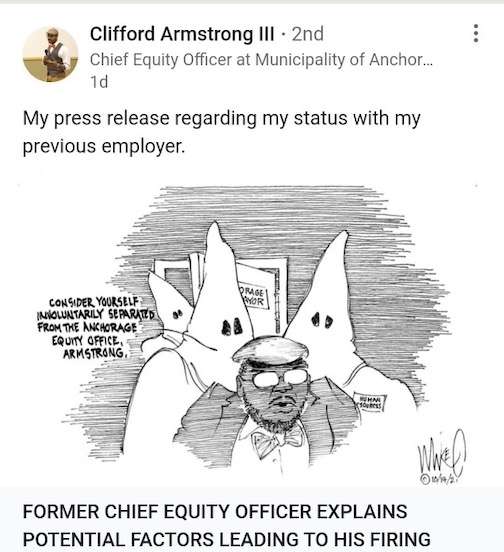
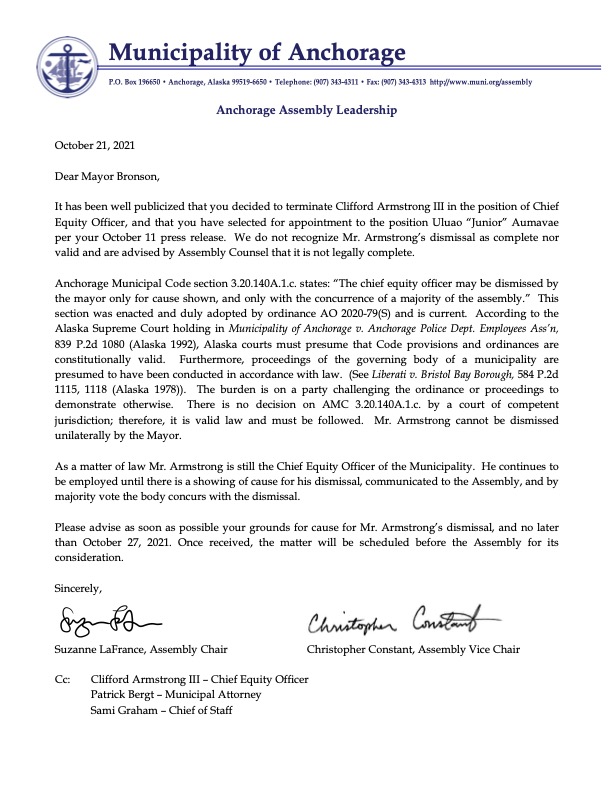
Last year the Anchorage Assembly authorized the hiring of an equity officer, who was then put on the payroll in April. He has no deliverables and cannot be fired by the mayor without the authorization of the Assembly.

The Anchorage Assembly, which is arguably the most radical of all local governing bodies in the state, will take up the ordinance at the meeting that starts at 5 pm in the Loussac Library. Agenda is here.

Hidden in Infrastructure bill, mandatory alcohol/drug detectors in new vehicles

Contained on page 1,066 of the $1.1 trillion infrastructure bill that passed the Senate on Tuesday is a hidden price hike on new vehicles.

The price hike comes in the form of a mandate that all new vehicles, within six years, will be required to have passive monitoring devices to detect drug and alcohol overuse in the vehicle.

The bill, which is mainly to fix roads, bridges, dams, and broadband, doesn’t say “breathalyzer,” but refers to “passive” systems that monitor the performance of drivers. That is usually accomplished by measuring the alcohol in the air inside the vehicle. If a driver doesn’t pass the test, the car won’t start.

The new requirement has been talked about since before 2019, when Sens. Tom Udall, D-N.M., and Rick Scott, R-Fla., introduced the Reduce Impaired Driving for Everyone Act of 2019, which would have mandated the devices by 2024. A coalition of auto manufacturers is behind the bill, which is also supported by groups such as Mothers Against Drunk Driving.

The newly passed bill, which includes $550 billion in new spending and $450 billion in already approved funds, also requires automobile technology to measure impairment from prescription drugs or simple drowsiness.

Drunk driving fatalities have decreased nationally by 52 percent since 1982, according to Responsibility.org. Among persons under 21, drunk driving fatalities decreased 83 percent.

The National Highway Traffic Safety Administration reports drunk driving accounts for one-third of all traffic deaths, with 10,800 people killed in drunk driving incidents in 2019.

Also in the bill is Section 13002, titled “National motor vehicle per-mile user fee pilot,” a demonstration project to tax drivers based on their annual mileage, rather than at the fuel pump. This helps the federal government recover some lost revenues now that electric car owners don’t pay federal fuel taxes of 18.4 cents per gallon. But it also would allow the federal government to track the whereabouts of every private vehicle.

The infrastructure bill’s new spending includes $110 billion for roads and bridges, $66 billion for rail projects, $65 billion to expand access to broadband and includes a $30 monthly voucher for low-income households to pay for their internet service.

The bill also tackles climate change with $65 billion for the electrical grid, $50 billion for protection from cyberattacks and floods and forest fires, and about $7.5 billion to build charging stations for electric vehicles. Another $7.5 billion will help replace school buses and ferries with electric models.

The bill still must pass the House, and Speaker Nancy Pelosi made it clear she will use the infrastructure bill as leverage to get the massive $3.5 trillion Green New Deal bill through the Senate and over to the House. She will not allow her chamber to take up either bill until she has them both. President Biden has also stated he will not sign the infrastructure bill until he has the larger bill along with it.

Voting in favor of the infrastructure bill were both members of Alaska’s Senate delegation, Sen. Lisa Murkowski, who helped negotiate the package, and Sen. Dan Sullivan.

Read Three and a half trillion dollar bill revealed by Democrats.

Democrats unveil $3.5 trillion budget with expanded Medicare, Obamacare, pre-K, free community college, and Green New Deal

The $3.5 trillion budget reconciliation plan rolled out by Senate Democrats on Monday is the Green New Deal, wrapped in the New Deal, wrapped in the President Lyndon Johnson Welfare State.

How big is $3.5 trillion? That’s the same amount the entire federal government spent in 2019.

This bill will make more people dependent on the federal government than ever before, whether it’s socialized health care or the massive public housing expansion envisioned. It incentivizes electricity over oil, and will create a climate industrial complex inside the federal government.

According to Democrats’ talking points, the plan:

  • Establishes universal pre-K for 3 and 4-year-olds and a new child care benefit for working families
  • Makes community college tuition-free for 2 years
  • Extends the largest tax cut for families with children ever (CTC/EITC/CDCTC)
  • Increases the Pell grant award
  • Creates the first ever federal paid family and medical leave benefit

CLIMATE:

  • Creates a new Clean Electricity Payment Program
  • Provides clean energy, manufacturing, and transportation tax incentives and grants
  • Imposes new polluter fees (methane and carbon imports)
  • Invests in climate smart agriculture and forest management investments for farmers and rural communities
  • Creates coastal and ocean resiliency programs
  • Makes drought, wildfire, and Interior Department investments
  • Provides new consumer rebates for home electrification and weatherization
  • Provides environmental justice and climate resilience
  • Electrifies the federal vehicle fleet and buildings

INFRASTRUCTURE AND JOBS:

  • Historic level of investments in public housing, green and sustainable housing, housing production and affordability
  • Establishes the first ever Civilian Climate Corps
  • Invests in workforce development and job training programs to connect workers to good-paying jobs
  • Provides green cards to millions of immigrant workers and families
  • Funds smart technology for safe and efficient borders for trade, travel and migration
  • Largest ever one-time investment in Native American infrastructure projects
  • Rehabilitates aging Veterans Administration buildings and hospitals
  • New economic development investments to revitalize communities and transform regions for new innovationjobs
  • Invests in research and development and strengthens U.S. manufacturing supply chains
  • Expands access to capital and markets for small businesses

HEALTH CARE:

  • Adds a new dental, vision, and hearing benefit to the Medicare program
  • Extends the recent expansion of the Affordable Care Act in the American Rescue Plan
  • Invests in home and community-based services to help seniors, persons with disabilities and home careworkers
  • Creates a new federal health program for Americans in the “Medicaid gap”
  • Reduces prescription drug costs

The cost of this plan will be in a revenue section the Democrats did not talk about, but that includes higher taxes on the wealthy, a death tax on inheritances, and a higher tax on corporations.

Dan Fagan: Murkowski and Sullivan refuse to say how they’ll vote on job-killing ‘PRO Act’

By DAN FAGAN

If the federal Protecting the Right to Organize Act, or PRO Act becomes law, it will make it much harder to work as an independent contractor or become self-employed. It would also destroy thousands of small businesses. 

Simply put, the Big Labor-backed, and Joe Biden-supported PRO Act is an assault on capitalism and a huge step toward socialism and eventually communism. 

Alaska Congressman Don Young was one of only five Republicans to vote for the PRO Act when it passed the House.

No surprise there. Young has been a wholly owned subsidiary of Big Labor for years. 

The legislation now sits in the Senate where Sens. Dan Sullivan and Lisa Murkowski remain undecided on the freedom-destroying bill.  

For six decades, Big Labor has struggled convincing private sector workers to join unions and pay dues. Private sector union membership in America has been as high as 35 percent. Today, it’s in the single digits and dropping. 

The PRO Act would tilt the playing field considerably in favor of dues-collecting labor union bosses at the peril of small business owners and the self-employed.

The U.S. Chamber of Commerce described the PRO Act as “a litany of almost every failed idea from the past 30 years of labor policy.” 

The PRO Act ends the secret ballot for workers when they’re voting on whether to unionize at their job. The worker will be forced to vote via a check card, meaning the union boss will know which workers voted against their efforts. That could cost the worker if the business becomes unionized.  

The PRO Act would force workers to pay dues even if they voted against joining the union. The legislation would also gut protections in the 27 states that passed Right to Work legislation, Alaska not being one of them. 

The bill also has a “You can never leave provision.” Once workers vote to unionize at a business, they are not allowed to vote the union out. 

Under current labor laws, if employees at a unionized business strike, the company has the right to lock the workers out. The PRO Act takes away that right from business owners.  

The PRO Act would also force most independent contractors to become employees. This aspect of the bill would all but kill the gig economy and companies like Uber and Lyft.

The emergence of ride sharing has been a win-win for both drivers and riders. It means drivers never have to worry about making ends meet. For passengers, it provides a much cheaper and less smelly mode of transportation. 

But as with anything that’s too good to be true, you can count on union boss puppet politicians like Congressman Don Young to end it. Unions don’t care much for the free market.  

In California, the state legislature passed a similar law to the PRO Act. After the bill passed, Uber and Lyft were poised to shut down in the state until an appeals court allowed the companies to continue to temporarily treat their drivers as independent contractors. 

California voters then passed a ballot initiative exempting Uber and Lyft drivers from being forced to becoming employees. 

The PRO Act would hit Alaska’s construction industry especially hard. 

“The PRO Act poses a significant threat to the viability of the commercial construction industry, its long history of offering advancement and opportunity to all workers and its ability to rebuild our economy and revive our nation,” according to a statement by the Associated General Contractors. 

The PRO Act would allow union bosses to force business owners to turn over their employees’ personal information like cell phone numbers and email addresses. The legislation puts no limits on how union bosses can use the private information. 

The PRO Act is a deeply punitive measure for small businesses. If a small business owner hires a contract worker, that worker will be considered an employee entitled to full benefits. 

If this legislation passes, owning a small business will become much more expensive. 

The PRO Act is an all-out assault on the free market and capitalism. The fact that Murkowski and Sullivan refuse to lead the fight against such legislation, or even refuse to commit to vote against the bill, speaks volumes about them. 

As for Don “Big Labor” Young, it’s more of the same. 

Dan Fagan hosts the top rated morning drive radio show on Newsradio 650, KENI. 

Pentagon rules: All members of military must get Covid-19 vaccine by Sept. 15

The Pentagon announced today that all members of the military must get a Covid-19 vaccine by Sept. 15. If the FDA moves the deadline for final approval of the vaccine, or if Covid continues to spread rapidly, the deadline may be moved up. The announcement was expected and leaked last week.

Some 64 percent of active duty military personnel are fully vaccinated.

Tens of thousands of woman of child-bearing age are in the military, and it’s unclear how the vaccine may affect them if they are pregnant or become pregnant. In 2016, over 13 percent of the women of childbearing potential in the military had a pregnancy-related “event,” according to the military’s health website. There were more than 64,000 live births in this military sub-population in 2016.

The Covid vaccine mandate also extends to military contractors.

The memo from Secretary of Defense Lloyd Austin said:

As many of you know, President Biden asked me to consider how and when we might add the coronavirus disease 2019 (COVID-19) vaccines to the list ofthose required for all Service members. So, over the last week, I have consulted closely with the Chairman of the Joint Chiefs of Staff, the Secretaries of the Military Departments, the Service Chiefs, and medical professionals. I appreciate greatly the advice and counsel they provided.

Based on these consultations and on additional discussions with leaders ofthe White House COVID Task Force, I want you to know that I will seek the President’s approval to make the vaccines mandatory no later than mid-September, or immediately upon the U.S. Food and Drug Administration (FDA) licensure, whichever comes first.

By way of expectation, public reporting suggests the Pfizer-BioNTech vaccine could achieve full FDA licensure early next month.

The intervening few weeks will be spent preparing for this transition. I have every confidence that Service leadership and your commanders will implement this new vaccination program with professionalism, skill, and compassion. We will have more to say about this as implementation plans are fully developed.

In the meantime, we will comply with the President’s direction regarding additional restrictions and requirements for unvaccinated Federal personnel. Those requirements apply to those of you in uniform as well as our civilian and contractor personnel.

We will also be keeping a close eye on infection rates – which are on the rise now due to the Delta variant – and the impact these rates might have on our readiness. I will not hesitate to act sooner or recommend a different course to the President if I feel the need to do so.

To defend this Nation, we need a healthy and ready force. I strongly encourage all DoD military and civilian personnel – as well as contractor personnel – to get vacci~ated now and for military Service members to not wait for the mandate.

All FDA-authorized COVID-19 vaccines are safe and highly effective. They will protect you and your family. They will protect your unit, your ship, and your co-workers. And they will ensure we remain the most lethal and ready force in the world.

“Get the shot. Stay healthy. Stay ready,” he wrote.

Census data coming this week

The U.S. Census Bureau will hold a news conference Thursday to discuss its release of the first local-level results from the 2020 Census.

The Aug. 12 release of the data is four days ahead of the agency’s Aug. 16 self-imposed deadline.

States use the data on race, Hispanic origin, and the voting-age population to redraw the boundaries of congressional and state legislative districts. Most legislators who intend to run for reelection next year have only filed “letters of intent” because they are not sure what the number of their district will be after the lines are drawn.

The release of the data was delayed by months due to the difficulty of conducting the Census in 2020, with the Covid-19 pandemic hitting during the data-collecting period.

Some of the data has already been released, but this week’s data will start the clock on the redistricting process in Alaska and other states. The lines for state House and Senate districts are expected to shift as a result in advance of the 2022 midterm election.

In April, the overall population of states was released. Alaska has 733,391 residents, according to the Census.

Read: Census report shows 733,391 residents in Alaska

Heartbreak for Alaska’s Little League team as Covid-positive test bumps them from California series

The Knik Little League baseball team that won the Alaska state championship is at the Northwest Region tournament in San Bernardino, Calif. Now they cannot play.

The team, 10-12 year olds, has been eliminated due to one player testing positive for Covid. That player is asymptomatic, but the entire team, parents, and support staff, and volunteers are stuck in California for the duration.

The team arrived Thursday, a day ahead of other teams in the division. That day they all tested for Covid-19, as is the requirement for the tournament.

The other teams arrived Friday and were able to play through the weekend because their Covid-19 results did not come back. The Knik team’s tests, taken the day before, came back Friday, said the team’s coach Mike McNeil. Because of their lengthy travel time from Alaska, they got penalized, while other teams didn’t.

The Little League International sent out a statement Friday afternoon, telling the team they would have to forfeit. Their first game was to be Monday morning.

Such is the era of Covid-19 policies. The rules are the rules.

McNeil said the team’s once-in-a-lifetime opportunity to play for a chance to go to the Little League World Series has been dashed. There are no do-overs, no second chance. The kids were taking it pretty hard, he said.

“It’s beyond heartbreaking to see these kids work so hard and come down here with a chance to play on ESPN, and then have it literally ripped away from them,” McNeil said. “No matter where you live in Alaska, this is the team that represents our state. Youth baseball on national TV is a big deal.”

McNeil said the group is trying to make the best of it and has as of yet been given no guidance for when they can travel.

Suzanne Downing: Is conservative base giving Sen. Dan Sullivan a fair shake? Not really.

By SUZANNE DOWNING / MUST READ ALASKA

Will we ever learn?

Time and again, I see conservative readers at Must Read Alaska expressing their disappointment with Sen. Dan Sullivan, saying he doesn’t stand strong enough for their positions.

Those positions would be, in general, to support Republicanism, a strong national defense, solid borders, our Constitutional rights, and to reject the extreme agenda of President Joe Biden and his surrogates in the House and Senate.

They rightfully rail about Sullivan’s vote to confirm the nomination of Secretary of Interior Deb Haaland, a hardcore radical now in charge of most of the public lands in Alaska.

Haaland has proven a disaster. She is squarely on the side of those who want the Department of Interior to be a parallel national parks agency. Her legacy in Alaska will be along the lines of former Secretary of Interior Sally Jewell. All three members of Alaska’s delegation made the mistake of supporting Haaland, and all three should have known better. Hindsight is a cruel judge.

But a look at Sullivan’s entire voting record tells a better story. It’s the story of showing up, debating, and voting like a conservative.

Sullivan votes correctly on matters important to conservatives, and he does so all the time. He isn’t a knee-jerk voter or ideologue, and seems to wring his hands quite a bit as he worries about whether something is good for the country and, importantly, Alaska. That’s his nature — he is a worrier as much as he is a warrior.

He voted against the confirmation of Biden radicals to important positions in government.

He said no to Nomination of Kiran Ahuja to be director of the Office of Personnel Management. She, an advocate and practitioner of Critical Race Theory, was confirmed 51-50, with Sen. Lisa Murkowski also voting no.

Sullivan voted against the nomination of Chiquita Brooks-LaSure as the administrator of the Centers for Medicare and Medicaid Services. Brooks-LaSure is considered a political ideologue who is hellbent on destroying the fabric of the American family, while being an advocate for illegal aliens. Murkowski voted in favor of this nominee.

Sullivan voted against the nomination of Vanita Gupta to be Associate Attorney General, while Murkowski voted in favor of her.

While Sullivan voted against the nomination of Michael Regan as Administrator of the Environmental Protection Agency, Murkowski voted in favor.

He voted against the nomination of Xavier Becerra as Secretary of Health and Human Services, while Murkowski also voted against this nominee.

Sullivan voted against the nomination of Rachel Levine as Assistant Secretary of the Department of Health and Human Services, while Murkowski voted in favor.

Sullivan voted no on the nomination of Miguel Cardona as Secretary of Education; Murkowski was a yes. Cardona is a pioneer for using Critical Race Theory in classrooms.

He voted against the nomination of Merrick Garland as Attorney General, while Murkowski voted in favor.

Sullivan voted against the radical “For the People Act,” which would have the federal government take over elections, against what is set forth in the Constitution.

He voted against the creation of a national commission to investigate the Jan. 6 “attack” on the United States Capitol Complex, while Murkowski voted yes.

Sullivan voted against increasing the federal minimum wage to $15 an hour; Murkowski also voted no.

When it came to the vote to impeach Donald Trump for high crimes and misdemeanors, Sullivan was a no; Murkowski was a yes.

Do you see a trend here? While conservatives may disagree with Sullivan on some of his votes, and may take issue with him on his strategy for getting things done for Alaska, the bulk of Sullivan’s votes are clearly conservative and well within reason.

We elect people to represent our views. One hundred percent of them will not represent 100 percent of our views, and so it’s critical that we step back and look at the big picture. Does this senator (or representative) work hard, show up for votes, speak effectively, move legislation, work well with others, and reflect our values?

If we are to be honest, Sen. Dan Sullivan does those things and more; his constituent relations office, no small part of his job, is responsive to Alaskans, for the most part.

As with all elected officials, he has a “miss” now and then. But his record is solidly conservative, and Alaska conservatives should remember to offer him a bit of grace next time they think about getting into the circular firing squad.

Suzanne Downing is publisher of Must Read Alaska. You can support this conservative news site with your donation.

Read Dan Sullivan slams David Chipman, Tracy Stone-Manning, both radical Biden nominees

Sullivan slams nominees David Chipman for ATF and Tracy Stone-Manning for BLM

Alaska Sen. Dan Sullivan took to the Senate floor today to express how troubled he is about a gun-control activist who is President Joe Biden’s nominee for the Bureau of Alcohol, Tobacco and Firearms.

Speaking of David Chipman, the ATF nominee, Sullivan said, “He is another extreme activist, this time against the Second Amendment and Second Amendment rights. He will be in charge of an agency, if confirmed, that’s actually in charge of law enforcement in regard to firearms.”

Sullivan quoted Iowa Republican Sen. Chuck Grassley, who said putting Chipman in charge of firearms is like putting Antifa in charge of the Portland Police Department.

“If my colleagues believe that the Second Amendment is as important as other amendments … they wouldn’t be supporting Mr. Chipman as the head of ATF,” Sullivan said.

Chipman is well-known for his extremist views in defiance of the Second Amendment. Chipman has proposed that people who fail background checks should be arrested before they commit crimes.

Sullivan quoted Chipman saying in an interview, “This is a perfect opportunity to arrest people before they commit crimes, rather than arrest them after the fact.”

“Let that sink in..Let’s arrest people before they commit a crime,” Sullivan said. “He’s actually advocated arresting people who failed background checks. This is extreme, to say the least.”

Chipman also wants to ban any rifle other than a .22, which Sullivan said is not appropriate for Alaska. Chipman has lobbied for universal background checks, and to establish a national firearms transfer delay period.

Chipman’s confirmation vote has not yet been brought to the floor by Sen. Majority Leader Chuck Schumer, D-NY. But Senate Judiciary Committee Chair Dick Durbin said he would have no further hearings on Chipman’s nomination, in spite of new allegations of racism were lodged against Chipman last week. Neither Sullivan nor Alaska Sen. Lisa Murkowski serve on that committee, but Sen. Ted Cruz of Texas does serve on it, and has been vocal about his objection to Chipman.

Of Tracy Stone-Manning for the Bureau of Land Management, Sullivan said, “Somehow the president has decided to put forward someone who’s not just an extremist, but a violent extremist, a former eco-terrorist named Tracy Stone-Manning. This nominee clearly undertook activities, as part of a group called Earth First! — tree spiking, they call it — that’s actually meant to harm Americans who are legally harvesting logs and timber. That’s unbelievable that we’re actually even debating this nominee.”

Sullivan continued, “It’s disturbing and I ask that the president pull that nominee.”