Alaska Attorney General Treg Taylor joined 21 other attorneys general in opposing the Bureau of Alcohol, Tobacco, Firearms and Explosives proposed rule to require federal registration of handguns equipped with stabilizing braces.
The new rule, if it takes effect, would reclassify such handguns as “short-barreled rifles,” and subject them to the stringent requirements of the National Firearms Act.
Stabilizing braces are devices that can be attached to the rear of a handgun’s frame. The brace extends rearward toward the shooter, allowing the handgun to be secured to the shooter’s forearm of the arm holding the handgun’s grip. Stabilizing braces are designed to assist in firing large format pistols without shouldering the weapon. Both stabilizing braces and large format pistols have gained popularity in recent years, with tens of millions in circulation.
“The federal government’s new interpretation of ‘rifle’ would result in the largest unilateral federal firearms registration program in American history,” Taylor said in a statement. “This definition would effectively force the registration or destruction of millions of privately-owned firearms and possibly criminalize the actions of otherwise law-abiding gun owners without any statutory authority to back it up.”
If the proposed rule becomes law, owners of these popular handguns would be forced to register them with the federal government, destroy them, or face a potential federal felony for illegally possessing an unregistered short-barreled rifle.
Alaska joined the Ohio led comment letter with the attorneys general from Alabama, Arizona, Arkansas, Florida, Georgia, Idaho, Indiana, Kentucky, Louisiana, Mississippi, Missouri, Montana, Nebraska, New Hampshire, Oklahoma, South Carolina, South Dakota, Texas, Utah, and West Virginia.
To date, more than 88,658 Alaskans have had a bout with the Covid-19 virus that originated in Wuhan, China in 2019 and has spread to every corner of the world. That does not count the perhaps-thousands of Alaskans who had the virus but never reported to a doctor, due to having mild symptoms or no symptoms at all.
Out of those 88,658 who were known to become infected, 2,059 ended up in the hospital, which is about 2.3 percent of the cases.
Covid has been the attributed cause of 437 deaths in Alaska, just under 1/2 percent of all known cases.
But, if you end up in the hospital with Covid, your chances of dying are over 21 percent, if past months are any indication. Over 20 percent of people in Alaska hospitals right now are needing treatment due to the Wuhan virus. Thus, a good reason to avoid the bug, if you can.
That may not be entirely possible. The World Health Organization says the virus is here to stay and, like the flu, will continue to mutate.
“I think this virus is here to stay with us and it will evolve like influenza pandemic viruses, it will evolve to become one of the other viruses that affects us,” said Dr. Mike Ryan, executive director of the World Health Organization’s Health Emergencies Program, during a Tuesday press briefing.
The number of people vaccinated against the virus in Alaska stands at 337,931, and when you add the vaccinated to that total, presuming there’s not a lot of overlap, well over half of the population, or 426,589 Alaskans, have either had the disease or received a shot to prevent it. That’s over 58 percent of Alaskans having some degree of protection.
And yet the numbers of those infected keep climbing, mostly among the 42 percent of Alaskans without protection, and with a smaller, unknown number of “breakthrough” cases, or cases that defied the vaccine.
With 432 new cases on Sept. 6, the virus has hit 17 percent more this week than it did last week. This would indicate that while more people have either medical or natural immunity, those not immune are being hit especially hard. However, the death rate is not climbing as it did during the first year of the pandemic, possibly because many elderly and medically fragile Alaskans have had the vaccine and have adjusted their lifestyles to limit their contact with those who might infect them.
A midair collision with minor damage near Anchorage between two Cessnas was reported on the Federal Aviation Administration. The incident happened on Sept. 4.
A Cessna 185, owned by Above and Beyond Aviation of Anchorage was reported to have had to dive in midair to avoid a Cessna 182, according to the FAA incident reporting system.
“AIRCRAFT IN-FLIGHT DAMAGED WING TIP AND LEFT TIRE MARKS ON N737DM, ANCHORAGE, AK.,” reads one line on the incident summary.
“AIRCRAFT DOVE TO AVOID ANOTHER AIRCRAFT N21132, LANDED AND POST FLIGHT INSPECTION REVEALED WING TIP DAMAGE WITH TIRE MARKS, ANCHORAGE, AK.” reads another line.
Both incidents were reported to have happened in the late evening.
The Cessna A185F Skywagon, a float plane, left Lake Hood in Anchorage at 6:50 pm for a 30-minute flight. It was struck by the Cessna 182P Skylane, a wheeled plane, which is registered to an Aniak address.
Few other details were available but apparently both planes were able to land without anything other than the black tire scuffs and minor damage on the wing of the Skywagon.
Lake Hood is the busiest seaplane base in the world, with nearly 200 daily operations.
Six jets are said to be still stuck at the airport in Mazar-i-Sharif, Afghanistan’s fourth-largest city. The Taliban will not allow them to exit, the State Department says, and now word is the State Department is telling countries not to take the planes, which contain an unknown number of Americans who have been stuck on the planes for six days.
Texas Congressman Michael McCaul, the top Republican on the Foreign Affairs Committee, told CNN that the number of Americans on those planes is in the hundreds. There are also reported Afghan allies — those Afghans who helped the Americans during the 20-year war.
“(The Taliban) are not clearing the airplanes to depart. They’ve sat at the airport for the last couple of days,” McCaul said on Fox News Sunday. “We know the reason why is because the Taliban want something in exchange. This is … turning into a hostage situation where they’re not going to allow American citizens leave until they get full recognition from the United States of America.”
McCaul has referred to the passengers as hostages, a characterization disputed by the Newsweek editor who is monitoring the story. Newsweek editor-at-large Naveed Jamali wrote: “Also @RepMcCaul was absolutely incorrect as characterizing any of these people as hostages. There is nobody being denied exit of the country, or being detained on a plane. Instead the Taliban has not granted clearance for the planes to leave. Spoke to two sources who confirmed.”
He elaborated, saying, “Also the PLANES are being denied clearance, not the PEOPLE. Yes that is a pretty big distinction.”
Among the “planes denied clearance” is a charted jet from Goldbelt, an Alaska Native corporation based in Juneau. Goldbelt has numerous military contracts, which included vetting people for entrance into the former “Green Zone” in Kabul, which was a zone that was safe from terrorism, as people were checked in and out of it. Later, the company was asked to help with evacuating Americans and Afghan allies and charted a jet. The company was not able to provide comment because of what is described as a very dynamic situation in Afghanistan.
At first, the hold up was blamed on having manifests that did not exactly match who was on the planes. Then, the State Department was being blamed for telling allies not to receive the planes.
Secretary of State Antony Blinken traveled to Doha, Qatar, to negotiate with the Taliban and to thank Qatar for its role in facilitating the U.S. retreat from Afghanistan.
Blinken said Tuesday the Taliban “had been reminded in recent hours that the international community is holding the group to its commitment to let anyone with valid travel papers leave Afghanistan if they choose,” according to the Voice of America.
Blinken said the number of U.S. citizens, including those with dual citizenship, who are thought to be still in Afghanistan is about 100, and he said the State Department is in direct contact with them, according to VoA. He said the State Department is in direct contact with them.
He said the Taliban has “told the world that they intend to allow people to travel freely. The world is determined to see that they make good on that commitment. They told the world that they intend to uphold the basic rights of the Afghan people, including women and girls. We’ll be looking very, very carefully at that. They told the world that they do not intend to engage in reprisals. We’ll be looking very, very carefully at that. And it’s not just the United States; it’s more than a hundred countries around the world that have come together and set clear expectations for the way forward.”
“We are not aware of anyone being held on an aircraft or any hostage-like situation at Mazar-i-Sharif. So we have to work through the different requirements and that’s exactly what we are doing,” Blinken told reporters.
The chair of the Republican National Committee, Ronna McDaniels, was not impressed: “When will Biden admit the Taliban is not offering ‘safe passage’ to Americans trying to leave the country? We’ve had reports of Americans blocked for weeks, but Biden is determined to believe the word of terrorists.”
Must Read Alaska reached out to Sen. Dan Sullivan’s office for comment; staff said that the senator is concerned and is monitoring the situation.
U.S. Customs and Border Protection has cause havoc in the Alaska pollock fishery by issuing Jones Act penalty of about S350 million, according to The Maritime Executive.
The trade publication reported that a lawsuit has been filed by Alaska Reefer Management, a subsidiary of American Seafoods Company over the massive fine. The $350 million in fines could mean pollock prices on the East Coast are seen, or shortages of the popular fish could result across much of the country.
Pollock is served in many restaurants and fast food chains. It is also used to make fake shellfish products, such as imitation crab.
American Seafoods ships pollock through the Panama Canal on foreign-built vessels. After loading fish in Dutch Harbor, Alaska, the ships do not touch any other American port. The frozen product is unloaded in Canada and a very short railway from Bayside, New Brunswick takes the fish across the border to the U.S. The distance by rail is about 100 feet.
This has been going on for years and has been a clever work-around of the Jones Act, which prohibits the use of foreign-flagged vessels traveling from one U.S. port to another, without stopping in another country. According to Martime Executive, 90 percent of the fish offloaded in New Brunswick is then taken to the U.S. by this method.
The railway is certified and registered as a Canadian rail line with the U.S. Surface Transportation Board, said the attorneys for American Reefer and terminal operator Kloosterboer International Forwarding, according to TheMaritime Executive.
Located along the south shore of New Brunswick on the Bay of Fundy at the mouth of the St Croix River, Bayside is one of the province’s major commercial centers, with frozen food storage available for up to 7,000 metric tons, and with 3,600 square meters of dry storage area to facilitate shipments of fish, agriculture, wood, and milled products. It formed as a private corporation in 1999 and now has three berths on the single wharf in what is an ice-free port.
In July of 2018, then-Alaska Commissioner of Labor Heidi Drygas penned an editorial talking about how important the Jones Act is for the Alaska economy and the necessity for keeping it intact. She is now former Gov. Bill Walker’s running mate as they try to retake power in Alaska.
After celebrating fleecing Alaskans of their Permanent Fund dividends yet again, the House Democrat Coalition and its allies began the drumbeat designed to pivot away from the damage they just inflicted upon Alaskans.
Now, the only thing that matters to them is the number of COVID-19 cases.
House leadership wants Alaskans forcibly masked, they want vaccinations, they want decreased capacities, and they want you to shutter your business and stay home.
I ran for office during the original disaster declaration and every single constituent I talked to wanted it to end. They believed, as do I, that the cost to our economy and the loss of jobs, businesses, freedom, and liberty were not worth the limited positive effect such a declaration had. Every single person told me that the government’s cure was, in aggregate, worse than the disease.
As President Ronald Reagan said, “Government is not the solution to the problem, Government IS the problem.” Alaska cannot afford another shut down or even decreased business capacity at a time they are fighting to recover from previous Declarations and facing yet another fleecing of their annual PFD checks. Covid-19 is big business with lots of dollars being made on the backs, and the psyche, of Alaskans.
In response to the constant drone from the House Democrat Majority, Gov. Mike Dunleavy quickly moved to make the tools, already in the legislative process, available on the call to special session by adding HB83/SB67 to that call.
These bills are exactly what our hospitals and special healthcare systems are asking for; Acts relating to licensure of nursing professionals and relating to telemedicine and telehealth, healthcare capacity and workforce improvements that will accelerate the State’s ongoing response to Covid-19. These bills need to be heard and moved out of committee immediately if not sooner.
In 2020, when the Legislature needed to get out of Juneau quickly due to Covid-19, they worked fast and furious. They were out of Juneau in 84 days. The House Democrat Coalition needs to get back to Juneau, hold hearings on the bills outlined above and move them through committee and over to the Senate so we can pass them in the most expeditious manner possible. These are the tools that will help our medical community, not a Declaration by the Governor who has stated many times that he does not need a disaster declaration.
Keep in mind that this issue is “so important” to our colleagues that the ink wasn’t even dry on their press releases calling for action to fight Covid before they were on planes home to their districts to enjoy the holiday weekend; they couldn’t even allow a minority member enough time to clarify his one question of the hearing so they could adjourn.
I’m angry. And every, single Alaskan has the right to be angry.
Those in power in the House are assuming the average Alaskan is too ignorant to see the game being played. The House Democrat Coalition took Alaskans PFDs down to the studs – then openly politicized our state’s response to the virus – for their own benefit.
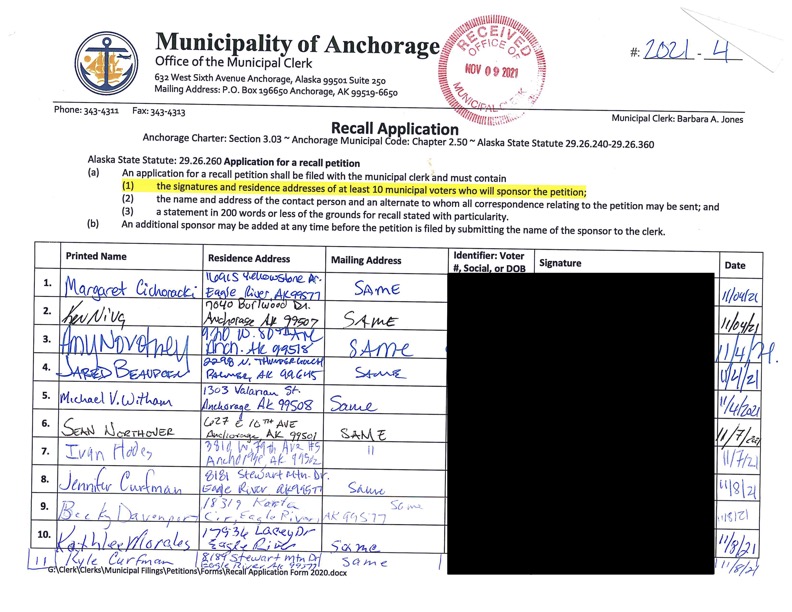
Granted, this game has a sympathetic ear with the media, which ran breathtaking opinion pieces from House Democrats as well as officials from former Governor Bill Walker’s administration, without disclosing their role in the recent recall campaign against Governor Dunleavy.
If the folks in Big Lake, who sent me down here, ask me what’s going on, I’ve got one answer: dirty politics. It’s time for those in House Leadership to get a rag and do some cleaning. I’m here to help with that and that is why I will continue to write #thetruthmatters articles.
Rep. Kevin McCabe represents House District 8, Big Lake.
Nov. 2, 2021 is the date for the Mat-Su Borough local elections. The Mat-Su Borough is home to more than one out of every seven Alaskans, with a population of 107,081. During the past 10 years, the borough, which is the size of Ireland, gained 18,086 people and was the fastest growing region in the state.
Some candidates for borough seats are now endorsed by Region 2 Republicans, made up of six legislative districts, two women’s clubs, and the Mat-Su Young Republicans.
The withdrawal period for candidates ended on Friday. The deadline to qualify to vote in the 2021 Regular Borough Election will be Sunday, Oct. 3.
A glimpse of who will be on the ballot:
Name
Party Affiliation
GOPData Center Calculated Profile
District-Precinct
Voting Frequency
Latest Campaign Disclosure Report
Notes
Mayor
Edna DeVries
R
1-Hard R
11-075
4/4
N
Endorsed by Region 2 Republicans. Current mayor of Palmer.
Bert Cottle
U
3-Swing
7-125
4/4
N
Former Mayor of Wasilla.
Matthew Beck
N
2- Weak R
11-095
4/4
N
Assembly #3
Dee McKee
R
1-Hard R
12-200
3/4
N
Endorsed by Region 2 Republicans. Longtime Republican activist.
Mark Bailey
N
5-Hard D
12-210
4/4
N
Dunleavy Recall Petion Signer.
F.Jay Kruger
N
2-Weak R
7-105
2/3
N
Assembly #6
Jesse Sumner
R
1-Hard R
7-110
4/4
N
Incumbent, Endorsed by Region 2 Republicans. Political/civic activist.
Richard Clippard
AI
4-Weak D
9-628
3/3
No Municipal Voting Record.
Kristi Short
D
5-Hard D
9-628
3/3
No Municipal Voting Record, Dunleavy Recall Petion Signer.
Assembly #7
Ron Bernier
R
2-Weak R
8-135
1/1
No Alaska Voting Record (except 2020 Gen), 2020 PFD Registered Voter
Tamara Boeve
U
4-Weak D
10-045
4/4
3/9/21
Incumbent, Dunleavy Recall Petition Signer.
School Board #1
Tom Bergey
R
1-Hard R
12-220
4/4
N
Incumbent, Endorsed by Region 2 Republicans.
Lori Berrigan
U
3-Swing
9-622
4/4
N
Dunleavy Recall Petition Signer.
School Board #4
Jubilee Underwood
R
1-Hard R
7-120
4/4
N
Scheduling Region 2 Republican / Vetting in process.
Jennifer Walther
R
1-Hard R
7-115
4/4
N
The Mat-Su Borough’s absentee by-mail application is separate from that of the Alaska State Division of Elections and the Mat-Su cities of Houston, Palmer, and Wasilla.
Things applicants for absentee ballots need to know about the process:
Apply early to receive your Borough ballot in a timely manner
Carefully complete ALL sections of the application
Omissions or errors may cause a delay in ballot mailing
Application MUST contain the applicant’s signature; no one else may sign for you!
Applications for the 2021 regular election will be available on this webpage starting January 1, 2021 or through the Borough Clerk’s Office by using the contact information above. The application deadline for the 2021 regular election is Tuesday, October 26, 2021. Completed and signed applications may be mailed to or hand-delivered to the Borough Clerk’s Office, or may be faxed to 907-861-7845.
Once the ballots are ready for distribution and upon the timely receipt of an application, the official ballot and voting material will be mailed to the applicant at the ballot mailing address provided on the application. Upon receiving the ballot, applicants need to carefully follow ALL instructions to ensure that the ballot is properly cast.
Ballot envelopes must be postmarked by Election Day, and received in the Borough Clerk’s Office no later than 5 p.m. three calendar days after the election. Hand-delivered ballots must be returned to a Borough election official by 8 p.m. on Election Day.
Newsweek reports that six private charter planes trying to evacuate at least 1,000 people — including more than 100 Americans—out of Afghanistan have been grounded by the Taliban. The terrorist group is in negotiations with the U.S. State Department, an official with an NGO working on the evacuation told Newsweek.
One is a plane chartered by Glenn Beck, the conservative media personality. It’s in the city of Mazar-i-Sharif.
Three other evacuation flights — two chartered by the international development organization Sayara, and one by Goldbelt, Inc., an Alaska Native corporation based in Juneau — are also said to have Americans onboard. It’s unclear if these planes and their passengers are being held hostage.
Funded with private money, Glenn Beck’s Mercury One rescue mission chartered two Airbus 340s and four Boeing 737s from Kam Air, the largest private Afghan airline, for eight evacuation flights to a Gulf state.
The other three flights with Sayara and Goldbelt were also chartered from Kam Air but their intended destination is currently unclear, the news company reported.
Must Read Alaska was unable to reach McHugh Pierre, the CEO of Goldbelt, Inc., for comment.
According to a source, Sayara has a manifest of 700 passengers, with at least 19 of who are Americans.
Goldbelt, Inc. is an urban Alaska Native Corporation formed in 1974. Goldbelt has extensive federal contracts, which represent about 96 percent of its revenue sources. It’s involved in IT work; medical services; and military support, including providing weapons, ammunition, and vehicles. It has contracts with the Department of Army, Department of Navy, and the State Department.
In Kabul, the company has a subsidiary that did prescreening for the Green Zone in Kabul for the Bureau of International Narcotic and Law Enforcement Affairs. Examples of Goldbelt’s military and other contracts can be found at this link.