Saturday, June 13, 2026
Home Blog Page 1014

Anchorage Assembly sets up to brawl over 83 nominations from Mayor Bronson to boards, commissions during special meeting

The Anchorage Assembly will hold a special work session on Nov. 4 from 1-3 pm to review Mayor Dave Bronson’s nominations to boards and commissions. Bronson has reappointed 10 people and nominated 73 new volunteers to various civic panels that advise the city.

The work session can be watched streamed live at this link.

The meeting will be conducted remotely with Microsoft Teams software. The phone number to call in is (907) 519-0237. Meeting Conference ID: ​723 849 169​​​​​ #​

In case of Microsoft Teams failure, the meeting will resume using the following conference bridge phone number: (907) 273-5190. Participant Code – 721227#​​

The nominations for board and commission appointments, as well as links to their resumes,​ can be found on the agendas for the Assembly Regular Meetings on Oct. 12 (Items 10.D.1-10.D.22 and 10.G.1-10.G.4) and October 27 (Items 10.G.2-10.G.3 and 11B. and 11.C.) The link is here.

While not part of this work session, a new batch of nominations will be included in the agenda for the Nov. 9 regular meeting, the Assembly said in a press release. Those will be reviewed by the Assembly at a later date.

The Assembly has turned down three of the mayor’s appointments to executive positions in his administration. They turned down Dave Morgan to run the Department of Health, Sami Graham to run Libraries, and James Winegarner as the director of the Real Estate Department.

The Assembly appears to be setting up for another brawl with the mayor over his appointments to the volunteers who offer their time and talent. Last week, the Assembly majority sent a series of questions to the mayor about his appointments, their qualifications, and specifically requested he make changes to his appointment schedule for the Elections Commission:

Questions sent to the Administration on October 26:

  1. What outreach and advertising was done to recruit the new appointees? Was the outreach done in a way that ensures broad community representation on the Boards and Commissions (several have specific requirements to meet geographic and demographic diversity)?
  2. There are 29 people whose terms expired in October 2021 who were not reappointed. How many of those submitted applications or indicated to their board/commission that they intended to serve out a new term? Can the Assembly have access to these applications? Were all existing members adequately informed that they would need to reapply for their positions (the past practice was to reappoint without a new application)?
  3. Several Boards and Commission have very specific requirements outlined in municipal code for who fills each seat, and sometimes technical requirements for appointees. Do the new appointments maintain these requirements?
  4. There were 23 people who expired prior to 2021, but according to OnBoard, that person was still serving (perhaps unaware that they had expired). Some of these were reappointed, but some were listed on the Administration’s appointment documents as Vacant and new appointees were put forward.
    1. Of those, how many were still actively participating in 2021?
    2. How many reapplied for their seats?
    3. How did the Administration determine which Members to reappoint and which ones to replace?
  5. The staggering is off for the Election Commission. Would the Administration be willing to readjust the new appointment for Seat 4 for one year to expire in 2022, to bring the Commission back into alignment with the code to have staggered terms?
  6. Jocasta Olp was appointed to the Health and Human Services Commission on 3/23/21 (see AM 183-2021), but does not appear in OnBoard. Can we assume that she is filling Seat #6?

The Assembly has also assembled a worksheet with all the names of those people who were not reappointed to seats.


Covid daily count dropping: 352 new cases on Halloween

7

The number of people who tested positive for Covid-19 on Oct. 31 was 352. For the Oct. 29-31 weekend, the total was 1,547 for new cases in Alaska, including the 352 on Sunday. There has been a decrease of 8 percent in new cases from the previous week.

Currently, 190 Alaskans are hospitalized with Covid-19, making up 19.3 percent of all hospitalizations, a decrease from last week. Also a decrease are the number of hospitalized Covid patients on ventilators. Last month the number of patients on ventilators spiked to 38 at one point. That number is now 28.

96 of the 118 ICU beds in the state are occupied and 779 of 1,100 non-ICU beds are occupied. The number of beds relates to whether there is staffing to take care of patients, and the base number tends to change. These occupied beds are being used by Covid and non-Covid patients.

Three more Alaskans died over the weekend with the cause attributed to Covid, bringing the state total to 702 since the pandemic hit Alaska in March of 2020.

60.3% of Alaskans 12 and older have been vaccinated.

The vaccination rate by by region:

  • Juneau Region: 80.3%
  • YK-Delta Region: 77.3%
  • Other Southeast Region – Northern: 76.2%
  • Southwest Region: 70.5%
  • Other Southeast Region – Southern: 68.1%
  • Anchorage Region: 64.1%
  • Northwest Region: 62.7%
  • Other Interior Region: 60.5%
  • Fairbanks North Star Borough: 52.9%
  • Kenai Peninsula Region: 50.5%
  • Matanuska-Susitna Region: 43.7%

Gov. Dunleavy: ‘No, Joe, mandates are not the answer’

By GOV. MIKE DUNLEAVY

By now it should be clear to anyone paying attention that President Joe Biden, with the help of many in Congress, is attempting to transform this country at break-neck speed into something that most Americans will not recognize. We are less than a year into his administration and are fully engaged in a serious battle for this country’s future. 

President Biden’s vaccine mandates are more examples of federal overreach that could have serious consequences for Alaska and must be fought.

That is why the State of Alaska joined nine other states in filing a lawsuit on Oct. 29 challenging the Biden administration’s vaccine mandate for companies that do business with the federal government. And rest assured, Alaska will join with many other states to take legal action as soon as the Biden administration follows through with its announcement to use the Occupational Health and Safety Administration to force any private business with more than 100 employees to require its workforce to either vaccinate or submit to weekly testing.

Beyond the fact that my administration believes these mandates as applied to contractors and private businesses are unconstitutional, Alaska is a perfect example of why the Biden mandate is completely unnecessary. 

Regardless of what armchair politicians and political detractors say, if people are truly honest with themselves, they should recognize that Alaska has handled Covid better than nearly every other state in the U.S. We led the U.S. (and most of the world) in testing very early in the pandemic. Additionally, unlike Texas and other states, we never had a mask mandate. We were also the first to remove our emergency declaration, even though other states like South Dakota continued theirs for months after ours ended. 

Even with today’s delta variant surge, Alaska has some of the lowest death rates in the country. We have the second-fewest deaths and the fourth-fewest deaths per capita. Just over the past month, my administration has also brought 457 health care workers to Alaska to aid our providers.

When vaccines became available, Alaska led the nation in distribution and vaccination rate. Not because of force or coercion, but because people freely chose to get one. Our state was the first to provide monoclonal antibodies as an effective therapeutic for Covid, and despite what some are falsely claiming, the State of Alaska has never prevented doctors and pharmacists from prescribing or dispensing other therapeutics, such as Ivermectin and Hydroxychloroquine. I have always advocated for individuals to work with their doctors to establish the best treatment possible for Covid and will continue to do so.

I have also been very public about opposing mandates related to Covid. While there is evidence that some Covid mitigations help, mandates cannot eradicate this virus. Despite this reality, the President chose to mandate vaccinations for federal workers, those who contract with the federal government, and for our brave women and men in the military. 

The U.S. and Alaska constitutions prevent me as governor from overriding some federal decisions on mandates. Thus, not I, nor any governor, has the legal authority to nullify Biden’s mandate for federal employees or the military. Opposition to this part of the mandate will have to come from individuals and Congress, and it will be litigated at the highest levels.

I applaud Sen. Dan Sullivan for speaking out recently against the President’s mandate. Our federal delegation, and ultimately the U.S. Supreme Court, are the proper means by which this part of the mandate should and will be attacked.

It is important to address some confusion about how the mandate impacts private businesses. This part of the mandate has not been implemented by the Biden Administration, and as of yet, not even a proposed rule has been released. Despite this, some companies are choosing to require their employees to get vaccinated. 

Any employee negatively impacted by a private company’s human resources policy should discuss that with their employer and their collective bargaining unit if applicable. 

Let this be clear: I am opposed to government mandates of any kind related to the Covid-19 vaccine, but not because I oppose the vaccine. Data shows that the vaccine is an effective way to protect people from getting seriously ill and dying from the virus. 

It is possible to be pro-vaccine and anti-mandate. I’m opposed to vaccine mandates because I do not believe that the government should use the force of law to make people get a medical treatment they don’t agree with or don’t need, perhaps because they’ve already contracted Covid and have natural immunity. 

I also believe we should be very cautious when intruding into private businesses decisions, workplace rules, and vaccination policy. Just as I don’t believe the government can order a private business to require vaccines, I don’t believe that government should keep private businesses from requiring a vaccination if they think that it is best for their employees and customers. 

Using the power of government to dictate to an employer whether they can or cannot require vaccination is a slippery slope that all should be leery of. 

Our system of government, with its three branches and system of checks and balances, is not only unique but is the reason why we do not have dictators and despots. It protects us from the tyranny of the majority through our representative form of government. 

Some have sown the seeds of disharmony in our state by politicizing the virus and insisting that I mandate what they want and limit the freedom of others. That is a road on which I will not travel because it leads to a destination that Alaskans do not want to reach.

Tyranny, whether it comes from the left or the right, is still tyranny that we should all fear.

– Gov. Mike Dunleavy

Tyranny, whether it comes from the left or the right, is still tyranny that we should all fear. One of the main purposes of the U.S. and Alaska constitutions is to outline what powers the people give government. It is a limiting document for government, and we should all be thankful for that. 

I am often asked by Alaskans to “do something.” This can be a dangerous request. Thank goodness for our constitutions, for the “something” I do today that tests or exceeds the bounds of executive power could become a regret that lasts far longer.

Be very careful what you wish for when your “side” temporarily holds power. The Constitution’s limiting powers are in place because the Founding Fathers understood that the challenging days that we’re seeing now would be a test for all of us, and that tyranny and despotism are always just a step away.

We must remember Benjamin Franklin’s quote attributed to him after the signing of the Constitution in 1787 when asked what kind of government had just been created: “A republic, if you can keep it.”

One of the main purposes of the U.S. and Alaska constitutions is to outline what powers the people give government. It is a limiting document for government, and we should all be thankful for that. 

I took an oath to protect and defend our constitution and republican form of government, and that includes accepting the limits it places on my executive power. I will not break my oath.

Mike Dunleavy was elected Alaska’s 12th governor in 2018.

A second Libertarian duo puts in for governor’s race

Two more Libertarians have announced they are running as a pair for governor and lieutenant governor.

Roman Shevchuk and Danny Clift announced this morning the launch of their campaign, with Shevchuk as the gubernatorial candidate, and Clift in the second spot.

The duo says it “intends to begin correcting Alaska’s course by promoting leadership guided by reason, restraint and accountability to the people.”

Shevchuk describes himself as a capitalist and second-generation American, whose family escaped the aftermath of communism in the Ukraine to seek a better life in the United States, settling in Wasilla in 2001.

Clift is an architect, entrepreneur and lifelong Alaskan who runs two businesses: his architectural practice and a marijuana cultivation site in Anchorage.

They detailed their platform:

– Believe in consensus-based leadership. Citizens give consent
to be governed and for this law to be common, it must be supported
by an overwhelming majority. It is not government’s duty to direct the
community. T
– Oppose partisan political behavior that has typified the
landscape of politics in this State.
– Believe in a full PFD and the statutory formula it’s based
upon, and are against the POMV.
– Aim to maintain or reduce state spending in all divisions.
– Protect our citizens’ rights. All of them.
– Are sensitive on LGBTQI+ issues
– Are Feminists in the classical way that the Merriam Webster
dictionary defines it.
– Believe in the subsistence lifestyle in Alaska and are
against trawling.
– Are friends of the marijuana industry.
– Believe in school choice.

Already announced are two other Libertarians, Billy Toien and Shirley Rainbolt.

Bill Walker and Heidi Drygas have announced as nonpartisan candidates, and Gov. Mike Dunleavy has announced, but has not announced his running mate.

Alaska will have, for the first time, an open primary, with all names on the same ballot, and a ranked choice voting general election, where voters will rank the four candidates (or teams, in the case of the governor’s race) who emerge from the primary with the most votes.

Candidates have until June 25, 2022 to withdraw from the primary ballot. The primary election is Aug. 16, 2022

Redistricting board wrapping up its work this week as deadline approaches

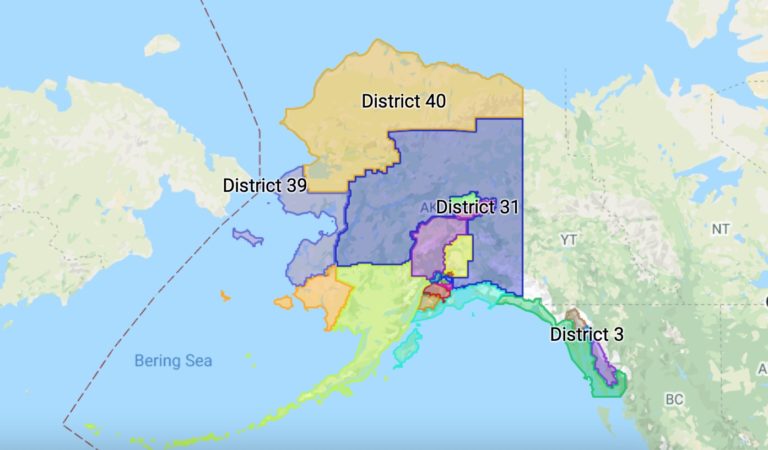
This week the Alaska Redistricting Board will try to wrap up its work of redrawing political boundaries across the state to even up the population of each of the 40 House seats. The board started its work in earnest after receiving final population numbers from the Census Bureau in mid-August. It has a Nov. 10 deadline. If necessary, the board will meet over the weekend, but the goal is to finish by Friday.

The public is invited to testify on Tuesday and Friday during the hours specified below. To date, most of the testimony has come from Democrat partisans.

Review all the maps under consideration at this link.

The meeting schedule for this week:

Tuesday, Nov. 2, 9 am: Full board meeting, at the Anchorage Legislative Information Offices

  • Agenda is attached
  • Location: Anchorage LIO, Denali Room (1500 W. Benson Blvd)
  • Streamed at: www.akl.tv
  • Testimony will be taken between 9:00-10:30am, in-person and via teleconference (please call in by 10am).
    Teleconference:  from Anchorage 563-9085; from Juneau 586-9085; from anywhere else: 844-586-9085
  • Online Public Notice: http://notice.alaska.gov/204203


Wednesday, Nov. 3
 and Thursday, Nov. 4: will be mapping work sessions at our office, starting at 9 am.

  • No formal agenda – this will be a more fluid process for members to finalize the maps
  • Location: Alaska Redistricting Board Office (3901 Old Seward Hwy, Ste. 141)
  • The public is invited to observe, but there will not be public testimony taken at this meeting.  Masks and social distancing will be required.
  • The meeting will be streamed via Zoom, details below:

Join Zoom Meeting https://zoom.us/j/9074062894?pwd=VWxjem42YUloTnBFcTlpVWZVS0wwZz09

Meeting ID: 907 406 2894

Passcode: MoreMaps

One tap mobile

+16699006833,,9074062894#,,,,*56615375# US (San Jose)

+12532158782,,9074062894#,,,,*56615375# US (Tacoma)

Friday, Nov. 5, 9 am: Full board meeting at the Anchorage LIO

  • The plan is to have another opportunity for public testimony, starting at 9 am, then finish out any agenda items held over from November 2, including adoption of the final redistricting plan.
  • Location: Anchorage LIO, Denali Room (1500 W. Benson Blvd)
  • Streamed at: www.akl.tv
  • Testimony will be taken starting at 9 am, in-person and via teleconference 
    Teleconference:  from Anchorage 563-9085; from Juneau 586-9085; from anywhere else: 844-586-9085
  • Online Public Notice: http://notice.alaska.gov/204263

All public testimony received before 6 pm Monday will be in tomorrow’s board packet.

Schools ignoring Pledge of Allegiance may be topic at work session prior to Monday’s Anchorage School Board meeting

The lone conservative on the Anchorage School Board, former State Sen. Dave Donley, has done site visits to two schools and found that, in defiance of School District policy, the Pledge of Allegiance is no longer being recited at the start of the school day.

Donley hopes to bring up this matter to light during the work session that precedes the Monday meeting of the Anchorage School Board. The work session may be attended by the public, and is held at the ASD Education Center, Boardroom, 5530 E. Northern Lights Blvd.

The work session starts at 4 pm, with the regular board meeting beginning at 6 pm. The regular board meeting will begin with an executive session, to which the public is not invited.

The school board is limiting the number of people who may attend the meetings due to Covid-19 mitigation protocols, but the meeting may be watched online at https://www.youtube.com/user/AnchorageSD

During the regular meeting that begins after the executive session, a capital bond that will be presented to voters next year will be reviewed. In the six-year plan the board will consider is construction for new schools to replace two aging elementary schools.

The board is looking at a two-year bond propositions for April 2022, April 2024, and April 2026. Two-year bonds enable better planning, the superintendent noted, which leads to increased efficiencies and reduced costs to the district given that contractors will have greater certainty of fund availability. 

East High School Academic Area Safety Improvements project is scheduled in year one, the design of which was previously funded in the April 2018 ballot proposition.  

Years two through six include replacement of two elementary schools, including tearing down and replacing Inlet View Elementary, and renovations for two secondary schools. Allocations are also included for deferred maintenance and security projects to address current backlog and growing facility sustainment.

The total cost of projects over the six-year period included in the proposed plan is about $278.3 million. Superintendent Deena Bishop Administration anticipates retiring nearly $236 million over this period for a projected net debt increase of $42.5 million.

American Airlines cancellations come with fine print that could cost travelers plenty

In September, American Airlines changed its fine-print contract with its customers. Now, if the airline cancels a flight, it will only be responsible for refunding the travelers’ tickets and fees — it’s not responsible for hotels, expensive last-minute replacement tickets, food, transportation, or missed connections.

In other words, American Airlines is now operating like a discount airline, with no guarantees: If you spent $100 on a ticket and the flight is cancelled, you’ll just get your $100 back.

That’s compounded this week by the more than 1,750 flights the airline canceled over the weekend and at least 336 canceled so far on Monday, or 12 percent of American’s flights today, according to FlightAware.com.

The airline is blaming wind gusts at Dallas-Fort Worth, its hub, according to CEO David Seymour’s memo to employees on Saturday. But the majority of the cancellations are due to staff shortages, especially flight attendants, according to the Wall Street Journal.

Southwest Airlines canceled 80 flights on Saturday and 20 on Sunday. Three weeks ago, Southwest canceled more than 3,000 flights over four days, blaming storms in Florida, and air traffic control staff shortages. Later it became evident that the airline was also short-staffed.

American Airlines and Alaska Airlines are part of the oneworld® airline partners group.

Read about how American Airlines’ new terms of service agreement may leave you stranded at Fortune magazine.

Michael Tavoliero: Eaglexit is only way to break Marxist control of Anchorage

By MICHAEL TAVOLIERO

Assembly Member Jamie Allard’s Must Read Alaska column on Oct. 29 nails the challenge we face in today’s Marxist control of our cities in America, detailed through her personal experiences in working to represent her community.

Anchorage is not an atypical Marxist stronghold.  

We can see these experiential examples in almost every state in America.  Seattle, Minneapolis, New York, Portland, San Francisco, and Los Angeles in particular stand out.  These formerly wonderful cities are now controlled by a Marxist regime solely focused on destroying Americanism, actively attempting to murder liberty in ways we have never seen in our respective lifetimes.

One may ask, why destroy something that is innately good and best for its citizens?  

Why implement a totalitarian regime with mind-numbingly rigid controls on citizens?  

And why are these same citizens seeming go along with the new regimes like lambs to slaughter?  

These are questions must be addressed if we are to survive the onslaught.

Here in Anchorage we see the conservative attempts to change the fabric of municipal government to a breathable balance between individual rights and the need for the rule of law.  However, the current assembly powered by the unions, the education industry, the health care industry, and the welfare industry not only continue to drive stakes through the heart of individual rights but ignores the law in favor of political expediency and situational ethics.

Oh, and the almost $1.5 billion dollar budget controlled by the municipal assembly and the school board continues to enrich the pockets of the unions, the education industry, the health care industry, and the welfare industry while Anchorage’s general and student population is on the decline.  

This situation necessitates the extraction of more and more money from a shrinking population.

This is the tragedy of the early 21st Century, which like the plague of the early 20th Century Progressive Movement captured the control of our banks, our education system, our food, and more, now focuses on indoctrination of our population through propaganda and entitlement.

We are moving closer to despotism and further away from liberty.

What is liberty? 

Frederic Bastiat in “The Law” asks, “Actually, what is the political struggle that we witness? It is the instinctive struggle of all people toward liberty. And what is this liberty, whose very name makes the heartbeat faster and shakes the world? Is it not the union of all liberties—liberty of conscience, of education, of association, of the press, of travel, of labor, of trade? In short, is not liberty the freedom of every person to make full use of his faculties, so long as he does not harm other persons while doing so? Is not liberty the destruction of all despotism—including, of course, legal despotism? Finally, is not liberty the restricting of the law only to its rational sphere of organizing the right of the individual to lawful self-defense; of punishing injustice?”

“Legal despotism” is the perversion of the rule of law.  

With every meeting, the innocent and alleged “enemies” of the municipal assembly are convicted on trumped-up accusations or false evidence in their kangaroo public hearings by limiting speech, attempts at humiliation, and betrayal of their oaths as they pervert public policy. 

They cut off the microphone, they mock the speakers, and they force citizens to wait for hours just to speak, and then end the meetings before those citizens have had their turn at the speaker’s box.  They pretend to be the victims of an angry and deranged public when they are the real bullies and tormentors.

Then there are the corrupt beneficiaries who all participate in the institutionalized theft of our public trust and taxes with impunity. 

We the public are outraged and incredulous.  

The innate desire for liberty, even here in Anchorage, is ignored and frustrated by its policy makers, who use our tax dollars to frustrate and demean the American spirit. 

These statists pretend superiority over their constituents as they attempt to arrange our lifestyles through their organizations and regulations.  Any successful conservative actions to limit these actions are worked around, overcome, and met with greater arrogance and greater limitations on our liberty.  Even when conservatives succeed, they end up in failure because of these arrogant and all-knowing autocrats.

In Alaska, the question is simple: How can we as conservatives change the policy makers who believe their sole task is to have power and control over every aspect of our lives and future?

The answer in 2021 is not through municipal elections, attending assembly meetings, sponsoring recalls, or other forms of legal civil disobedience.  We have seen these all fail to our disappointment, despair, and great expense.

The answer, in my opinion, is simply take our ball and go to another field to play.

Eaglexit is all that we as conservatives have left.  

Think about it.  

Is there any other way?

The Municipality of Anchorage must be decentralized. The detachment of Assembly District 2, including Eagle River, Chugiak, and its other communities, will weaken the power and control of the Marxist assembly in the remainder of Anchorage.  

In this process, Assembly District 2 will have their chance at real liberty.

What will follow?  

Perhaps Assembly District 6 and other assembly districts will realize their potentials and detach.  

It really is not a question of whether we can afford it.  The real question is can we afford not to decentralize Anchorage?

Those who are against Eaglexit argue that costs will rise.  Yet, from 2019 to 2021, our mill rate in the Eagle River Tax District 10 increased by 10%. 

Do they not see this?  

Or are they just the epitome of the frog in the water, slowly heating to a boil and ignoring the impending disaster?    

Perhaps it is time for a civics course.  

Come join us.

Oh, and by the way, Assembly District 2, you may want to jump out of seats and give Assembly Member Jamie Allard the standing ovation she deserves! 

Michael Tavoliero is a realtor in Eagle River, is active in the Alaska Republican Party and chairs Eaglexit.

Ninth Circuit lets ‘no limit’ campaign contribution ruling stand

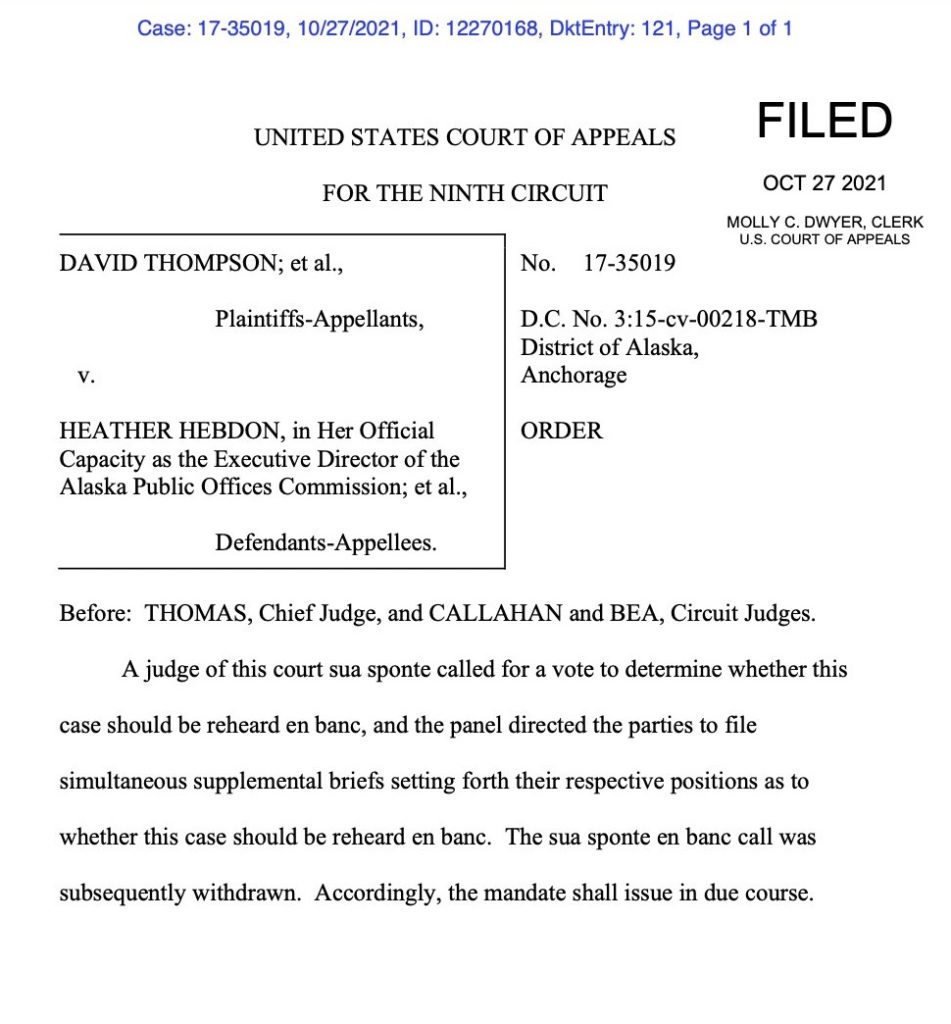
The Ninth Circuit Court of Appeals will not rehear the case on Alaska’s $500 campaign finance limits.

The apparent meaning is there are no limits on on donations to campaigns in Alaska, until new campaign contribution laws are passed.

A judge on the Ninth Circuit asked that the ruling be heard by a larger panel from the Ninth Circuit Court of Appeals.

But the State of Alaska never requested that the court do so, and with the state uninterested in an appeal, the judge, whose name has not been revealed, withdrew the request for the en banc hearing.

In July, the Ninth Circuit Court ruled that Alaska’s draconian $500 campaign contribution ceiling “significantly restrict the amount of funds available to challengers to run competitively against incumbents.”

The lawsuit Thompson vs. Hebdon has been dragging on for seven years. During that time, one of the plaintiffs, Aaron Downing, died. The other plaintiffs are Jim Crawford and David Thompson. 

The men had challenged the State of Alaska’s statute that puts a $500 annual limit on an individual contribution to a political candidate, (2) the $500 limit on an individual contribution to a non-political party group, (3) annual limits on what a political party—including its subdivisions—may contribute to a candidate, and (4) the annual aggregate limit on contributions a candidate may accept from nonresidents of Alaska.

The decision went to the Supreme Court, which partially remanded it back to the Ninth Circuit. There, two judges made the decision in favor of the plaintiffs, saying the $500 limit is unconstitutional.

The Dunleavy Administration could have asked for the full Ninth Circuit to hear the case en band, but did not, even though Democrats begged him to quite publicly. The $500 limit works best for Democrats because their candidates enjoy more funding from unions.

Instead, another judge on the panel asked for the rehearing, likely at the request of Democrat Party interests; those interests control much of the judicial system.