Sunday, June 14, 2026
Home Blog Page 1003

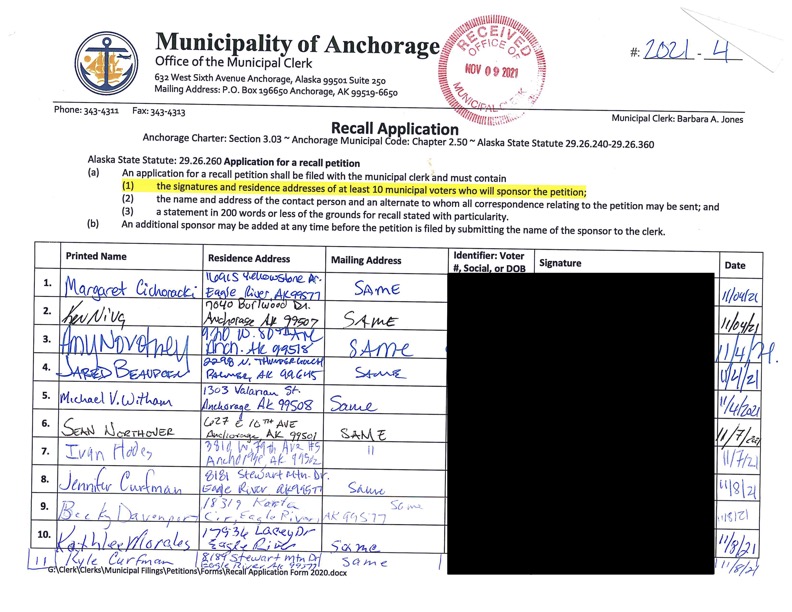
Recall petition approved, group will go after Jamie Allard

Two women from Anchorage have won approval of their petition to recall Eagle River Assemblywoman Jamie Allard.

The petition application is almost exactly like the ones that failed to get rid of Assembly members Meg Zaletel and Felix Rivera. It says Allard violated former Mayor Ethan Berkowitz’ emergency order that banned gatherings of more than 15 people back in the summer of 2020.

“Even though the merits of recall are laughable because I was the only one who objected — on the record — to the issue they are attempting to recall me for, I believe in our democracy and the vote of the people,” Allard said in a statement. “The extreme partisan backers of this couldn’t even find someone in our district to sponsor it. The people from Eagle River will see through the political gamesmanship.”

The petition applicant signers, most of whom are not from Eagle River, said that Allard continued to participate in gatherings of more than 15 people after “being specifically informed of the violation.”

In fact, she was the one who informed the Assembly that it was in violation of the mayor’s order, but the Assembly leadership persisted in continuing the meeting outside the law.

The recall proponents now must collect 2,530 signatures, all of which must be verified voters of Assembly District 2, in order for the question to be put to a ballot for the voters of the district.

Read the petition at the following link:

Sen. Sullivan calls White House spokeswoman Jen Psaki ‘Baghdad Bob’

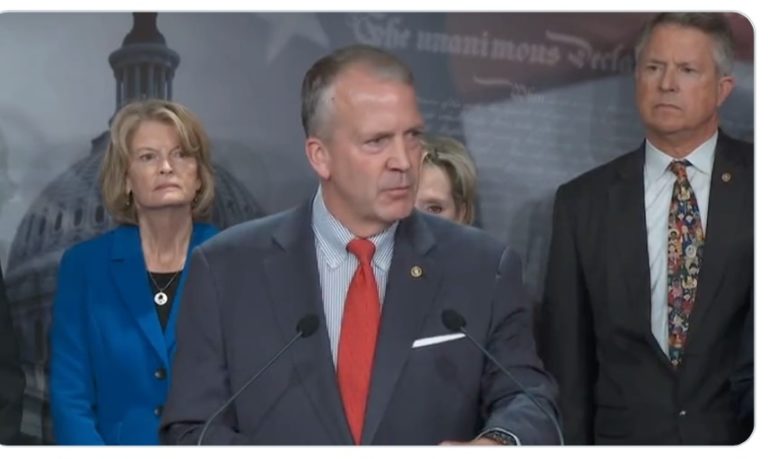
In a press briefing on Thursday with other Republican senators, Alaska Sen. Dan Sullivan said the White House is out of touch with inflation’s impact on Americans, and he called out Press Secretary Jen Psaki, who during a recent daily press conference joked that the supply chain crisis is the “tragedy of the treadmill that’s delayed.”

“This administration is so out of touch,” Sullivan said. “You had the White House chief of staff (Ron Klain) recently tweet-out saying high energy prices, inflation is a ‘high-class problem.’ What the heck does that mean?” Sullivan said.

“The White House press secretary on these issues is starting to look like ‘Baghdad Bob’,” Sullivan continued, comparing her to a colorful spokesman who was the media and foreign affairs minister under Iraqi President Saddam Hussein, and who was spokesman for the Arab Socialist Ba’ath Party and Saddam’s government. During the the Ba’athist regime, would regularly read aloud a list of executed Iraqis on state television

Referring to labor shortages combined with shortages of basic essentials, Sullivan said, “These issues are exploding all around the White House, and they just ignore them.”

Talking about energy prices, Sullivan said, “This is purposeful policy. The White House isn’t a bunch of dummies. They are purposely driving up prices on Americans for energy. How do we know that? A. Just listen to the rhetoric of Gina McCarthy and others – the tzars, where they say limited supply will increase prices and that will quote accelerate the transition to renewables. Go ask them, this is purposeful.

“The second reason we know it’s purposeful is just look at the policies. When you limit the production of American energy, when you go and kill energy infrastructure like pipelines, when you go and strong arm the financial institutions of this country, which they’re doing, saying don’t invest in American energy,” he said. “And, oh by the way don’t invest in American energy in the Arctic, which is called Alaska…” Sullivan said.

From A to Z: Doctors who signed letter demanding medical board sanctions on pioneering physicians revealed

ALSO, LETTERS FROM THOSE SUPPORTING EARLY TREATMENT OF COVID

After an Early Treatment Symposium took place in October in Anchorage, some in the mainstream medical community got up in arms and started a drive to force the Alaska Medical Board to investigate local doctors who T took part in the event, which was attended by about 1,200 Alaskans and which was broadcast on the internet to thousands more.

The following letter was sent by 141 doctors as written testimony to the Alaska Medical Board regarding early treatment of Covid-19 by Alaska doctors, which these physicians are calling “incompetent, unprofessional and improperly trained.”

In a scan of the voter files for the first 50 doctors on the list of signers, fully 50 percent of them are registered Democrats, and one-third of all of the 142 doctors were politically active enough that they signed the Recall Dunleavy Petition in 2019. Only two of the 50 were registered Republicans, and the rest were Undeclareds and Nonpartisans.

The Alaska Medical Board meets on Friday and will likely discuss the matter, since this is the board that handles complaints about the profession.

Must Read Alaska obtained the doctors’ letter through a public records.

Below the doctors’ letter is a file with multiple comments submitted by the public, mostly in support of the pioneering doctors who are using drugs like ivermectin and hydroxychloroquine for the treatment of early Covid.


From: Denali Psychiatry

Date: November 16, 2021
To: Alaska State Medical Board

Subject: Witten Testimony for Medical Board Meeting

We are writing out of concern that medical misinformation about the COVID-19 vaccine and treatment is being spread in Alaska, including by physicians.

The US Surgeon General, Dr. Vivek Murthy, has declared that health misinformation is “a serious threat to public health”, and urged “all Americans to help slow the spread of health misinformation during the COVID-19 pandemic and beyond…it can cause confusion, sow mistrust, harm people’s health and undermine public health efforts. Limiting the spread of health misinformation is a moral and civic imperative that will require a whole-of-society effort”.

Alaska’s chief medical officer, Dr. Anne Zink, recently wrote about a patient “…he had chosen not to be vaccinated because he feared side effects and misunderstood the risk of COVID; when he became ill, he had spent hundreds of dollars for online remedies. My patient…was suffering not just because of the virus, but also because of the deadly combination of misinformation and disinformation in a broken health-care system, in a country of broken trust”.

The American Boards of Family Medicine, Internal Medicine and Pediatrics recently issued a statement to the Federation of State Medical Boards (which supports state licensing boards), saying that providing misinformation about the COVID-19 vaccine contradicts physicians’ ethical and professional responsibilities, and therefore may subject a physician to disciplinary actions. They further state “expertise matters, and board-certified physicians have demonstrated that they have stayed current in their field. Spreading misinformation or falsehoods to the public during a time of a public health emergency goes against everything our boards and our community of board certified physicians stand for. The evidence that we have safe, effective and widely available vaccines against COVID-19 is overwhelming. We are particularly concerned about physicians who use their authority to denigrate vaccination at a time when vaccines continue to demonstrate excellent effectiveness against severe illness, hospitalization and death…providing misinformation about a lethal disease is unethical, unprofessional and dangerous”.

Such misinformation seems to have been spread in October 2021 at the “Alaska Early Treatment Medical Summit”, presented by a group called the Alaska Covid Alliance. Parts of the conference that were “live streamed”, as well as some of the information reprinted in the media, misrepresented the efficacy of the COVID-19 vaccines and the recommended courses of treatment. Some local physicians were involved presenting this event (which has been documented in the local media). This is of grave concern.

We hope that you will investigate this seriously, as the spread of misinformation has been identified as a threat to public health by the US Surgeon General, the Alaska Chief Medical Officer, and three medical specialty boards. According to the AMA Journal of Ethics, “The overriding mission of medical boards is to serve the public by protecting it from incompetent, unprofessional and improperly trained physicians”. We believe that this conduct, as defined by the Federation of State Medical Boards, meets the standard for investigation.

Sincerely,

Merijeanne Moore DO, DLFAPA

Helen Adams MD

Ankita Ambasht MD

Saket Ambasht MD

Jessica Arasmith MD

April Arseneau MD

Beth Baker MD

Sharolyn Baldwin MD

Timothy Bateman MD

Will Bemben MD

Matthew Berenson MD

Anna Berkeziewicz DO

Tyler Berliner MD

Randal Bladel MD

Derek Bowers MD

Desiree Brooks MD

Leslie Bryant MD

Robert Bundtzen MD

Jaime Butler MD

Andrea Caballero MD

David Cadogan MD

Leslie Cayco-Travis DO

Anson Cheng MD

Monique Child MD

Megan Clancy MD

Steven Compton MD

Nicholas Constantino DO

Margaret Constantino DO

Jeannette Cook MD

William M Cox MD

Gwenyth Crabtree MD

Bradley Cruz MD

Irisa Devine MD

Susie Dietz MD

Jennifer Dow MD

Andrew Elsberg MD

Summer Engler Jager MD

Shannon Faber MD

Shannon Faber MD

Robert Finch MD

Lucy Fisher MD

Steven Floerchinger MD

Gregory Gerboth MD

Zach Gibson DO

Casey Gokey MD

Leslie Gonsette MD

Madeleine Grant MD

Katie Grey MD

Dwight Gurley MD

Douglas Haghighi MD

Hannah Hawkins MD

Susan Hayner MD

Meghanne Hendricks MD

Michelle Hensel MD

Susan Heverling MD

Sean Higgins MD

Eiluned Hogenson MD

Jessie Janowski MD

Brian Jeppesen MD

Laura Jones MD

Michael Jones MD

Emily Junck MD

Javid Kamali MD

Chris Kelly MD

Ronald Kim MD

Mary Klix MD

Thomas Kramer MD

Nancy Kraught DO

John Lapkass MD

Anthony Larson MD

Jeanette Legenza MD

Tanya Leinicke MD

Corrine Leistikow MD

Megan LeMasters Soule MD

Joseph Lestina MD

Lisa Lindquist MD

Jana Linfield MD

David Ling DO

Stephen Livingston MD

Lucinda MacNeal MD

Jordan MacNeil MD

Julie MacNeil MD

Stacey Maddox DO

Karen Mailer MD

Elizabeth Martinez DO

Terin Martinjak MD

Kathy McCue MD

Allison McLellan MD

Jennifer McNichol MD

Sean Meadows MD

Sar Medoff MD

Rhene Merkouris MD

Danny Mindlin MD

Triin Minton MD

Jacob Miss MD

Laurie Montano MD

Peter Montesano MD

Shari Morgan MD, FACP

Michael Mraz MD

Sarah Murphy MD

Rick Navitksy MD,

Mary Nettlow MD

Brian Newman MD

Robin Ninefeldt MD

Cristin O’Grady MD

James O’Malley MD

Jozef Ottowicz MD

Tanya Pasternack MD

David Penn MD,

Timothy Peterson MD

Elise Pletnikoff MD

Ronald Pollock DO

John Quimby DO

Max Rabinowitz MD

Syed Rahman MD

Robert Reeg MD

Megan Ritter MD

Julian Rojas MD

Michelle Rothoff MD

Erin Royal MD

Katy Ryan DO

Rachel Samuelson MD

David Scordino MD

Dorothy Shearn MD

Benjamin Shelton MD

Tim Silbaugh MD

Jess Sotelo MD,

Charles Steiner MD

Mary Stewart MD,

Tina Tomsen MD (retired)

Ailinh Tran MD

Allison van Haastert MD

Maude Vance MD

Nilam Vaughan DO

Natalie Wallace MD

Andrea Wang MD

Kendal Webb MD

Scott Wellman MD

Benjamin Westley MD

Pamela Williams DO

Gina Wilson-Ramirez MD

Theodore Wright MD

Chris Zerger MD

Other public testimony received by the Alaska Medical Board:

Mark Mellman: Are independents really so independent? The voter files say they think and vote like partisans

By MARK MELLMAN / MELLMAN GROUP

People repeat it regularly. “Partisanship is in decline. Independents are the booming segment.”

Political partisanship entails at least two distinctly different facets, and keeping them separate is important. On the one hand, partisanship is a psychological concept. How do you feel about the parties?

I’ve written before about the fact that most people who respond to poll questions tapping their psychological predispositions by telling us they are independents are, in fact, closet partisans.

In 31 states (plus D.C. and the Virgin Islands), partisanship is also a legal concept. It’s about which party you checked on the voter registration form.

The always thoughtful and inquisitive founding editor and CEO of the Nevada Independent, Jon Ralston, chronicled the growing number of legal independents in Nevada, a phenomenon evident in other states as well.

Just over a decade ago, when I had the privilege of working with an amazing team to re-elect Senate Democratic Leader Harry Reid, one of the very finest people I’ve ever known, just 22 percent of Nevadans were registered as something other than Democrats or Republicans. Much further back, in 1972, it was fewer than 8 percent.

Today, it’s 36 percent.

Ralston asked my firm to examine Nevada’s nonpartisan registrants, though the basic conclusions probably apply elsewhere.

Because our poll used a sample generated from the state’s voter file, we know whether each individual signed up as a Democrat, or as a Republican, or as neither.

We asked those registered as nonpartisans a question we typically pose about psychological partisanship.

Roughly equal thirds of registered nonpartisans identified with each party grouping. Thirty-five percent identified as Democrats, 33 percent as Republicans and 32 percent were, psychologically speaking, true independents.

Of course, they are more independent than the state as a whole, but on first blush, two-thirds of voters who are legally registered as non-partisans turn out to identify themselves psychologically with one major party or the other.

In our hyper-polarized society, most people, and most Nevadans, like their party but disdain the opposition. They don’t just feel positively about their own party, they actively dislike the other one.

Seventy-three percent of Nevada’s partisan registrants fall into that category, while a very similar 68 percent of registered nonpartisans follow suit—harboring a favorable view of one party and an unfavorable view of the other. It’s further evidence most are closet partisans.

Another 14 percent of nonpartisan registrants dislike both parties, while an intrepid 6 percent actually persist in expressing favorable attitudes toward both Democrats and Republicans. 

At the end of the day though, we are ultimately interested less in how voters feel about parties, or how they sign forms, than about how they vote.

We gave Nevadans two ways to tell us.

First, we asked in a generic way how often they voted for Democratic and for Republican candidates.

Over 70 percent of registered nonpartisans “often” or “almost always” vote for one party’s candidates or the other’s, further diminishing the core of the truly independent.

When we gave respondents actual candidate match-ups to vote in — for governor and Senate — the partisanship of declared nonpartisans was similarly conspicuous.

In three match-ups, 85 percent of registered independents never crossed party lines. Over two-thirds (67 percent) voted for either the Democrat or the Republican 3 of 3 times.

The difference between the 67 percent and the 85 percent were folks who may have voted for Republican or Democratic candidates 2 of 3 times, but professed indecision on a third vote, thus not crossing party lines.

While the ranks of the registered non-partisans have swelled, the number of true independents has not. Indeed, it probably shrank.

Somewhere between 66 and 85 percent of those registered as independents are actually closet partisans — our cluster analysis pegs the figure at 72 percent in Nevada.

No matter how they sign the form, the vast majority of Americans, including those who register as independents, think and vote like partisans. 

Mellman is president of The Mellman Group and has helped elect 30 U.S. senators, 12 governors and dozens of House members. Mellman served as pollster to Senate Democratic leaders for over 20 years, as president of the American Association of Political Consultants, and is president of Democratic Majority for Israel. This column first appeared in The Hill.


Seattle School Board asks state to enact vaccine mandate on all schoolchildren

The Seattle Public School Board on Wednesday passed a resolution to ask the Washington Board of Health to begin the process for adding a Covid-19 vaccine to the list of vaccine requirements for students attending the public schools.

According to Fox News, the board held community engagement sessions in advance of the decision. The board met with Leading up to the decision, school leaders conducted additional community engagement sessions with the following: Latinx Community with Public Health –Seattle and King County, the NAACP, the Seattle Special Education PTSA, the Somali Community, Families of Color Seattle, General Seattle Public Schools Families and Staff, Native American Families and Students of Color.

The process for adding the vaccine to the list of required shots for schoolchildren goes through a rigorous process at the state level and no decision is expected for many months.

Seattle Public School has 55,986 students in grades PreK-12.

On Tuesday, the Portland Public School Board debated a vaccine mandate for all students, but decided that this is not the right time to implement such a mandate. The board ultimately delayed the decision. Portland has 49,000 students enrolled in its public schools.

California was the first state in the nation to announce Covid-19 vaccine requirements for in-person learning starting the term following FDA full approval of the vaccine for a child’s age.

Since then, demonstrations have taken place. After Southern California parents pulled their children out of school to protest the Covid-19 vaccine mandate on Monday, the schools saw a 2 percent dip in attendance. Hundreds of people converged on the Capitol in Sacramento that day to protest the mandate.

The Pfizer-BioNTech Covid vaccine has been approved for youth ages 5 to 11 (and up to age 17) under the Food and Drug Administration emergency use authorization. Earlier, the FDA approved the vaccine for ages 12-18. On Nov. 2, the Centers for Disease Control expanded vaccine recommendations to about 28 million children in the United States in this age group and allowed providers to begin vaccinating them immediately.

Anchorage School Board postpones action on Family Partnership Charter School

16

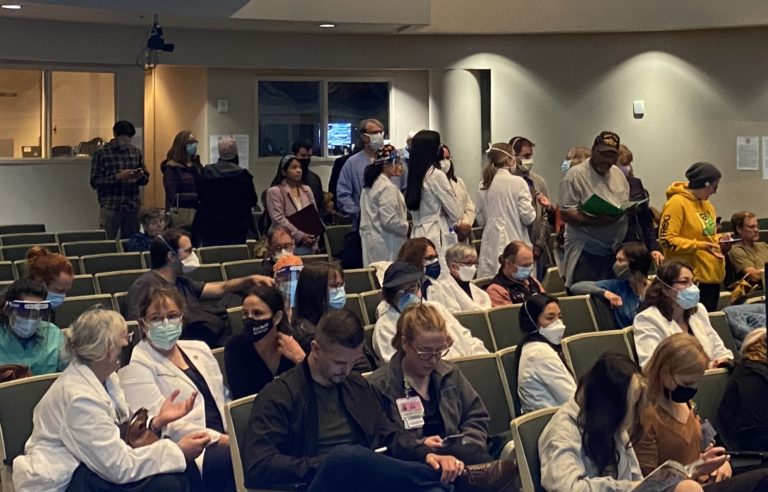
The Anchorage School Board meeting heard testimony Tuesday about the homeschooling charter program Family Partnership Charter School. Discussion about the school consumed over two hours of the meeting, and a vote was never taken on extending the charter, as the matter was postponed.

Board Member Kelly Lessens motioned to extend Family Partnership’s charter to a full 10 years. The Board members began discussion on that amendment and there were three who appeared to support granting a full 10-year charter — Margo Bellamy, Dave Donley, and Kelly Lessens, while Dora Wilson and Carl Jacobs seemed to be undecided.

The apparent dissenters — Andy Holleman and Pat Higgins — argued that a 5-year charter would be adequate.

Although it was never said outright, the apparent sticking point is that a few years ago, a reimbursement was made to a parent at the charter school for a class from a religious-based institution, without that class having been preapproved by the district. The amount was minor, but some school board members do not like the religious-based education service providers.

Before last year’s school shutdowns, FPCS had 679 students, but now about 1,000 students attend the FPCS, and the school would like to expand capacity to 3,000, thus are asking for a 10-year extension on its charter so it may plan for expansion. Some school board members apparently want to cap enrollment.

During the meeting, Superintendent Deena Bishop and others mentioned how schooling had changed and how Family Partnership Charter school is the future of schooling.

As hundreds of students and their families look for resources and options for learning, a proposal from ASD to cap the number of students was concerning to those testifying in support of the charter school.

“Hearing homeschooling is the future of education, made me more resolved we need a 10-year charter and not to limit the number of students. Please commit to letting ASD hear your voice about where your tax dollars will go. Please feel free to check out the attached sample letter about Family Partnership Charter Renewal,” one parent wrote to Must Read Alaska.

Family Partnership Charter School began with the efforts of parents and teachers. The school’s first charter application was presented to the Achorage School District in 1996 and unanimously approved in January 1997.  Final approval by the State of Alaska Board of Education approval came on June 23, 1997 and  FPCS opened its doors a week later.  

The charter school is a bridge between home-school students and formal education. It provides a mechanism by which families may work with certified teachers to plan personalized individualize learning plans for their students. The school enrollment is by lottery, and is highly sought by parents in the district.

In the end, Family Partnership Charter renewal was tabled until the Dec. 6 meeting. The public may still testify by writing to [email protected].


Party with the Polynesian community as they celebrate Uluao ‘Junior’ Aumavae as Equity Officer

Mayor Bronson named Uluao “Junior” Aumavae as Chief Equity Officer of Anchorage in October, and the Samoan community is preparing to celebrate in Samoan style.

On Friday evening from 6-8 pm in the Wilda Marston Theater at the Loussac Library, the Samoan community is inviting Anchorage to come and celebrate what they view as history in the making. Traditional dancing, food, and festivities are planned to fete Aumavae for breaking through that glass ceiling and becoming a key adviser to the mayor on matters of fairness. Aumavae is the highest-appointed Samoan in Anchorage’s history.

The chief equity officer position is set by an ordinance signed by former Mayor Ethan Berkowitz. According to the ordinance, the chief equity officer cannot be fired without the consent of the Assembly. But Mayor Dave Bronson has asserted that that is a power-grabbing overreach by the Assembly, and he fired the equity officer who had been hired by former acting mayor Austin Quinn-Davidson, just before she had to hand over the keys to the city to Bronson.

That man, Clifford Armstrong, is suing, asking for damages that include back pay and attorneys’ fees.

The Assembly leftist majority of nine does not recognize Aumavae as the legitimate chief equity officer, yet his confirmation vote is set for next Tuesday’s Assembly meeting. The majority says it still recognizes Clifford Armstrong of Tacoma as the actual equity officer, and is setting up a lawsuit against the mayor over his firing of his senior adviser without the Assembly’s permission. The Assembly has appropriated $50,000 for its legal fees to litigate the case. It seems unlikely the Assembly majority will attend the celebratory event, as they view Aumavae as illegitimate.

Sen. Sullivan and others file formal challenge to Biden vaccine mandate for businesses

On Wednsday, the formal challenge against President Biden’s vaccine mandate under the Congressional Review Act has been filed by all 50 Republican senators, including Dan Sullivan, Mike Braun, Republican Leader Mitch McConnell, Bill Hagerty, Roger Marshall, Mike Lee, James Lankford, Rick Scott, Marsha Blackburn, Rand Paul, Cynthia Lummis, Shelley Moore Capito, Marco Rubio, John Barrasso, Cindy Hyde-Smith, John Thune, Jerry Moran, Roger Wicker, Richard Burr, Mike Rounds, John Hoeven, Pat Toomey, Tommy Tuberville, James Risch, Mike Crapo, Ted Cruz, Tom Cotton, Joni Ernst, Kevin Cramer, Josh Hawley, John Boozman, Jim Inhofe, Chuck Grassley, Todd Young, John Kennedy, Ron Johnson, Ben Sasse, Steve Daines, Deb Fischer, Lindsey Graham, Thom Tillis, John Cornyn, Tim Scott, Bill Cassidy, Roy Blunt, Richard Shelby, Rob Portman, Susan Collins, Lisa Murkowski, and Mitt Romney.

Congressman Fred Keller (R-Penn.) and other members in the U.S. House of Representatives introduced the same bill.

The Congressional Review Act provides an expedited process for Congress to eliminate an executive branch rule. This move to overturn President Biden’s vaccine or test mandate for private employers is guaranteed a vote on the Senate floor. The rule was transmitted to the Senate on Nov. 16th, setting up a floor vote as soon as early December.

“I’ve been co-leading the effort with Senator Braun to ensure appropriate congressional review of President Biden’s overreach in implementing this unconstitutional mandate on private employees before it goes into effect. No employee of a private business should ever be forced to choose between getting vaccinated or putting food on the table for their families because of an unconstitutional mandate,” Sen. Sullivan said.

“In 2020, Congress and the President worked in a bipartisan way on an agreement that we would provide relief to American businesses on the condition they keep their employees. Now, Joe Biden is taking a sledge hammer to that employer-employee connection,” he said.

“Firing hard-working Americans who have made the personal choice not to get vaccinated not only undermines the significant work Congress and the Trump administration did to save millions of jobs during the pandemic, it also exacerbates the workforce shortages employers are already facing. This is just wrong. We all want to put this pandemic behind us for the benefit of our health, our families, and our economy, but we cannot lose sight of the massive, negative impacts that this unconstitutional mandate will have on hard-working Americans and their families.” – Sen. Dan Sullivan

BACKGROUND:

  • On Sept. 8, President Joe Biden announced vaccine mandates that extend to 80 million private sector workers and additional mandates on millions of federal workers and contractors.
  • To implement this mandate, the Occupational Safety & Health Administration (OSHA) issued an Emergency Temporary Standard (ETS). Employers that fail to comply will be fined $13,653 for each offense and willful violations will result in a $136,532 penalty. This rule places unrealistic compliance burdens on employers—especially during a time where business and supply chains are already under duress. For example, 30 days after publication, all requirements other than testing for employees must be in place. In addition, 60 days after publication, all testing requirements must be in place.
  • The Congressional Review Act (CRA) can be used by Congress to overturn certain federal agency regulations and actions through a joint resolution of disapproval. If a CRA joint resolution of disapproval is approved by both houses of Congress and signed by the President, or if Congress successfully overrides a presidential veto, the rule at issue is invalidated.

Yikes! State economist says number of North Slope workers are back to 2005 level

14

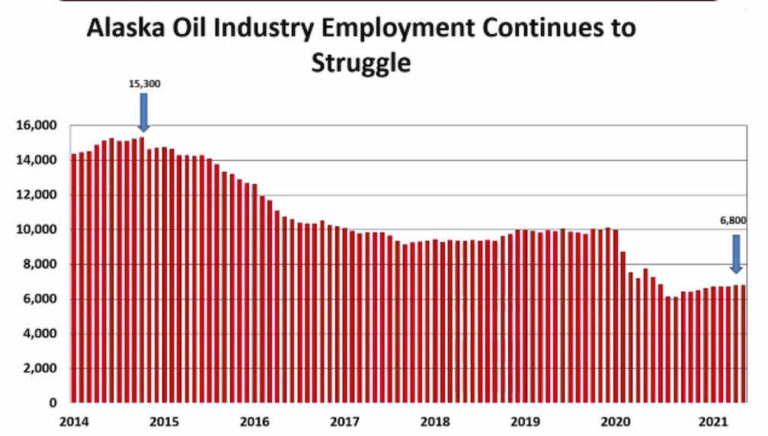
Neal Fried, an economist for the State of Alaska, says the number of employees working on the North Slope are back down to the numbers of employees working there in 2005. There’s no recovery yet, as it takes longer in Alaska than in other oil-producing regions, he said.

Fried was a presenter at the opening of the Alaska Resource Development Council’s annual meeting, which is being held via teleconference this year.

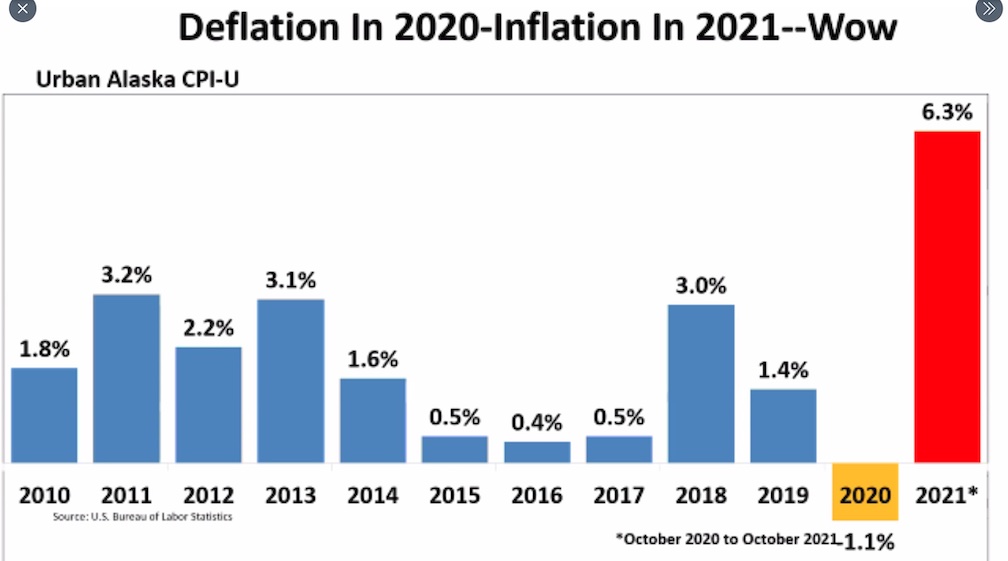
Fried also said that last year, Alaska experienced deflation, but this year has experienced record inflation.