By Phil Izon
We need a strategy that elects a conservative governor, not an idealistic fantasy that will give us another Murkowski-type conservative or worse-yet a Democrat. The only way the “all Republicans drop out” consolidation strategy actually works is if every single Republican candidate actually drops out, which will not happen.
Under Alaska rules, candidates can withdraw until August 31. If one of the current top four exits, the next-highest finisher from the primary gets elevated straight onto the November ballot. If Dave Bronson drops, that immediately moves someone like Treg Taylor or Click Bishop into the general-election field. Click Bishop may refuse to drop. In that case you still have a multi-Republican field that splits first-choice conservative support, especially with a soft R and hard R. You either get a Democrat with exhausted ballots, or you get Click Bishop as Governor.
Why “Rank Just 1” Advice Fails
Ballots that fail to rank a second viable conservative become exhausted (called bullet voters—people who only pick one candidate) and the race is handed to a Democrat or Soft R like Bishop.
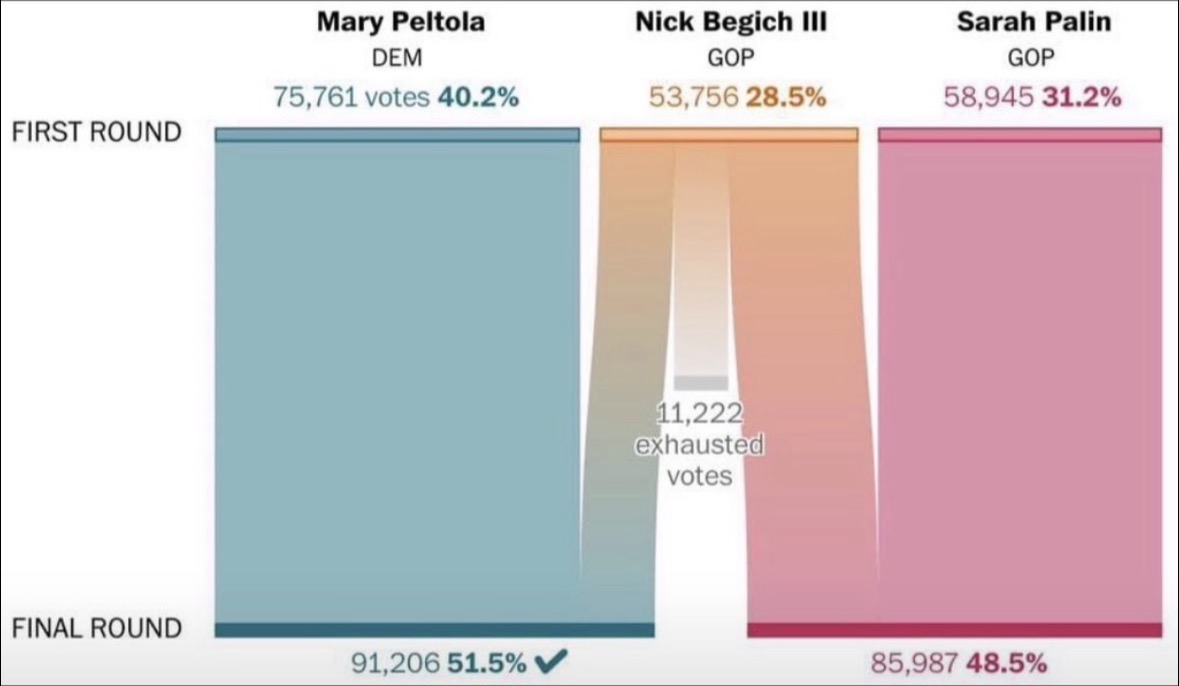
That is exactly what happened in the 2022 House special election. Roughly 11,290 Begich first-choice ballots exhausted. Mary Peltola won 51.5–48.5 even though combined Republican first-round support was near 60 percent.
Re-read that: 11,000 Begich voters not ranking Sarah Palin let a Democrat win the U.S. House seat for the first time in 50 years. 100% fact.
One of the biggest problems with Ranked-Choice Voting in Alaska is that the Party and far too many Alaskans still treat RCV advice as one-size-fits-all. Strategy has to be recalibrated after every Jungle/Open Primary once we know the actual top-four makeup. Advice that made sense in 2024 (where Dahlstrom dropped out) does not automatically apply in 2026. The ranking order and the “rank-the-pair” (or rank-the-trio) message change with whatever field actually reaches November.
The Mechanics Never Change
Here’s what does not change:
- First-choice tallies
- Sequential elimination of the lowest candidate
- Transfer of secondary preferences
- Exhaustion of any ballot that no longer ranks a continuing candidate (AS 15.15.350)
When conservative first-choice support is majority-sized but fragmented, failure to mark downstream rankings shrinks the active pool and manufactures a “majority” for the remaining Democrat or Soft R.
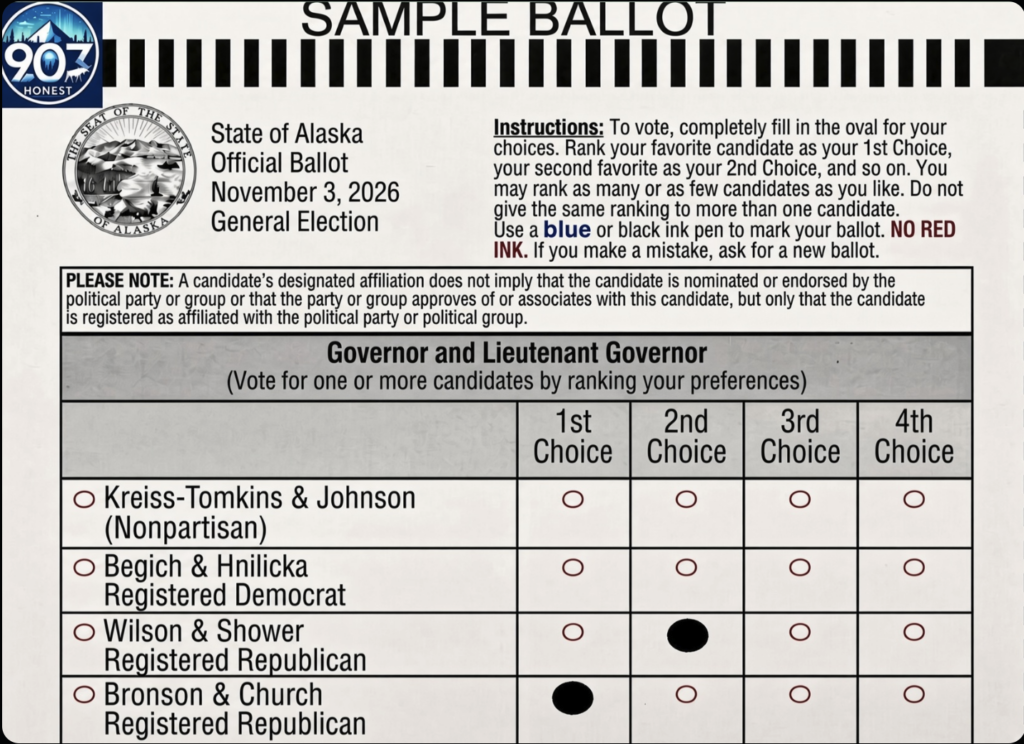
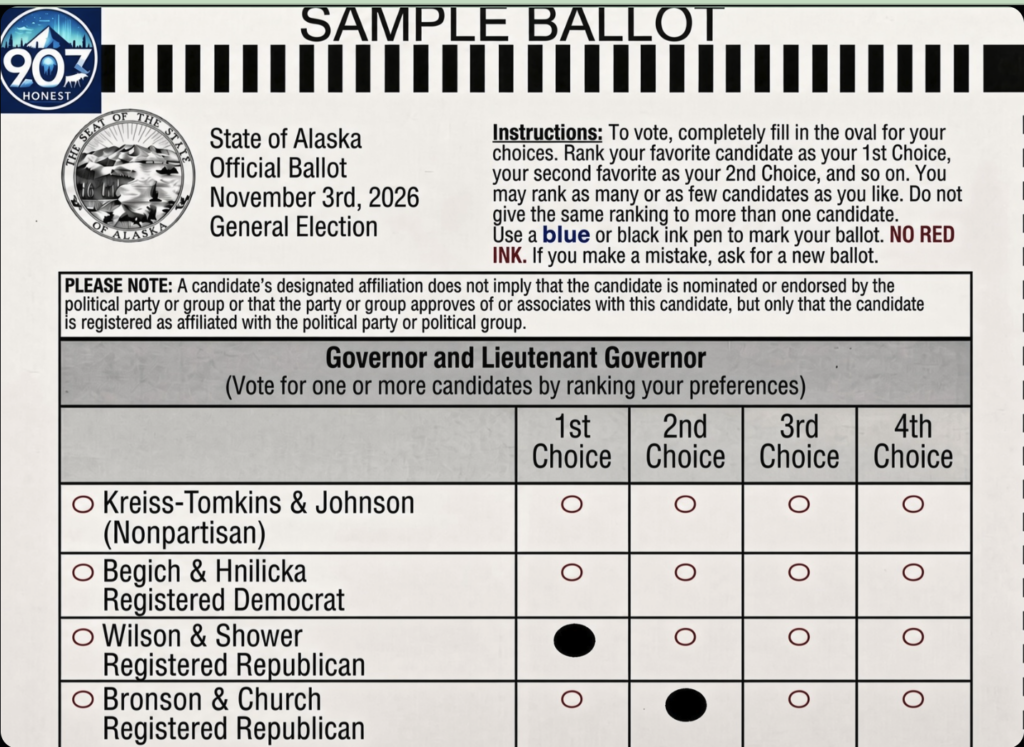
The practical safeguard is still “rank the pair.” Rank both (or all) viable conservative finalists 1 and 2 so your ballot stays alive and transfers cleanly. Keep real conservatives on the ballot—don’t hand Soft Republicans like Click Bishop an opening. Assume Bronson drops out: Treg Taylor moves up. If Treg Taylor also drops, Click Bishop advances. But if Click Bishop refuses to leave the race, the exact scenario everyone fears plays out in the worst possible way, uncontrolled. Ballot exhaustion then hands the keys to a Soft R like Bishop, or worse, delivers the Governor’s seat to a Democrat. We already saw this in 2022. Nearly 60% of Alaskan voters chose a Republican for U.S. Congress, yet Mary Peltola won because Republican ballots were exhausted and the combined Republican vote was split.
Additional 2022 Lessons: Administrative Failures, Exhausted Ballots, and Voter Confusion
The 2022 cycle exposed more structural weaknesses that prove why precise, election-specific ranking education is non-negotiable for 2026.
Al Gross Ballot Controversy
The Alaska Supreme Court ruled that the Division of Elections failed to strictly follow election-law deadlines and regulations when Dr. Al Gross tried to withdraw from the U.S. House race. The court said his name should have legally remained on the special general election ballot. Gross finished third in the special primary and withdrew after the deadline. The Division removed him anyway and refused to elevate fifth-place Tara Sweeney. The resulting three-candidate field changed the ranking dynamics and transfer patterns that produced the Democratic victory.
Exhausted and Discarded Ballots
RCV produced a significant volume of exhausted, overvoted, or blank non-transferable ballots:
- U.S. Senate: 4.9% (12,933) thrown out
- U.S. House: 6.4% (17,063) thrown out
Those discarded ballots shrank the active pool in the final rounds and amplified every first-choice split.
Voter Sentiment and Turnout
These problems coincided with the lowest voter turnout in Alaska history, approximately 44% of registered voters. Senator Dan Sullivan said the vast majority of constituents he spoke with found the new system confusing.
Administrative mistakes, high exhaustion rates, and widespread confusion prove that generic “rank the red” messaging is not enough. Voters need concrete, race-specific guidance once the final field is locked.
Summary of Ranked-Choice Voting Concerns
Nationwide experience with RCV shows the same operational failures, fairness problems, and high-level political skepticism we see in Alaska.
Operational Failures and Exhausted Ballots
In New York City’s first ranked-choice primary (2021 Democratic mayoral), nearly 15% (140,202 out of over 942,000) of certified ballots became exhausted or inactive because voters did not rank either of the top two finalists, Eric Adams or Kathryn Garcia. In the San Francisco Bay Area, Alameda County had to re-tally ranked-choice races after a programming error announced the wrong winner in an Oakland school-board contest. The error flipped the result and triggered calls for broader recounts.
“Vote-Trashing” and Fairness Criticisms
Hundreds of thousands of ballots have been discarded in ranked-choice races in NYC, Maine, Alaska, and San Francisco—what critics correctly call “vote-trashing.” The system is flawed because candidates who lead on first-choice votes are sometimes ultimately defeated (Kelly Tshibaka, Sarah Palin, Nick Begich). That raises legitimate questions about fairness, reliability, and accuracy.
Political Opposition
California Governor Gavin Newsom and former Governor Jerry Brown both criticized the system’s complexity, saying it confuses voters and deprives them of genuinely informed choices. Newsom vetoed legislation that would have expanded RCV for exactly those reasons. Nevada Governor Steve Sisolak warned that rushing constitutional changes to implement ranked-choice voting would only increase voter confusion and exclusion.
These patterns across the country reinforce one hard fact: Alaska’s RCV rules reward only the voters who fully understand and execute multi-candidate rankings tailored to the specific post-primary field.
Effective Outreach Strategies to Educate Voters
The post-primary field is still fluid. Administrative irregularities have already happened. Generic slogans (“RANK THE RED” or “BULLET VOTING”) fail when exhaustion and confusion are this high.
The highest-impact tactics are localized, concrete, and timed to the final ballot. These strategies are taken directly from Australia, which has used RCV for over 100 years:
1. Immediate post-certification “ballot simulation” kits. Once the final four (or elevated next candidate) are locked after the August 31 drop deadline, produce and widely distribute simple, race-specific sample ballots showing the exact ranking order for the two (or three) viable conservatives. Put them in every Republican district office, church bulletin, union hall, and gun-club newsletter. Pair each sample with one clear sentence that references the 2022 exhaustion numbers, the Gross ruling, and the national pattern of discarded ballots: “If your first choice is eliminated, or if a candidate is improperly removed, this ranking keeps your vote in the conservative column instead of exhausting it.”
2. Short-form video series that models the actual ballot and references past failures. Produce 15–30-second clips filmed on a real or mock November ballot that walk through every possible elimination path for the final field. Briefly note the Gross administrative error, the 2022 exhaustion percentages, and the documented problems in New York City, the Bay Area, Maine, and San Francisco. Release them on Facebook, YouTube, and local talk-radio apps the moment the top four stabilize. Caption every clip with the non-negotiable rule: “The only safe strategy is ranking every viable conservative. Leaving the second slot blank is a gift to the Democrat.”
3. Candidate and surrogate coordination must openly acknowledge contingencies and past failures. Public statements from Wilson, Bronson, and any other elevated candidate should explicitly urge supporters to rank the other as second, Wilson saying “Rank me first and put Bronson second,” and Bronson doing the reverse, thereby putting victory ahead of ego. Joint appearances and shared digital ads that visibly demonstrate these mutual second-choice rankings will lower the trust barrier that currently stops many voters from marking downstream preferences.
4. Trusted non-candidate messengers in high-turnout conservative networks. Equip pastors, hunting-club leaders, PFD-advocacy groups, and small-business associations with the same race-specific ranking cards and a two-minute talking point that ties ballot longevity directly to Permanent Fund Dividend protection, energy costs, and crime, while noting that 2022’s confusion and discarded ballots coincided with historically low turnout and that similar “vote-trashing” has occurred nationwide. These messengers are more credible than party apparatus when voters are skeptical of one-size advice.
Because the candidate makeup can still shift until August 31, lock the precise ranking recommendations only after that date and then execute the above tactics at maximum intensity through early voting and Election Day.
The mathematics of RCV, the risk of administrative error, the documented exhaustion rates, the record of voter confusion, and the nationwide pattern of discarded ballots and operational failures do not change. Only the names on the ballot do.
Not to mention the nearly $30 million the RCV lobby has spent to get and defend RCV in Alaska—the circus continues.
Educating voters to keep their ballots alive for every viable conservative is not a generic slogan. It is the only strategy that converts a first-round conservative majority into a November victory. If you select only one candidate you could very likely give the election to a Democrat.
Please don’t exhaust your ballot. Don’t throw away your vote. Rank all the conservative candidates.
Phil Izon has been a leading grassroots opponent of ranked-choice voting since Alaska’s 2022 elections, authoring and driving the 2024 repeal petition. He has briefed legislators and supported anti-RCV campaigns in multiple states, contributing to rejections or bans in Idaho, Oregon, Arizona, Nevada, Colorado and others.
Learn More About RCV
From Must Read Alaska
For Informed Voters: RCV, Jungle Primaries, Campaign Finance Law— The Statements of Support and Opposition for Ballot Measure 2
From Phil Izon
Phil Izon, “Field Manual to Ranked Choice Voting (RCV): Dark Stories about use cases of Ranked Choice Voting across the U.S.” (2024). https://archive.org/search?query=creator%3A%22Phil+Izon%22
20+ part video series from Ranked Choice Education Association: https://www.youtube.com/@RankedChoiceEDU
Phil Izon debate with U.S. Presidential Candidate Chase Oliver on RCV: https://youtu.be/Pu938l9_4og?si=1Clo0tpKDUTZhlvn
Phil Izon debate with three Oregon legislators in Portland, 2024: https://youtu.be/01SqO_JX6_8?si=mAU2OW39uanQMKFL
Phil Izon’s presentation on RCV at the Oregon GOP Convention, 2024: https://x.com/907Honest/status/1801992422228205758?s=20