
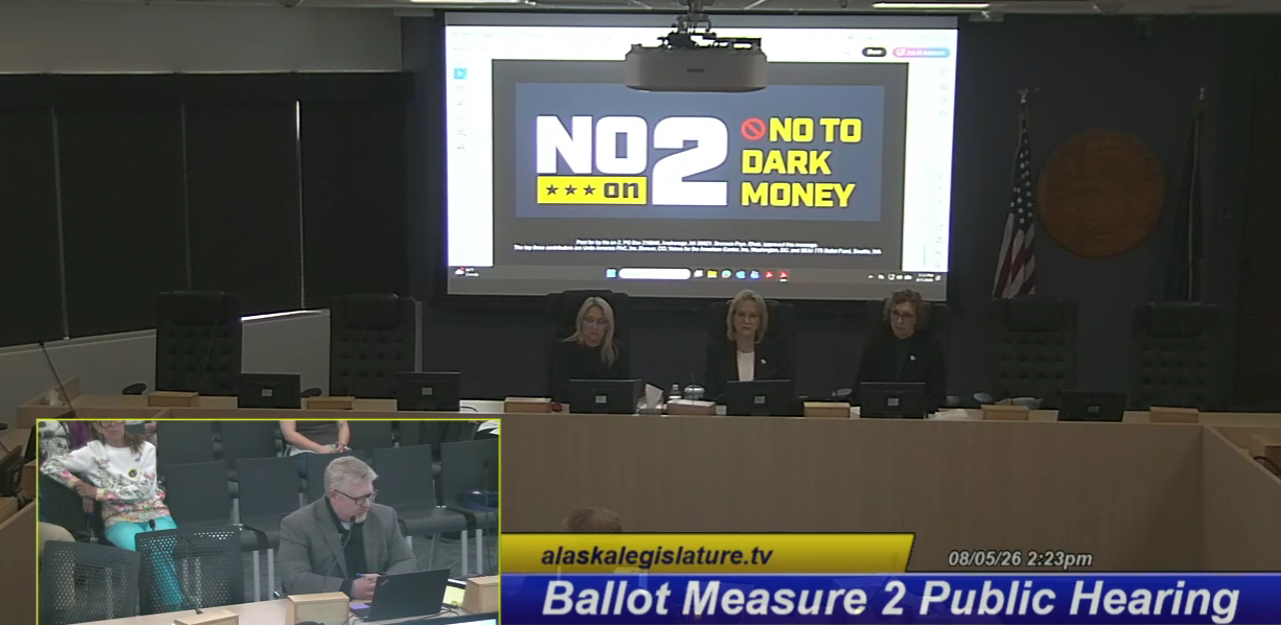
At the public hearing held August 5 for Ballot Measure 2—the measure to repeal ranked-choice voting, jungle primaries, and certain campaign finance disclosure rules—Scott Kendall told voters, “Saying so, doesn’t make it so.” He used this truth against Repeal Now as an attempt to discredit the statement of support given by Bethany Marcum. However, the phrase holds truth regardless of political stance. Voters deserve to know the facts, not simply what a campaign is saying are the facts. How do Mr. Kendall’s claims hold up?
Claim #1: “Ranked-choice voting was not an outside idea sprung upon Alaska for the first time in 2020. It was, in fact, brought forward by basically every political party except for the Democratic Party back in 2002.”
Analysis: In 2002, a ballot measure was attempted to institute ranked-choice voting for state and federal elections except for governor and lieutenant governor. The measure was indeed backed by the Alaska Republican Party and all four of Alaska’s recognized minor parties at the time. The Alaska Democrat Party opposed the measure, claiming the system would be “expensive, complicated, and unnecessary.”

Democratic Lt. Governor Fran Ulmer commented on the 2002 measure: “I’m deeply troubled by this. If the system isn’t broken…, why do we want to change it?”
Another major opponent of RCV in 2002 was the League of Women Voters. The league’s president at the time, Cheryl Jebe, stated: “Our main concern is that preferential voting [another term for RCV] allows some voters to cast a vote for more than one candidate, and it appears to compromise the principle of one person, one vote.”
Now, in 2026, Mr. Kendall quotes a statement written by the Alaska Republican Party in 2002: “Ranked-choice voting is good government at its best.” He says this “is as true today as it was when they wrote it in 2002.” But what makes that statement true today but Fran Ulmer’s statement false today? Answering that will require a look at the actual concepts and reality of the system, not a potshot at a political party’s shift in stance after almost two decades.
Claim #2: “Despite the photo of a trash can, no ballot in ranked-choice voting in Alaska has ever been trashed.”
Analysis: Kendall’s claim here rests on perceptions of the term “exhausted.” The pro-repeal side interprets “exhausted” as “trashed.” The pro-RCV side rejects this interpretation. Who is right?
In ranked-choice voting, an “exhausted” ballot is one that can no longer be transferred because the voter did not rank any of the candidates still remaining. Once that happens, the ballot stops counting toward any candidate for the rest of the process. It is removed from the pool that determines the final winner.
That is functionally the same as the ballot being discarded for the purpose of choosing the ultimate winner. The system then calculates a “majority” only among the ballots that are still active. A candidate can therefore be declared the majority winner while receiving support from fewer than half of all voters who cast a ballot in that race.
Pro-RCV advocates prefer the softer word “exhausted” because it implies the voter’s preferences were fully honored until they ran out. In reality, the ballot is simply no longer part of the final decision. The votes that could have expressed a preference between the last two (or few) candidates are no longer counted. That is why critics accurately describe those ballots as trashed or discarded for the decisive round.
The language difference is not semantic nitpicking. It puts a mirror to the core claim of ranked-choice voting that it produces true majority winners and ensures every vote continues to matter. When thousands of ballots drop out before the final round, that claim simply does not hold true.
Claim #3: “Every irregularity cited by the Yes on 2 team comes from outside, and that’s for a reason. Alaska does it better, and we have handled the transition to the system very well.”
Analysis: This claim is a deflection to evaluating the system’s implementation rather than the merits of the system itself. Alaska’s own elections have shown the same structural problems as other states have had with RCV.
In the 2022 U.S. House race, more than 11,000 of Nick Begich’s ballots were exhausted and stopped counting—more than double the final margin. A “majority” was declared among remaining ballots while falling short of a majority of all votes cast. That is an Alaska result under Alaska rules.
Alaskan voters themselves describe the system as confusing. Interviews conducted by the Anchorage Daily News feature Alaskan voters saying that they “didn’t know what the heck they were voting for,” that seniors were “all confused,” and that “everybody’s confused.”
Ranked-choice voting inherently produces exhausted ballots, delays results, and can yield winners without majority support of all voters. Those features of the system, not the particular state implementing the system. Better administration relative to other states does not erase structural flaws.
Claim #4: “But as you can see from this section, a simple notice to the director that they have changed their bylaws to exclude undeclared and nonpartisan voters—by that simple stroke— either party can make it unlawful. And again, I will say that again, unlawful for nonpartisan and undeclared voters to vote in primary elections.”
Analysis: Mr. Kendall is referring to Sec. 15.25.014 of the repeal bill. In slides 5 and 6 of his PowerPoint presentation, he provides highlighted screenshots of paragraphs a and b, but conveniently leaves out paragraph c. Sec. 15.25.014(c) clarifies: “Party bylaws required to be submitted under (a) of this section must be precleared by the United States Department of Justice under 42 U.S.C. 1973c (sec. 5, Voting Rights Act of 1965) before submission.” This is not a “simple stroke.”
Furthermore, either party may also change their bylaws to expand participation by “permit[ting] a voter registered as affiliated with another party to vote the party’s ballot.” Nothing in the ballot measure would necessarily restrict nonpartisan or unaffiliated voters from voting in party primaries. Kendall’s rhetoric is a scare tactic relying heavily on a supposition that political parties would choose to exclude nonpartisan and unaffiliated voters from the primary election. But the ballot measure itself would not close primaries.
Claim #5: “If Ballot Measure 2 were to pass, we will have no ban on dark money in Alaska for two years… and there’s nothing we can do about it as voters, and there’s nothing the legislature could do about it.”
Analysis: This, too, is a scare tactic, and one with even less ground than the previous scare tactic regarding primaries. The actual bill language of Ballot Measure 2 states clearly in Sec. 6: “AS 15.13.074(b) is amended to read: A person or group may not make a contribution anonymously, using a fictitious name, or using the name of another.” Full stop.
Ballot Measure 2 does not affect the state’s ban on dark money, which is found in AS 15.13.040(r). This statute (which the repeal effort leaves fully intact as it was not part of the ballot measure in 2020) requires “every individual, person, nongroup entity, or group that contributes more than $2,000 in the aggregate… shall report making the contribution… The report must include the name, address, principal occupation, and employer of the individual filing the report and the amount of the contribution… For purposes of this subsection, the reporting contributor is required to report and certify the true sources of the contribution… The contributor is also required to provide the identity of the true source.”
So, how does Ballot Measure 2 affect dark money? The short answer is it doesn’t. It doesn’t bring more dark money into the state, but it doesn’t stop dark money either. It does not impact disclosure requirements for the person or group donating, but it does lessen the burden for the person or group receiving the donation (the campaign). This lessened burden will allow grassroots campaigns to focus more of their energy and resources on reaching voters rather than navigating government bureaucracy.
Aug 5 Public Hearing of Ballot Measure 2 in Full:
Link to Full Bill Text, AG Opinion, PowerPoints, etc.: https://aws.state.ak.us/OnlinePublicNotices/Notices/View.aspx?id=224503


