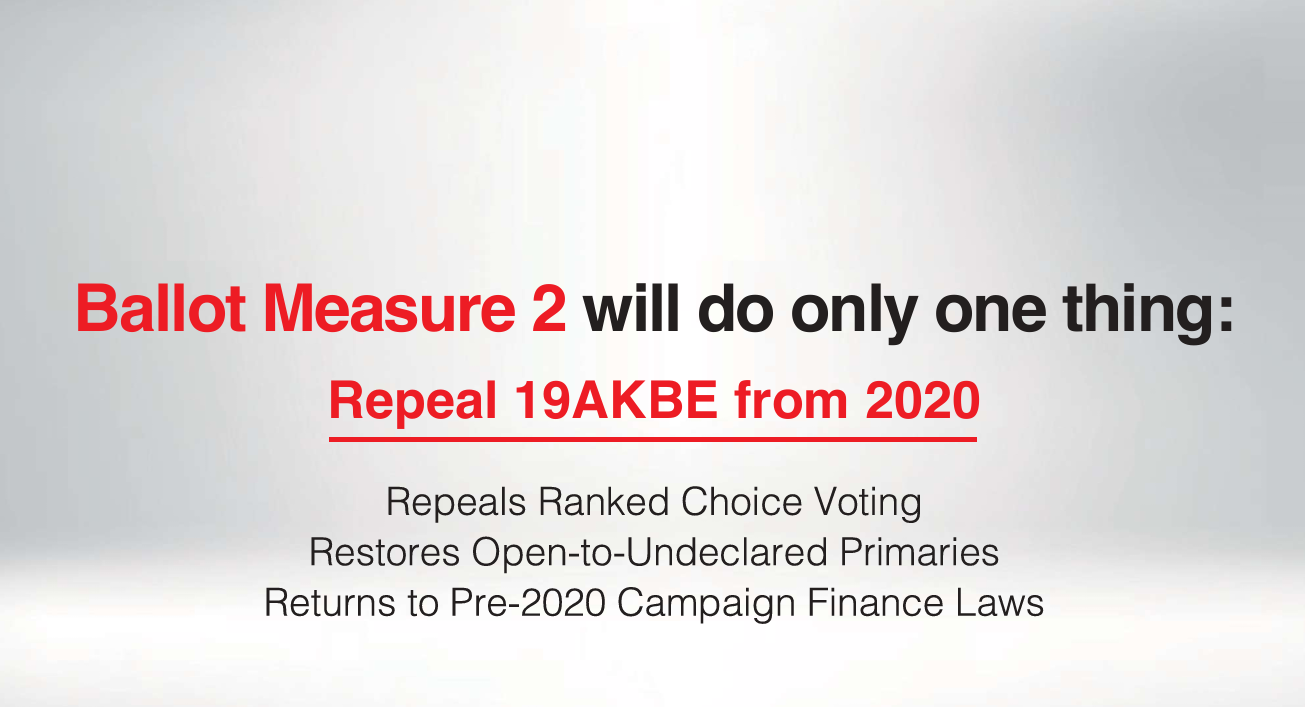
The hearing for Ballot Measure 2 on Monday, July 27, featured a statement of support by Bethany Marcum and a statement of opposition by Scott Kendall. Marcum emphasized that the repeal effort aims to do one thing: a complete repeal of the 2020 ballot measure that instituted ranked-choice voting, jungle primaries, and added certain campaign disclosure requirements. Marcum’s arguments focused on Alaskans’ distrust of the RCV system, the failure of the 2020 ballot measure to stop dark money despite its promises, and the undue burdens certain campaign disclosure laws impose on grassroots campaigns.
Scott Kendall presented the statement of opposition, which largely focused on claims relating to the repeal effort’s credibility, such as litigation now before the Alaska Public Offices Commission claiming Yes on 2 improperly uses an Anchorage address for a donor “based in Wisconsin.” Kendall also denied many of Marcum’s claims, calling them “100% false.”
Ballot Measure 2
Lt. Governor Dahlstrom began the hearing by reading the ballot measure and reminding the audience that a ballot measure differs from legislation debated in the legislature in that it may not be amended or altered.

Here is how Ballot Measure 2 will appear on the ballot in November:
An Act Restoring Political Party Primaries, Ending Ranked-Choice General Elections, and Repealing Recent Campaign Finance Laws
This act would get rid of open primary elections, where all candidates appear on one ballot. It would also get rid of ranked-choice general elections. It would bring back political party primaries and single-choice general elections. It would also repeal certain campaign finance rules that were added by a 2020 ballot measure.
Elections would occur as they did before open primaries and ranked choice voting. In the primary election, voters would choose a party’s ballot, unless prohibited by the party’s bylaws. They would only vote for candidates on that ballot. The winning candidate from each primary would be the party’s nominee. In the general election, voters would vote for only one candidate in each race. The candidate with the most votes would win. Party petitions, special runoff elections, and other processes would return.
This act would also repeal campaign finance rules that were passed in 2020. It would remove the limits on donations to joint campaigns for governor and lieutenant governor. It would remove limits and disclosure rules under current law, including for digital ads, out-of-state donations, undisclosed donations, and the true source of donations. It would change the meaning of a campaign expenditure and remove some fines.
Should this initiative become law?
The full bill text is 35-pages long with 91 sections and largely repeals 19AKBE. Readers can review the full text and a section-by-section summary provided by the Department of Law here:
Statement of Support
Bethany Marcum delivered the statement of support. First, she emphasized that ballot measure 2 “will only do one thing. It will completely undo all of the changes that were made as part of the 2020 ballot measure.”
There are three components to the ballot measure passed in 2020 that Ballot Measure 2 seeks to repeal: 1) the establishment of a ranked-choice voting system, 2) the establishment of a jungle primary system, and 3) certain campaign disclosure laws.
“Why should we repeal ranked-choice voting?” asked Marcum. She explained the primary reasons: concerns about exhausted ballots, the complexity of the system, lack of transparency regarding exhausted ballots, voter fatigue, general voter confusion, multiple points of failure, inefficiency, and widely expressed voter distrust in the system. “Our campaign is one person, one vote. That’s been the bedrock of the American Republic for the last 250 years,” stated Marcum.
Marcum also discussed Alaskans’ distrust of the computers used to determine election outcomes. “Voters also don’t trust turning elections over to a computer algorithm. It’s one thing for them to trust a system to just count the votes and see who has the highest number of votes, but for them to trust this complex calculation that happens behind the scenes is a step too far for most people. They simply don’t trust that.”
Doubts regarding election integrity negatively impact a society built as a Democratic-Republic. “When you have a system that voters don’t trust, they don’t participate,” said Marcum, connecting the RCV system to low voter turnout in Alaska’s elections.
Addressing the second component of Ballot Measure 2— repealing the jungle primary system— Marcum first clarified definitions. She stated that saying Yes on 2 would not force Alaska into a closed primary system. “It’s just false to say that this repeal will result in closed primaries. The United States Supreme Court really put forth a clear explanation of what a closed primary is. I’m going to read that to you here. This was in the year 2000. ‘A closed primary is one in which only a political party’s members can vote on its nominees.’ That’s not what Alaska had before this 2020 ballot measure, and it’s not what Alaska would go back to if this repeal succeeds.”
Rather than close primaries to only party members, the repeal of the jungle primary would return Alaska “to a system where independent and unaffiliated voters are able to participate in Alaska’s primary system…. If we repeal, 100% of Alaskan voters will still be able to vote in Alaska’s primaries.”
Moving on to the third component regarding campaign disclosure rules, Marcum argues that the rules passed in the 2020 ballot measure “were made to protect incumbent candidates. And second, they were made to ensure that more dark money can flow into Alaska.”
Marcum discussed the “disproportionately burdensome” campaign disclosure laws that eat up a grassroots campaign’s budget. “That means there’s less money and less time for them to actually reach out to and participate in talking to voters…. Smaller campaigns have to spend up to a third more of their money and their ad space on these disclaimers that do nothing to inform the public. So, whose interests are really being protected under the current disclosure system? Well, it’s only the big incumbents that are running sophisticated campaigns with out-of-state dark money, not Alaskan voters.”
Statement of Opposition
Scott Kendall gave the statement of opposition. He began with a brief history of ranked-choice voting in Alaska, saying it was first supported by the Alaska Republican Party in 2002. “That campaign did fail, but they came up with a good idea, which later on folks used and passed in 2020.”
He then countered Marcum’s argument about exhausted ballots, claiming “no ballot in Alaska is ever trashed. Those ballots are counted. They are counted during the tabulation process.”
He also argued that Marcum’s examples of mishandled or failed ranked-choice voting systems come from states other than Alaska. “[RCV] has been implemented and well implemented by our Division of Elections, who quite honestly— I’ve worked in other states— we do it better here than they do it anywhere else.” However, Kendall failed to address Marcum’s argument that RCV has multiple points of failure and higher potential for mishandling or corruption than Alaska’s prior election system.
Kendall refused to concede that RCV results in greater delays for election results. “To the delay issue, as we all know, the mail system in Alaska is what it is. We have very late, historically, ballot acceptance deadlines. Those are the things that cause us delay in that we have to wait for ballots to be brought in from across the state before we can tabulate. Again, that has nothing to do with ranked-choice voting.”
“They talk about only repealing RCV, [but] that is only a fraction of what the measure does,” continued Kendall. “It also weakens Alaska’s campaign finance system… closes primaries, returning them to partisan primaries… removes the requirement that disclaimers be on ads throughout the ad… removes a requirement that any organization that gets over half its money from outside has to disclose that in their disclaimers.” He argues this would eliminate “the ban on dark money.”
Additionally, Kendall claims, “The thought that it is burdensome on small campaigns is false.” He also says, “Ms. Marcum’s claim that this will return us to primaries that are open to nonpartisans— that is 100% false.”
“In a state like Alaska where two-thirds of all voters do not register with either party, the thought of taking publicly funded elections and allowing the political parties to choke off who can participate in them should be abhorrent,” said Kendall.
He then attacked the Yes on 2 campaign, pointing to litigation before the Alaska Public Offices Commission claiming Yes on 2 improperly uses an Anchorage address for a donor “based in Wisconsin.” However, the donor is not based in Wisconsin. The treasurer is located in Wisconsin. “One of their top three donors was caught generating their own personal funds through Medicaid fraud. Over half of their funding comes from a single billionaire based in Pennsylvania.” He also brought up a previous $100,000 fine that the repeal effort incurred in 2024.
“Our campaign, the Vote No campaign, is trying to stop outside billionaires from anonymously buying into our elections…. We have a ban on people buying into our elections and hiding behind innocuous names of other organizations. That is what they would stand to repeal. The Yes campaign seems to want to empower dark money, and again, it doesn’t take much to connect the dots when again, nearly all their money comes from a single billionaire who doesn’t live here, who for all I know, has never even visited Alaska.”
The repeal campaign does accept out-of-state donations to a total of $386,500 as well as $130,750 in-state donations, according to an analysis conducted by Must Read Alaska on July 14. On the other hand, No on 2 has accepted $2,375,655.93 of out-of-state money and $0 from Alaskans.
Further Debate
The Lt. Governor will hold a second hearing for each ballot measure on August 5th. Each side will get an opportunity to further defend their positions. More coverage to follow.