
This article was originally published in the author’s personal Substack 7/23/2026.
House Bill 381 died on the Alaska House floor on July 16, on a 19 to 19 vote, four votes short, after Governor Dunleavy threatened to veto the conference committee’s version over a pass-through entity income tax the Senate had attached to secure its own votes. The Governor called the provision a dealbreaker and ordered the legislature back to Juneau for a third special session beginning July 27, this time, in his words, for a bill focused on gasline property tax relief rather than a broader oil tax fight. On the process point, he was right, and so was the House majority that voted the conference committee version down. That income tax provision was not written from scratch in conference committee. It already exists as its own bill, SB 280, where Section 23 imposes the identical bracketed rate structure on pass-through entities with oil and gas income, a provision that had already gone through Senate Resources Committee hearings under its own bill number before the conference committee folded it into HB 381. Collapsing two separately vetted policy questions into a single take-it-or-leave-it conference report was a legitimate objection, regardless of what anyone thinks of the underlying tax policy.

The trouble is that the same objection applies with more force to the rest of HB 381, and it has gotten none of the same attention. When the legislature reconvenes July 27, it is expected to take up a narrower bill built around gasline property tax relief, stripped of the income tax fight. If it does, the process objection that just killed this bill will have been resolved. The structure examined in the rest of this piece will not have been touched at all, and it deserves exactly the same scrutiny before it becomes permanent law.
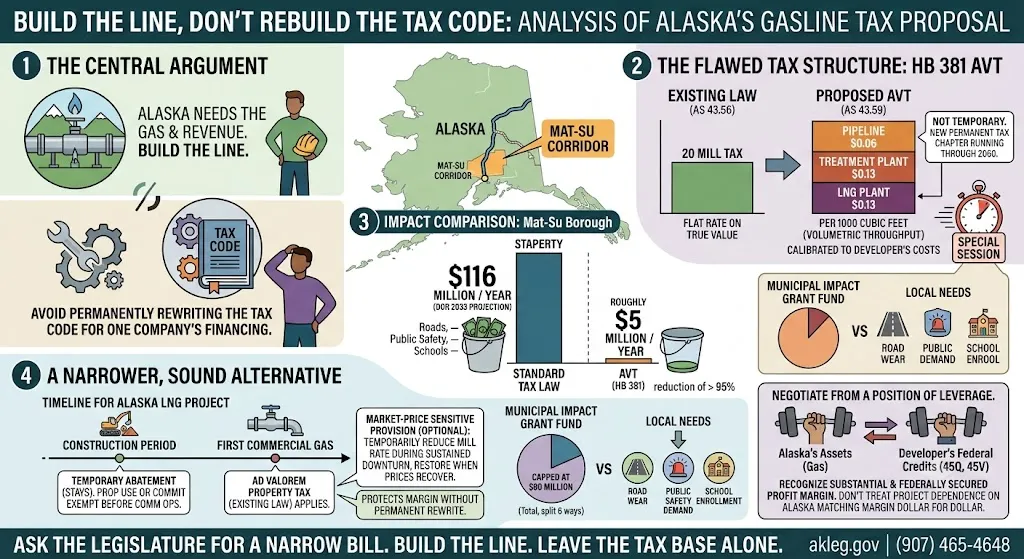
The AVT structure at the center of HB 381, and expected to carry forward unchanged into whatever narrower bill emerges July 27, does not simply exempt the Alaska LNG project from property tax during construction, a request that has precedent and a reasonable policy rationale behind it. It repeals the state’s existing framework for taxing gas pipeline property under AS 43.56.010(a), which levies a flat 20 mill tax on the full and true value of taxable property, and replaces it with an entirely new tax chapter, AS 43.59, built around a component-weighted volumetric throughput tax. Under Section 25 of the bill, once the temporary abatement period ends, the owner pays $0.06 per 1,000 cubic feet of throughput on the pipeline component, $0.13 on the gas treatment plant and carbon capture facility component, and $0.13 on the liquefied natural gas plant component, each weighted by that component’s share of total capital expenditure. That structure, once triggered, is not temporary. Under the bill’s conditional effect sections, the old ad valorem framework is not restored until January 1, 2060, more than three decades after the pipeline is expected to reach first gas.
This is a larger and more permanent restructuring of Alaska’s tax code than the pass-through income tax the Governor and House leadership objected to, and it is being built around the financing needs of a single project sponsor that has not yet completed a pipeline project of comparable scale. If a bracketed income tax on S corporations deserved its own bill and its own hearings before being attached to HB 381, a permanent replacement of the state’s oil and gas property tax structure with a volumetric tax calibrated to one company’s component cost weighting deserves at least the same scrutiny.
The documentary record gives some sense of why the tax architecture looks the way it does. GaffneyCline’s own adviser, Nicholas Fulford, testified to legislators on the record that gas itself is not the driver of the project’s carbon capture component. Representative Kevin McCabe, who voted Do Pass on HB 50 and sits on House Resources, has acknowledged publicly that Glenfarne would not be present without the ability to sequester CO2 on the North Slope, and that the project is unfinanceable without that capability. Whether the operative driver is the federal 45Q credit itself, as I have argued in prior pieces, or the carbon sequestration capacity that credit was built to subsidize, as Representative McCabe has argued, the practical result is the same. The tax structure proposed for HB 381 is shaped around a federal credit monetization architecture that has never appeared as a line item in any Department of Revenue fiscal note put before the legislature. The Governor’s office has separately confirmed a clean hydrogen hub component to this project in a private conversation while declining to state that publicly. Alaskans weighing HB 381 are being asked to evaluate a tax structure without a clear public accounting of what federal revenue stream that structure is actually designed to protect.
Alaskans are being asked to evaluate a tax structure without a clear public accounting of what federal revenue stream that structure is designed to protect.
None of this is an argument against building the pipeline. Alaska needs the gas, the state needs the revenue, and the in-state spur line requirement written into Section 43.59.025 of the bill deserves support regardless of how the financing question is resolved. The argument is against solving a financing problem by permanently rewriting the state’s tax base under emergency special-session conditions timed to a federal construction deadline that has nothing to do with when Alaska needs the gas.
A narrower alternative exists within the bill’s own logic. Section 7 of HB 381 already establishes the principle that property used or committed to the project should be exempt from state and municipal tax before commencement of commercial operations, defined as first revenue-generating gas flow. That construction-period abatement is a sound and limited tool, and it should stay. What does not need to accompany it is a permanent replacement of AS 43.56 with a new volumetric tax chapter running through 2060. Once the project reaches first commercial gas, ordinary ad valorem property tax under existing law can apply, the same law that applies to every other taxable pipeline asset in the state.
If the concern driving the AVT’s design is that a fixed ad valorem tax exposes the project to margin compression when LNG or Henry Hub prices fall, that concern can be addressed directly and temporarily rather than by rebuilding the tax base. A market-price-sensitive provision, tied to a published reference index and triggered only after a sustained decline over a defined period such as two consecutive quarters, could reduce the mill rate for the duration of the downturn and restore it once prices recover. That approach protects the same margin the AVT’s component weighting is designed to protect, without converting a temporary market risk into a permanent restructuring of how Alaska taxes gas pipeline property for the next three decades.
Proponents of HB 381 have leaned on a version of a familiar argument. Zero percent of a project that never gets built is zero, so even a modest volumetric tax is better than nothing. Under the Department of Revenue’s own numbers, that modest tax is genuinely modest, and the gap it leaves is not. DOR’s own May 2026 modeling projects Mat-Su’s pipeline corridor generating 116 million dollars a year by 2033 under standard property tax law. HB 381’s AVT replaces that with roughly five million dollars a year in midstream AVT revenue once the project reaches full throughput, a reduction of more than 95 percent, backfilled only by a developer-funded municipal impact grant fund capped at 80 million dollars total and split among six impacted municipalities at department discretion, not allocated to Mat-Su specifically and not tied to how much tax base any one borough actually gave up. Those AVT rates were not calculated from what the borough will actually need to absorb in road wear, public safety demand, and school enrollment growth tied to a multi-year construction workforce and a permanent industrial facility running through its boundaries. A Senate Resources Committee presentation on the AVT’s design states plainly that the rate structure was built to replicate the total annual revenue target negotiated by the 2015 Municipal Advisory Group, a fixed dollar figure inherited from a decade-old negotiation over a different project design and a different Cook Inlet supply picture.
DOR’s own modeling projects Mat-Su’s pipeline corridor generating $116 million a year under standard property tax law. The AVT replaces that with roughly $5 million.
The zero percent framing treats Alaska’s tax terms as the variable that decides whether the project gets built at all, and it is worth asking whether that premise holds. Glenfarne already holds the 2020 FERC authorization to construct and operate the full Alaska LNG project, a regulatory milestone that exists independent of anything the legislature does with HB 381. On the financing side, the documented record includes GaffneyCline’s own testimony that the ability to sequester carbon on the North Slope, not the underlying gas sale, is what brought Glenfarne to the table, along with the federal 45Q and potentially 45V credit streams that ability unlocks, a combined federal credit exposure that, at the statutory ceiling for both streams running simultaneously, could approach two billion dollars in a single year. If federal credit monetization is doing meaningful work to make this project financeable on its own terms, independent of what Alaska concedes in its own tax code, then the state is not choosing between the AVT and zero. It is choosing between negotiating from a position where the developer already has a substantial and federally secured profit margin, and negotiating as though the entire project depends on Alaska matching that margin dollar for dollar through its own tax base.
The state is not choosing between the AVT and zero. It is choosing between negotiating from a position of leverage and negotiating as though it has none.
None of this is an argument against Glenfarne pursuing federal tax credits. A private developer is entitled to structure its financing however federal law allows, and 45Q and 45V exist for Congress to decide, not the Alaska legislature. But there is a difference between the state declining to interfere with a developer’s federal financing strategy and the state redesigning its own permanent tax structure to protect the profitability that strategy is already expected to deliver. Those credits, if realized at anything close to their statutory ceiling, represent real and substantial profit value to the project sponsor. Recognizing that value is not an argument for blocking it. It is an argument for negotiating Alaska’s own tax terms as though the state has more leverage than a zero-sum framing admits, rather than less.
The Governor and the House majority were right that a bracketed pass-through income tax did not belong bolted onto a natural gas pipeline bill during a special session called under deadline pressure. The same reasoning, applied consistently, argues for separating the pipeline’s construction-period tax treatment from a permanent rewrite of the state’s tax code. If the tax restructuring in HB 381 is sound policy on its own terms, it can survive being introduced, heard, and passed as its own bill, the way SB 280’s income tax provision already was. If it cannot survive that process, that is worth knowing before it becomes permanent law tied to a single company’s financing model.
The legislature returns to Juneau on July 27 to try again, three weeks before the August 18 primary. That session should produce a narrow bill. Give the project the construction-period tax abatement already built into HB 381’s own logic, running until first commercial gas. Add a market-price-sensitive mechanism if legislators want one, to protect margins during a genuine downturn without touching the underlying tax base. Leave the rest of the twenty-mill ad valorem system alone.
The AVT itself does not belong in this bill. It is a permanent replacement of how Alaska taxes gas pipeline property, running through 2060, and it deserves its own hearings, its own fiscal note, and its own vote, on the same standard the Governor and House majority just applied to the income tax provision. Alaskans who agree should say so now, before the third special session gavels in on July 27. Legislators can be reached through the akleg.gov website or the legislative switchboard at (907) 465-4648.
Dana Raffaniello lives in Palmer, Alaska. He works as a network engineer, reads Alaska energy legislation closely, and publishes analysis of its fiscal and structural implications at raff6482.substack.com. He is running for the Mat-Su Borough Assembly, District 2. He has no commercial interest in any energy project discussed in this analysis.



