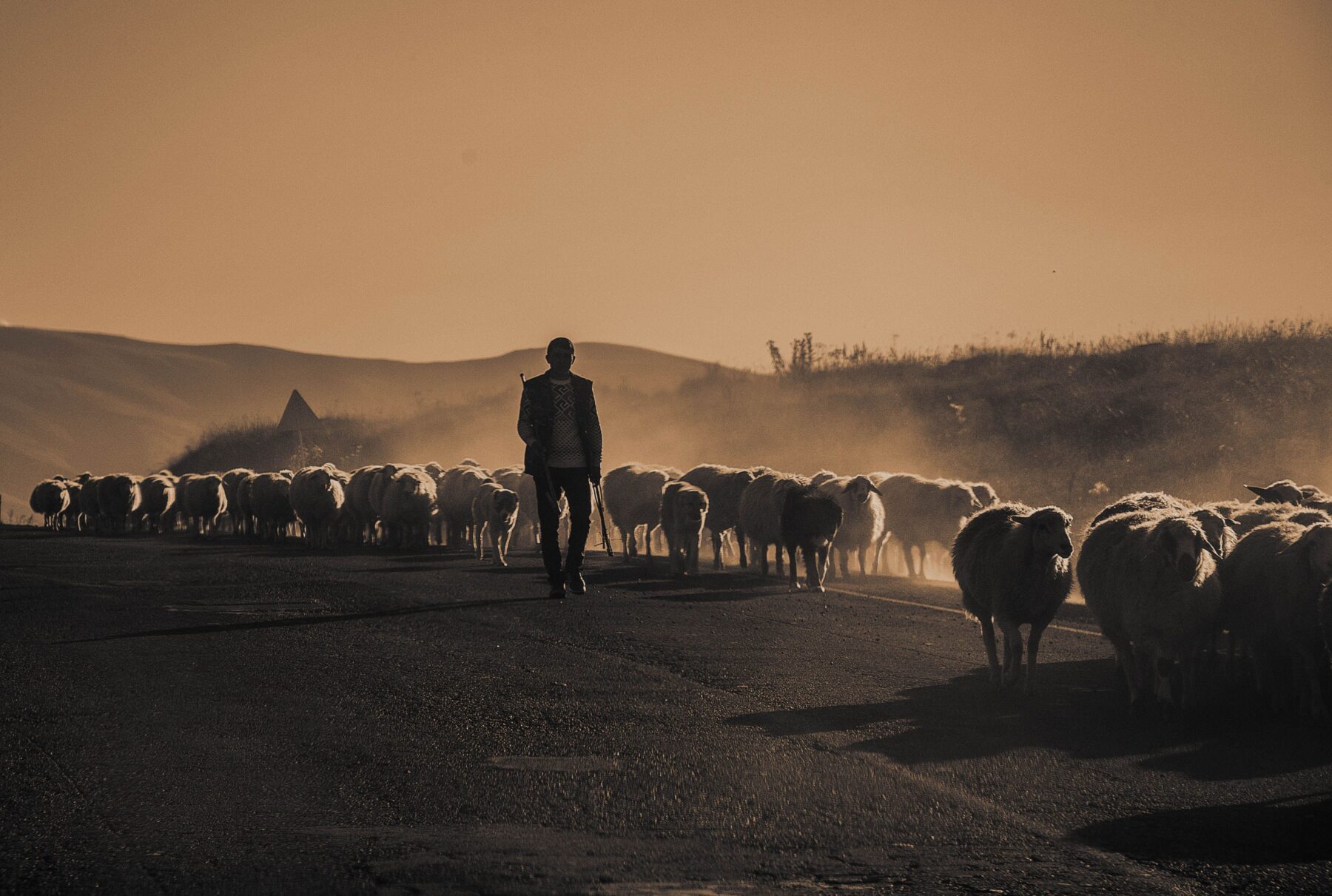
When I read through Psalm 23 a few days ago, it prompted me to ask myself, “What are the marks of a true shepherd?” What are his duties to the sheep and their owner?
After delving into this topic, I discovered many interesting characteristics concerning shepherds.
They would lead their flock, walking ahead of them and calling out to the sheep, which followed their voice (unlike driving them from behind). They would guide them to good grazing land and water sources. They would find pastures and ensure access to still waters or wells to feed them. Sheep were vulnerable and needed daily care.
Protecting the flock was a major responsibility. They defended against predators— wolves, lions, bears, and leopards— using a rod (for defense and clubbing), a staff (also known as a shepherd’s crook, for guiding or rescuing), and a sling (for flinging stones). They also guarded against thieves and robbers.

During the daylight hours, their duties were to lead the flock to pasture, watch over them constantly, and rest in the shade at midday. Their nighttime duties consisted of keeping watch in the fields or sleeping at the entrance of a sheepfold (a stone enclosure or cave), literally acting as “the door” to protect the sheep.
They counted the sheep when returning them, searched for strays, and cared for the sick or injured. When a shepherd takes the job of caring for the flock, he is putting his life on the line for each and every one of the sheep. He rarely sleeps; he remains vigilant.
Now, with all this being said, I would like to focus on another kind of shepherd— those entrusted to care for a congregational flock, also known by the Latin word “Pastor.”
“Pastor” was originally defined as a shepherd who tends and feeds a flock. Over time the word evolved to mean a spiritual leader who “feeds” and cares for a congregation, modeled after Jesus as the “Good Shepherd.”
As David wrote the 23rd Psalm, he begins with the words “The Lord is my Shepherd.” He took his lived experience about shepherding and placed the title of Shepherd on our Lord. Jesus is the “Good Shepherd” who leads, protects, knows each sheep by name, and lays down His life for the flock. What beautiful imagery. Indeed, David was a master wordsmith.
Abraham, Moses, and David were shepherds, giving the imagery deep cultural resonance. Jesus’ birth narrative highlights shepherds as the first to receive the angelic announcement, fitting the theme of humble origins.
I encourage you now to read Psalm 23, and then read John 10. You will see how they both weave together in one beautiful piece of Biblical imagery that is easy to understand.
Getting back to our pastors: Keeping in mind what you have just read in the Psalm and in John’s Gospel, how would you say your pastor measures up to Jesus’ description of what a true shepherd is?
- Is your pastor “leading” you to green pastures?
- Is he ready to go out and find the lost “sheep” and bring them back?
- Is he setting the example of what it means to “protect” the flock?
- Is he willing to put his life on the line and stand up to the wolves, lions, and other “thieves” who are trying to destroy and devour the flock, or does he run away like a hireling?
- When he speaks, is it with proper authority, and does the flock recognize his voice?
Sadly, there are too many “shepherds” who do not measure up to these biblical standards. I have often wondered why they become pastors in the first place.
I honestly have to believe that most of them, in the beginning, were well-intentioned. But somewhere along their journey, they lost their way. Only they can tell you— if they recognize and admit they are lost— the when, where, and why it happened.
It will usually be because they have no support from their brother pastors, no fraternal relationship with their bishops, and because they have stopped praying and believing in the real reason they heard the call to be a pastor in the first place.
As the saying goes, “It is better to know that you have walked through the wrong door, than to spend your whole life in the wrong room.”
There are many ordained leaders from every denomination who have aligned themselves with the wolves, convincing themselves and their flock that “the wolf is a vegetarian” and has no ill intentions toward the flock.
This is your cue. Do not let any pastor, on any level, tell you something contrary to what Jesus taught— either written or by word of mouth— about what it means to be a pastor.
It is a dangerous thing to lead God’s children astray. In the Synoptic Gospels (Matthew 18:6, Mark 9:42, and Luke 17:2), Jesus himself warns those who would do so: “Whoever causes one of these little ones who believe in me to sin, it would be better for him to have a millstone fastened around his neck and to be drowned in the depth of the sea.”
God’s Word is truth. God’s Word is goodness itself.
You, as a member of the flock, should first and foremost pray for your pastors. They desperately need your prayers. But you also have every right to call them out on any and all of the qualities that the Scriptures have laid out for them.
They are not perfect; none of us are. Our pastors need our support and prayers, for the job they have is dangerous and at times lonely.
In short, being a pastor is a hands-on, protective, and guiding vocation that requires vigilance, endurance, and intimate knowledge of the challenges they will face. Their reward for doing so will be in the words of our Lord: “Welcome home, my good and faithful servant.”
Live your life worthy of His sacrifice +
God bless you +
Deacon Dez