
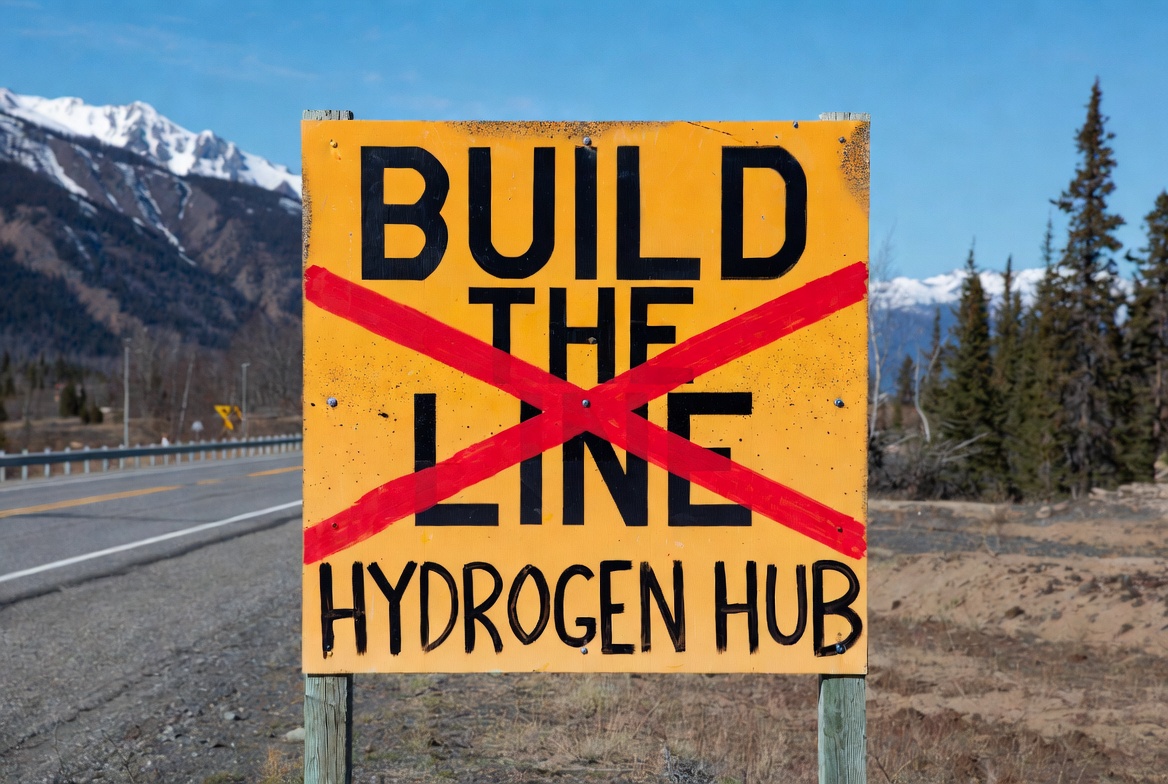
This article is a partial reprint of “The Paper Shields: How HB 381’s “Not Precedent” Clause and Its Project Labor Agreement Are Legally Hollow, and What That Means for Your PFD and Your Borough” by Dana Raffaniello, originally published 7/4/2026 on the author’s personal Substack.
The Governor’s Hydrogen Hub: What They Will Not Say in the Bill
There is a reason the bill’s proponents say “build the gasline” rather than “build the hydrogen hub.” The public record tells a different story than the legislative one, and the gap between them is the single most important transparency failure in this entire debate.
In December 2022, Governor Dunleavy published an op-ed advocating clean hydrogen as Alaska’s energy future. In January 2023, AGDC submitted a concept paper to the U.S. Department of Energy describing a hydrogen development framework for the North Slope. That same month, the governor led a trade mission to Japan where the central economic propositions were hydrogen export and carbon capture, not residential gas delivery to Southcentral Alaska.

The administration has been making the hydrogen and carbon capture case in every venue except the one where it matters most legally, which is the Alaska Legislature, whose fiscal notes have never once modeled the federal 45Q carbon capture credit stream or the 45V clean hydrogen credit stream as components of the project’s actual financial architecture.
The project’s own paid consultant filled in part of that picture involuntarily. GaffneyCline senior director Nicholas Fulford told the Senate Finance Committee on May 27, under oath, that natural gas itself “is not the driver” of this project’s value, and that gas “is not worth much.” A member of House Resources had already confirmed this privately months earlier, writing that Glenfarne would not be here without the ability to sequester CO2 on the slope, and that Japan would not purchase Alaska’s gas without CCUS.
The $10.9 billion Gas Treatment Plant on the North Slope is not sized and specified to deliver affordable residential heating gas. It is engineered to remove carbon dioxide to below fifty parts per million, the purity standard required to prevent gas from freezing inside liquefaction equipment and hydrogen cracking facilities, and to enable the carbon capture that generates approximately $595 million annually in federal 45Q credits at $85 per ton for sequestered CO2.
A facility designed for residential gas delivery would need to remove CO2 to roughly 2 to 3 percent pipeline specification, achievable at a fraction of that cost.
The 45V clean hydrogen credit, potentially worth up to $1.5 billion annually at the $3 per kilogram maximum rate for qualifying hydrogen production, carries a federal construction commencement deadline of December 31, 2027 under the One Big Beautiful Bill Act, P.L. 119-21, signed July 4, 2025. Alaska’s own statutory construction trigger sits at January 1, 2028.
The alignment between the December 31, 2027 federal deadline and the urgency that has driven two special sessions and a conference committee working through the July 4 holiday weekend has not been explained publicly. Whether that deadline is a material factor in the pace of these negotiations is a question the legislature and the public have not been given a direct answer to.
Acknowledging that openly would transform this debate. If the administration said plainly that this project is primarily a hydrogen hub and carbon capture credit architecture that will incidentally deliver some in-state gas as a secondary product, the legislature and the public could evaluate the terms of that deal honestly.
Alaska owns the pore space where the CO2 will be injected. Alaska owns the right-of-way. Alaska’s royalty gas provides the throughput collateral for Glenfarne’s international financing. The 45Q credits flow from the state’s own geology.
A transparent negotiation over what Alaska should receive in exchange for those contributions, including a statutory share of the credit streams that depend on state-owned assets, would be a negotiation Alaska could win. The current approach, presenting this as a property tax adjustment for a gas delivery project while keeping the hydrogen and credit architecture out of every fiscal note, guarantees Alaska loses that negotiation by default.
The Additional Cost Layers That Make the Affordability Claim Untenable
The affordable energy promise attached to this legislation deserves examination against the bill’s own text, because Version Q’s cost structure runs against ratepayers on multiple dimensions simultaneously.
The $16 per Mcf ceiling under AS 42.05.435 is already approximately 40 percent above what Enstar residential customers in Anchorage and the Mat-Su pay today from Cook Inlet gas, which the Regulatory Commission of Alaska has confirmed runs approximately $11.50 per Mcf all-in at current rates.
DOR’s own chief economist told the House Finance Committee in late May that imported LNG in 2033, the pipeline’s own target completion year, would cost approximately $17 per Mcf. The pipeline’s downside price ceiling sits barely below the import alternative before any additional cost layers are applied.
Those additional layers are documented in the bill’s own text. Section 36(a)(3)(C)(v) requires the Fairbanks spur line’s capital, financing, and construction costs to be allocated “across all consumers systemwide,” defined in Section 36(c)(8) as the area from the North Slope to the Southcentral region of the state, meaning a Mat-Su residential customer who will never receive Interior gas pays a proportional share of the spur line’s capital costs embedded in the pipeline tariff.
The alternative volumetric tax, once the temporary abatement period expires, functions as a throughput cost that the standard RCA tariff mechanism allows utilities to recover through the Gas Cost Adjustment. And the $10.9 billion GTP’s capital costs, embedded in the pipeline tariff and allocated across all throughput under the systemwide tariff structure, are passed to every Southcentral ratepayer for a processing standard their furnace does not need and will never use.
The governor’s own earlier proposal, SB 280, contained a statutory cap of $5 per Mcf after LNG plant completion as a binding legislative commitment. That commitment disappeared between the governor’s bill and the version that passed the House on June 12.
A Pipeline Alaska Could Actually Support
Building the hydrogen hub is a legitimate economic goal. Alaska sits on one of the world’s largest natural gas reserves, owns the geological formations needed for carbon sequestration, and is geographically positioned to supply Asian hydrogen markets. Those are real advantages that deserve a real strategy.
The argument here is that a real strategy requires transparency about what the project actually is, so that Alaska can negotiate terms commensurate with what it is contributing.
A bill built on that honest foundation would present the 45Q and 45V credit architecture to the legislature with full financial modeling rather than a passing reference to non taxable cash payments in a footnote. It would negotiate a direct Alaska share of the credit streams proportional to the state’s contribution of the underlying assets those credits depend on: the pore space, the right-of-way, the royalty gas, and the Class VI injection geology.
It would maintain standard property tax assessment on infrastructure within borough boundaries, with a defined construction phase abatement that expires when the project reaches commercial operations, rather than permanently replacing the borough’s independent taxing authority with a state-controlled throughput formula that every future industrial developer in the Mat-Su will immediately cite as the baseline they are entitled to demand.
And it would price in-state gas at a level that genuinely reflects Alaska’s ownership of the resource rather than the developer’s need to recover export grade processing costs from ratepayers who have no alternative supplier.
The people of Mat-Su Borough deserve to know that what is being built is primarily a hydrogen and carbon capture export platform, not a residential heating utility. They deserve to know that the tax structure being negotiated to make it possible strips their borough of hundreds of millions in cumulative industrial tax revenue, creates a legal precedent that every future developer at Port MacKenzie and in the West Susitna corridor will invoke, and delivers residential gas at a price well above what they pay today.
And they deserve a representative on their Borough Assembly who read the bill, read the legal memoranda, followed the conference committee proceedings, and concluded that their interests require a better deal than Version Q provides, not a better explanation of the deal that already exists.
Dana Raffaniello lives in Palmer, Alaska. He works as a network engineer, reads Alaska energy legislation closely, and publishes analysis of its fiscal and structural implications at raff6482.substack.com. He is running for the Mat-Su Borough Assembly, District 2. He has no commercial interest in any energy project discussed in this analysis.



