
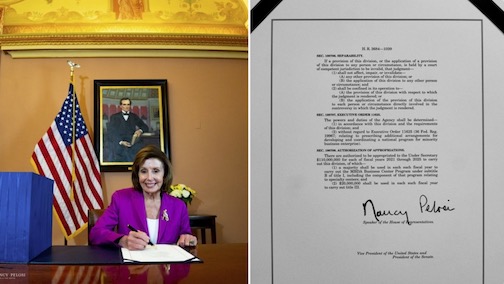
The massive $1.2 trillion spending package passed by the U.S. House of Representatives late Friday night has the infrastructure needs of the country at the center of it, along with climate change mitigation.
There are billions of dollars for roads, bridges, ports, broadband, and the power grid.
Here are some of the big ticket items:
$110 billion for roads, bridges, bridge repair and replacement, and major infrastructure projects. President Joe Biden had originally asked for $159 billion for this portion of the spending package, which had been dubbed the American Jobs Plan.
$65 billion for expanding high-speed broadband access.
$66 billon to eliminate a portion of the Amtrak maintenance backlog, modernize the Northeast Corridor, and bring “world-class service to new areas,” according to the White House.
$5 billion for replacing old, diesel-burning school buses, with $2.5 billion designated for purchasing electric school buses.
$7.5 billion to develop a national network of electric vehicle chargers.
$55 billion to replace lead water pipes.
$65 billion to upgrade the power infrastructure, including thousands of miles of new transmission lines.
$50 billion to make communities more resilient to the impacts of climate change and cyber-attacks.
$362 million over five years for transportation grants.
$3.5 billion for the U.S. Department of Energy Weatherization Assistance Program to help low-income homeowners with energy efficiency, i.e. windows, doors.
$42 billion to modernize airports, ports, waterways to support supply chains and reduce emissions, including repair and maintenance backlogs, reducing congestion and bottlenecks.
$21 billion to clean up superfund and brownfield sites, reclaim abandoned mines, and cap orphaned gas wells. Of that, Some of those old wells are on the North Slope. $150 million will be awarded to tribes or Native corporations involved in the work.
$11.6 billion for the Army Corps of Engineers for flood control projects.
$3.5 billion for the Federal Emergency Management Administration (FEMA) for flood mitigation and assistance.
$140 million for the National Oceanic and Atmospheric Administration for forecasting climate change.
$500 million for NOAA for mapping and forecasting of flooding.
$100 million of $65 billion for internet will come to Alaska.
$3.5 billion for Alaska roads.
$225 million for Alaska bridges.
$18 billion in loan guarantees for an Alaska natural gas export project that has an estimated cost of $38 billion.
$180 million for water and wastewater projects in Alaska over five years.
$130 million to help Alaska communities relocate away from eroding coasts.
$100 million for the Bureau of Indian Affairs to relocate Native communities away from eroding coastlines.
$230 million for the Alaska Native villages grant program for water and wastewater systems in rural Alaska villages.
$73 million for construction of ferries and ferry terminals and facilities, and operating costs.
$250 million for pilot electric or “low-emitting” ferry development. One grant of that amount is marked for Alaska.
“Tonight, I proudly signed the historic Bipartisan Infrastructure Framework and sent it to @POTUS to be signed into law. This bill delivers a once-in-a-century investment in our infrastructure, creates good-paying jobs and takes a crucial step to #BuildBackBetter For The People,” said House Speaker Nancy Pelosi on Twitter.
The majority of the Biden Administration climate change, social justice, and socialist safety net agenda is in a separate bill called Build Back Better Act. The infrastructure portion was separated from the BBA because of the resistance in Congress to the social engineering aspects of the bigger bill, which include socialist safety-net programs, expansions of Medicaid, universal government funded daycare and other programs. The BBA is what the Democrats will tackle next.


