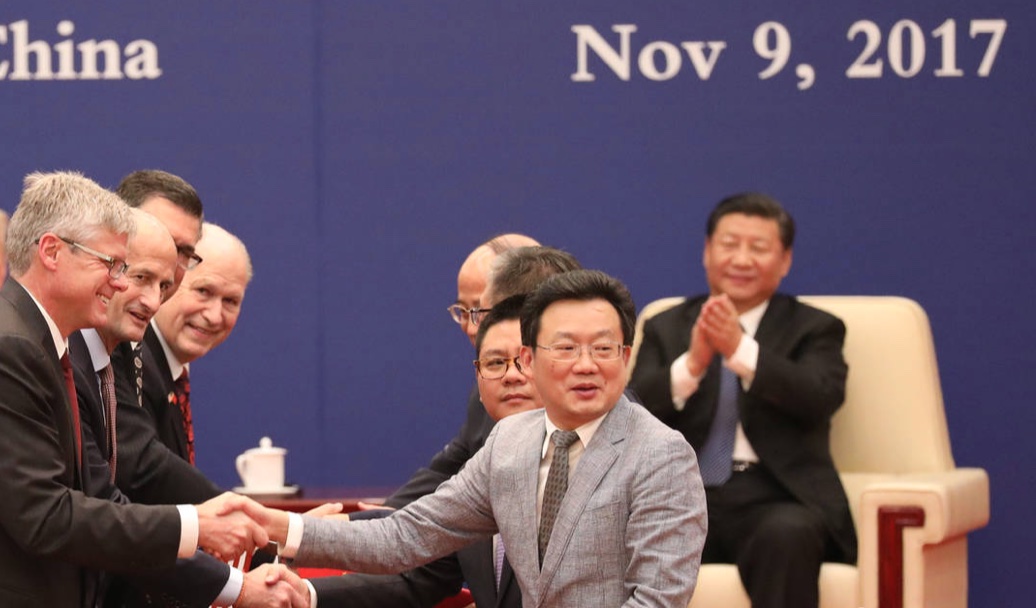
UNDER GOV. BILL WALKER, ALASKA WAS AN EASY TARGET
In November of 2017, then-Alaska Gov. Bill Walker signed a major deal with Chinese government-owned companies to build a gasline across Alaska. A new report shows that, if he had succeeded in partnering with the communist government companies, he could have put the entire nation at risk. The Alaska LNG project included eight compressor stations along the 804-mile route from Prudhoe Bay to the liquefaction plant in Nikiski, the entire project built in collaboration with China.
A major report by The Washington Post says the Chinese military has already broken into the computers of one unnamed oil and gas pipeline in the U.S. The Chinese are probing many smaller energy entities to test vulnerabilities and have vastly improved in their ability to disrupt American infrastructure. The report says it’s likely that Chinese hackers are already inside the computers that run America’s infrastructure, and may be just laying in wait until given the order to act.

The Chinese have infiltrated power and water utilities in America, as well as communications and transportation systems. They have invaded a water utility’s computers in Hawaii, and those at a major West Coast port, people familiar with the incidents told The Washington Post in a story headlined, “China’s cyber army is invading critical U.S. services.”
The hackers, affiliated with China’s People’s Liberation Army, made an attempted incursion into the systems of Texas’s power grid, which operates independently from the major electrical systems in the country, and which covers the state that produces the most oil for America — 42.4% of American oil comes from Texas.
The newspaper’s report comes at a time when Alaska Sen. Dan Sullivan has been raising concerns about China and companies in the United States that are investing in China’s government-owned businesses engaged in advanced technology that can be used against America.
As a member of the Senate Armed Services Committee, Sullivan took to the Senate floor to ask House Speaker Mike Johnson to ensure legislation moves to a vote before the end of January that, at a minimum, would require U.S. firms to report foreign investments that could pose a threat to American national security.
“We have American financial companies that are investing in Chinese Communist Party companies and are producing things like advanced semiconductors, artificial intelligence, quantum computing, and hypersonics– all technologies that are critical to dominating the 21st century battlefield,” Sullivan said.
“This is a giant American national security issue. . . Right now, we have Republican House Members—hopefully not the Speaker, but certainly the chairman of the Financial Services Committee—who are saying: No, I want to keep it in the dark, what Americans [firms] are doing to make [Chairman Xi Jinping] stronger. That is wrong. Mr. President, 99.9 percent of Americans would think that is wrong. So we need to fix it. The House needs to take leadership on this issue. My Republican colleagues keep talking tough on China. It is time to act.”
In a related development, Duke Energy, a large U.S. utility company with 8.2 million customers, last week said it had disconnected large batteries from Camp Lejeune Marine Corps Base in North Carolina because of the Chinese battery maker’s close links with the ruling Chinese Communist Party. Both Republican and Democrat lawmakers have been raising concerns about the potential security threats posed by the batteries, which may have the capacity to take down electrical grids.
Over the past year, the Chinese hackers have infiltrated computer systems in dozens of critical U.S. entities, the sources told the newspaper, with a goal of creating widespread panic and chaos, and to snarl logistics if there is a confrontation between the U.S. and China in the Pacific, especially if there is a Chinese invasion of Taiwan.
“The recent cyber intrusions seem to be part of a broader military initiative named ‘Volt Typhoon,’ the newspaper reported.
The communist Chinese strategy has changed over the past decade, according to Brandon Wales, the executive director of the Department of Homeland Security’s Cybersecurity and Infrastructure Security Agency (CISA).
While a decade ago, computer break-ins were focused on political and economic espionage, today the Chinese are attempting to compromise critical infrastructure, “in part to pre-position themselves to be able to disrupt or destroy that critical infrastructure in the event of a conflict, to either prevent the United States from being able to project power into Asia or to cause societal chaos inside the United States — to affect our decision-making around a crisis.”
The Chinese have zeroed in on Hawaii as an area for their concentrated interest, as it is the home of the U.S. Pacific Fleet and a logistics hub for military operations. According to the report, Microsoft revealed that Volt Typhoon activities were also targeting entities in Guam, another hub for the U.S. Navy.
Biden had a meeting with China’s head of state Xi Jinping on Nov. 15 in Woodside, Calif., but he did not bring up the matter.
“The topic of Chinese cyber intrusions into critical infrastructure was on a proposed list of talking points to raise in Biden’s encounter with Xi, according to people familiar with the matter, but it did not come up in the four-hour meeting,” the Post reported.
The White House readout of the Biden-Xi meeting is at this link, with a list of the topics the two leaders reportedly discussed.
Nearly six years ago, Alaska Gov. Bill Walker signed a deal with the Chinese government-owned Sinopec, the Bank of China, and China Investment Corporation to build a gas pipeline from Prudhoe Bay to Nikiski, with processing plants on the North Slope and also at tidewater. The gas would be loaded onto ships and taken to China, Korea, and other customers in the Pacific. China was to be entitled to 75% of the gas.
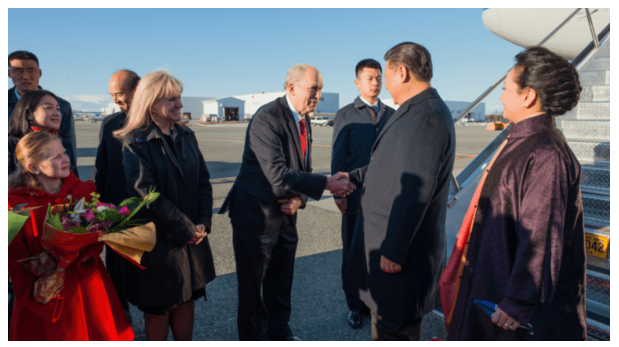
That deal was tabled when Mike Dunleavy became governor in 2018.
Sen. Sullivan, who has long been sounding the alarm over China, was not shy about confronting U.S. companies that are investing in the Chinese Communist Party’s cyber war initiatives.
“We have, who knows, a lot of financial institutions investing in Chinese companies to make their military stronger. We have financial companies that are investing in the Chinese Communist Party, companies that are producing things like advanced semiconductors, artificial intelligence, quantum computing, hypersonics–all technologies that are critical to dominating the 21st century battlefield. This is a giant American national security issue,” Sullivan said.
“I don’t normally come down to the Senate floor and quote Lenin. I am not a big fan of Lenin. But he purportedly said that ‘capitalists will sell us the rope with which we will hang them,'” Sullivan continued. “There is a little bit of that going on right now here in the United States of America. We have executives in this country and certain financial institutions–by the way, these American financial institutions and executives owe everything to their success by being American, being in the greatest country in the world, with the rule of law and our capital markets and our dynamic economy. Their success is because of the great Nation we live in, and yet some, kind of addicted to making more money–listen to Lenin. They are like, you know, maybe I will do that advanced chip manufacturing investment in the Chinese economy; maybe I will help them a little bit with artificial intelligence or quantum computing,” Sullivan said. Sen. Sullivan’s complete remarks are at this link.
The Washington Post story about the China cyber threat is at this link.