
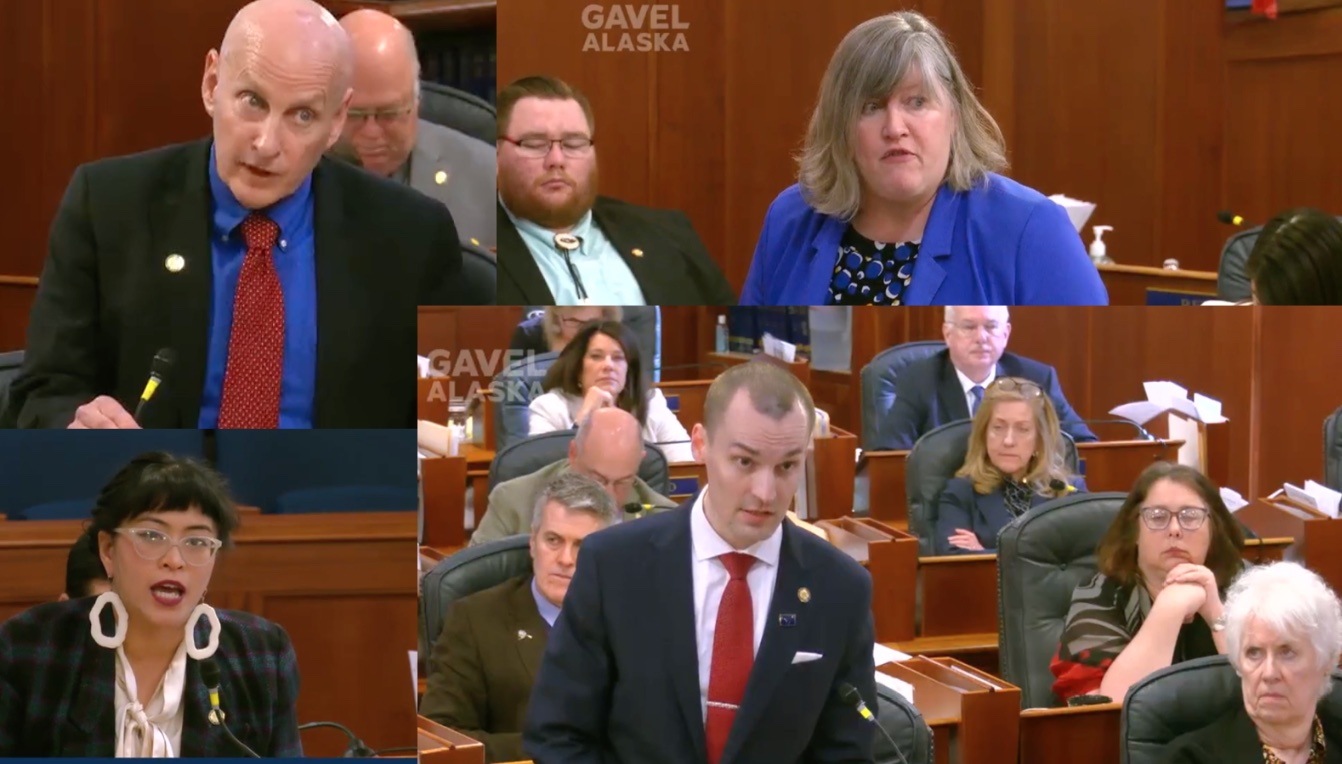
The Alaska House on Saturday ran a marathon session, forced by the minority Democrats, who moved amendment after amendment on a bill that is designed to protect female competitive athletes in Alaska’s public schools and universities.
The Democrats made 88 amendments in all, carefully coordinated in caucus and designed to delay the passage of House Bill 183. Each amendment had at least six Democrats standing to speak in support of it to wear out the Republican majority. The amendment sponsor had three minutes to present, and three minutes to wrap up, and each member who rose had one minute to argue.
Even with that structure, it was going to take all day, and lawmakers were cranky.
One amendment was to exempt competitive chess tournaments from the proposed law that would protect girls in sports. Then came the amendment to exempt synchronized swimming teams from the protections for girl athletes.
On the chess amendment, Rep. Rebecca Himschoot of Sitka said she would vote for the bill because she had seen the movie, “The Queen’s Gambit,” on Netflix, and it made her realize how important chess is. Himschoot was a public school teacher in Sitka and Hawaii, teaching science.
On the synchronized swimming amendment, Rep. Donna Mears said she was a synchronized swimmer once and she got a concussion from the sport. But despite the brain injury, she supports males being able to be on these competitive teams with females.
One amendment was to create a “transgender awareness day” in schools and force a curriculum addition on notable transgenders in history.
Another amendment addressed “hate crimes” against transgenders.
Yet another amendment would have made the NCAA policy the standard by which Alaska schools would follow. The NCAA policy is being challenged in court by former NCAA champion swimmer Riley Gaines, who now fights for the rights of women athletes.
At one point in the proceedings, House Minority Leader Calvin Schrage threatened House Speaker Cathy Tilton, saying she would reap the consequences for years to come. After an extended at-ease, he apologized for the threat.
Also acting out in the House was Rep. Zack Fields, who petulantly broke the rules by interrupting the House Speaker, speaking on and on after he was past time, continuing to argue even though his mic had been shut off, and showing other disrespect to the institution by reading passages without first asking permission from the Speaker.
Rep. Daniel Ortiz, who is not an admitted Democrat but has only caucused with the Democrats since taking office, stood to ask for an indefinite delay of the bill. He said that if the House got through all its other business it could return to the topic. It was a lie perhaps he hoped tired Republicans would fall for, but Rep. David Eastman called him out on it, saying that by the rules, an indefinite postponement meant the bill could not be brought back up. That amendment, like all the others, failed.
While some Democrats pointed out that House Bill 183, sponsored by Rep. Jamie Allard, was a solution in search of a problem, Rep. Josephson admitted on the floor that a transgender track runner in Haines competed competitively in the girls’ division, the one instance in state history where he said this issue mattered. That occurred in 2016. Since it was the only case Josephson knew of, he stated it was the only instance, and therefore the bill is unnecessary.
However, with increasing frequency transgenders have started taking away medals from women on the national level in swimming, track and field, cyclocross, tennis, skiing, and a growing list of sports, as boys and men who cannot win in their own category switch to the female roster, even after they have gone through male puberty and have the musculature to prove it. In Alaska, the Alaska School Activities Association at first left the matter up the the schools, but now even the ASAA and the Alaska School Board have had to set boundaries in order to protect girls from boys who covet their medals and scholarships.
Although these are policies and regulations, the Democrats in the House don’t want the protections for girls to be in statute, and fought through the day and late into the night against the rights of girls.
The matter was finally referred to Sunday’s House calendar for a third reading and vote. Both sides — Democrats and Republicans — were worn out by the end of the debate.
But what Republicans got was hours and hours of Democrats on tape saying what they really think, such as Rep. Andrew Gray insisting that “trans girls are girls,” and Rep. Genevieve Mina suggesting that mixed martial arts should be co-ed if the athletes are of the same weight.
Rep. Sara Hannan, a former Juneau teacher, authoritatively talked about zygotes, and how all humans start out as females for the first several weeks before the testosterone turns some into males.
“The question is are we all transgender or just the men?” Hannan asked the body.
Rep. Himschoot and Rep. Fields falsely said the bill would force teachers to do genital inspections.
“I would be very uncomfortable doing a genital inspection,” said Himschoot.
Rep. Jennie Armstrong said transgenderism is an immutable characteristic, but later Rep. Mina said that children explore their gender identity.
At times the Democrats referred to girls as girls, and at other times they used the slur “cisgender girls.” It’s all on record for posterity — and election cycles to come.


