
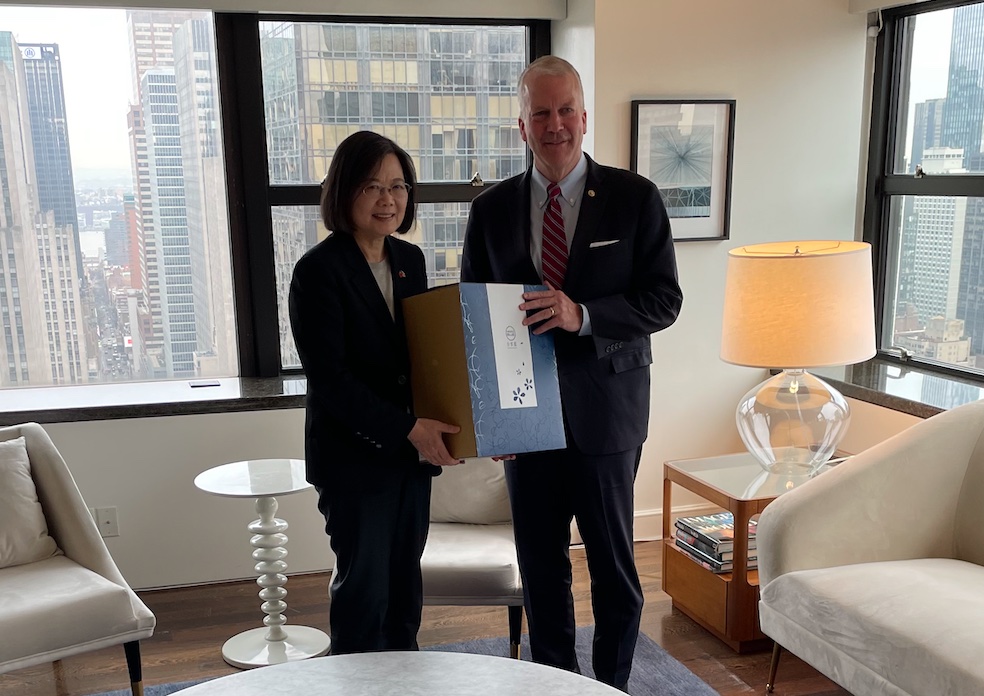
Alaska Sen. Dan Sullivan, a member of the Senate Armed Services Committee, along with Joni Ernst (R-Iowa) and Mark Kelly (D-Ariz.), met with Taiwan President Tsai Ing-wen on March 31 in New York City. The senators showed their support for the island democracy and Sullivan emphasized that China has no right to dictate whom foreign leaders can or cannot meet with.
Sullivan added that the US Senate does not serve the Chinese Communist Party’s interests and that Taiwan is not isolated, despite the CCP’s propaganda. This is his fourth meeting with President Tsai and he led this delegation.
Sullivan later tweeted that he sees Taiwan as the 21st Century’s West Berlin, as it stands as a defender of democracy against a powerful, expansionist authoritarian regime.
The Taiwanese president is meeting today with House Speaker Kevin McCarthy in Los Angeles. She was met with strong support from pro-Taiwan supporters who gathered at the airport and later in front of her hotel. Meanwhile, a small group of pro-communists demonstrated nearby, chanting “One China.”
Tsai’s meeting with McCarthy and a bipartisan group of a dozen or more lawmakers will take place in the Ronald Reagan Presidential Library.
Chinese top officials call the meeting a “provocation” that violates the one-China principle, under which the United States, since 1979, has recognized the CCP as the sole legitimate government of China, while maintaining unofficial relations with Taiwan. Under the one-China principle, the U.S. simply recognizes that China thinks it has sovereignty over Taiwan.
In November, President Joe Biden told China President Xi Jinping that the U.S. stand on one-China is unchanged, and he told the media he does not think there is an immediate threat that China will invade the island, which is a democracy.
On March 29, Sullivan and Rep. Mike Gallagher reintroduced the “Sanctions Targeting Aggressors of Neighboring Democracies (STAND) with Taiwan Act of 2023,” which seeks to impose significant economic sanctions against China if it invades Taiwan. The same bill was introduced in 2022 by Sullivan and would require approval from both the Senate and the House of Representatives, as well as the president.


