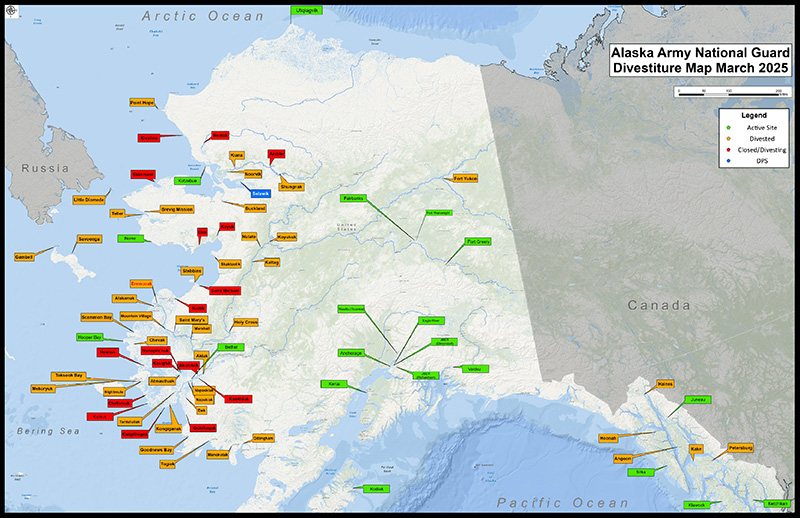
Today, June 23, U.S. Senator Dan Sullivan’s Alaska National Guard Rural Community Revival Act passed out of the Senate Armed Services Committee and onto the Senate floor as part of the broader FY 2027 National Defense Authorization Act (NDAA).
The Act mandates the Secretary of the Army and the Chief of the National Guard Bureau, in coordination with U.S. Northern Command and the Golden Dome for America Office, to develop the “National Guard Rural Community Revival Plan” within 90 days of enactment. This comprehensive plan aims to optimize readiness and force posture across remote regions where extreme environments and isolation pose unique challenges to strategic national security priorities, specifically addressing critical sites that were once robustly supported by the Department of War (DOW) but have been neglected or abandoned over time.
“Rural Alaska used to be a critical component of America’s northern defense, with Alaska National Guard units anchored by armories and supportive communities. Unfortunately, most of these National Guard units and armories were shut down during the 1990s, harming these communities, national security, and opportunities for young Alaska Native men and women who want to serve their country. Today, we begin to correct this strategic mistake,” said Sen. Sullivan. “My legislation initiates ‘Phase One’ of our strategy to revive the Alaska National Guard in Rural Alaska—to reopen, invest in, modernize, and staff the infrastructure and armories that were so important to defending our nation during World War II and the Cold War. My legislation directs the Pentagon to comprehensively evaluate available assets, engage local partners, and deliver Congress a clear roadmap with actionable options and precise cost estimates. Ultimately, this ensures we have the exact baseline needed to secure long-term investments and continue the essential military build-out across Alaska.

“This plan isn’t just about military readiness; it’s also about community resilience. As we upgrade these facilities, we are establishing a framework where the Department of War and our local economies directly invest in one another. By aligning DOW resources with local workers and allowing Alaskans to serve in their own backyards, we ensure our rural communities grow stronger right alongside our national security posture.”
“The Alaska National Guard Rural Community Revival Act further cements Alaska’s role as ‘Top Cover for North America,'” said Maj. Gen. Torrence Saxe, adjutant general of the Alaska National Guard and commissioner of the Alaska Department of Military & Veterans Affairs. “Alaska is both a potential platform to project power and our home to defend. Rebuilding thriving and active armories in all parts of the state, especially in Western Alaska, gives us better ability to respond to whatever situation may come, whether they be from a foreign actor or an immediate response to a natural disaster. Additionally, the various military training programs available only strengthen and broaden the opportunities for Alaska’s youth in rural areas. This is a win-win scenario for all involved and I support Senator Sullivan’s efforts to strengthen our dual-state and federal mission capabilities.”
“As a state Senator who has represented Rural Alaska for decades, I support Senator Sullivan’s Alaska National Guard Rural Community Revival Act,” said Alaska state Senator Lyman Hoffman. “Reopening our National Guard armories will boost our rural economies, enhance emergency response throughout Western Alaska, and provide a pathway for more young Alaska men and women who want to join the military and live in their communities.”
Click here or the map above to see the status of the National Guard armories in Alaska.
During World War II, a series of Federal Scout Readiness Centers were established across Alaska to create a logistics network for the military, particularly the Alaska Territorial Guard, to defend the vast territory, especially following the bombings and subsequent invasion of the Aleutians by the Japanese in 1942. This foundation was expanded dramatically during the Cold War with the creation of the Alaska Army National Guard’s Scout Battalions and armories, which supported surveillance, early warning, and defense mobilization efforts to counter the threat from the Soviet Union. Since the fall of the Soviet Union, many of these armory facilities and lands have been abandoned.
The Alaska National Guard Rural Community Revival Act includes six key pillars:
- Modernizing Arctic Infrastructure: The Act requires a comprehensive audit of all armories, readiness centers, and ranges in remote areas to ensure they can support training and operations, including integrated survival and combat operations, in contested environments.
- Strategic Logistical Hubs: The Act mandates the creation of strategic logistical hubs to pre-position and store critical assets, including extreme cold-weather gear, emergency materiel, homeland defense equipment, and advanced communications infrastructure. These hubs will be strategically optimized to ensure the National Guard maintains rapid-response capabilities for both domestic disaster relief and national security operations in remote and austere environments.
- Rural Personnel Incentives: To address critically understrength units, the Act authorizes a localized incentives framework, including exploring specialized remote duty allowances, signing bonuses, and educational stipends, designed to recruit Guard members directly from local rural communities.
- Technological Resiliency: The Act prioritizes structural and technological upgrades, such as microgrid integration for primary power under extreme conditions, secure tactical satellite integration, and redundant high-latitude network systems.
- Dual-Use Airfield Expansion: The Act promotes the expansion of existing runways and hangar facilities to accommodate both modern military platforms, such as rotary-wing and autonomous aerial systems, and civilian aircraft.
- Public-Private Partnerships: The Act encourages leveraging enhanced use lease (EUL) authorities to co-locate commercial telecommunications and energy infrastructure within National Guard footprints, lowering costs for taxpayers while enhancing installation resilience.
Press release provided by the Office of U.S. Senator Dan Sullivan, June 23, 2026.