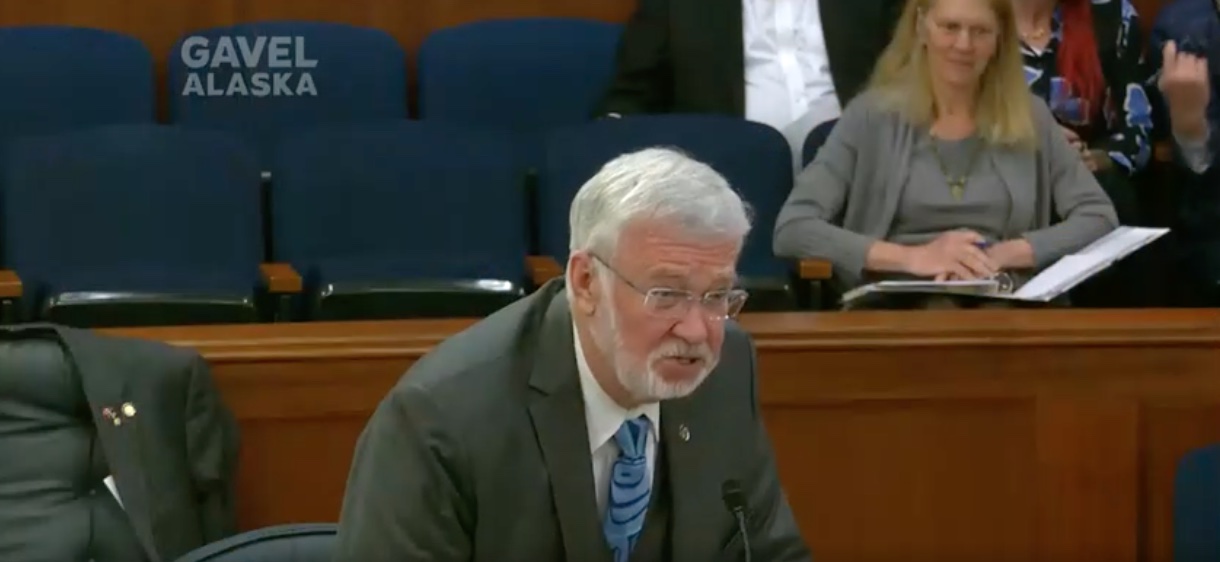
The Senate Democrat majority announced its formation today as a result of decisions of eight Republicans who allowed nine Democrats to dominate the majority, rather than forming a majority of 11 Republicans. Some 65% of Alaska voters chose Republicans during the most recent election, but the Senate majority has now been handed to a Democrat majority.
The majority has 17 members, which the presumed Senate President Gary Stevens, a Republican from Kodiak, called “a healthy majority.”
The Majority’s membership includes Senator Click Bishop (R-Fairbanks), Senator-elect Jesse Bjorkman (R-Nikiski), Senator-elect Matt Claman (D-Anchorage), Senator-elect Forrest Dunbar (D-Anchorage), Senator-elect Cathy Giessel (R-Anchorage), Senator Elvi Gray-Jackson (D-Anchorage), Senator Lyman Hoffman (D-Bethel), Senator-elect James Kaufman (R-Anchorage), Senator Scott Kawasaki (D-Fairbanks), Senator Jesse Kiehl(D-Juneau), Senator-elect Kelly Merrick (R-Eagle River), Senator Donny Olson (D-Golovin), Senator Bert Stedman (R-Sitka), Senator Gary Stevens (R-Kodiak), Senator-elect Löki Tobin (D-Anchorage), Senator Bill Wielechowski (D-Anchorage), and Senator David Wilson (R-Wasilla).
Wielechowski will be Senate Rules Chair, Giessel will be Senate Majority Leader, Bishop will be Majority Whip, and Gray-Jackson will be Legislative Council Chair.
All but three people in the Senate are included in the caucus. The three excluded from the caucus are all Republicans — two from the Valley and one from Fairbanks: Sen. Shelley Hughes, Sen. Mike Shower, and Sen. Robb Myers.

There will be and unusual aspect in the Senate Finance Committee this year: Three co-chairs, including Sen. Stedman for operating budget, Sen. Hoffman for the capital budget, and Sen. Olson, who will will handle bills coming through committee.
It appears to be a binding caucus with all members expected to vote in favor of the budget when it comes to the floor, Sen. Stevens said.
There was no commitment on the Permanent Fund dividend, and Stevens indicated there is not agreement on that item. Sen.-elect Cathy Giessel said that education needs more funding than it has now and “all of that has to be weighed out.” This is an indication that the budget will balloon for education at the expense of dividends.
Giessel said that “all members of this caucus are responding to what we heard from Alaskans. We heard door to door and in elections that Alaskans are looking for people in Legislature who will work together to get things done, to get important things done.”
When asked why they favored joining the Democrats for a majority rather than plan offered by the three excluded Republicans, Stevens said it was a recognition of “the reality of the last four years, we have not been able to give several of our senators support on budget. We had to go around them and get the budget passed.”
As for whether the Senate would overturn ranked choice voting, Sen. Stevens said he was “loathe to overturn it,” since it was the will of the people and has “led to more moderation in the Senate.”
Giessel agreed, said that 92% of the people had been instructed on how to use the people, and 60% of the people said they felt that the races were more competitive with ranked choice voting.
Meanwhile, the Senate minority announced its three members: The new Republican Senate Minority consists of the current Senate Majority Leader, Senator Shelley Hughes; the current State Affairs Chair, Senator Mike Shower; and the current Transportation Chair, Senator Robb Myers. It is one of the smallest minorities in Alaska Senate history.
“The new Minority looks forward to and is proud to stand with the overwhelming majority of voters across Alaska who demonstrated on their ballots their desire for the Senate to take a right-of-center pathway,” the three wrote in a press release this afternoon.
The three senators in the new Minority had previously proposed to all of their Republican colleagues a pathway for what would be a functional and successful majority to respect the 65% of Alaskan voters who had voted for Republicans to represent them in the State Senate.
“The proposal included a clear route to passing a responsible budget without draconian cuts along with policy priority options that were positive for Alaska and around which caucus members could coalesce. The inclusion of several Democrats was also part of this proposal,” the press release said.
Sen. Shelley Hughes began discussions over the summer with the now Republican members of the Majority about policy priorities as a unifying bond. In the days following the Nov. 8 election, on behalf of the now Republican Senate Minority, Hughes reached out by phone, text, and email to her Republican colleagues to offer a solution to ensure a Republican majority would meet its constitutional duty to pass a budget. This approach was offered as an ethical alternative to the “binding caucus rule” adopted by the bipartisan coalition.
With a binding caucus rule, before the session begins, members pledge to vote yes on the budget sight unseen; if a member fails to vote for the budget, punishment in the past has included the loss of chairmanships, committee assignments, staff, staff pay, district resources, and office space.
“Unfortunately, in response to the reasonable proposal offered, only one Republican colleague (who is now a member of the Democrat-weighted Majority) contacted Hughes at the last minute to convey they were not interested in the proposal nor willing to come to the table to dialogue,” the press release stated.
“It’s very disconcerting that my fellow Republicans in the Senate were not even willing to have a conversation about joining together for the betterment of Alaska, but more troubling than that is my colleagues defied the voters and have let Alaskans down. When 65% of Alaskans send a majority of Republicans to represent them in the Senate in Juneau, they are voting for a right-of-center Majority. Alaskans are concerned about high inflation, gas, and energy prices; Biden’s anti-resource development policies which are harmful to our state; and leftist policies that hurt families and children. Alaskans’ votes for state Senate clearly indicated Alaskans preferred policies based on conservative principles that will open up new opportunities and promote a strong economy, strong communities, and strong families. Despite being in the Minority, I want my district and Alaskans to know I will aim for these goals in the Senate in my work on Alaskans’ behalf to the best of my ability, as well as in my work with the House and with our governor,” Hughes said.
Following the Senate Majority’s announcement, Senator Robb Myers of Fairbanks and North Pole said, “I had hoped to join a majority focused on fixing our long-standing fiscal problems and moving the state forward. Unfortunately, the new coalition is bound by terms counterproductive to what I ran on and seems to be focused on maintaining the status quo. Nonetheless, I am focused on being as productive as possible for my district and the state under the new arrangement.”
Sen. Mike Shower said, “It’s disappointing a majority of Republicans rejected discussing the formation of a Republican controlled Senate among the 11 of us. We presented a common-sense path forward: 1.) separate the PFD into its own bill to prevent legislators from having to commit political self-destruction voting against it year after year and 2.) agree to some version of a spending cap limit to ensure controlled growth of the operating budget. We made two basic requests to ensure Republican senators were not put in untenable positions on hot button issues in their very diverse districts. Instead, our colleagues appear willing to throw away a clear Republican majority for a Democrat-dominated Senate: 9 Democrats joining 8 Republicans. Their arrangement is hard to justify considering roughly two-thirds of first place votes in the Senate races went to Republicans.”
Shower said he would continue to work with the Republican governor and Republican- dominated House to advance important priorities for Alaska.
“I will continue to do so wherever possible within the Senate with anyone willing to advance smart policy like the bipartisan fiscal working group’s recommendations presented last year. I will work on the repeal of ranked choice voting, continue election and judicial reform efforts, and will never give up on a balanced budget comprehensive fiscal plan Alaska desperately needs. There are many ways to solve problems. I’ll do whatever I can and whatever we must do to move Alaska forward,” he said.
Hughes wrapped up remarks for the group: “We want Alaskans to know that our Minority organization may be small, but we will be mighty. We understand that voters have been betrayed and a very substantial majority of you cast your votes against watered-down principles, left-leaning policies and for a right-of-center majority. We will stand up and fight for Alaskans every chance we get. We will also work to find consensus with the Bipartisan Coalition wherever and whenever we can to advance items that will lead to a better future for Alaska. In the end, we will be true to Alaskans and to our districts.”