Friday, June 19, 2026
Home Blog Page 955

Anchorage school lottery is now open

By DAVID BOYLE

The Anchorage School District is holding a lottery for its charter and alternative schools, and now is a chance for parents to help their children get a better opportunity for an education from the public school system.

The district started accepting lottery applications on Feb. 1 for the next school year, which starts in mid-August. The application period ends March 17. A link to the ASD lottery questions and applications can be found here: https://www.asdk12.org/lottery.

There are several school types on this lottery, including charter schools and alternative schools. Two of the charter schools are correspondence/home schools, while the others focus on culture, a specific language, STEM (science, technology, math), or a structured basic curriculum.

Two of the most popular among the lottery schools are Aquarian Charter School and Northern Lights ABC alternative school. Students attending these schools have performed extremely well on the State’s PEAKS summative test.

A listing of the PEAKS scores (2020-21) for all the charter and alternative schools:

SCHOOL                                                           ENGLISH-LANGUAGE-ARTS/MATH / Percent advanced and proficient

Anchorage School District (All schools) – 43/37

Alaska Native Cultural Charter School – 23/16

STrEaM Charter School – 55/30

Aquarian Charter School – 73/59

Eagle Academy Charter School – 75/79

Family Partnership Charter School – 70/66

Frontier Charter School – 88/58

Highland Academy Charter School – 47/26

Northern Lights ABC School – 74/66

Polaris K12  – 54/39

Rilke Schule Charter School – 62/61

Steller Secondary School – 78/54

Winterberry Charter School – 64/17

Birchwood ABC School – 58/58

These figures indicate the percentage of students proficient in English/language arts and mathematics. 

Proficiency rates are not the only factor to consider. One must first consider what learning style/curriculum fits a child best.

There is usually a long waiting list for students to get into most of these schools. A few years ago, there were more than 2,500 students on the waiting list for these schools. The schools are in demand because they cater to the customers’ needs-the parents.

Why is there so much demand for these schools with so little supply from the ASD?  Because the district is a monopoly it does not have to respond to customers’ demands.  If a shoe store only offered brown shoes, one style and one size, it would not be in business for long. Customers would go elsewhere to buy shoes.

If the district wants a new neighborhood school, it merely floats a bond, builds the school, and bills the taxpayers. On the other hand, if parents want a charter school, they must organize, develop a long business plan, and then get approval from the local school board. This usually takes more than a year. 

The greatest hurdle for a new charter school is finding a facility to house the new school. In the Anchorage School District, even though there are some schools with less than 60% fill rate, schools will not be consolidated to free up a facility for a charter school. 

Parents/guardians must also consider that they must provide transportation for their children, even though the district receives transportation funding for that child. Unfortunately, this can deter low-income and single parents from even applying for a charter/alternative school.

It’s common for parents to be overwhelmed by the procedures and hurdles one must go through to win this lottery, but winning a spot could be the best thing that happens to your child.  

The district is holding an event to learn about its charter and alternative schools on Saturday, Feb. 19 from noon to 4pm at the ASD headquarters, 5530 East Northern Lights Blvd.  Find a charter/alternative school that fits your child.  Then apply for the lottery.

Report: Anchorage students making little progress in math

11

BY DAVID BOYLE

Superintendent Deena Bishop tried to put a happy face on her report this week when she briefed the Anchorage School Board on math proficiency of students in grades three through nine.

But the results were disappointing at best, with little progress shown when it comes to student math scores.

Currently, only 37% of students in grades 3-9 in Anchorage are proficient in math according to the most recent PEAKS assessment. 

The district established a goal to have 55% of these grade 3-9 students proficient as measured by the state’s summative assessment—PEAKS by May 2026. If the target is met, 45% of this cohort of Anchorage students will be unable to do math problems at grade level by the end of school year 2026.  

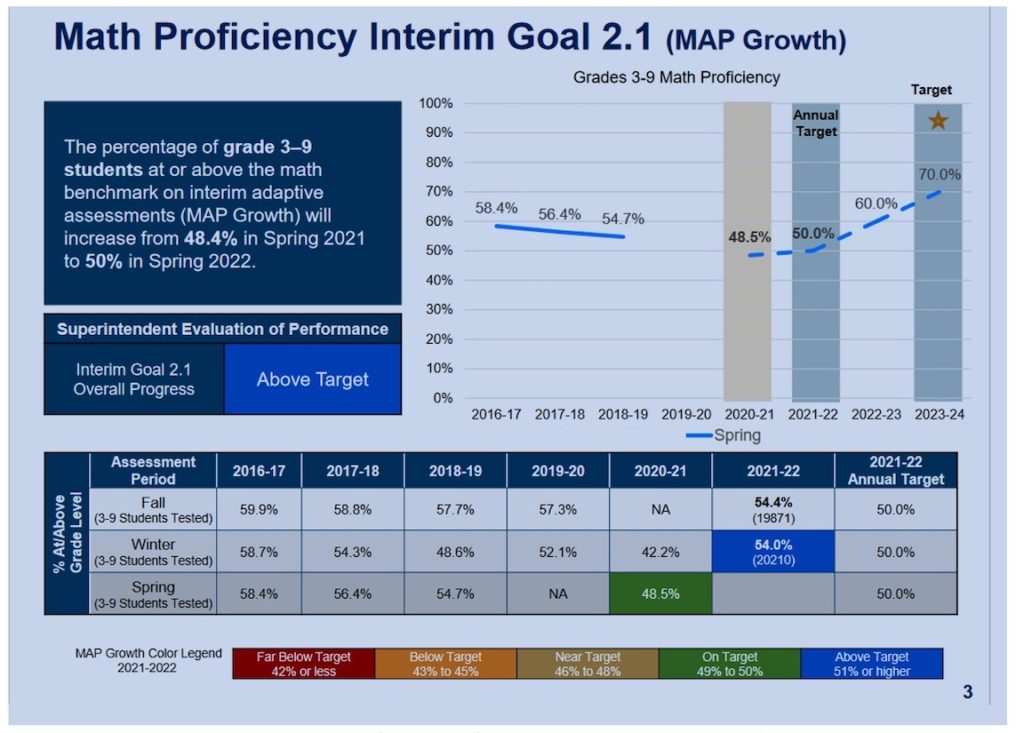
The district’s goal is to have only half the students proficient in math by Spring 2022.  While achievable, it is a low target. Yet the district hopes for a massive 40% increase in math skills in the next two years (from 50% to 70%).

Between last school year and this school year the district hopes for just a 1.5% increase in student math proficiency. 

Note the decrease in math proficiency from the 2016-17 school year to the 2020-21 school year. Anchorage students saw a nearly 10-percentage point drop—a 17% overall drop.  

The district puts some of the blame for low math performance on the various student demographics — race, low income, homelessness, and special education. Still, white students and wealthy students were only about 73% proficient in math.

There is a “bright spot” in the ASD: According to a strategic planning document presented to the board on Jan. 6, 2020, “The overall graduation rate is a bright spot for ASD which is at an all-time historical high of 84%”.  

In other words, not even half of the students are proficient in math, yet they are being graduated out.

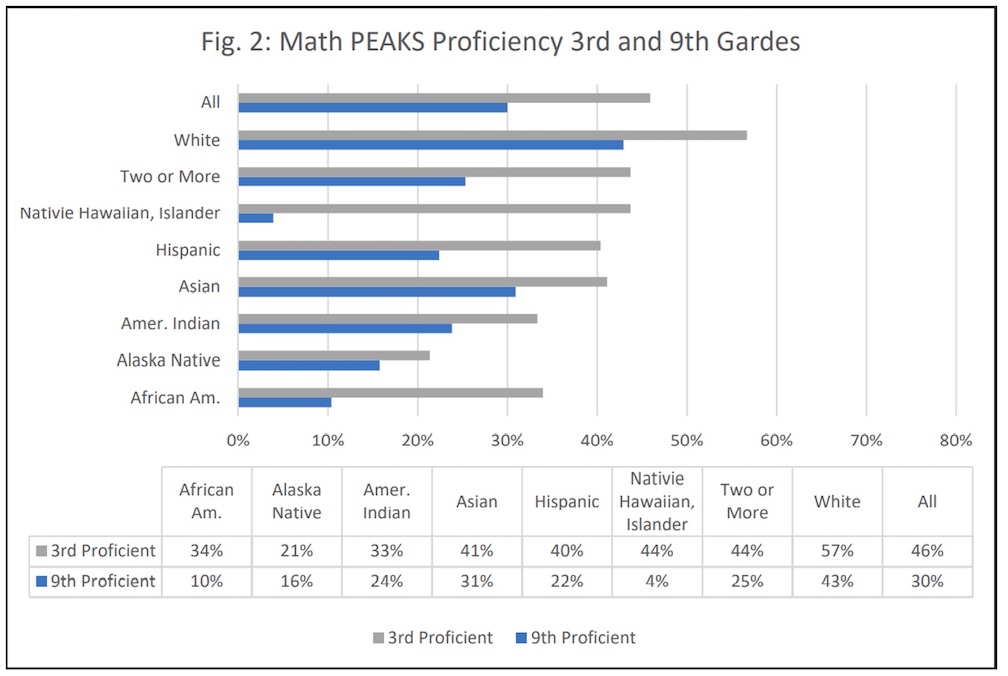
Looking back, PEAKS results for 2019 showed that 46% of third graders and 30% of ninth graders achieved ‘proficient” or higher scores on the PEAKS math assessment. What is happening to a student between the 3rd grade and 9th grade?  Here is the chart from January 2020 school board retreat:

In the chart above, students from all races actually became less math proficient between grade 3 and grade 9. 

In the past few years, the ASD has changed it math program from EveryDayMath (EDM) to GoMath to the current I-Ready Math.  The EDM program was a failure because it was too conceptual for most students and did not focus on foundational math concepts. 

This district considered several programs to replace EDM. One of these was Saxon Math.  However, Saxon Math was discarded early on.  But this math program seems to work very well in schools where it is being used:

SCHOOL  / PEAKS (Percent of students proficient and above)

ASD (overall) – 37%

Aquarian Charter School – 59%

Eagle Academy Charter School – 79%

Northern Lights ABC School  – 66%

Birchwood ABC School  – 58%

The numbers point to the curriculum as a cause of the poor math proficiency in the district.If a student does not have a good grasp of math basics, that student will have a difficult time in algebra and higher math.

A second cause of low student math proficiency may be the lack of effective classroom instruction. Bishop addressed this in her briefing but noted that it is still “a work in progress.”  There are no data provided regarding the effectiveness of classroom teachers, and “work in progress” is not particularly measurable.

The district does admit that increasing math proficiency requires effective instruction in the classroom. But it has not identified gaps and barriers to identify lower performing teachers and support for those teachers. 

The formula for excellent education is an effective classroom teacher, a motivated student, and an excellent curriculum.  

Fauci: Fourth shot may be needed as vaccine booster fades after four months

18

Booster shots for Covid-19 are losing their potency after about four months, according to the Centers for Disease Control, in a report released Friday.

“There may be the need for yet again another boost — in this case, a fourth-dose boost for an individual receiving the mRNA — that could be based on age, as well as underlying conditions,” said Dr. Anthony S. Fauci, the Biden Administration Covid expert, speaking to the media. “So, I don’t think you’re going to be hearing, if you do, any kind of recommendations that would be across the board for everyone.  It very likely will take into account what subset of people have a diminished, or not, protection against the important parameters such as hospitalization.”

Based on the latest CDC data, the agency estimates over 66 percent  of all eligible adults, and over 80 percent of all eligible seniors, who are considered at greatest risk for serious effects of Covid, have received a booster shot. Those shots have warded off serious illness, hospitalization, and death, but the protection fades more quickly than Americans would expect of a normal vaccine.

Research from Israel and Britain indicates that boosters decline in efficacy after a few months, the White House said on Friday.

The agency is not yet recommending a fourth shot, but based on its previous actions, that recommendation could come within a few weeks, starting with the elderly.

When asked about the CDC’s universal masking recommendation for schools and whether it’s time to change that recommendation, the CDC’s Director Rochelle Walensky dodged the question entirely: “So we certainly understand the need and desire to be flexible, and we want to ensure the public health guidance that we’re providing meets the moment that we’re in. As we’ve discussed and as you noted, cases and hospitalizations are falling.  This is, of course, encouraging.  And that leads us, of course, to have us look at all of our guidance based on the latest data and the science and what we know about the virus.  We also look, of course, as Jeff mentioned, to our hospitalizations, looking at the hospitals as a barometer of how they’re doing locally so those decisions can be made at the local level. And, of course, we at CDC will keep the public informed about our guidance, and we will clearly communicate those recommendations to the public if and when they are updated.”

No reporter credentialed to be at the briefing asked the White House about adverse reactions or complications that have arisen for some Americans receiving the Covid-19 vaccine.

Read the White House transcript of the Covid briefing here.

Trump: Murkowski is a ‘disaster,’ while Kelly Tshibaka will make a ‘great senator’

At Mar-a-Lago in Florida, former President Donald Trump told Alaskans today that U.S. Senate candidate Kelly Tshibaka will make a great senator. for the 49th state.

He said it was no secret he wants Sen. Lisa Murkowski out because she is bad for Alaska, but after getting to know Kelly “It’s about getting Kelly Tshibaka in!”

Murkowski is bad for roads, bad for the Tongass, bad for oil development, Trump said. “Lisa is a vote for Biden and Biden’s anti-Alaska agenda,” Trump said, as the candidate and her husband Niki Tshibaka stood next to him.

More than 85 flew from Alaska to Florida for the fundraising event at Trump’s seaside golf resort, where he also hosted a fundraiser for Alaska Gov. Mike Dunleavy several weeks ago. After the formal remarks by Trump and Tshibaka, the Alaskans gathered outside by the pool to continue their fellowship and lifetime opportunity to hang out with a former president.

Tshibaka has also been endorsed by the Alaska Republican Party, which has censured Murkowski and asked her to not run again as a Republican.

Newspaper forces Biden Administration to specify no federal grants for crack pipes for minority communities

14

“Applicants for the grants are prioritized if they treat a majority of ‘underserved communities,’ including African Americans and ‘LGBTQ+’ persons.”

Those were the terms for the “safe smoking kits” that taxpayers are paying for for minorities under the Biden Administration equity plan.

While in the middle of Black History Month, the Biden Administration rolled out a grant program for “safe smoking” kits for the poor. Then, after the Washington Free Beacon reported that the $30 million that would be available for crack pipes, the Biden Administration had to backtrack.

The Department of Health & Human Services has since stipulated that federal funding would not be used for pipes in “safe smoking kits,” as part of a substance abuse harm reduction grant program.

But Snopes, a liberal fact-checking site, had already said the claim was “mostly false.” Even Snopes had to admit it was wrong.

“This newly-stipulated detail was not originally available, meaning the assertions made in a first wave of coverage had become outdated,” said Snopes in its track-covering explanation.

“This [Snopes] article has been updated after the U.S. Department of Health and Human Services stipulated that federal funding would not be used to include pipes in the safe smoking kits to be distributed as part of a substance abuse harm reduction program. As a result of that newly-stipulated detail, Snopes has changed its rating from ‘Mostly False’ to ‘Outdated,'” Snopes wrote.

Of course, Snopes didn’t actually admit it had blown the crack pipe fact checking. It was just giving the Biden Administration the benefit of the doubt in its initial rating of “Mostly False.”

But the claim by the Washington Free Beacon was anything but “mostly false.” It was the newspaper identifying the problem that forced the Biden Administration to change grant terms, but not before many liberals on Twitter defended the crack pipe distribution plan as a smart way to help addicts, one that supposedly has had proven results across the globe.

Read the fact-checking backtrack at Snopes.

The Free Beacon story is at this link.

The original terms of the grant are at this link.

HHS Secretary Xavier Becerra issued a statement on Thursday along with Office of National Drug Control Policy Director Dr. Rahul Gupta:

“HHS and ONDCP are focused on using our resources smartly to reduce harm and save lives. Accordingly, no federal funding will be used directly or through subsequent reimbursement of grantees to put pipes in safe smoking kits. The goal of harm reduction is to save lives. The Administration is focused on a comprehensive strategy to stop the spread of drugs and curb addiction, including prioritizing the use of proven harm reduction strategies like providing naloxone, fentanyl test strips, and clean syringes, as well as taking decisive actions to go after violent criminals who are trafficking illicit drugs like fentanyl across our borders and into our communities. We will continue working to address the addiction and overdose epidemic and ensure that our resources are used in the smartest and most efficient manner.”

Rep. Chris Tuck announces for State Senate seat freed up by Sen. Elvi Gray-Jackson

16

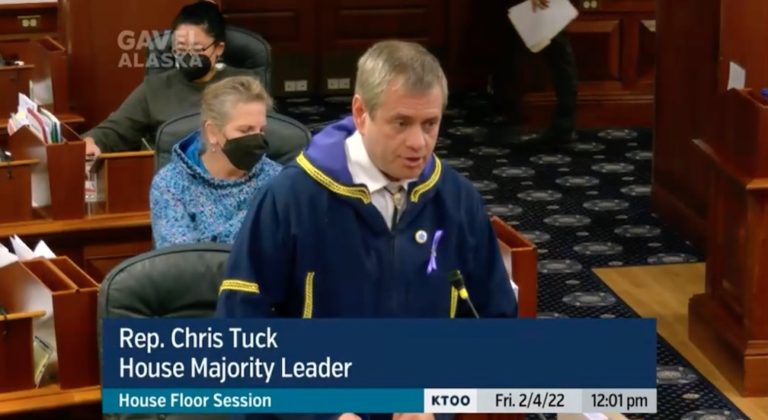
Something had to give. With State Sen. Elvi Gray-Jackson no longer in the running for her Anchorage seat, House Rep. Chris Tuck has decided to run for her seat. Redistricting had put him in the same House seat as Rep. Andy Josephson, and both are Democrats.

The Senate district, now called Seat G, is drawn for Democrats who dominate that area of midtown Anchorage. Tuck has the endorsement of Gray-Jackson, as well as State Sens. Bill Wielechowski and Tom Begich.

“Hard work, dedication, and the will to succeed are the values that pioneered Alaska and throughout my life, I have demonstrated those values. Now, I would like to apply those values to serve Alaskans in the Alaska State Senate. My focus is education, the economy, and jobs.
I want Alaska to be a place where ideas and innovations flourish; education is of the highest quality; the economy thrives; and most of all, I want to make sure that as we develop our resources, Alaskans come first,” Tuck said in his announcement for his campaign, called Tuck for Alaska.

Tuck also used his announcement to endorse Gray-Jackson in her bid for U.S. Senate.

Tuck has been in the House since 2009, serving as minority leader and now as majority leader. Outside of his legislative work, he has been a business representative for the International Brotherhood of Electrical Workers Local 1547 and an instructor at the Alaska Joint Electrical Apprenticeship School.

He is currently chair of the House Military and Veterans Affairs Committee, which is conducting an inquisition into Jan. 6, 2021 Capitol riot and Rep. David Eastman’s membership in the veterans militia group called Oath Keepers.


Canadian government freezes funds raised for truckers protesting vaccine mandates

32

According to the Canadian Broadcasting Corp., a Canadian Superior Court granted a request from the Ontario government to freeze access to millions of dollars donated through online fundraising platform GiveSendGo to the truckers convoy protesting Covid-19 restrictions in Ottawa and at several border crossings with the United States.

GiveSendGo was the site chosen by supporters of the trucker blockade after GoFundMe.com decided to freeze the funds and return them to donors. Many Alaskans involved in the Sunday Freedom Convoy 2022 gave funds to the GiveSendGo site.

“A statement from Premier Doug Ford’s office on Thursday said Attorney General Doug Downey brought the application for the order, under 490.8 of the Criminal Code, to prohibit anyone from distributing donations made through the website’s’Freedom Convoy 2022′ and ‘Adopt-a-Trucker’ campaign pages,” the CBC has reported.

The order “binds any and all parties with possession or control over these donations,” according to Ford’s office. It’s unclear how those funds will now be returned to donors.

The primary page, Freedom Convoy 2022, had raised over $8.5 million since the GoFundMe page had been shut down, toward the goal of $16 million to help with food and fuel for truckers protesting the vaccine mandates of Prime Minister Justin Trudeau. The Adopt-a-Trucker page had raised $7 million.

Former Sen. Johnny Ellis, champion of children, passes

Former Sen. Johnny Ellis, a Democrat and powerful member of the Alaska Democratic Party, has passed after serious health issues he had been dealing with for a long time.

Ellis was born March 13, 1960, who served in the Alaska Senate from 1992 to 2017. He served in the Alaska House of Representatives from 1986 through 1992. In his early days he was an activist in Young Democrats.

He will be remembered for championing children’s issues, and while many Republicans disagreed with him, they respected him because he treated them with respect.

According to Wikipedia, Ellis was born in Springfield, Missouri and moved to Anchorage in 1975.  Ellis was an Eagle Scout. After graduating from Bartlett High School in 1978, he attended the University of Alaska Anchorage before earning a bachelor of arts degree from Claremont McKenna College in 1982.

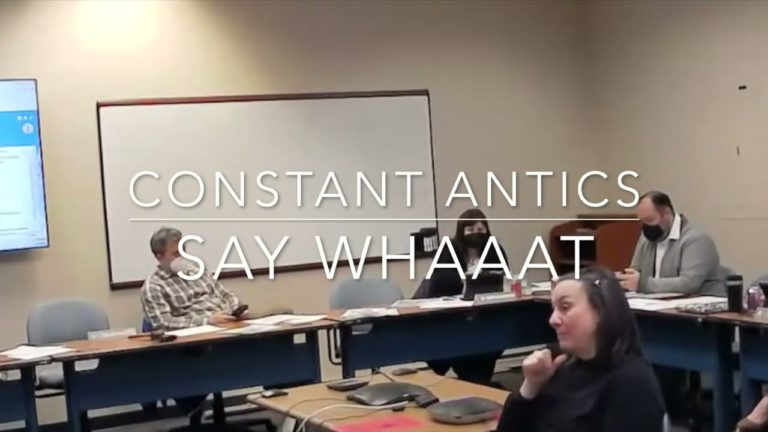
Did this Anchorage Assemblyman call Jamie Allard a ‘slut’ at end of the redistricting meeting?

At the end of the Anchorage Redistricting Committee on Wednesday, someone in the room uttered the word “slut.”

There was a murmur of laughter from Assemblywoman Austin Quinn-Davidson, who turned to the apparent source of the whispered word — Redistricting Committee Chairman Chris Constant.

Constant neither admits or denies saying it, but only responded to Must Read Alaska’s question with this phrase: “You should see an audiologist.”

He also wrote, “Thank you for all the coverage.  It’s been really valuable.  I couldn’t pay for this kind of media.  I don’t think anybody could argue with the prolific volume of your work product.”

The “slut” incident came after a testy exchange with Allard, who was trying to advance her version of a redistricting map for Anchorage, but she had missed Constant’s Friday deadline. Her map was evidently submitted to him on Monday. So was Assemblyman John Weddleton’s map version, which Constant accepted.

After the exchange, in which Constant interrupted her while she was speaking and reacted to her comments with agitation, he announced that because she had impugned his motives, he would change his vote to be against accepting her map.

Constant was visibly angry, while Allard stated her case. She had called into the meeting from a trip out of state that she had scheduled weeks ago.

There are many other maps already under consideration in drawing new lines for Assembly seats, some of them offered by left-wing political action groups.

Constant has, in the past, used derogatory words toward women. Several years ago, Constant called the publisher of Must Read Alaska a “cunt” on social media; he later apologized.

Watch the tape here and listen to the audio, which we have slowed down at the end to better illustrate what was said:

Assemblyman John Weddleton said he did not hear the comment. Allard did not hear it, but also has a hearing impairment and was on the phone.

Other than Allard, Weddleton and Constant, other Assembly members did not yet respond to a question posed by Must Read Alaska.

Last week, Constant appeared on a leftist podcast, calling Mayor Dave Bronson a clown and his team “fools,” who are not smart enough to know how to gaslight the Assembly.

Update: Assemblywoman Austin Quinn-Davidson, who had encouraged Constant to not allow Allard’s map, has responded to our question, saying: “That is absolutely false, like most things you print. I recommend you listen again.”

Assemblywoman Crystal Kennedy has responded: “I did not hear that but both of them were talking over each other so I’m not exactly sure what was said.”