Congressional candidate Jeff Lowenfels says that without notice Wells Fargo bank has closed his campaign account, which had several thousand dollars in it. Lowenfels wants the bank to at least issue him a cashiers check immediately so he can pay campaign bills that are due to vendors, but so far has received no reasonable response from the bank, whose representative told him he will get a check in the mail.
Lowenfels thinks that the problem is that his campaign manager, Patrick Flynn, has a small interest in a cannabis company, and the bank is known for steering clear of any funds that could be sourced or commingled with dollars related to cannabis. Lowenfels said he waited for 45 minutes on the phone to speak with someone who could give him a straight answer — which he says he never got.
It has happened to candidates before. In 2018, Wells Fargo closed the account of Nikki Fried, who was a former medical marijuana lobbyist and a then-candidate for Florida commissioner of Agriculture and Consumer Services. Fried is now a candidate for governor in Florida.
In that case, Wells Fargo wrote Fried’s campaign, “As part of the onboarding of the client it was uncovered some information regarding the customers [sic] political platform and that they are advocating for expanding patient access to medical marijuana.” The bank asked, “Can you confirm the types of transactions expected for this customer & if any of the transactions will include funds received from lobbyists from the medical marijuana industry in any capacity?”
In the case of Lowenfels, he is a known advocate for legalization of marijuana and he writes and speaks publicly about the topic. He authored the book, “DIY Autoflowering Cannabis: An Easy Way to Grow Your Own,”available at Amazon.
But he runs his campaign by paying attention to detail, he said. He is a lawyer, has filed his paperwork properly with the Federal Elections Commission and his financial disclosures with the Clerk of the Congress. He has a compliance officer on contract.
“It is Wells Fargo’s policy not to knowingly bank or provide services to marijuana businesses or for activities related to those businesses, based on federal laws under which the sale and use of marijuana is illegal even if state laws differ,” spokeswoman Bridget Braxton told the New York Timesin a statement in 2018. “We continually review our banking relationships to ensure we adhere to strict regulatory and risk guidelines.”
The late Congressman Don Young was not only a big advocate for legalized cannabis but was a founding member of the congressional Cannabis Caucus.
Lowenfels has said he would continue the Don Young tradition of promoting more sane federal policies in regards to the plant, which is legal in some states and not others.
He is not the only candidate with a cannabis business or advocacy connection. Andrew Halcro also was involved in the cannabis business, but it’s unclear if he is actually running for office, since he has not filed officially with the Federal Elections Commission, but is simply running social media ads that provide no campaign disclosure. Halcro may not even have an actual campaign account.
Must Read Alaska has reached out to Wells Fargo for comment.
The FBI on Friday arrested former Trump adviser Peter Navarro as he was boarding a plane at Reagan International Airport in Washington D.C. A federal grand jury had indicted Navarro on charges of criminal contempt of Congress for refusing to appear before the partisan Jan. 6 committee, which is investigating what the Department of Justice calls a “domestic terrorist attack” on the Capitol on Jan. 6, 2021. That was a protest of the election that turned riotous inside the U.S. Capitol, leading to the death of one unarmed protester, who was shot by Capitol police.
Navarro was placed in handcuffs and leg irons at the airport and taken to court for his first appearance. He told the judge that he was going to Nashville for a media event. He was then put in jail.
“What they did to me today violates the Constitution,” Navarro told reporters outside the courthouse.
During the Trump Administration, Navarro was assistant to the president, director of Trade and Manufacturing Policy, and the national Defense Production Act policy coordinator during the early days of the Covid-19 pandemic.
The Department of Justice had earlier indicted former Trump adviser Stephen K. Bannon for refusing to comply with a subpoena issued by the committee; Bannon’s trial is scheduled for July 18. The Justice Department has declined to indict Mark Meadows, President Trump’s last chief of staff, and Dan Scavino, the deputy chief of staff for communications.
Navarro, 72, has been charged with one contempt count involving his refusal to appear for a deposition and another charge involving his refusal to produce documents, despite a subpoena from the House Select Committee to Investigate the January 6 Attack on the United States Capitol.
“In its subpoena, the Select Committee said it had reason to believe that Navarro had information relevant to its investigation. Navarro, formerly an advisor to the President on various trade and manufacturing policies, has been a private citizen since departing the White House on Jan. 20, 2021,” the Department of Justice wrote.
Each count of contempt of Congress carries a minimum of 30 days and a maximum of one year in jail, as well as a fine of up to $100,000. A federal district court judge will determine any sentence after considering the U.S. Sentencing Guidelines and other statutory factors, according to the Department of Justice.
The latest vote count in the special primary election for Congress is just over 103,158 ballots received at the Division of Elections, as of 3:30 pm Friday. The last day to get your ballot postmarked is Saturday, June 11.
Keeping up with the door-knocking crew: About a dozen volunteers for Americans for Prosperity Alaska Action knocked on doors on Saturday afternoon to spread the word for Nick Begich for Congress. Their biggest discovery?
Tune into the Must Read Alaska Show on Monday at about 10 am to hear from Bernadette Wilson (pictured above) of Americans for Prosperity Alaska Action to talk about the state of the race. It will be live on the MRAK Facebook page, and posted midday on all the podcast channels.
Palin spotted: On Friday, Sarah Palin, who is one of the 48 who are running for Congress for Alaka, showed up at Evangelo’s restaurant in Wasilla to support the Charlie Pierce for Governor banquet and auction. Although she didn’t steal the show, there were lots of selfies afterwards. Over 60 people were at the event, including Sharon Jackson, running for Alaska House in Eagle River District 24.
Sarah Palin at the Skwentna fly-in.
Over the weekend, Palin was at the Swentna 11th annual fly-in, pictured above. She was there with dozens of other aviation and STOL plane enthusiasts.
Lisa Murkowski, Bill Walker spotted: In Cordova on Saturday, U.S. Sen. Lisa Murkowski and gubernatorial hopeful Bill Walker showed up with their plus ones at the grand opening and ribbon cutting of the Prince William Sound Science Center. Walker and Heidi Drygas were at the Reluctant Fisherman cafe for a meet-and-greet on Sunday morning.
Nick Begich spotted in Stuckagain: In Stuckagain Heights on a hot Saturday night, U.S. congressional candidate Nick Begich spoke about the problem with the Feds printing so much money, with about 25 people at a fundraiser in a private home, where there were plates and plates of homemade cobbler. Over 40% of every dollar in circulation was printed in the past two to three years, Nick said. This is a huge problem for the next generation.
Kelly Tshibaka spotted in Mat-Su: At the Mat-Su Seahawkersluncheon, and later a tour of Mat-Su Services, Kelly Tshibaka, candidate for U.S. Senate, spent the day in the Valley, ending it at the Church on the Rock for the Rise Above it rally, where she was guest speaker on suicide prevention and awareness.
Mike Dunleavy open house: Gov. Dunleavy and Lt. Gov. candidate Nancy Dahlstrom are having an open house at their new campaign office, which is the old Alaskans for Don Young office on Fairbanks Street, just off of Fireweed Lane. That event is on June 8, at 5 pm, hosted by John Sturgeon, chairman of the Dunleavy for Governor campaign. Must Read Alaska will attend and livestream, if allowed by the campaign.
Les Gara meet-and-greet: If you’re in Juneau on June 8, and want to meet Les Gara, running for governor as a Democrat, head over to Kim Metcalfe’s house in the afternoon, 5-7 pm.
Chris Constant barbecue: At a downtown home in Anchorage on June 6, a 5:3-7:30 pm fundraiser and barbecue for Constant for Congress will be hosted by Harry Need, Mark and Tom Begich, Austin Quinn-Davidson and Meg Zaletel.
(Apparently the Democrat Begich uncles didn’t get the memo that their nephew, Republican Nick, is running for Congress. Without Mark and Tom, Chris Constant would only have three hosts — two of them on the Assembly with him — for his barbecue?)
Tara Sweeney live: A Facebook live event with congressional candidate Tara Sweeney is on the schedule for June 8 at 4 pm, at this link.
Nick fundraiser onJune 9: Over 100 people are hosts of the Nick Begich for Congress fundraiser on June 9 at the Manternach hangar in Anchorage. If even half of the hosts show up, the place will be packed with interesting people.
Al Gross making the rounds at Palmer Ale House on Saturday.
Al Gross spotted: Campaigning at the Palmer Ale House on a sunny evening on Saturday, sporting a sunburn and shaking hands … and going for the microbrew vote.
Democrat fix is in for Daniel Volland for Assembly: The Democrats convinced Anchorage voters to add another downtown Assembly seat. Little did they know it would most certainly go to a Democrat. Now, the Democrats’ candidate, Daniel Volland, has the endorsement of the politburo that engineered the 12th seat.
A California appeals court has ruled that bumble bees are protected under a state law that protects endangered and threatened fish. A lower court had ruled the opposite, saying laws protecting endangered fish were not meant to include insects.
But the appeals court has said that since bees are invertebrates, they can be classified as fish, and that the California Endangered Species Act definition of fish as only “aquatic invertebrates” is simply a “term of art.”
The ruling made it clear the court was aware that it was making the decision that bees are fish, as it wrote, “The issue presented here is whether the bumble bee, a terrestrial invertebrate, falls within the definition of fish….” Then, “We first reaffirm and expand upon our conclusion in California Forestry Association that section 45 defines fish as the term is used in sections 2062, 2067, and 2068 of the Act, by application of section 2.”
“Although the term fish is colloquially and commonly understood to refer to aquatic species, the term of art employed by the Legislature in the definition of fish in section 45 is not so limited. We acknowledge the scope of the definition is ambiguous but also recognize we are not interpreting the definition on a blank slate. The legislative history supports the liberal interpretation of the Act (the lens through which we are required to construe the Act) that the Commission may list any invertebrate as an endangered or threatened species. We thus agree with the Commission, the California Department of Fish and Wildlife (Department), and intervenors Xerces Society for Invertebrate Conservation, Defenders of Wildlife, and Center for Food Safety (collectively public interest groups) that the trial court erred when it reached a contrary conclusion. We accordingly reverse the judgment.”
In the past, California law defined fish as “wild fish, mollusks or crustaceans, including any part, spawn or ova thereof.” The Legislature in 20215 changed the definition slightly, opening the loophole for bees to be considered fish: “ ‘[f]ish’ means a wild fish, mollusk, crustacean, invertebrate, amphibian or part, spawn, or ovum of any of those animals.”
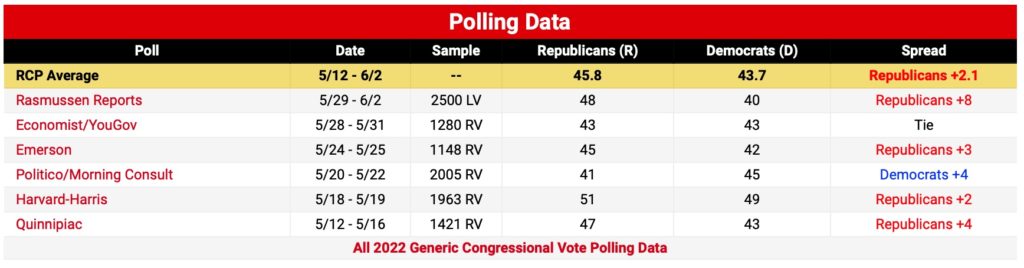
Republicans have an eight-point lead in their bid to recapture control of Congress, according to the latest Rasmussen Reports poll.
The latest telephone and online survey reveals that if the elections for Congress were held today, 48% of likely U.S. voters would vote for the Republican candidate, while 40% would vote for the Democrat. Just 4% would vote for some other candidate, and 8% are not sure.
Republicans have gained two points in just one week, the poll shows.
The average for various polls conducted last week, shown below, put the two parties closer, 45.8% to 43.7%, but still give an advantage for Republicans. The Rasmussen Reports poll is the most recent of those in the group rated by Real Clear Politics.
Most polls tend to favor Democrats, with Republican voters being more reluctant to answer questions from pollsters. The Rasmussen Report polling is rating just above Gallup in terms of its predictive accuracy.
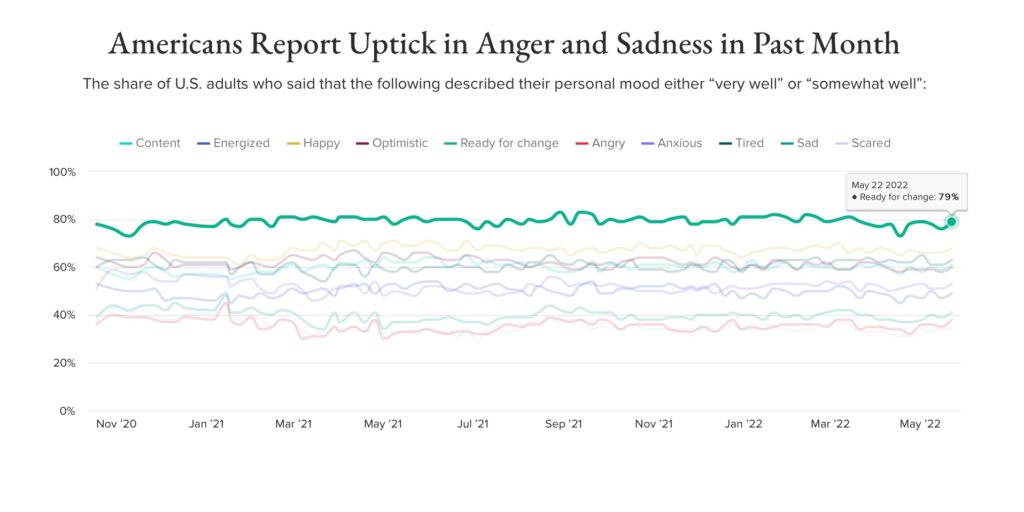
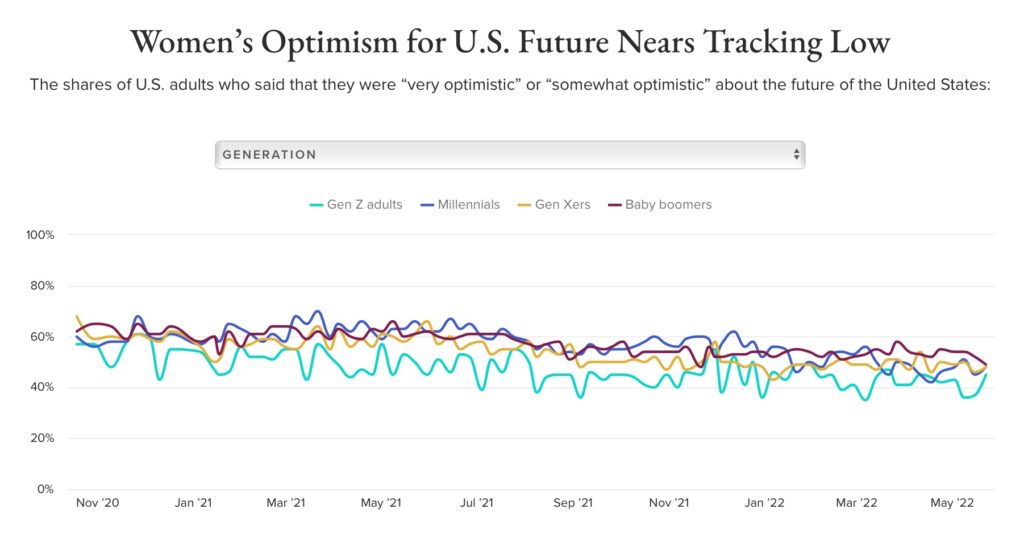
In another set of polling, Americans are increasingly ready for change, and women in America are growing pessimistic about the future of the nation. Morning Consult, which has been tracking these emotional viewpoints since October, 2020.
The number of Americans who said they are “ready for change” hit 79% in the Morning Consult poll of people’s personal moods, which may influence elections this year.
Every week, Morning Consult asks a nationally representative sample of U.S. adults whether they are happy, angry, tired, optimistic, scared and a range of other emotions. The data is released monthly and gives a glimpse into the shifting mood of the country. The information is broken down by age, gender, class, and political leanings. The latest results have a margin of error of 2 percentage points and are based on a survey conducted May 19-22, 2022, among 2,210 U.S. adults.
An important segment of the electorate — women — said they are not optimistic about the future of the United States. Democrat women were more optimistic, at 61%, but both Republican and non-aligned women’s optimism for the future of the country hovered at near 40%. Democrat women’s optimism surged right after the November 2020 presidential election to 77%, but has dropped 16 points in 18 months.
View the Morning Consult polling data on the state of Americans’ emotions at this link.
“Alaska and Japan have a trade partnership going back over fifty years to the first LNG export from Nikiski to Japan,” said Gov. Mike Dunleavy, upon his return from a trade mission to Japan on Friday.
“The natural gas of the Cook Inlet literally turned the lights on in cities across Japan and powered the economic engine that lifted that nation’s postwar society into a critically powerful western ally,” he said. “There appears to be, due to the shift across the world away from older fuel sources, and the simultaneous need for supplies that are not risked due to political instability, a role that Alaska natural gas could play. Alaska can supply Japan with another fifty of natural gas and clean hydrogen for decades to come.”
Dunleavy returned after meeting with Japanese companies, utilities, and government ministries about procuring Alaska’s natural gas while also assessing the state’s potential to export various new sources of fuel. The Japanese are keen on doing business with stable entities, and with much political instability to the nation’s east, in China, Russia, and Eastern Europe, the nation may be interested in locking down longterm contracts.
The meeting comes at a time that Japan is pivoting towards an energy transition that Alaska can supply in the coming decades, including blue and green hydrogen, at a time of great geopolitical instability around the world.
Dunleavy’s trip followed the first-ever governor’s Alaska Sustainable Energy Conference, which showcased the many ways Alaska can produce various sources of fuel for both the state and the world. The governor, First Lady Rose Dunleavy, and members of the Alaska Gasline Development Corporation, made the trip, which was Dunleavy’s second trip to Japan.
For four days, Governor Dunleavy and the Alaska delegation held meeting with representatives of the Japan Energy Resource Agency (JERA), the Japanese Ministry of Economy, Trade, and Industry (METI), the Japan Oil, Gas and Metals National Corporation (JOGMEC), the Japan Bank for International Cooperation (JBIC), along with Tokyo Gas and TOYO Engineering. Meetings were also held with the Mitsubishi Corporation, the Chiyoda Corporation, well as INPEX and O.S.K. Lines.
The Office of Alaska Gov. Mike Dunleavy on Saturday announced that First Lady Rose Dunleavy tested positive for Covid-19 while the couple was in Japan, and will stay in isolation until after weekend. Her symptoms are mild.
The Dunleavys were on a trade mission to Japan and were returning home when Rose tested positive at the Narita International Airport in Tokyo, and went into isolation.
Rose had tested negative prior to flying to Japan early this week, along with Gov. Dunleavy and members of the state delegation. The first lady is fully vaccinated for Covid. All other members of the delegation have subsequently tested negative.
The journey marks the second trip to Japan by the governor and the first lady; in 2019, they went to Japan at the invitation of dignitaries there to commemorate the 50th anniversary of Alaska LNG exports from Nikiski, on the Kenai Peninsula, to Tokyo.
Following Japanese government protocols, Rose Dunleavy will complete quarantine before flying home to Alaska.
Candidate for Congress and sitting Anchorage Assemblyman Chris Constant claims that he has received multiple death threats. He is referring to two phone messages left on his voice mail from a disgruntled constituent who was rude and disrespectful. Whether the caller made an actual threat is in dispute.
But last week during an especially hot Assembly meeting, during which the air conditioning had failed in the Loussac Library’s Assembly Chambers, Constant became agitated about a side door being left open without a police officer stationed at it. He disrupted the meeting to ask why the door was open, and Municipal Manager Amy Demboski informed him that the temperature in the room was 80 degrees and yes, there was a security officer outside. At some point, Constant must have described his fear of a death threat to Demboski.
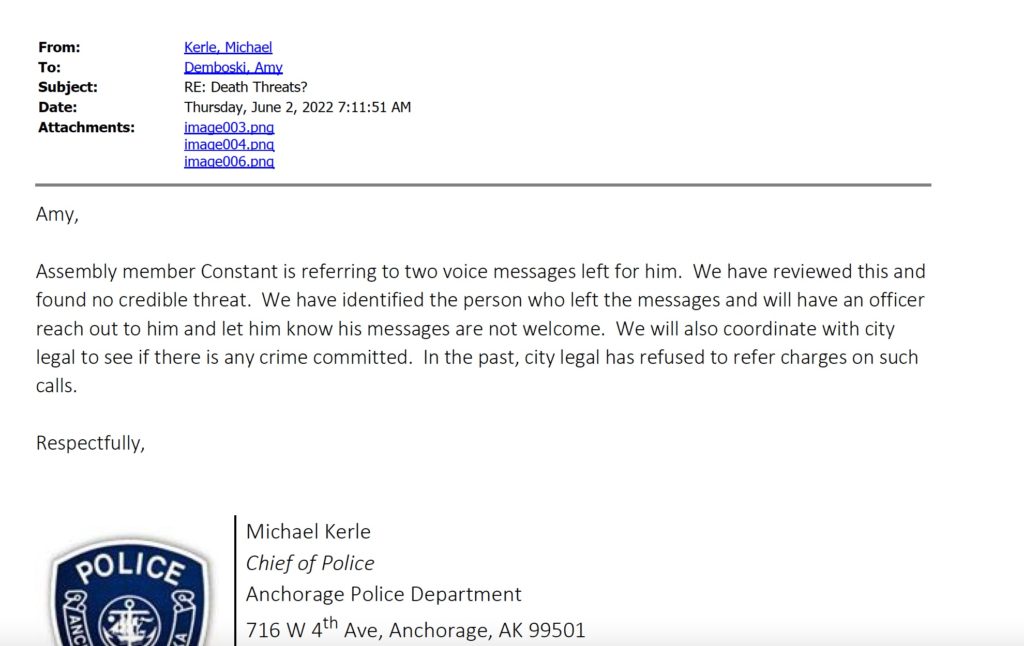
Soon thereafter, Manager Demboski reached out to the Anchorage police chief on Wednesday to ensure that the matter was being taken seriously: “I had a discussion at the Assembly meeting tonight with Assembly member Constant and he told me he has had numerous death threats in the past two weeks. Are you aware of those threats? Has APD received these threats from Assembly Member Constant and have they been reviewed/assessed for credibility?” Demboski asked the chief. “Any information you can share would be appreciated; I just want to ensure Mr. Constant has provided APD with information to assist in situations like these.”
Chief Michael Kerle responded to Demboski that a review found there was no threat: “Assembly member Constant is referring to two voice messages left for him. We have reviewed this and found no credible threat. We have identified the person who left the messages and will have an officer reach out to him and let him know his messages are not welcome. We will also coordinate with city legal to see if there is any crime committed. In the past, city legal has refused to refer charges on such calls,” the police chief wrote.
Must Read Alaska obtained the notes via a public records request made last week of any communication on the matter between the Mayor’s Office and the Police Department.
“I listened to the voicemails Mr. Constant alleged were death threats and all I heard was someone who disagreed with him politically, I didn’t hear a death threat in those recordings,” Demboski told Must Read Alaska.
Constant, in an essay on his campaign website, refers to the “multiple” threats and provided links to a story written by the South Florida Gay News, the reinforces the claim. That story led off with a description of the tearful sense of victimization that Constant experienced when he listened to the two phone messages:
“Tears welled up in his eyes as Christopher Constant played the recording of a telephone call to his office,” the story started. “The gay assemblyman for the City of Anchorage, Alaska, is conditioned to intimidation tactics, but this call adds a dangerous layer to the game.”
According to the news site, the man said, “I wanna see you get smoked so bad and you’re going to too.”
“I’m not afraid of you homosexuals,” the man was described as saying. “It disgusts me. Pervert!”
Constant turned over the tape to the Anchorage Police Department, according to the South Florida Gay News and according to the notes between Manager Demboski and Chief Kerle.
“He fights back tears when talks about his love for Alaska, his dog, mountain biking and, sadly, how his campaign for Congress is revealing old prejudices,” the news group wrote.
“This is the reality of what the race is and he is just the one who is willing to say it,” Constant said to the Florida reporter. “Just know this, this is what makes me strong, we make the difference for all the kids coming forward in a world that is not going to be like this anymore.”
Constant’s campaign has focused the issues of interest to him and the LGBTQ community.
Read the South Florida Gay News report at this link.
On his website, Constant writes that after the Supreme Court invalidates the 1973 abortion ruling known as Roe v. Wade, it will go after the gay community.
“It’s more important than ever to support LGBTQ+ candidates. With the U.S. Supreme Court expected to overturn Roe v. Wade next month, LGBTQ+ rights are next. Electing LGBTQ+ candidates sends a message to the nation that we will not accept hate and intolerance. We are working toward a better future, not willing to fall into a darker past. As an openly gay man, Chris Constant has experienced homophobia and bigotry for most of his life,” his website states.
“These threats and hate speech are despicable, and are only becoming more common. We need to overcome these horrible elements of our society by electing progressive leaders to the highest offices of our country,” Constant’s page says.
“This is the latest in a series of death threats Chris has received over the past three years. These death threats are not due to Chris misusing his elected office, giving out contracts to supporters or failing in his duty as an elected official. They are for enacting mask mandates to protect our hospitals and the medically fragile, for voting to transform our homelessness response system and for banning discredited and trauma-enducing conversion therapy. They are for standing up to a mayor who has routinely violated municipal code and lied to the public about his actions. These threats come from a place of fear. The fear is that Chris Constant is working to create an equitable future where all Alaskans have hope and opportunity, not just some,” the essay states. Read the entire Constant Pride Month essay at this link.
The past three years has been anything but dull in the political arena of Alaska. The Legislature has its share of fighting. While most of the attention on internal squabbling has focused on the Alaska House of Representatives and its six years of slim majorities, the Senate escaped focus. That is, until now.
The Alaska Senate did not always have the benefit of being the most quiet and outwardly stable arena of lawmaking in Alaska. For six years, ending in 2012, a bipartisan coalition of all Democrats and more-than-a-few Republicans dominated the upper legislative hall, serving as a backstop against a Republican-dominated House and then-Gov. Sean Parnell, also a Republican. That wall of resistance ended in the 2012 elections, and the formation of an almost exclusively Republican majority in 2013 has been intact, imperfectly at times, since then.
This year appears to be a watershed in how the state’s lawmaking bodies constitute themselves. Record levels of retirements in both the House and the Senate guarantee a lot of new faces being sworn in next January.
But it is the Senate, unique in the country due having just 20 senators, where the vacancies have the greatest sway and impact.
Four senators are not seeking election, including the Senate President Peter Micciche and the Senate Minority leader Tom Begich. This is the first time in living memory such a dual vacancy occurred by that manner.
Sen. Natasha von Imhof of Anchorage and Sen. Lora Reinbold of Eagle River are also not seeking another term. Combined, nearly a quarter of the Senate will be cycled out before Alaska voters cast a single ballot.
The consequences of this week’s official filings are huge. It has been an open secret in Juneau that the Senate Republican caucus has for four years been split virtually right down the middle of its membership, primarily on issues related to the Permanent Fund dividend. Though the controversy over the dividend really ignited when former Gov. Bill Walker vetoed part of the PFD in 2016, the Senate infighting really developed a year later during the formation of the operating budget.
Then-Sen. Mike Dunleavy, a member of the Finance Committee since he entered the Legislature in 2013, voted against the budget once a unilateral reduction of the annual dividend was included in the bill.
Dunleavy was followed in a later vote by Shelly Hughes of Palmer in rejecting a budget relying on reduced dividends (both left the majority caucus over those disagreements). Dunleavy eventually resigned his Senate seat in early 2018, and was elected Governor that fall.
The Senate organization of 2018 was marked by the divide over the dividend and the use of the Permanent Fund’s earnings. There were real attempts by the Senate Democrats to entice a handful of Republicans to cross over as they had done in 2007, and put them back into power.
Democrats’ efforts were stymied by the ability of Republicans to still remain together. Micciche’s predecessor, Cathy Giessel of Anchorage, initially announced a caucus in 2019 that would balance the rights of individual lawmakers to vote their conscience on key issues with the need of a legislature to do its constitutionally mandated work.
This, combined with the election of a Republican governor and what appeared to be a Republican-dominated House, seemed enough of an enticement for Senators to hold their tongues and work together.
But that arrangement was in tatters by the summer of 2019, with Giessel expelling members of the caucus from key leadership positions and committee chairships over voting differences on the dividend. (Giessel, along with fellow member of leadership John Coghill, were voted out by Republicans in the 2020 election. Giessel, like Walker, is seeking a return to office, while Coghill is seeking the congressional seat made vacant by Congressman Don Young’s passing in March).
As 2021 began, it was unclear, until the first day of the legislative session, whether there would be a Republican or a Democratic-led Senate. And yet, when the gavel came down, it was Micciche of Soldotna who was made President by his peers, and who installed a caucus that demonstrated, at least on paper, that Republicans were in charge.
But if on paper the Republicans ruled the Senate, in practice they were a divided caucus to the point of paralysis. The majority caucus of the House and Senate traditionally meet at least once a week. In 2022, it was reported that the Senate majority held less than a handful of meetings. Reasons for this were unclear, though Senators said, on condition of anonymity, that the decision was Micciche’s attempt to manage the combustible relationships between members. Getting Senators who otherwise would not talk to each other in a confined space appeared a recipe for disaster, and Micciche was managing those dynamics.
Though some criticized what was perceived as fecklessness on the part of the Senate President, others saw the conundrum Micciche was placed: keep the Republicans together in a loose, uneasy alliance, or shatter the caucus and allow the Democrats to officially run the agenda.
Another key dynamic was the makeup of the Senate Democratic caucus. Past leaders included Sen. Johnny Ellis, a brilliant but bitter and ruthless politician who saw the role of the Democratic caucus to inflict misery on Republicans at all costs. Ellis was succeeded by Sen. Berta Gardner, whose years leading the caucus were spent in serving as a perpetual proxy for the Walker administration.
The election of Sen. Tom Begich as leader of the Senate Democrats marked a significant transition for the party’s prospects. Begich, the son of a former congressman and the brother to a former United States senator, was and is considered one of the chief political operatives of the Democratic party.
Representing a downtown bastion (Begich succeeded Ellis upon his retirement), the Democrats’ leader had a liberal base that would return him thanks to his political pedigree and reputation, allowing him leeway to work Republicans and the heft to hold back some of the bombastic members of his caucus, a departure from what Sen. Ellis encouraged and Sen. Gardner appeared unable to stop.
For the past two years, large parts of the Senate Republican caucus voted against their body’s final budget over differences in how it was crafted by its architect, Sen. Bert Stedman of Sitka. In order to lift the budget off its floor, Sens. Stedman and Micciche relied, initially with some, eventually for all, of Sen. Begich’s caucus to pass it. This leverage afforded the Senate Democrats, and Begich in particular, an effective swing vote status in the impaired chamber.
This dynamic played itself out in the waning months of this year’s session. There is an old saying muttered in the Capitol that “it’s always 2 on 1.” The “3” in that equation are the House, the Senate, and the Governor. By May, the equation was set, and it was the Senate and Gov. Dunleavy’s Administration combining forces on issues such as a higher dividend, the reading bill, and crime, against a House majority that was dominated by members of the Bill Walker Caucus opposing any Republican initiative.
Once morning broke on May 19, the first time Alaskans were not facing a special session prospect in four years, the dam had broken over the Walker Caucus in the House.
The Permanent Fund Dividend was set at the largest amount in state history, though the energy rebate, funded by the Constitutional Budget Reserve, failed by a single vote (Walker Caucus member Rep. Grier Hopkins of Fairbanks casting that rejection, as his finger paused over the red or green button).
But the Senate Majority and Democratic Caucus appeared to have reached an agreement on bills that could pass, and most did, marking the 2022 session one of the more productive ones in recent memory.
Micciche’s retirement makes him the third consecutive Senate President to not come back after their term ended (though Micciche is leaving by his own volition while his two predecessors were defeated in their bids for re-election). The retirement of Tom Begich leaves a vacancy in the Democratic caucus along with a seat that will, it appears, be filled by a person who currently staffs for him.
With two leaders exiting, and the field of play very much undecided for most members of the Senate, what kind of organization will take shape is an open question.
Some politicos are betting on 2023 finally being the year the Democratic caucus is given the keys to majority power with the agreement of several Republicans. There is some credence to that. Unlike the House, which has almost a 100% turnover rate from 10 years ago, several members of the old bipartisan coalition are still around, including Sens. Stedman and Gary Stevens of Kodiak. And Rep. Matt Claman, a downtown Anchorage Democrat, is preparing an all-out assault for the seat held by Republican Sen. Mia Costello of Jewel Lake.
However, some of these key potential coalition members are in comparatively tough races. There is also the prospect of new entrants who will fill the strategic vacuum left by Tom Begich and Peter Micciche.
Tuckerman Babcock, a former chair of the Alaska Republican Party and former chief of staff to Dunleavy, is running for Micciche’s Senate seat. Organizing a majority caucus is as much about relationship building and diplomacy as it is dealing with party platforms and policy agendas.
The massive potential for the Senate membership to be remade actually makes the “senior chamber,” unlike the House, the most potentially explosive arena for politics in Alaska this year.