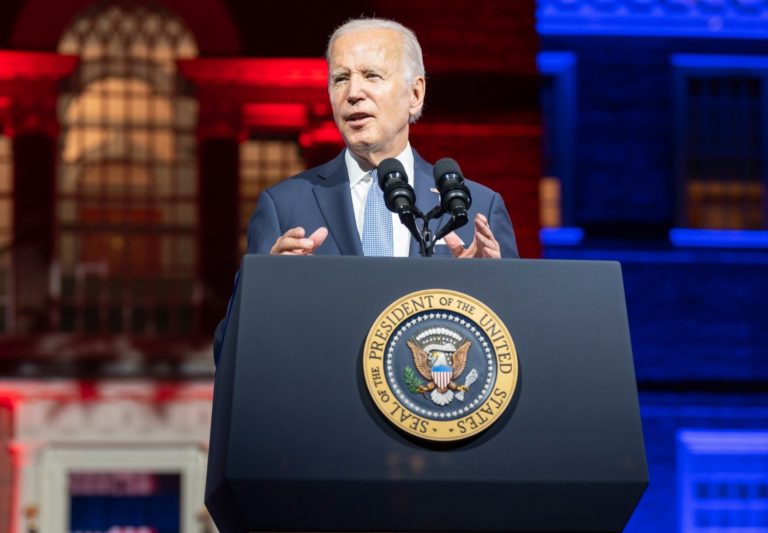
In a widely panned speech on Thursday night in Philadelphia, President Joe Biden attacked Republicans and other supporters of former President Donald Trump.
The speech, given in Independence Hall, is being widely seen as a condemnation of Republicans in the same way that Hillary Clinton called Republicans “deplorables” in 2016, only this time Biden painted Republicans who support Trump with the “extremist” label and said they are a threat to democracy.
“Too much of what’s happening in our country today is not normal,” Biden said. “Donald Trump and the MAGA Republicans represent an extremism that threatens the very foundations of our republic.”
Biden said, “Not every Republican, not even a majority of Republicans, are MAGA Republicans. Not every Republican embraces their extreme ideology. But there is no question that the Republican Party today is dominated, driven, and intimidated by Donald Trump and the MAGA Republicans. And that is a threat to this country.”
The White House insisted the speech was not political, but Biden implored his listeners to “vote, vote, vote.” He brought up Trump many times, and spoke to the differences between his vision of America and what he perceived to be Trump’s vision. On the White House Facebook page, numerous messages condemning MAGA Republicans, including lawmakers, were posted throughout the day by the Biden social media staff. Some found his message to be menacing. Behind him stood two U.S. Marines, in uniform.
The bulk of his speech, after the introduction, focused on “MAGA Republicans,” the danger of Trump, and how scary these Americans are who have influenced the Republican Party. Watch the speech at this White House Facebook link.
The transcript of the majority of the speech not summarized above:
These are hard things, but I’m an American president, not a president of red America or blue America, but of all America. And I believe it’s my duty, my duty to level with you, to tell the truth no matter how difficult, no matter how painful.
And here, in my view, is what is true: MAGA Republicans do not respect the Constitution. They do not believe in the rule of law. They do not recognize the will of the people. They refuse to accept the results of a free election, and they’re working right now as I speak in state after state to give power to decide elections in America to partisans and cronies, empowering election deniers to undermine democracy itself.
MAGA forces are determined to take this country backwards, backwards to an America where there is no right to choose, no right to privacy, no right to contraception, no right to marry who you love. They promote authoritarian leaders, and they fanned the flames of political violence that are a threat to our personal rights, to the pursuit of justice, to the rule of law, to the very soul of this country.
They look at the mob that stormed the United States Capitol on Jan. 6, brutally attacking law enforcement, not as insurrectionists who placed a dagger at the throat of our democracy, but they look at them as patriots. And they see their MAGA failure to stop a peaceful transfer of power after the 2020 election as preparation for the 2022 and 2024 elections.
They tried everything last time to nullify the votes of 81 million people. This time, they’re determined to succeed in thwarting the will of the people. That’s why respected conservatives like Federal Circuit Court Judge Michael Luttig has called Trump and the extreme MAGA Republicans “a clear and present danger” to our democracy.
But while the threat to American democracy is real, I want to say as clearly as we can, we are not powerless in the face of these threats. We are not bystanders in this ongoing attack on democracy. There are far more Americans, far more Americans from every background and belief, who reject the extreme MAGA ideology than those that accept it. And folks, it’s within our power, it’s in our hands, yours and mine, to stop the assault on American democracy.
I believe America is at an inflection point, one of those moments that determine the shape of everything that’s to come after. And now, America must choose to move forward or to move backwards, to build a future or obsess about the past, to be a nation of hope and unity and optimism or a nation of fear, division and of darkness.
MAGA Republicans have made their choice. They embrace anger. They thrive on chaos. They live, not in the light of truth but in the shadow of lies. But together, together, we can choose a different path. We can choose a better path forward to the future, a future of possibility, a future to build a dream and hope, and we’re on that path moving ahead.
I know this nation. I know you, the American people. I know your courage, I know your hearts, and I know our history. This is a nation that honors our Constitution. We do not reject it. This is a nation that believes in the rule of law. We do not repudiate it. This is a nation that respects free and fair elections. We honor the will of the people. We do not deny it. And this is a nation that rejects violence as a political tool. We do not encourage violence. We are still an America that believes in honesty and decency and respect for others. Patriotism, liberty, justice for all, hope, possibilities — we are still at our core a democracy.
And yet, history tells us that blind loyalty to a single leader and a willingness to engage in political violence is fatal to democracy.
For a long time, we’ve told ourselves that American democracy is guaranteed, but it’s not. We have to defend it, protect it, stand up for it, each and every one of us. That’s why tonight, I’m asking our nation to come together, unite behind the single purpose of defending our democracy regardless of your ideology.
We’re all called by duty and conscience to confront extremists who put their own pursuit of power above all else. Democrats, independents, mainstream Republicans, we must be stronger, more determined and more committed to saving American democracy. And MAGA Republicans are destroying American democracy.
We, the people, will not let anyone or anything tear us apart. Today, there are dangers around us we cannot allow to prevail. We hear — you’ve heard it, more and more talk about violence as an acceptable political tool in this country. It’s not. It can never be an acceptable tool. So, I want to say this plain and simple: There is no place for political violence in America, period, none, ever.
You saw law enforcement brutally attacked on January the 6th. We’ve seen election officials, poll workers, many of them volunteers of both parties, subject to intimidation and death threats. And, can you believe it, F.B.I. agents just doing their job as directed, facing threats to their own lives from their own fellow citizens.
On top of that, there are public figures today, yesterday and the day before predicting and all but calling for mass violence and rioting in the streets. This is inflammatory. It’s dangerous. It’s against the rule of law. And we, the people, must say this is not who we are.
Ladies and gentlemen, we can’t be pro-insurrectionist and pro-American. They’re incompatible. We can’t allow violence to be normalized in this country. It’s wrong. We each have to reject political violence with all the moral clarity and conviction this nation can muster now.We can’t let the integrity of our elections be undermined, for that is a path to chaos. Look, I know politics can be fierce and mean and nasty in America. I get it. I believe in the give and take of politics, in disagreement and debate and dissent. We’re a big complicated country, but democracy endures only if we, the people, respect the guardrails of the Republic. Only if, we the people accept the results of free and fair elections. Only if, we the people see politics, not as total war, but mediation of our differences. Democracy cannot survive on one side believes there are only two outcomes to an election: Either they win or they were cheated. And that’s where the MAGA Republicans are today.They don’t understand what every patriotic American knows. You can’t love your country only when you win. It’s fundamental.
American democracy only works only if we choose to respect the rule of law and the institutions that were set up in this chamber behind me. Only if we respect our legitimate political differences.
I will not stand by and watch — I will not — the will of the American people be overturned by wild conspiracy theories and baseless evidence-free claims of fraud. I will not stand by and watch elections in this country stolen by people who simply refuse to accept that they lost. I will not stand by and watch the most fundamental freedom in this country, the freedom to vote and have your vote counted, and be taken from you and the American people.
Look, as your president, I will defend our democracy with every fiber of my being, and I’m asking every American to join me.
Throughout our history, America has often made the greatest progress coming out of some of our darkest moments like you’re hearing in that bullhorn. I believe we can and must do that again, and we are.
MAGA Republicans look at America and see carnage and darkness and despair. They spread fear and lies. Lies told for profit and power.But I see a different America — an America with an unlimited future, an America that’s about to take off. I hope you see it as well. Just look around. I believe we could lift America from the depths of Covid, so we passed the largest economic recovery package since Franklin Delano Roosevelt, and today America’s economy is faster, stronger than any other advanced nation in the world. We have more to go. I believe we can build a better America, so we passed the biggest infrastructure investment since President Dwight D. Eisenhower, and we’ve now embarked on a decade of rebuilding the nation’s roads, bridges, highways, ports, water systems, high-speed internet, railroads.I believe we can make America safer, so we passed the most significant gun safety law since President Clinton.
I believe we could go from being the highest cost of prescriptions to the world to making prescription drugs and health care more affordable, so we passed the most significant health care reform since President Obama signed the Affordable Care Act.
And I believed we could create a clean energy future and save the planet, so we passed the most important climate initiative ever, ever, ever.
The cynics and the critics tell us nothing can get done, but they’re wrong.
There is not a single thing America cannot do, not a single thing beyond our capacity if we do it together. It’s never easy. But we’re proving that America, no matter how long the road, progress does come.
Look, I know the last year, few years have been tough, but today Covid no longer controls our lives. More Americans are working than ever. Businesses are growing, our schools are open, millions of Americans have been lifted out of poverty. Millions of veterans once exposed to toxic burn pits will now get what they deserve for their families in compensation. American manufacturing has come alive across the heartland, and the future will be made in America, no matter what the white supremacists and the extremists say.
I made a bet on you, the American people, and that bet is paying off, proving that from darkness, the darkness of Charlottesville, of Covid, of gun violence, of insurrection, we can see the light. Light is now visible. Light that will guide us forward. Not only in words but in actions. Actions for you, for your children, for your grandchildren, for America.Even in this moment with all the challenges we face, I give you my word as a Biden, I’ve never been more optimistic about America’s future. Not because of me, but because of who you are.We’re going to end cancer as we know it, mark my words. We’re going to create millions of new jobs and a clean energy economy. We’re going to think big. We’re going to make the 21st century another American century because the world needs us to. That’s where we need to focus our energy. Not in the past, not on divisive culture wars, not on the politics of grievance, but on a future we can build together.
The MAGA Republicans believe that for them to succeed, everyone else has to fail. They believe America, not like what I believe about America. I believe America is big enough for all of us to succeed, and that is the nation we’re building, a nation where no one is left behind.
I ran for president because I believed we were in a battle of the soul of this nation. I still believe that to be true. I believe the soul is the breadth, the life and the essence of who we are. The soul is what makes us, us.
The soul of America is defined by the sacred proposition that all are created equal in the image of God, that all are entitled to be treated with decency, dignity and respect, that all deserve justice and a shot at lives of prosperity and consequence. And that democracy, democracy must be defended, for democracy makes all these things possible.
Folks, and it’s up to us. Democracy begins and will be preserved, and we the people’s habits of the heart — in our character, optimism that is tested, yet endures, courage that digs deep when we need it. Empathy that fuels democracy. The willingness to see each other not as enemies but as fellow Americans.
Look, our democracy isn’t perfect. It always has been. Notwithstanding those folks you hear on the other side there. They’re entitled to be outrageous. This is a democracy. But history and common sense — good manners is nothing they have ever suffered from — but history and common sense tell us that opportunity, liberty and justice for all are most likely to come to pass in a democracy. We have never fully realized the aspirations of our founding, but every generation has opened those doors a little bit wider to include more people who have been excluded before.My fellow Americans, America is an idea; the most powerful idea in the history of the world, and it beats in the hearts of the people of this country. It beats in all our hearts. It unites America. It is the American creed.The idea that America guarantees that everyone be treated with dignity. It gives hate no safe harbor. It installs in everyone the belief that no matter where you start in life, there’s nothing you can’t achieve. That’s who we are. That’s what we stand for. That’s what we believe.
And that’s precisely what we’re doing — opening doors, creating possibilities, focusing on the future — and we’re only just beginning.
Our task is to make our nation free and fair, just and strong, noble and whole, and this work is the work of democracy, the work of this generation. It is the work of our time for all time. We can’t afford to leave anyone on the sidelines. We need everyone to do their part, so speak up, speak out, get engaged, vote, vote, vote!
And if we do our duty, if we do our duty, in 2022 and beyond, then ages still to come will say we, all of us here, we kept the faith. We preserved democracy. We heeded our words. We heeded not our worst instincts but our better angels. We proved that for all its imperfections, America is still the beacon to the world, an ideal to be realized, a promise to be kept. There’s nothing more important. Nothing more sacred. Nothing more American. That’s our soul. That’s who we truly are. And that’s who we must always be.
I have no doubt, none, that this is who we will be and that we’ll come together as a nation that will secure our democracy. That for the next 200 years we’ll have what we had the past 200 years, the greatest nation on the face of the earth. We just need to remember who we are. We are the United States of America, the United States of America. And may God protect our nation, and may God protect all those who stand watch over our democracy.
God bless you all. Democracy. Thank you.