While the bulk of state expenditures occur via the operating budget, the capital budget is a separate lever policymakers often use to cut or increase the state’s overall spending. This year, due in part to high oil revenue, they wedged many pet projects into the capital budget. This is unfortunate, unsurprising, and irresponsible.
The state capital budget is meant to fund exactly what it sounds like: capital projects, mainly infrastructure and assets, such as public buildings, bridges, and roads. It is assumed that the capital budget pays for necessary projects that will benefit the entire state, not community projects that are more appropriately funded through local government or private support.
Yet this year, Alaska policymakers appropriated at least $16 million to pay for projects outside the scope of state government. While many of them are admirable programs, they are not state priorities, and the appropriated money would be better used elsewhere, including savings.
Distribution of capital project funds by House district — which legislators slid in pet projects for their districts — is availablethrough Alaska’s Legislative Finance Division. The list includes handouts such as $2.5 million for facilities at the private Alaska SeaLife Center; $7.3 million for the private Alutiiq Museum & Archaeological Repository; $6.3 million for creation of a new private Chugach Region Archaeological Museum; $87,000 to replace a scoreboard for the private Seawolf Hockey Alliance; and $588,775 to the private Dimond Alumni Foundation to replace diving boards.
Many Alaskans (and visitors to the state) benefit from sports teams and museums. However, these should be financially supported by beneficiaries, not by the state’s pocketbook, which is not bottomless.
For contrast, two appropriations that will benefit the vast majority of Alaskans were $175 million for the Port of Nome and $200 million for the Port of Alaska. While the Port of Alaska is owned by the Municipality of Anchorage, it handles goods bought by 90% of Alaskans. Projects enabling the Port of Nome to expand its capacity, meanwhile, are broadly beneficial because Alaskans are currently so reliant on the Port of Alaska. Creating capacity through multiple ports not only increases the available flow of goods, but also protects against unexpected problems at one or the other.
The governor vetoed some capital projects that clearly did not belong in the state’s budget, such as $300,000 for the construction of a private “Equity Center.” The requestor was a community-based advocacy group, meaning it should be financially supported by its community, not the government. State government should not be paying for non-state-owned buildings regardless of the cause for which they are used. It is unfortunate that more pet projects were not eliminated on similar grounds.
Overall, state funds appropriated for the capital budget add up to more than $935 million. This is the largest share of state funds in the capital budget Alaska policymakers have enacted since 2014, and the federal government added another $2 billion. While many projects required state matches to claim the federal funds, the vast wave of cash allowed policymakers to sneak in their favored projects and increase the capital budget total.
Millions of dollars are being spent to fund localized community projects that should instead be funded by local support and private sources. Alaskans deserve responsibility and transparency, not waste and opacity.
The Log Cabin Republicans, the nation’s largest group of Republican lesbian, gay, bisexual and transexuals, has endorsed Sarah Palin for Congress. Palin reported the endorsement on her social media.
“Palin is a trailblazer who paved the way for the America First movement. Her commitment and dedication to Alaska is unparalleled and admirable. Palin will protect individual liberties for all Americans!” the group wrote. The group, in 2016, withheld its endorsement from President Donald Trump, but did endorse him in 2020.
The announcement received a lot of pushback from gay, lesbian, bisexual and transexual social media accounts.
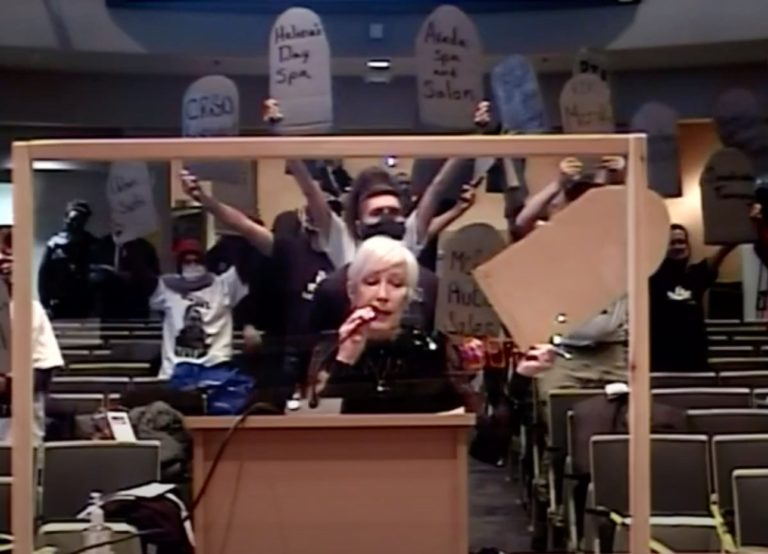
The half hour that has been reserved for audience participation during the early part of the Anchorage Assembly meetings is no more. The Assembly majority has killed it with a stealth move.
AO 2022-82passed on Tuesday night, with a surprise amendment from Assemblyman Chris Constant, removing the “initial audience participation” that was given one half hour after some early business was taken care of by the Assembly. There will be a limited time for a member of the public to speak if that person has made an appearance request in advance. At this point, the reservations for those appearances are limited to three people, for three minutes each.
The title of the ordinance didn’t suggest that audience participation would be limited. That came from the surprise amendment by Constant, which passed. Assemblyman Felix Rivera, who usually votes with the leftist majority, broke from the majority to vote against the amendment.
The title of the ordinance gave no indication of what was coming: “Ordinance No. AO 2022-82, an ordinance of the Anchorage Assembly amending Anchorage Municipal Code Chapter 2.30 Rules of Procedure for Assembly, Assembly Chair LaFrance and Assembly Vice-Chair Constant. P.H. 9-27-2022. 14.G.1. Assembly Memorandum No. AM 481-2022.”
Constant said the intent of having the public participation had failed, and the public can still testify at the end of the meeting and during any item on the agenda that allows testimony.
There were only about five people in the audience at the Assembly meeting by the time the item came up for a vote. Those observing said it appeared that Constant had pre-arranged it with the Assembly chair and others to slip the amendment in.
Public participation at the Assembly meetings is often contentious to the Assembly majority, with people using their three minutes to heap criticism on the Assembly for one transgression or another. The public testimony portion has been one of the more entertaining portions of the Assembly meetings, but clearly aggravates the liberal majority.
In the past 18 months, the Assembly has tightened other rules pertaining to participation and the public, such as cordoning off the area in front of the dais to prevent the public from approaching Assembly members. During the Covid pandemic, the Assembly severely limited the number of people allowed to attend Assembly meetings in person, and during that time angered the public by passing numerous controversial provisions.
Former Alaska Permanent Fund Executive Director Angela Rodell promised the Permanent Fund Board of Trustees that she’d make a political firestorm for them when they fired her last December. And she did.
An independent investigation commissioned by the trustees reveals that Rodell threatened political retribution during the meeting in which she was told there would be a vote on her retention.
The key takeaways from the report include:
Problems between the board of trustees and Angela Rodell went back to at least 2018.
The trustees had brought in an outside executive consultant to help Rodell repair her performance problems.
Rodell shocked the trustees by sending out a press releasedescribing the fund’s strategy for continuing operations in the event of a government shutdown in June of 2021, due to budget disputes between the governor and legislative leadership. In that press release, she inserted her opinion into the political dispute.
Gov. Mike Dunleavy did not get involved in the decisions or circumstances around Rodell’s firing, and was surprised when he learned of it.
Rodell was described by trustees during depositions as threatening political retribution against them.
Rodell, who was paid $389,000 a year, was fired after being given the option by the board to resign during the December, 2021 trustees meeting. Among the concerns were the tensions between Rodell and her staff of investment professionals, and her deteriorating relationship with the board of trustees.
By January, the Legislative Budget and Audit Committee of the Alaska Legislature commissioned an independent investigation to determine if the firing was political, as Rodell had told the committee. Rodell and the committee’s Chairwoman Sen. Natasha von Imhof have a close personal friendship.
Normally, personnel matters are kept confidential. But once the Legislative Budget and Audit Committee became involved, this personnel matter became political. In response to the committee chair creating and using public funds to pay for an investigation into Rodell’s firing, the trustees hired their own law firm to conduct an independent investigation, the results of which were obtained by Must Read Alaska through a public records request.
We received these reports on Tuesday, Sept. 27. On Wednesday, the Legislative Budget and Audit Committeeis scheduled to meetat 1 pm to go over the report from the committee’s investigator. The trustees released their report to the committee, but the committee’s own report is not yet available. Documents obtained from the Permanent Fund Corporation show that the trustees’ investigator has asked for, but was not given advance copies of the legislative committee’s separate report, conducted by the law firm of Schwabe Williamson and Wyatt, which will be discussed during Wednesday’s meeting.
The report commissioned by the trustees was completed by attorney John M. Ptacin of Sedor, Wendlandt, Evans, Filippi, an Anchorage law firm. As part of the investigation, the firm observed and recorded the legislative committee’s investigator’s depositions of trustee members, who were asked about Rodell’s history with the board, her performance reviews, specific incidences that led to her firing, and her reaction to being fired.
When asked about Rodell’s reaction to being given a choice to resign or face being fired, trustee Lucinda Mahoney, who was the commissioner of the Department of Revenue at the time, told investigators:
“She [Rodell] said that we were making a big mistake because no one would ever be able to do the job that she did and manage the fund as she did. She told us that there would be political ramifications for our decision. She told us that she was going to hold each one of us individually accountable. It was very unprofessional.”
Q: I mean, sitting here today, do you think the outcome was still the correct decision?
A. Yes, especially her closing words. Yeah. I think all the trustees were very taken aback at that, and it probably validated their decisions.
Trustee Corri Feige, who was the commissioner of the Department of Natural Resources, expanded on the interaction in her deposition, also describing Rodell as unprofessional:
Q: So what was Ms. Rodell’s reaction or response to Chair Richards telling her what the board’s direction was going to be?
A: She said okay. And when he said, you know, we will extend you the courtesy — professional courtesy of being able to resign, and she said, nope, and then proceeded to launch into one of the most vitriolic diatribes I have ever heard as a professional. Clearly she was embarrassed and her feelings were hurt, but she immediately went to, I knew you were going to do this. You will all have to wear this decision. You don’t know the political firestorm you will — you have created for yourself, or something to that effect, and then good luck replacing me. I knew I had made the absolute right decision…And for someone not only to — to refuse the courtesy of being able to resign when you are a CEO and then, you know, turning around and — and having, you know, the eruption that she had, that communicates to me that that’s an individual that doesn’t believe that they have anything they need to improve. They don’t have shortcomings. They are blind to where they need to improve their own skill sets. And as a fiduciary of the trust, we can’t — we can’t have that at the helm. We just can’t. So I was — I was very firmly rooted that I had made the right decision.
Board Chairman Craig Richards, when asked how Rodell responded to being fired, said Rodell threatened a political storm:
A: So she first indicated that she thought that this was going to happen and she should have made us have this discussion in open session, and then she said something to the effect of, you don’t know the political storm that you have created for yourself and the consequences. I took it as you are going to reap the whirlwind sort of deal. She made it very clear that she planned to politicize this, and she did.
Trustee Mahoney, when asked why Rodell was terminated, said that Rodell had not handled internal conflicts at the organization well, and that her relationship with the trustees had led to a lack of confidence.
A: Okay. So I kind of already said it, but I’ll restate it. Hopefully I’m consistent. So my vision is that the fund is a 100-billion-dollar fund by the year 2030. And in order for that to happen, we need to have a very high performing team where the investment officers who do the buys and the sells have a very good relationship, cohesive, work in harmony, collaborative with the executive director so that we don’t have attrition issues that could potentially impact returns. I have a vision that the organizations, both the operations organizations and the investment organizations, work really well together as a team. There is all this conflict that is going on there that she hadn’t been able to resolve. And then additionally, the relationship with some of the members of the board was in jeopardy. They had lost confidence in her. So I considered all of that in terms of as we move forward and we really continue to grow, is this the right leader to lead us into the future. Then I also considered the history, you know, the historical performance reviews. And that – that was — that was the foundation of my vote.
Ethan Schutt, who is now the Permanent Fund Board’s chairman, said his reason for voting for Rodell’s termination were due to what he described as an unhealthy relationship between the board and Rodell:
Q. So when you said there was discussion about the disconnect between Rodell and the Board of Trustees, what do you mean by that?
A: Several trustees were clear in that they didn’t feel like we had a good, healthy, open dialogue back and forth between Ms. Rodell and the board and that there was sort of an unnatural and unhealthy tension in that relationship. I guess those are my kind of paraphrased summary of the issue.
The report, included below so Must Read Alaska readers can review it in its entirety and come to their own conclusions, summarizes the breakdown of trust between Rodell and her governing board:
“At their 2022 depositions, each trustee further reflected on the Board’s decision to terminate Ms. Rodell’s employment. Trustee Moran, for instance, voted to retain Ms. Rodell, explaining that fund performance constituted eighty- five percent of his decision. Trustee Feige felt the quarterly meetings were poorly managed and that Ms. Rodell was not an effective communicator—and Trustee Feige was particularly troubled by Ms. Rodell’s foray into government shutdown politics. Trustee Schutt generally noted that Ms. Rodell was unprofessional at the September 2021 meetings and he was concerned that Ms. Rodell’s leadership would lead to the departure of key investment staff. Trustee Schutt took a particularly negative view of Ms. Rodell’s politicization of the fund relative to the potential of a 2021 government shutdown. Trustee Schutt was also concerned with some of the low scores on Ms. Rodell’s survey, namely from investment staff. Trustee Richards was highly concerned about the eroding relationship between the Executive Director and investment staff. Trustee Mahoney sensed that Ms. Rodell was not going to improve as Executive Director and that APFC needed a leader that would grow alongside the fund. Trustee Rieger felt that because a majority of the trustees had lost confidence in the Executive Director, it would be untenable for Ms. Rodell to continue.”
The report also describes what happened during the meeting in which Rodell was fired:
“After the trustees concluded their deliberations, the trustees invited Ms. Rodell into executive session. Chair Richards thanked Ms. Rodell for her service and relayed that the trustees would vote to terminate her employment. Chair Richards offered Ms. Rodell an opportunity to resign in lieu of termination. Ms. Rodell had an unprofessional reaction to the news of her departure. She stated she would not allow the trustees to ‘take the coward’s way out,’ or something to that effect. She instructed the trustees to vote on her removal in open session and she forecasted a ‘political firestorm’ over her firing, which came to fruition due in part to her conjecture that Governor Dunleavy’s administration orchestrated her firing.
“Ms. Rodell’s conduct during this final executive session provided further evidence to some trustees that their relationship with the Executive Director had deteriorated beyond repair.”
After her firing, Rodell made statements indicating that her removal was political. To the Legislative Budget and Audit Committee, which opened an investigation into her firing, she said, “I believe my removal to be political retribution for successfully carrying the board’s mandate to protect the fund and advocate against any additional draws over the (percent of market value) spending rule … which is contrary to Governor Dunleavy’s agenda.”
The independent report commissioned by the trustees states there’s no evidence the firing of Rodell was political, and says that when trustee Corri Feige relayed the news to the governor by phone, Gov. Mike Dunleavy was genuinely surprised.
“There is no evidence to suggest that Governor Dunleavy or some other political actor orchestrated Ms. Rodell’s termination. Ultimately, Ms. Rodell and APFC staff have two important duties. First, they are expected to maximize returns as instructed by the trustees. Second, they are expected to provide lawmakers unbiased information about how legislation could impact to the fund. There is little to no evidence Ms. Rodell played some outsized role in the more tectonic political discussions about the future of the fund and its uses. And there is no evidence that Ms. Rodell’s purported incursions into debates about spending APFC money compelled the Governor or any executive branch official to seek her dismissal. Ms. Rodell’s allegations of political retribution ignore the fact that trustees began raising concerns about her performance in 2018,” the report says.
The depositions of the trustees, conducted by the legislative committee’s separate investigator, support that summary. Even Bill Moran, who voted against Rodell’s firing, said he didn’t think it was political and did not think the governor was involved.
Read the report by the Permanent Fund trustee’s independent investigator:
Three sudden and separate leaks in the Russia-owned Nord Stream 1 and 2 pipelines in the Baltic Sea are possibly due to acts of sabotage. Gas from the gas line is bubbling to the surface of the sea, as shown in the photo above from a Danish military flight over the pipeline route, and scientists say that there had been two bursts in undersea seismic activity during the hours leading up to when the pipelines lost pressure.
Comprised of two 1,224 km-long pipelines, Nord Stream is the main supply line for Russian gas to Europe, which gets 40% of its gas from Russia. The lines run from Vyborg, Russia to a port in Germany.
The Kremlin has not ruled out sabotage after the pipelines underwent sudden falls in pressure after seismic spikes, according to Kremlin spokesperson, Dmitry Peskov. The Danish Prime Minister Mette Frederiksen said sabotage was a possibility.
In February, 2022, President Joe Biden said on ABC News, “If Russia invades…then there will be no longer a Nord Stream 2. We will bring an end to it.” A reporter asked, “But how will you do that, exactly, since…the project is in Germany’s control?” Biden replied, “I promise you, we will be able to do that.”
Pres. Biden: "If Russia invades…then there will be no longer a Nord Stream 2. We will bring an end to it."
Reporter: "But how will you do that, exactly, since…the project is in Germany's control?"
It has been 20 long months since Joe Biden took the oath of office and took direct aim at America’s energy industry.
For all his documented failures as president, Biden has succeeded in his promise to fulfill a green agenda, beginning with his first day in office, as he used executive orders to shut down the Keystone XL pipeline and halting development in the 10-02 area of Alaska’s Arctic National Wildlife Refuge (ANWR).
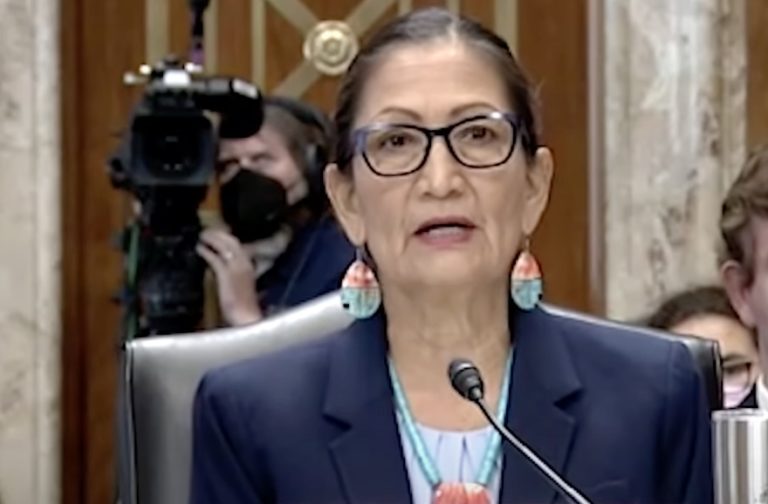
No one on Team Biden has done a better job of following the eco-left’s green playbook than Interior Sec. Deb Haaland, who has used her position to push for economic, cultural and racial justice as cornerstones of her department’s mission. She has traveled across the country while in her role, under the guise of learning more about the balance between public lands and economic opportunity.
However, a review of her actions shows a clear imbalance, one tilted heavily toward environmental lock-ups rather than economic opportunity for the very people and communities who need those jobs the most.
Earlier this year, Haaland traveled to Minnesota, where she stayed in the Twin Cities (hardly ‘public land’ that Interior focuses on), drawing the ire of Republican Rep. Pete Stauber. Haaland could have traveled to Northeast Minnesota and the Twin Metals nickel mining project that she had issued an executive order blocking development of just months earlier, but she chose not to.
Haaland failed to intervene in cases brought by environmentalists to halt leasing for coal mining on federal lands and to keep Nevada and California-based lithium mining opportunities from moving forward, even as America faces supply-chain dependence on Communist China, Russia and African-warlord-controlled mines for critical and strategic minerals needed for the environmental lobby’s desired ‘green’ revolution.
She has even stifled development opportunities in her home state of New Mexico, whose economic outlook is ranked 38th in the nation. The Navajo Nation, the nearest Indigenous people to Chaco Canyon in the northwestern portion of the state, have lambasted Haaland and the Biden administration for ignoring tribal consultation requirements and further disregarding the Navajo’s desire for a smaller (5-mile) buffer zone around the Canyon; one that would allow the Navajo to continue with its oil and gas development projects in the area, rather than be shut down by Interior’s larger, 10-mile proposed zone.
But nowhere has Haaland targeted quite like our state of Alaska, where Interior controls nearly 63% of our acreage through public lands, national parks, forests and wildlife areas.
Haaland and the Interior Department have acted as nothing short of attack dogs against development opportunities. She celebrated the cancellation of development of ANWR’s 10-02 area, even though local Indigenous people — the Inupiat in Kaktovik, located within ANWR’s borders — overwhelmingly support the project, as they have seen how nearby Prudhoe Bay has benefitted villages across the North Slope of Alaska.
When a federal judge tossed out an approved development plan for ConocoPhillips’ Willow project in the National Petroleum Reserve-Alaska (NPR-A) in July 2021, it took nearly a year and constant pressure from Alaska’s business, political and congressional leaders for the Bureau of Land Management (BLM) to issue a plan to re-review the project. The delay, overseen by Haaland and the Bureau of Land Management, could delay the project for years. With global energy supply restricted, the 180,000 barrel-per-day project would be welcomed by consumers.
Even after visiting our state and professing a desire to listen to those closest to the projects Interior has influence and control over, the hits just kept on coming.
Subsequent rulings included shrinking the land available for development in NPR-A by nearly 50% from a plan approved by the previous administration, cancelling a regulatorily required Cook Inlet oil and gas lease sale, and a pause and subsequent requirement to reexamine the obligations to build an access road to the Ambler Mining District in Northwest Alaska, an area rich in the same critical and strategic minerals previously noted as being nearly wholly imported from less-than-friendly sources.
Deb Haaland and her bias against traditional energy has been devastating for rural America, including numerous areas noted as being economically and racially disadvantaged. If she really cared about her stated mission to bring opportunity to the poorest areas of the country, she would stop with the assaults, focus on balancing environmental stewardship with responsible development, and encourage — not block — projects and prospects that could bring tens of thousands of traditional energy jobs back to rural America.
Rick Whitbeck is the Alaska state director for Power The Future, a national nonprofit organization that advocates for American energy jobs.
The Alaska Center (for the Environment) has issued its list of endorsed candidates, and there’s something Alaska voters need to know about them. They answered affirmatively a question about whether they will work to end Alaska’s oil economy in 27 years.
Earlier this year, the center sent a questionnaire to all candidates for State House, State Senate, U.S. House, U.S. Senate and Governor.
The candidates were asked:
Do you acknowledge that human actions are a significant contributor to climate change? Will your actions to stop climate change match the urgency of its effects in Alaska?
Do you support transitioning to 100 percent clean energy no later than 2050 to help build pollution-free communities?
Many Republican candidates did not bother to answer the questionnaire, they told Must Read Alaska. Why? They already know they will not be endorsed by the group that has become a major arm of leftist dark money influence from Outside the state.
The Alaska Center is funded by groups such as the Sixteen Thirty Fund, League of Conservation Voters, and Tides Advocacy Fund, the Alaska Conservation Foundation, the Brainerd Foundation, and the Harder Foundation.
The Sixteen Thirty Fund is a dark money arm of Arabella Advisors and was active in other Alaska campaigns this year, such as Forrest Dunbar for Anchorage mayor, and in recent years in Alaska.
Arabella Advisors, founded by a former appointee of President Bill Clinton, is a Washington, D.C.-based, for-profit business that works with left-leaning donors and progressive nonprofits and has become known as the hub of the liberal “dark money” network. It’s part of what might be called a vast left-wing conspiracy, to turn a phrase from Hillary Clinton.
The Alaska Center, which is now dependent on Arabella Advisors through its dark money donors, advocates for things like ranked choice voting, automatic voter registration, carbon taxes, and a mandate of reaching 50 percent “renewable” energy statewide by 2025, with 100 percent clean energy by 2050.
The group also supports higher taxes on oil and natural gas. At least until oil and gas can be destroyed as an industry in Alaska.
Arabella Advisors also supports the nonprofit States Newsroom, which operates the Alaska Beacon, a new online news organization, making Arabella one of the biggest media influencers in the state. All mainstream media outlets now routinely run stories from the Alaska Beacon.
This year, Arabella-Sixteen Thirty Fund is also attempting to defeat Alaska’s Ballot Measure 1, which is the call for a constitutional convention.
The Alaska Center has endorsed 100 percent Democratic ticket except for candidates such as former Gov. Bill Walker, who in his fourth run for governor, declines to associate with a party. With Walker, the Center advises voters to mark him second, after Democrat Les Gara. The group has endorsed Calvin Schrage, also another pretend-independent, who actually caucuses with the Democrats for Anchorage House District 12.
The Alaska Center has endorsed Pat Chesbro, the Democrat, for U.S. Senate, and Democrat Congresswoman Mary Peltola for U.S. House.
The list of the group’s endorsed radical, far-left candidates is at this link.
ActivistFacts.com, which tracks radical organizations like Arabella, describes it this way:
Arabella Advisorsis a consulting firm that oversees a major leftwing “dark money” network. Arabella manages the Sixteen Thirty Fund, a 501(c)(4) nonprofit organization that has been widely dubbed as a “dark money” political fund, and its sister project, the New Venture Fund. Other Arabella-managed entities include the Windward Fund and the Hopewell Fund.
Arabella, founded in 2005 by Eric Kessler, an alum of Bill Clinton’s White House, is known for using its four main funds to prop up paper-thin nonprofit groups that promote left-wing policies. These nonprofits have been dubbed “pop-ups”because most of them appear to be grassroots organizations but, in effect, are barely more than websites. The “pop-ups” drive millions in donations to promote liberal policy issues all while providing cover for whoever is making the donations.
This layer of anonymity has helped Arabella rake in billions into the projects it manages. Between 2013 and 2018, four nonprofits under Arabella’s umbrella reported a combined revenue of roughly $2.3 billion. Those four funds financed hundreds of leftwing “pop-up” campaigns.
While Arabella’s projects are often cloaked in secrecy, the organization is facing more scrutiny from corporate media. The Daily Beast reported Arabella got caught scrubbing its Wikipedia pagesof mentions of “dark money.”
Some in the media, meanwhile, have condemned Arabella for its “dark money” operations that have pushed policy changes on everything from the supporting mail-in voting to opposing Justice Brett Kavanaugh’s confirmation to the Supreme Court. In a 2018 report, Politico found that Arabella’s Sixteen Thirty Fund had spent $140 million on more than 100 left-wing causes during the midterm election season. More than one-third of that money came from one anonymous donor.
The New York Times published a similar report after tracing several mundane-sounding nonprofits back to Arabella, including Keep Iowa Healthy, New Jersey for a Better Future, and North Carolinians for a Fair Economy — all of which were advocating for policies in areas with vulnerable Republican House members.
Its main funds cover the habit of the leftwing ideology. The Hopewell Fund promotes access to abortion and social justice, the Windward Fundpromotes environmental issues, and the New Venture Fund acts as an incubator for scores of smaller left-wing campaigns through “fiscal sponsorship” programs.
Many of Arabella’s board members sit on boards for the various funds. Kessler, for example, was president of the New Venture Fund.
For more information on Arabella projects, read the profile ofAccountable.US and InfluenceWatch’s profile of the New Venture Fund.
Twenty-nine years after he was a freshman living in the dorms at the University of Alaska Fairbanks, Steven H. Downs was sentenced to 75 years in prison for sexually assaulting and murdering 20-year-old Sophie Sergie in 1993.
In sentencing Downs on Monday in the Rabinowitz Courthouse in Fairbanks, Superior Court Judge Thomas Temple noted that there was nothing the Court could do to restore the harm caused by Downs’ actions.
In his sentencing remarks, Judge Temple commented that Sergie’s life was taken by Downs’ senseless act and noted Downs gave zero regard to her autonomy as a person, to her value of life, and pointed out that she is forever gone because of Downs’ callous choice. Judge Temple commented that in addition to taking Sophie from the world, Downs robbed her family of their ability to love her, experience life with her, to continue time on earth with her.
For nearly three decades after Sergie’s murder, there were no suspects in the cold case. A DNA sample taken from Sergie’s body was put into a national DNA database, but did not match another profile in the database. In 2017, a new investigative method linking DNA technology and genetic research was used to solve a murder case in California. Alaska State Troopers first used this same methodology in 2018, when they submitted the unknown sample from Sergie’s body for genetic genealogy analysis.
This analysis identified Downs as a possible suspect based on a connection to an aunt who had uploaded her profile to an open-source genealogy website. Investigation confirmed that at the time of the murder, Downs was attending UAF and living in the dorm where Sergie was murdered. When interviewed in 2019, Downs denied having ever met or come into contact with Sergie. Downs was arrested in February 2019, when his DNA was definitively linked by traditional DNA comparison to the DNA sample collected decades ago on Sergie’s body. Downs was extradited from Maine where he worked as a nurse.
Sergie was from the Native village of Pitkas Point in western Alaska. Sergie was a UAF student who had taken the semester off. She returned to Fairbanks for an orthodontics appointment and was staying at a friend’s dorm room on a girls-only floor of Bartlett Hall. In the early hours of April 26, 1993, Sergie left her friend’s second floor room for a late-night smoke; the next afternoon, she was found dead in a bathtub in the women’s bathroom on the second floor. Evidence showed that Sergie had been sexually assaulted, stabbed multiple times on her face and shot in the back of the head at close range.
Jenna Gruenstein with the State Office of Special Prosecutions argued for a 99-year sentence, with 20 years suspended, for the murder in the first-degree charge and eight years for the sexual assault in the first-degree charge, or 87 years to serve.
Gruenstein argued to the judge that Downs’ brazenness in committing the crime in a public bathroom should be considered when sentencing him. “First it was unprovoked and a wholly unexplained crime,” she said. “He committed it against someone Downs never met and committed it for no discernible reason. Second, Sergie is a woman who Downs overpowered in every way, height, weight, and weapons. … The way he committed the crime, it’s pretty shocking it wasn’t caught earlier because this crime is really one that should’ve been easily detected. It was in a public place with a bathroom stall separating murder from washing and brushing teeth, as students came and went, fairly busy with activity.”
Downs’ defense attorney, Jim Howaniec, described the younger Downs in court as “a boy 4,000 miles away from home for the first time.”Howaniec said he would not downplay the offense, but told the court that Downs continues to assert his innocence.
Howaniec described 18-year-old Downs as both well-adjusted and well-liked with a girlfriend, but he also described him as “very immature, drinking and partying a lot, as much as a 1/5 of whiskey every night, somehow maintaining his grades, doing a lot of weed, alienated like a lot of young 18-year-olds.”
The defense asked for 50 years of incarceration with 30 years suspended or 20 years to serve, for murder, and eight years for the sexual assault, to run concurrently.
Judge Temple said Downs’ three decades of not committing a crime could not reduce the magnitude of his conduct. Applying the sentencing laws that were in effect for sentencing when the crime occurred in April 1993, Judge Temple sentenced Downs to 67 years for the murder conviction and eight years for the sexual assault conviction, to run consecutively for a total of 75 years.
Under law, Downs is eligible to ask for discretionary parole after he has served 25 years, at which point he will be 73 years old. Judge Temple also ordered Downs to register as a sex offender for life.
Gruenstein said she was hopeful that the sentencing would help bring healing to Sophie’s family and friends and to the community.
“For both Chris (Chris Darnell, Assistant Attorney General) and myself, it was a real honor to work on this case, given how long it had gone unsolved, how long the community–Fairbanks, UAF, Sophie’s family–had suffered knowing that somebody had apparently gotten away with this murder and rape. I think that being able to provide some closure to the community is one of the best things that came out of this. It’s another example of how helpful genetic genealogy can be. This is the first case that has gone to court in Alaska using this technology.”
The Alaska State Troopers investigated this case with the help of the Maine State Police and the Auburn Police Department. The Alaska State Crime Detection Laboratory and the Maine State Laboratory both conducted DNA testing.
The Anchorage Assembly, in a special meeting on Monday, voted to approve $2.4 million in funding for the Assembly’s plan to house about 350 homeless people for three months.
That’s a cost of over $6,800 per person for the three months, or $2,285 per homeless person for housing alone, per month beginning on Oct. 1. That only pays for housing the homeless through December through this plan. It does not include services such as free meals and social services.
The ball is now in the mayor’s court. The Assembly majority has blocked his ability to erect a navigation center in time for winter, and he has said that addressing the homeless problem in Anchorage is one of his priorities.
The Assembly majority, after preventing any of Mayor Dave Bronson’s own plans from being implemented, offered its own plan, which includes the controversial Golden Lion Hotel, which was part of former Mayor Ethan Berkowitz’s expenditures when he bought the hotel for the city to use as a drug treatment facility in 2020, before he left office in disgrace. Many on the Assembly are aligned politically with Berkowitz and continue his left-leaning legacy.
During the debate over the purchase of the Golden Lion in 2020, however, the Assembly passed an ordinance that promised it would not be used to house the homeless.
The Assembly’s new plan also includes reopening the Sullivan Arena for 150 people who are unsheltered but also unsuited to live in a structured hotel environment, and adding funding for nonprofit shelters so they can accommodate a few more people.
The Sullivan Arena was commandeered by Berkowitz during the Covid pandemic to spread homeless people out and slow down the spread of Covid in traditional shelters around town. It was used as a mass shelter for two years, closing at the end of June, when Mayor Dave Bronson’s administration opened up a campground for people to use without having to pay a campground fee.
Centennial Campground has sanitary facilities and social service agencies have provided food trucks with free meals for people camping there this past summer.The campground is set to close on Friday, as snow makes its way down the mountains. Temperatures at night are reaching in the low 40s this week in the Anchorage bowl.
The ball is in the mayor’s court now, as the Assembly has signaled it will not approve any of his plans, and will only fund the plans that come from the Assembly.