Thursday, June 18, 2026
Home Blog Page 739

Feds give thumbs up to scaled down version of Willow Project

The federal government has given a qualified thumbs-up to a scaled-down version of the Willow Project. A Bureau of Land Management final Supplemental Environmental Impact Statement released on Wednesday represents a major milestone in the permitting process for the ConocoPhillips project that commenced in 2018. The company, which has not made its final investment decision, is indicating that the scaled down version is still economically viable.

Located in the National Petroleum Reserve in Alaska, the Willow Project could produce 180,000 barrels of oil per day at its peak and deliver $8 billion to $17 billion in new revenue for the federal government, the State of Alaska, and North Slope Borough communities, not to mention significant economic activity in a state that has been in economic decline.

The company says the project, if it gets a final record of decision from the Department of Interior, will be built using materials primarily made and sourced in the United States and has the potential to create over 2,000 construction jobs and 300 long-term jobs.

ConocoPhillips announced the new oil discovery in January 2017. Located in the Bear Tooth Unit in the northeast portion of the National Petroleum Reserve-Alaska (NPR-A), Willow started with two discovery wells, Tinmiaq 2 and 6, which had been drilled on federal leases in early 2016.

A project the size and scope of Willow hasn’t been developed on the North Slope since Alpine was developed in the late 1990s. Additional oil production will keep a key piece of U.S. infrastructure, the Trans-Alaska Pipeline System, economically viable. The production rate from Willow is estimated to be about a 20% increase over current TAPS throughput.

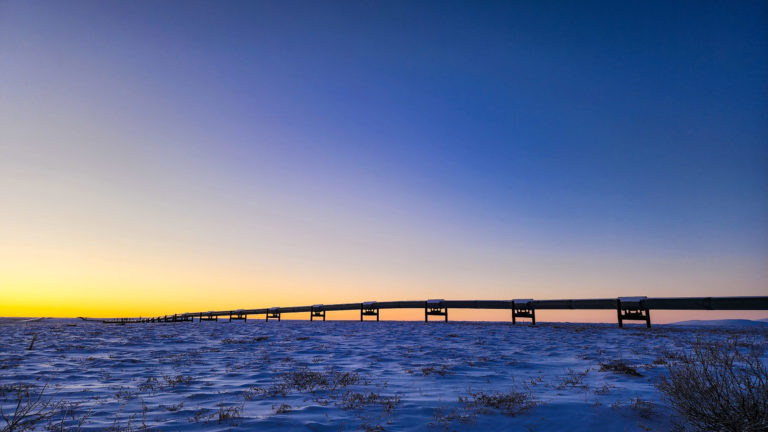
TAPS is now running at about one quarter of its capacity, with roughly 490,000 barrels of oil per day flowing from the North Slope to the port of Valdez.

“After nearly five years of rigorous regulatory review and environmental analysis, the National Environmental Policy Act process is almost complete and should be concluded without delay. ConocoPhillips looks forward to a final record of decision and is ready to begin construction immediately after receiving a viable ROD and full authorization from all permitting agencies,” said Erec Isaacson, president, ConocoPhillips Alaska.

Alaska Natives are one of the big winners in this decision. Federal law requires 50% of lease revenue from NPR-A projects be made available to a unique grant program that offers significant social and environmental justice benefits to Alaska Native communities.

In the supplemental environmental impact statement, the Bureau of Land Management identified Alternative E as the preferred alternative. Under Alternative E, the federal agency could authorize three drill sites initially, and potentially one additional drill site in the future, pending the final record of decision.

There were five drill sites initially proposed by ConocoPhillips and this alternative is a reduction of project footprint in the Teshekpuk Lake Special Area by more than 40%. The three core drill sites in Alternative E (BT1, BT2, and BT3) reflect an integrated design concept and ConocoPhillips says the path forward with three is “viable.”

ConocoPhillips Alaska intends to immediately initiate gravel road construction once all necessary approvals are in place, and then proceed to a final investment decision, the company says. Mobilization could start as soon as February. Additional North Slope construction activities for Willow will occur throughout the summer and fall. Concurrently, material fabrication will begin in U.S. facilities and the pace of contracting and procurement will increase, the company said.

“We appreciate the strong support for Willow from communities on the North Slope and across the state, as well as from Alaska’s bipartisan congressional delegation,” Isaacson said. “Willow will produce much needed domestic energy while generating substantial public benefits.”

Rick Whitbeck of Power the Future Alaska said that although the decision is not final, the EIS “contained incredibly good news for the Willow project. In spite of #ClimateCult opposition, the right decision was made for America, Alaska & energy independence.”

Peltola votes ‘no’ on allowing health workers to choose whether to get a Covid vaccine

Fish, Family, Freedom was Rep. Mary Peltola’s campaign slogan. But in the House of Representatives today, Alaska Rep. Mary Peltola vote no on a bill that would give health care workers the freedom to choose whether to get the Covid-19 vaccine.

Freedom for Health Care Workers Act passed 227 to 203, with nearly all Democrats voting against giving health care workers the right to choose. Four member did not vote.

All Republicans voted in favor of the bill, while five Democrats voted with the Republicans.

The bill, H.R. 497, if passed by the Senate and signed by the president, nullifies a rule titled Medicare and Medicaid Programs; Omnibus COVID-19 Health Care Staff Vaccination, which was issued by the Centers for Medicare & Medicaid Services on Nov. 5, 2021. The rule requires health care providers, as a condition of Medicare and Medicaid participation, to ensure that staff are fully vaccinated against Covid-19.

During her campaign, Peltola said that vaccine mandates should not be required nationally.

President Joe Biden has vowed to veto the bill if it makes it to his desk.

“The bipartisan passage of the Freedom for Health Care Workers Act in the House is a win for medical freedom and individual liberty,” said Congressman Jeff Duncan, the bill’s sponsor. “Over the past few years, far too many Americans were forced to get this shot against their will to keep their job, while others were fired or forced to walk away from their profession altogether. I began leading the charge against Joe Biden’s authoritarian vaccine mandate in 2021 when the frontline workers who were praised as heroes in the early days of the pandemic were forced to get to the shot or get out, even as we struggled with a nationwide staff shortage in the health care industry.” 

Imposing the COVID shot on health care workers is unscientific and un-American, especially as we now know the COVID shot is ineffective at preventing transmission, Duncan said. 

“Joe Biden’s draconian COVID authoritarianism has no place in this country, and I urge my colleagues in the Senate to ‘follow the science’ and see this legislation through. While this is an important step, the fight is far from over, and I will continue fighting to end all of Joe Biden’s remaining COVID mandates,” the South Carolina congressman said.

FreedomWorks, a grassroots group that fights for personal liberty, said it consistently believes the decision on whether to receive the Covid-19 vaccine should be left up to the individual and not the government.

“Congress should also be the branch that writes laws that impacts every American, not unelected bureaucrats. Hospitals and health care systems across the country are facing staffing issues that are directly impacting the quality of care Americans receive and keeping qualified individuals from working only worsens the crisis and harms more people. We thank Rep. Duncan for being a leading voice for Freedom through his service in Congress,” FreedomWorks wrote.

Associated Builders and Contractors also praised the bill saying, “Throughout the COVID-19 pandemic, ABC member employers consistently demonstrated their commitment and willingness to create safe and healthy job site conditions because health and safety are always our No. 1 priority. H.R. 497 would eliminate unnecessary compliance costs and burdens imposed on contractors that provide vital services to our nation’s hospitals and health care facilities and would ensure work opportunities for thousands of experienced, skilled construction workers throughout the country.” 

USA Today: Rep. George Santos and Mary Peltola have something in common — resumes that don’t hold up

Are Peltolas violating federal laws against influence peddling?

Through her teeth: Rep. Peltola said Inflation Reduction Act is about cost of living, but Al Gore tells Davos it’s really a climate change act

Races shape up as some filers drop out of Anchorage races

The final candidates for Assembly races narrowed on Monday with a few dropping out.

In the Chugiak-Eagle River District 2 race, candidates Roger Branson and Cody Anderson have withdrawn, leaving Democrat Jim Arlington running against Republican Scott Myers in that race.

In the West Anchorage District 3 race, David Eibeck has withdrawn, leaving three in the race: Republican Brian Flynn, Anna Brawley and Dustin Darden.

In the South Anchorage District 6 race, Darin Colbry has withdrawn, leaving three in the race: Republican Rachel Ries, Mikel Insalaco, and Zac Johnson.

The line-up, as of the 5 pm withdrawal deadline:

District 1 – Seat ​B – North Anchorage

Danger, Nick​​ – Filed 1/25/2023

Trueblood, John​ – Filed 1/26/2023

Constant, Christopher – Filed 1/13/2023​

District 2 – Seat C – Chugiak, Eagle River, JBER

Branson, Roger – Filed 1/27/2023 – Withdrawn​ 1/30/2023

Arlington, Jim – Filed 1/27/2023

Anderson, Cody – Filed 1/26/2023 – Withdrawn 1/31/2023

Myers, Scott​ – Filed 1/24/2023​

District 3 – Seat E – West Anchorage

​​​Darden, Dustin Thomas House – Filed 1/20/2023, amended

Brawley, Anna – Filed 1/13/2023​​

Flynn, Brian​ – Filed 1/20/2023

Eibeck, David – Filed 1/26/2023 – Withdrawn​ 1/30/2023

District 4 – Seat G – Midtown Anchorage

Di Grappa, Jenny – Filed 1/26/2023​​

Szanto, Travis​ – Filed 1/26/2023

Rivera, Felix​ – Filed 1/18/2023

District 5 – Seat H – East Anchorage (2-Year Term)

Sloan, Leigh​ – Filed 1/27/2023

​​Bronga, Karen​ – Filed 1/17/2023

District 5 – S​eat I – East Anchorage

Martinez, George​​ – Filed 1/13/2023

Moore, Spencer – Filed 1/26/2023

District 6 – Seat K – South Anchorage, Girdwood, Turnagain Arm​

Ries, Rachel – Filed 1/13/2023

Insalaco, Mikel – Filed 1/27/2023

​​Colbry, Darin – Filed 1/13/2023 – Withdrawn​ 1/30/2023

Johnson, Zac​ – Filed 1/25/2023, updated

‘Ah, here we go’: Jan. 31, 2000, the day Flight 261, bound for Seattle plunged into the Pacific Ocean, all 88 lost

On Jan. 31, 2000, Alaska Airlines Flight 261, bound for Seattle from a Mexican resort town, plunged into the Pacific Ocean off the coast of California, with all 88 souls on board lost.

The flight had taken off from Puerto Vallarta, Mexico, heading for the Seattle-Tacoma International Airport with a stop scheduled in San Francisco. Over half of the people onboard were heading to Seattle, and three of the crew members were Seattle based.

Among the 88 killed were Alaskan Morris Thompson, who had been commissioner of the Bureau of Indian Affairs in Alaska from 1973 to 1976, along with his wife Thelma and daughter Sheryl. Thompson had recently retired as the CEO of Doyon Ltd., a Native corporation in Alaska.

Capt. Ted Thompson and First Officer William Tansky struggled to control the McDonnell Douglas MD-83, for two hours.

“Folks, we have had a flight-control problem up front here,” Thompson announced over the jet’s speaker. The passengers knew it, of course, as the plane had just made a dive from 31,000 feet to 23,000 feet. “We have a jammed stabilizer and we’re maintaining altitude with difficulty…our intention is to land at Los Angeles.”

Thompson radioed to the control tower, but as the pilots attempted to get to redirect to Los Angeles for an emergency landing, the plane went topsy turvy, and then went into an uncontrolled nosedive from 17,000 feet.

Thompson’s final recorded words were “Ah, Here we go.”

The recovered flight recorder data later showed the plane crashed into the ocean at 4:22 pm Pacific time, at about 200 miles per hour.

Read the transcript of the pilots’ communication as they tried to control the aircraft.

The investigation by the National Transportation Safety Board led to problems with a two-foot-long jackscrew, and a lack of grease on the jackscrew, which had caused the threads to be stripped, resulting in the horizontal stabilizer jamming and putting the aircraft in a nose-down position. The aircraft had no backup system to protect it in the event of a loss of the function of the jackscrew.

Alaska Airlines and Boeing, which had bought the McDonnell Corp., ended up settling 87 of the 88 wrongful death lawsuits by 2003. The settlements were sealed but the entire amount was believed to be $300 million. Lawyers for the family pointed out that it was not merely the crash, but that the people on board had gone through two separate free falls of 80 seconds and 90 seconds, adding to the trauma of their deaths. The final lawsuit, brought by the family of passenger Joan Smith, was still in court in 2004 and the outcome is unclear.

Read the account by the leader of the NTSB team that investigated the crash at Aviation Maintenance Magazine.

(Side note, on that fateful day, Alaska Airlines President William Ayers was in the office of the editor of the Juneau Empire, at the same time that the plane went down, a fact he learned about after leaving the building. This writer was the editor of the newspaper and saw the alert on the Associated Press wire just moments after Ayer had departed the building to meet with officials at the Alaska Department of Transportation in the building next door. Ayers was making his rounds of the Capital City during the first few weeks of the legislative session, and learned of the missing plane at about the same time the news was just appearing in newsrooms as an AP alert.)

New acting Labor commissioner: Cathy Munoz

Gov. Mike Dunleavy has appointed Cathy Munoz as acting commissioner of the Department of Labor and Workforce Development. Commissioner Tamika L. Ledbetter, who has been commissioner since 2018, gave her resignation letter to the governor today.

Acting Commissioner Munoz has been with the department since December 2018. She was a representative in the Alaska House for her hometown of Juneau for several years, and served on the City and Borough of Juneau Assembly.

“I am very much looking forward to spending time with my family, traveling abroad and welcoming the birth of our first grandchild,” said Ledbetter, who began her career with the State of Alaska in 2007 as a career development specialist. During her tenure with the department, she was the manager of the Mat-Su Job Center and later served as the regional manager for the Anchorage/Mat-Su Economic Region before being appointed commissioner.

Biden EPA kills Pebble — again

The Environmental Protection Agency has once again killed the Pebble mining project in Southwest Alaska, preemptively banning a project that has been a political football for decades.

The EPA’s Office of Water Assistant Administrator Radhika Fox made the preemptive determination under Section 404(c) of the Clean Water Act to prohibit and restrict the use of certain waters in the Bristol Bay watershed as disposal sites for discharges of dredged or fill material associated with developing what’s known as the Pebble Deposit or any other similar project on State-owned lands in the area. 

“This is another gut-punch from the Biden Administration to Alaskan workers,” said Rick Whitbeck, Alaska state director for Power The Future. “The EPA has again chosen China over America, fear over facts and slimy politics over science with its actions today. They’ve completely ignored Pebble’s clean Final Environmental Impact Statement – issued by the Army Corps of Engineers in 2020 after years of review – noting that the mine and Bristol Bay fishery can co-exist without threat to the salmon.” 

Today’s actions “not only set back the green energy movement they claim to support, it withholds over 300 full-time jobs in an area with some of the highest unemployment in the nation,” Whitbeck said.

The politics of the mine began during the Obama Administration, when the EPA preemptively vetoed the proposed project before agencies even conducted environmental impact studies. Later, the Trump Administration allowed the U.S. Army Corps of Engineers to do an environmental analysis. The Corps found in 2020 that the mine would have no measurable effect on salmon in Bristol Bay. But with Donald Trump Jr. coming out against the mine, the Corps rejected Pebble’s permit in late 2020, after the November election.

The Pebble site, on state land set aside for mining, has the potential to be one of the biggest suppliers of gold and copper. Over $1 billion has been invested in exploration, engineering, and studies throughout the decades.

The EPA’s decision was not unexpected. Sen. Lisa Murkowski immediately released her statement supporting the decision.

“EPA’s final determination should mark the end of Pebble, which was already rejected by the agency in 2020 and does not have the access, permits, financing, public support, or disposal sites needed to proceed. As Senator Stevens once said, it is the ‘wrong mine in the wrong place,’ and does not deserve to move forward—for good reason,” she said.

“To be clear: I oppose Pebble. To be equally clear: I support responsible mining in Alaska, which is a national imperative. This determination must not serve as precedent to target any other project in our state and must be the only time EPA ever uses its veto authority under the Clean Water Act in Alaska,” Murkowski said.

“The Biden administration has now further sealed Pebble’s fate. But they have a responsibility to advance other mining projects in Alaska to help reduce our foreign dependence and prevent looming shortages. Going forward, I expect the President and his team to step up and meet that responsibility,” Murkowski said.

Gov. Mike Dunleavy’s administration had a different response, one that emphasized process and state’s rights:

“EPA’s veto sets a dangerous precedent. Alarmingly, it lays the foundation to stop any development project, mining or non-mining, in any area of Alaska with wetlands and fish-bearing streams,” Dunleavy said. “My Administration will stand up for the rights of Alaskans, Alaska property owners, and Alaska’s future.”

“The State of Alaska has a responsibility to develop its resources to provide for itself and its people,” Dunleavy said. “Alaska does resource development better than any other place on the planet, and our opportunities to show the world a better way to extract our resources should not be unfairly preempted by the federal Government.”

Responding to EPA’s primary concern about protecting the fish and fish habitat, Alaska Department of Fish and Game Commissioner Doug Vincent-Lang said, “Alaska’s Title 16 permitting process would ensure protection of fish and fish habitat in the Bristol Bay area. But these statutory protections have been flouted by EPA, choked off before Alaska’s expert habitat and fish biologists had the opportunity to weigh in.”

“The precedent set by this action will percolate throughout the investment community,” said John Boyle, Alaska Department of Natural Resources Commissioner. “EPA is violating the rights guaranteed by the Alaska Statehood Act through the capricious exercise of its authority, robbing Alaskans of a multi-billion dollar asset on State lands that were specifically selected for their mineral potential without affording the project the predictable, fair, and science-based permitting process that all projects deserve.”

“EPA’s draconian decision—taken under a Biden Administration that so desperately wants to see domestic development of the natural resources needed to support our Nation’s renewable energy goals—is dumbfounding,” said Alaska Department of Environmental Conservation Commissioner Jason Brune. “This decision will drive development not only out of Alaska but out of the country, straight into third world countries where little care is given to environmental protection, environmental justice is non-existent, and child labor is exploited.”

Calling EPA’s decision “legally indefensible,” Attorney General Treg Taylor stated, “The precedent set by this preemptive veto—if valid—should alarm all permit applicants, investors, and States who wish to retain their traditional land- and resource-management authority. If EPA can rely on undefined terms and subjective standards not based in science to short circuit the Corps’ appeals process and the State’s permitting process here—it can do it anywhere.”  

The Governor noted several flaws in the veto’s supporting documents. One is the veto’s prematurity: project plans are still working through the established permitting process, which the Army Corps of Engineers oversee.

At this juncture, Alaska’s State agencies—the Alaska Department of Fish and Game, the Alaska Department of Environmental Conservation, and the Alaska Department of Natural Resources—have not yet weighed in through the State permitting process, the State’s 401 certification process, or through State input as a landowner. 

The veto disregards the Alaska Statehood Act, violates the Clean Water Act, and departs from basic scientific methodology. Of particular concern is EPA’s failure to demonstrate why the Army Corps of Engineers was wrong when it reviewed the same scientific data but arrived at the opposite conclusion—that the proposed mine plan “would not be expected to have a measurable effect on fish numbers or result in long-term changes to the health of the commercial fisheries in Bristol Bay.”

In 2022, the State of Alaska was joined by Arkansas, Idaho, Indiana, Kansas, Kentucky, Louisiana, Montana, Nebraska, South Carolina, Texas, Utah, West Virginia, and Wyoming in a letter of opposition filed concurrently with the Governor’s. “Decisions like these,” the States emphasized, “throw a wild card into the entire 404 permitting process.” 

Additionally, united by a desire for greater predictability in the 404 permitting process, the Western States Water Council, representing 18 states and accountable to the Western Governors’ Association, passed a resolution urging EPA to adhere to established procedure, meaningfully consult with affected States, and adequately document its rationale before exercising the 404(c) veto power, the Governor’s Office said.

Biden to end Covid emergency declarations May 11

The Biden administration has announced it will extend the national Covid emergencies through May 11, the White House said on Monday.

The public health national emergencies were declared by President Donald Trump in January 2020, and have been renewed every three months. The current national health emergency and the public health emergency are now set to expire on March 1 and April 11.

In December, a group of 25 Republican governors, including Alaska Gov. Mike Dunleavy, wrote a letter to Biden, requesting he end the emergency in April, at the end of the current declared emergency.

“We ask that you allow the PHE [Public Health Emergency] to expire in April and provide states with much needed certainty well in advance of its expiration,” the governors wrote.

The emergency is negatively affecting states, primarily by artificially growing the number of people under Medicaid (both traditional and expanded populations), regardless of whether individuals continue to be eligible under the program, the governors wrote.

“While the enhanced federal match provides some assistance to blunt the increasing costs due to higher enrollment numbers in our Medicaid programs, states are required to increase our non-federal match to adequately cover all enrollees and cannot disenroll members from the program unless they do so voluntarily. Making the situation worse, we know that a considerable number of individuals have returned to employer sponsored coverage or are receiving coverage through the individual market, and yet states still must still account and pay for their Medicaid enrollment in our non-federal share. This is costing states hundreds of millions of dollars,” the governors said in their letter. 

“It is time we move on from the pandemic and get back to life as normal,” the governors wrote. 

But Biden wants to extend the emergency for another month so hospitals and health officials can prepare for a return for normalcy.

The White House wrote that an abrupt end to the emergency declarations would create wide-ranging chaos and uncertainty throughout the health care system — for states, for hospitals and doctors’ offices, and, most importantly, for tens of millions of Americans.

“During the PHE, the Medicaid program has operated under special rules to provide extra funding to states to ensure that tens of millions of vulnerable Americans kept their Medicaid coverage during a global pandemic. In December, Congress enacted an orderly wind-down of these rules to ensure that patients did not lose access to care unpredictably and that state budgets don’t face a radical cliff. If the PHE were suddenly terminated, it would sow confusion and chaos into this critical wind-down. Due to this uncertainty, tens of millions of Americans could be at risk of abruptly losing their health insurance, and states could be at risk of losing billions of dollars in funding,” the White House wrote.

The lifting of the national emergencies also means an end to the Title 42 provision that has allowed the United States to quickly remove illegal immigrants from the country.

“While the Administration has attempted to terminate the Title 42 policy and continues to support an orderly lifting of those restrictions, Title 42 remains in place because of orders issued by the Supreme Court and a district court in Louisiana. Enactment of H.R. 382 [a bill offered by Republicans in the House] would lift Title 42 immediately, and result in a substantial additional inflow of migrants at the Southwest border,” the White House said.

“The Administration supports an orderly, predictable wind-down of Title 42, with sufficient time to put alternative policies in place. But if H.R. 382 becomes law and the Title 42 restrictions end precipitously, Congress will effectively be requiring the Administration to allow thousands of migrants per day into the country immediately without the necessary policies in place,” the White House said.

Biden opposes two Republican bills that would terminate both of the emergency declarations. Neither bills [H.R. 382 and H.J. Res. 7] are expected to pass the Senate, which is controlled by the Democrats.

Rep. Kevin McCabe: Defined benefit, golden handcuffs, and HB 22’s hidden fiscal dangers for the future state budget

By REP. KEVIN MCCABE

With defined-contribution plans, employers promise to invest a certain amount of money each year. Defined contribution promises are short term, just a year at a time, and the employee is responsible for managing his or her account. 

A defined benefit plan, however, is a promise to employees to pay them a set amount, in retirement, no matter what the performance of the actual investment is. 

The problem with a defined benefit plan is that the amount an employee is guaranteed for retirement has little relation to what the employee puts in. The employee’s pension benefits are based on his or her final salary – which is often plussed up by overtime work at the end of a career – not on how much the employee contributed over his or her career.

We have all heard defined benefit employees saying. “Sorry, gotta work overtime, I am in my high three years.” 

With defined-benefit plans, employers also promise to top up the accounts if their investments don’t perform well enough to cover the agreed payouts. That is reassuring for employees. But what it all means to Alaskans, in aggregate, is that an employee earns far more in benefits than the employee ever contributed. Where is the money going to come from? The difference must be made up by the employer…. and what happens when the employer can no longer fund the plan? Do they shed it like a pair of dirty coveralls or turnout gear? 

Then who suffers? The 70-year-old retiree who can no longer get a job? The person who has worked for many years to get to the point where he can retire, who maybe has slowly used his savings and retirement for 10 years — who now has neither?

Personally, for me, I would rather have control of my own retirement than leave it for future legislators, bureaucrats, or a bankruptcy judge.

Consider, as well, that the top-ups may be needed years or even decades later. If an employee starts work for the state at 25 and retires at 65, his or her first pension check won’t arrive until 40 years after the first paycheck. That’s a very long-term promise, and it consequently presents some risks for employees.

The first risk is that the pension payout money might not be there when needed. Defined-benefit plans should pay retirees better than defined-contribution plans during economic downturns. But downturns are exactly when the state is least willing or able to top up their plan. Also consider that 40 years covers about 10 Senatorial and Governor election cycles and up to 20 House of Representative cycles. Will all those politicians and the bureaucrats they hire keep their predecessors’ promises through thick and thin?

Because they didn’t in Detroit. To squirm out of bankruptcy in 2014, Detroit politicians cut existing defined benefit pensions by almost 5% and eliminated other benefits entirely. Some benefit loss was even retroactive – retirees had to give money back as well as pay for health care plans. Could you afford a 5% decrease in your fixed income when inflation is headed above 10%?

In 2011, Rhode Island officials realized that they had saved only 56 per cent of the money needed to fund Rhode Island’s pension promises; Their defined benefit plan. To avoid disaster, they spent four years overhauling the state Defined Benefit plans. Retirees past and future lost some of their supposedly “defined” benefits.

The second risk with defined-benefit pensions is that employees (or their spouses) might not be there to receive them. The pension formulas typically set thresholds for calculating payments, based on age and/or years of service.  If you stick around long enough, you receive the full defined payout. The spousal benefit is typically an election; but what happens when both spouses pass away? In that case, the defined benefit money goes away. In a defined contribution scenario, however, the money in your account is yours and can be easily willed to your survivors. 

Defined benefit pensions are sometimes called “golden handcuffs.” They penalize people who switch employers too soon. Golden handcuffs refers to any benefits offered to an employee as an inducement to continue service. The meaning can be both positive and negative. In a positive spin, companies invest significant resources in the hiring and training of employees. In the negative, they may keep people around just waiting to meet some threshold or “high five” requirement.

Let’s face it, HB22 is designed handcuffs on police, EMS, and firefighters. It is designed to be an inducement to remain on the job. My question to Alaskans is this: Where is the money going to come from?

There will be public testimony on this bill in Community & Regional Affairs Committee at 8 am Tuesday, Jan. 31. You can testify on this bill through these methods:

https://akleg.gov/pages/testify.php

Phone numbers:

  • From Juneau Prefixes: 586-9085
  • From Anchorage Prefixes 907-563-9085
  • All other Callers (Toll Free) 844-586-9085

Rep. Kevin McCabe serves in the Alaska House of Representatives for the Big Lake area.

Drygas hired to represent state employee union as executive director of ASEA

She may not be running Alaska’s elections as lieutenant governor, but Heidi Drygas, the former commissioner of the Department of Labor and Workforce Development under Gov. Bill Walker, is going to be running one of the biggest unions in the state.

Drygas has been named executive director of Alaska State Employees Association. ASEA represents 8,600 employees of the State of Alaska.

Drygas, who ran as the running mate for Bill Walker for governor in 2022, fills the position vacated by Jake Metcalfe, a Democrat Party operative, who had been the executive director of ASEA from 2018 to September of 2022.

Drygas, who is a labor lawyer, will work out of the Juneau office.

ASEA/AFSCME Local 52 is an affiliate of the American Federation of State, County, and Municipal Employees, which represents more than 1.4 million public service workers across the country. AFSCME Local 52 is the largest union of state and municipal public service workers in Alaska.