Home Blog Page 685

NHL drops ‘Pride’ rainbow warmup jersey

 Three weeks into Pride Month, and the National Hockey League is worn out by all the drama.

NHL commissioner Gary Bettman said teams are no longer going to be wearing themed jerseys for any warm-ups during specialty nights like Pride Night. No pink ribbon jerseys for breast cancer awareness. No special camo-styled jerseys to recognize veterans for Veterans Day. And no rainbow jerseys for LGBTQ+.

A growing number of players and teams had been refusing to wear the special LGBTQ-theme jerseys.

Bettman told Sportsnet following the NHL’s Board of Governors meeting on Thursday, “I’ve suggested that it would be appropriate for clubs not to change their jerseys in warmups because it’s become a distraction and taking away from the fact that all of our clubs in some form or another host nights in honor of various groups or causes, and we’d rather them continue to get the appropriate attention that they deserve and not be a distraction. But in the final analysis, all of the efforts and emphasis on the importance of these various causes have been undermined by the distraction in terms of which teams, which players, this way we’re keeping the focus on the game and on these specialty nights, we’re going to be focused on the cause,” he said.

The league’s Board of Governors agreed with Bettman’s view that the players’ refusals, which started in January and have grown over the months, overshadowed the point of hockey.

The pushback began Jan. 17, when Philadelphia Flyers defenseman Ivan Provorov was the first to refuse, saying the LGBTQ-themed clothing goes against his Russian Orthodox beliefs.

“I respect everyone. I respect everybody’s choices,” Provorov said. He added that his own choice was staying true to himself and his religion.

Then, on Jan. 27, the New York Rangers scheduled its “Pride Night,” but at the last minute issued a statement saying the Rangers would not be wearing rainbow attire in the warmup period before they played the Las Vegas Golden Knights. Apparently the team members were rebelling.

“Our organization respects the LGBTQ+ community and we are proud to bring attention to important local community organizations as part of another great Pride Night,” the Rangers wrote. “In keeping with our organization’s core values, we support everyone’s individual right to respectfully express their beliefs.”

The controversy kept going, week after week, with either a team or a player making the statement that they would not participate in donning the rainbow. The NHL has thus decided that no specialty warm-up jerseys will be worn from here on out.

Starlink working with State of Alaska to get rural areas back online

Starlink, the satellite service owned in part by Elon Musk, said it is working with Alaska officials at the state and local level to restore internet and cell service to a wide swath of northern and northwestern Alaska, where a fiber optic cable break operated by Quintillion has has a breakdown.

Starlink is a satellite internet constellation division owned and operated by American aerospace company SpaceX, which uses low-orbit satellites to cover over 50 countries. Launched by SpaceX in 2019, Starlink is 44% owned by Musk, who also has controlling ownership of the social media company Twitter. Starlink now has a low-orbit satellite providing Alaska service, and it is designed for low-density areas such as rural Alaska.

“After ice severed a fiber optic cable in the Arctic Ocean, cutting internet & cell service across Northern Alaska, the Starlink team has been coordinating with the State of Alaska, various local governments & Native communities to help provide connectivity where it’s needed most,” Starlink reported on Twitter.

Regarding the baby moose illustration it uses, (copyrighted by Kelsey Morgan), Starlink added, “PSA for the baby moose in Alaska, Starlink is not edible.”

While $100 million in taxpayer borrowing is appropriated for Alaska build out of fiber-optic cable, these low-orbit satellites by Starlink, Pacific Dataport and OneWeb are another solution for rural areas, and they have been deployed largely without government subsidies.

Quintillion, a high-speed internet provider to Alaska, provided an update on the repair timeline for the damaged Arctic sea fiber optic cable, which has left northern Alaska without internet access for several weeks.

While no change has been made to the estimated time for repair, Quintillion is actively exploring various options to expedite the process, considering risk profiles, probability of success, and safety measures.

Quintillion has been closely monitoring ice-free estimates and forecasts to determine when it can access the area where the cable has broken.

The company has placed orders for 500Mbps capacity with the support of Pacific Dataport Inc. and OneWeb, satellite partners in the telecommunications industry. User terminals have been tested in Anchorage, with shipment for local installation commencing this week.

Quintillion has the initial plan of work for the cable repair from its marine maintenance vendor. The repair vessel, equipped with Quintillion’s spare equipment, is scheduled to be mobilized and stationed off Wainwright in anticipation of the expected Beaufort Sea ice-free opening window.

The availability of ice-strengthened vessels, which can be outfitted with cable repair equipment and personnel, is seen as an alternative to be developed concurrently with the contracted marine maintenance vessel, the company said.

Quintillion is also exploring unconventional options for temporary repairs or establishing temporary fiber connectivity around the faulted fiber segment, alternatives to be pursued alongside the primary marine maintenance vessel repairs.

The earliest estimated arrival of the repair vessels is anticipated to be in the first week of August.

What did President Biden know and when did he know the Titan sub had imploded?

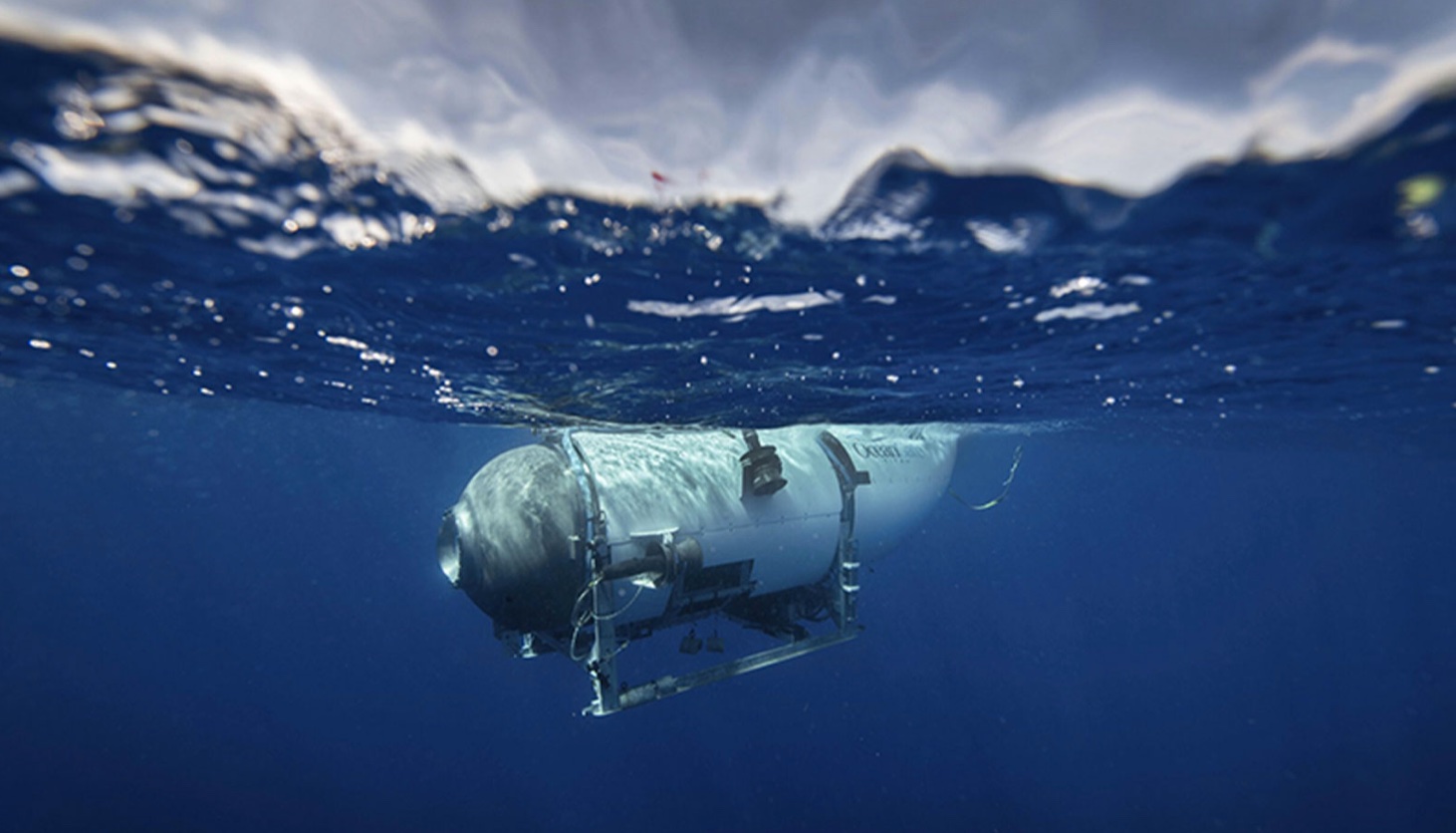
President Joe Biden was certainly made aware of the probable implosion on Sunday of the OceanGate submarine Titan during its descent to explore the Titanic wreckage. The submersible lost communication just two hours after it began its dive to the wreckage.

Despite this knowledge, President Biden appears to have deliberately withheld the information from the public, instead fostering hope for the rescue of the five individuals on board — at least until the Hunter Biden plea deal became part of the news cycle.

The truth was ultimately revealed by the Wall Street Journal, which reported today that a military acoustic detection system, designed to spot enemy submarines, detected what appeared to be an implosion only hours after the submersible began its ill-fated journey to the bottom of the sea.

According to U.S. defense officials who spoke to the newspaper, the Navy initiated monitoring for the submarine shortly after it lost communication. The acoustic detection system detected a suspicious sound near the debris site, which was ultimately discovered on Thursday.

While the Navy could not definitively confirm that the detected sound came from the OceanGate submarine, it played a pivotal role in narrowing the search area before the debris was located.

In a statement to newspaper, a senior U.S. Navy official explained, “The U.S. Navy conducted an analysis of acoustic data and detected an anomaly consistent with an implosion or explosion in the general vicinity of where the Titan submersible was operating when communications were lost.”

The Navy shared the information with the incident commander to aid in the ongoing search and rescue mission. Despite indications of a possible implosion, officials decided to continue their efforts as a search and rescue operation, in the slim chance that there were lives to save.

Meanwhile, all news reports throughout the week indicated that the people on board were alive and running out of oxygen, which would have occurred early Thursday morning — except that the vessel had, in fact, imploded days prior. The four-day saga captivated the attention of the world.

To safeguard national security concerns, the Navy refrained from disclosing the specific acoustic detection system employed, as it is typically utilized to identify enemy submarines. But officials would have at least notified the president, the commander in chief.

The official account from the White House and from the Coast Guard at the time were at odds with what they evidently knew to be true.

Biden was “watching events closely, ” the White House said Tuesday and National Security Council Coordinator for Strategic Communications John Kirby said the president wanted the Coast Guard to participate in search and rescue efforts. On Tuesday, Kirby said the US Navy was on standby “should they be needed because they have some deep-water capabilities that the Coast Guard wouldn’t necessarily have.”

The Coast Guard didn’t immediately respond to the Wall Street Journal’s requests for comment about what information it received, when it received it, and how it was used.

“Throughout the search, rescue crews detected several types of noises, U.S. and Canadian officials said, including the one suspected of being the sub’s implosion. An underwater implosion is the sudden collapse of a submarine when the tremendous pressure of the seawater overpowers the pressure inside the vessel and crushes it,” the Journal reported.

Searchers heard sounds similar to knocking from the vessel, but said they couldn’t conclude the noises came from the Titan.

But a U.S. defense official told the newspaper that “the analysis of the acoustic data was a significant factor in scoping the search area, and thereby enabling the assets on scene to locate the degree of the debris field.”

Since the the Navy said it shared its findings Sunday with the Coast Guard, it also would have shared them with the president.

“It looks that the Titan imploded on Sunday on its way down to the Titanic shortly after contact was lost at a depth of around 9,000 feet,” said a source said to have knowledge of the matter.

In 2020, OceanGate Expeditions CEO Stockton Rush, said that he explained that he preferred not to hire “50-year-old White guys” with military experience to pilot the submersible, which is steered with a $30 video game joy stick.

“When I started the business, one of the things you’ll find, there are other sub operators out there, but they typically have gentlemen who are ex-military submariners, and you’ll see a whole bunch of 50-year-old White guys,” he told Teledyne Marine in a 2020 Zoom interview, as reported by Fox News.

“I wanted our team to be younger, to be inspirational, and I’m not going to inspire a 16-year-old to go pursue marine technology, but a 25-year-old, you know, who’s a sub pilot or a platform operator or one of our techs can be inspirational,” Rush said. “So we’ve really tried to get very intelligent, motivated, younger individuals involved because we’re doing things that are completely new.”

On Thursday, OceanGate company issued a statement:

Statement from OceanGate Inc.

“We now believe that our CEO Stockton Rush, Shahzada Dawood and his son Suleman Dawood, Hamish Harding, and Paul-Henri Nargeolet, have sadly been lost. 

“These men were true explorers who shared a distinct spirit of adventure, and a deep passion for exploring and protecting the world’s oceans. Our hearts are with these five souls and every member of their families during this tragic time. We grieve the loss of life and joy they brought to everyone they knew.

“This is an extremely sad time for our dedicated employees who are exhausted and grieving deeply over this loss. The entire OceanGate family is deeply grateful for the countless men and women from multiple organizations of the international community who expedited wide-ranging resources and have worked so very hard on this mission. We appreciate their commitment to finding these five explorers, and their days and nights of tireless work in support of our crew and their families. 

“This is a very sad time for the entire explorer community, and for each of the family members of those lost at sea. We respectfully ask that the privacy of these families be respected during this most painful time.”


Seth Church appointed to Board of Regents

Gov. Mike Dunleavy has appointed Seth Church, a business entrepreneur from Fairbanks, to the University of Alaska Board of Regents. The appointment was announced
Thursday and is effective immediately.

Church launched his first business venture at the age of 17, and has spent the past two decades as a business owner, specializing in construction and real estate.

Church served on several influential committees and advisory boards, including as a member of the Alaska Juvenile Justice Advisory Committee, the Coalition for Juvenile Justice, and the Marine Transportation Advisory Board.

“The University of Alaska plays an essential role in equipping Alaskans with the skills they need to meet workforce demands. As a business owner, Seth brings a perspective to the Board of Regents that will ensure the University of Alaska is effectively preparing students for productive careers,” Dunleavy said.

Last month, Dunleavy appointed Tuckerman Babcock to another vacancy on the Board of Regents. Both appointments must be approved by the Legislature when it reconvenes next year.

Anchorage Assembly says no to the mayor again — this time denying him library board appointees

It’s Groundhog Day on the Anchorage Assembly. The ongoing clash between the Anchorage Mayor’s Office and the city’s Assembly reached a new level of intensity on Tuesday, as the Assembly rejected all three of the mayor’s nominees to the Library Advisory Board. This move follows a pattern of increasing hostility by the Assembly and the pattern of saying no to the mayor at every turn.

The rejected nominees include Leigh Sloan, an advocate for home-school learning; Jesse Moody, an employee at Global Credit Union; and Robyn Branson, a student success coach for migrants at Sand Lake Elementary. Sloan was also a candidate for the Assembly during the recent spring elections but lost to Karen Bronga. The refusal to confirm these individuals leaves the nine-member panel with four vacant positions.

At the heart of the conflict lies a dispute between left-leaning members of the Assembly and the Mayor’s Office regarding the presence of explicit material within the city’s public library, specifically targeting books accessible to children.

One controversial book in the Loussac Library Teen Underground, “Let’s Talk About It,” has particularly fueled the disagreement. The book, described as graphic, allegedly promotes sexual content and provides explicit instructions on sexual activities, including anal and oral sex. It gets around being labeled pornographic because it has drawings instead of pictures of the various sexual activities, many of which can lead to serious diseases. Democrats are pushing to keep this and similar titles in the library, and conservatives are trying to have them removed.

The Assembly has also stripped the Library Advisory Board of its ability to have books removed from the children’s section when they are clearly inappropriate for children.

The Assembly’s decision to reject the mayor’s nominees is seen as evidence of its disapproval of the current administration at every turn. By denying these appointments, the Assembly members are asserting their ability to hobble the mayor as he moves into a reelection cycle.

Simultaneously, the Assembly also has voted against all of the mayor’s proposed plans for addressing homelessness in the upcoming winter season. In a further display of obstinence, the Assembly refused to approve its own most recent plan, which aimed to provide housing for the chronically homeless in homeless tent cities and shack cities within Anchorage. As a result, the Sullivan Arena, a popular local venue, is expected to become a shelter for those who do not adhere to the rules set by other shelters around town. The Assembly is running out the clock on solutions of the homeless for the second year in a row.

Tuesday’s meeting left the Library Advisory Board shorthanded, and was a significant setback in the city’s efforts to tackle the challenges of homelessness. The inability of the Assembly and the Mayor’s Office to find common ground has become a running theme in Anchorage.

Mayor Bronson names Mario Bird as chief of staff

Mayor Dave Bronson announced that he named Mario Bird as his chief of staff. Bird had been serving as acting chief of staff since April. It is not a position that requires Assembly approval.

“Mario has served my Administration and the people of Anchorage incredibly well since joining our team a year ago. Through his measured approach, thoughtfulness, and dedication to making Anchorage a better place for the next generation I am confident in his abilities to excel as Chief of Staff,” said Bronson.  

“I am honored by Mayor Bronson’s confidence in me, and look forward to working with the Assembly and public to make Anchorage a safer and more prosperous city for all,” Bird said.

Bird was born in Soldotna and graduated from Nikiski High School. He is a graduate of the University of Notre Dame with a Bachelor of Arts in Film (magna cum laude).

He received his juris doctor from the Ave Maria School of Law (magna cum laude) in Naples, Fla. and served on the Ave Maria Law Review.

He has been a practicing attorney for 10 years. Prior to pursuing a legal career, he worked as a photographer and editor for the Alaska Channel and as a teacher and coach for Holy Rosary Academy.

Bird has served in the acting capacity since Adam Trombley left the municipality in April. When he first started in the Bronson Administration, he was named Municipal Attorney, but it became clear the leftist Assembly would not confirm him, and so the mayor brought him in as a senior policy adviser.

CDC panel advises RSV vaccine for those 65 years and older

The Advisory Committee on Immunization Practices, a panel of the Centers for Disease Control and Prevention, has recommended that the respiratory syncytial virus (RSV) vaccine be included in the list of recommended vaccines for all Americans aged 65 and over.

The panel voted 9-5 in favor of the recommendation, which also includes adults aged 60 and older based on individual needs and medical advise.

RSV is a common respiratory virus that affects almost everyone by the age of 2, usually causing cold symptoms.

It can be severe in newborns and young children, and can hospitalizations. According to data from the CDC, between 58,000 and 80,000 hospitalizations occur annually among children under 5 years of age due to RSV.

However, to put that in perspective, millions of children under the age of 5 are hospitalized each year due to various reasons and pediatric hospitalizations have been declining in recent years. Between 2004 and 2019, the number and rate of inpatient stays for children aged 0–17 years decreased by 20%, according to data from the U.S. government.

Before the RSV vaccines can be made widely available, the panel’s recommendation must be endorsed by the director of the CDC, which almost always occurs.

But this decision by the panel was not decisive. The vote falls short of the agreement the panel made last year on a vote to include Covid-19 vaccinations to the 2023 child, adolescent, and adult immunization schedule. That vote was unanimous.

The panel did not reveal why over one-third of its membership vote against adding the RSV vaccinations to the older adult schedule.

Win Gruening: Juneau’s 4th of July celebrates what’s good about America

By WIN GRUENING

Growing up in Juneau, and later when raising our own children, our family attended countless Fourth of July parades, patriotic celebrations, and picnics.  The holiday also continues to be a popular time for family and class reunions.

On the Fourth, it’s exciting to see the floats, some often funky, but always entertaining and patriotically themed.  Parades are a kaleidoscope of colors and sounds. Filipino and Native dancers often march along with political candidates of every persuasion vying for votes.

It is gratifying to see the pride in our country and share the good will with everyone.

Independence Day commemorates the Declaration of Independence, which was ratified by the Second Continental Congress on July 4, 1776, establishing the United States of America. No longer under the British monarchy of George III, our original thirteen colonies were now united, free, and independent states. 

The U.S. Congress made July 4th a national holiday in 1870. Before Juneau was even incorporated as a city in 1900, it joined other communities across America in celebrating the Fourth of July.

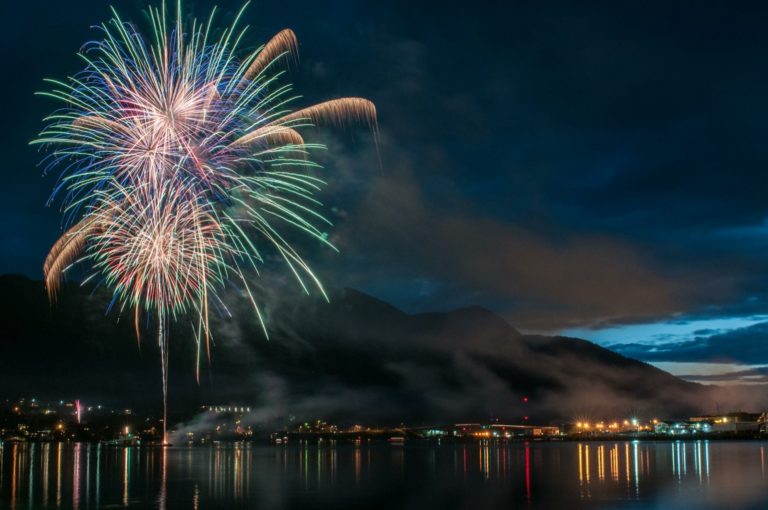
One of the most unique aspects of Juneau’s celebration is its fireworks display on July 3.  Legend has it that this tradition dates back to when the Treadwell Mine on Douglas Island was operating. Since the mine only shut down on Christmas and the Fourth of July, in order to allow miners a chance to enjoy the fireworks, the show was moved to a day earlier at midnight.

In the early mining days, celebrations occurred on each side of Gastineau Channel, when Douglas and Juneau were distinct cities. Festivities were varied and included many of the activities we enjoy today. Newspapers of the day published extensive schedules of events and reported even the most minute details on attendance, contest winners, and sports scores.

  • Douglas Island News – July 11, 1900

“A Glorious Fourth, Douglas Excels All Other Celebrations. Fine Weather. The Prize Winners” was the headline in the weekly edition of the Douglas Island News following the Fourth of July, 1900.  

The article included these descriptions: “About 3 o’clock on the morning of the nation’s birthday the little cannon which belongs to the Douglas City belched forth in mighty tones…at an early hour crowds of people in holiday attire thronged the streets. The men from the mines were out among the first…at 11, the tug-of-war teams began to gather and from that time until six o’clock the sports held the attention of everybody…the grand ball in the evening was the crowning feature of the day’s entertainment…the armory hall was beautifully decorated with boughs and bunting, flags and Japanese lanterns.”

  • Alaska Daily Empire July 3, 1913

“Douglas, July 3 – The Fourth of July program will begin at Treadwell tonight at 7 o’clock with the rock drilling contest…prizes will be $120 for the double-hand test and $60 for the single.” (Note: $120 in 1913 would be equivalent to about $3,500 today).

  • Alaska Daily Empire July 5, 1913

“The celebration of Independence Day in Juneau yesterday was marked by the attendance of enormous crowds…attendance at the baseball park was between three and four thousand…ferry service was overtaxed despite the fact three boats were on the run.”

In Juneau, activities and observances have grown even larger with the addition of June 14 Flag Day decoration contests in Douglas and Juneau Gold Rush Days, an event that commemorates Juneau’s mining and logging history.  

Fourth of July celebrations are an opportunity to appreciate the freedoms that Americans enjoy and express our gratitude to America’s Founding Fathers. America is not perfect, but it is always striving to correct its past mistakes in order to deliver on its promise of equal rights and opportunity for all.  In spite of our nation’s challenges, millions of people around the world still want to come to America. 

Perhaps now, more than ever, we can use the occasion of the Fourth of July as a time to reflect on America’s true gift – our commonality as Americans and Alaskans living in freedom. 

By doing so, the Fourth of July will remain a special Juneau tradition.

After retiring as the senior vice president in charge of business banking for Key Bank in Alaska, Win Gruening became a regular opinion page columnist for the Juneau Empire. He was born and raised in Juneau and graduated from the U.S. Air Force Academy in 1970. He is involved in various local and statewide organizations.

Downing: ProPublica is a political action committee posing as reportage

By SUZANNE DOWNING

ProPublica has launched a partisan “investigation,” this time targeting another conservative U.S. Supreme Court member. 

As if on cue, mainstream media outlets jumped on the bandwagon, relishing in the prospect of free content for their publications – content that undermines conservative jurists, and conservative lawmakers by association. This is purely political payback for the Dobbs decision of 2022.

The latest subject of the nonprofit’s assault is Justice Samuel Alito, author of the Dobbs decision, which sent the question of abortion rights back to the states, since the Constitution does not give that authority to the federal government.

Alito’s so-called transgression? A personal salmon fishing excursion to Alaska in 2008, which, according to ProPublica, was not duly reported in his disclosures. 

This ProPublica trophy is a minnow in the sea of things about which Americans are concerned. It’s dragnet “journalism” reminiscent of ProPublica’s recent attack on Justice Clarence Thomas. In that instance, the political action committee posing as a newsroom attempted to discredit Thomas based on the fact that a friend had purchased Thomas’ elderly mother’s home with plans to transform it into a museum.

With the anniversary of the Dobbs decision approaching, media outlets with a left-leaning bias increasingly utilize ProPublica as a source.

It must be repeated regularly that ProPublica is, at its core, a politically motivated group funded by Democratic billionaires with the clear mission of attacking Republicans. Thanks to the nonprofit’s partisan benefactors, the group has grown from a mere two-person operation in 2007 to over 100 today.

This ProPublica PAC, if we are to be honest about what it is, works hand-in-glove with a media that has not chosen to spend for its own investigative reporting. Theirs is a co-dependent relationship that leaves newsrooms compromised, because they are not looking behind the curtain at the organization providing them with “news.”

Let’s critically examine these ProPublica attacks. In the case of Alito, ProPublica emphatically claims that he failed to report a fishing trip with a billionaire in his annual disclosure form.

An important detail relegated to the end of the story is that another judge had previously sought advice from the Judicial Conference on whether to disclose a similar journey. The verdict was that it wasn’t necessary, as it was a personal trip. Alito was leaning on that decision. Despite changes to the rules since then, Alito was aware of the regulations in 2008 and understood what should and should not be included in his disclosure forms.

Moving on to ProPublica’s description of the “luxury fishing trip,” the King Salmon Lodge, while comfortable and pleasant, is far from opulent. It doesn’t feature a golf course or a day spa; it’s simply a lodge, whose upkeep in the harsh Alaskan environment is a costly endeavor. The rooms are spare, and the decor is woodsy, not ritzy.

The costs associated with running such lodges, in locations where all food and necessities have to be flown in, result in a nightly rate that reflects the high cost of living in Alaska’s wilderness. In four short months, lodge owners must make enough to keep the lodge in working order throughout the long, harsh winter.

Shifting to ProPublica’s ludicrous story about Justice Thomas, the supposed revelation was laughable. Thomas’ 94-year-old mother, who is a descendent of Gullah-Geechee slaves and for whom Gullah was a fist language, resides in a very modest house in Savannah, Georgia. The house and adjacent two lots, the equivalent of a side yard, were sold to a wealthy friend of Thomas’, who ProPublica insistently labels as a “GOP donor,” as if he personally donates to Thomas.

Then, ProPublica claimed that Thomas under-reported the value of the house on his disclosure forms back in 2009, when he valued the house at $15,000. A few years ago he sold the house to Harlan Crow, a friend of his, for $133,000. Thomas’ mom still lives there today.

Real estate values in Savannah have skyrocketed in the past 20 years, making this an underachieving fishing expedition by ProPublica. Thomas, who has been attacked by Democrats since the day of his nomination, merely needs to update his disclosure reports.

Here we have a political effort, paid for by the Democrat donors of ProPublica, to tarnish the reputations of both Thomas and Alito. ProPublica’s focus on their relationships with “GOP donors” and subsequent actions paints a biased picture, and is richly ironic, considering who funds ProPublica’s operation.

It’s time that when Americans speak the word “ProPublica,” they need to add “Democrat Political Action Committee” to the name.

Suzanne Downing is the publisher of Must Read Alaska, which was founded to balance the left-wing reporting in the mainstream media.