Home Blog Page 641

Biden breaks law, burns Alaska by booting oil development from ANWR

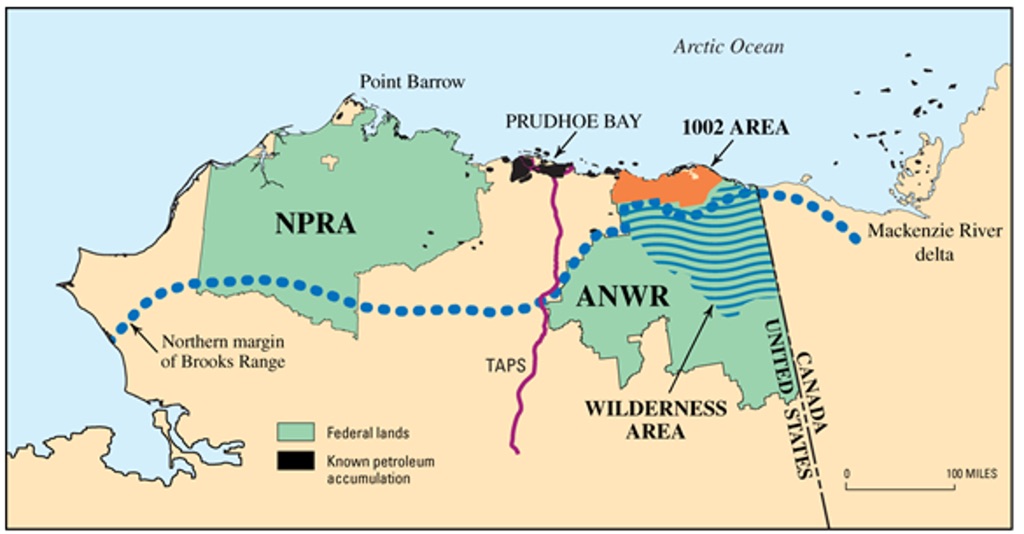
After a summer of sending a parade of cabinet members to tour Alaska, President Joe Biden today said he is canceling all of the oil and gas leases in the Arctic National Wildlife Refuge’s 1002 area, and also is shutting down development of the National Petroleum Reserve-Alaska.

Area 1002 was set aside by Congress for oil and gas production. In 2020, the Alaska Industrial Development and Export Authority bid on and was awarded land leases in the region, a lease that was part of the Tax Cuts and Jobs Act signed into law by President Donald Trump in 2017.

As a candidate, Biden promised to shut down oil and gas production on federal lands, including ANWR and the NPR-A, which meant destroying high paying jobs Americans and Alaskan families and communities would benefit from. 

Candidate Biden said that he is “completely totally opposed [to development] in ANWR. No more drilling on federal lands period!”

AIDEA said in a statement it will fight the Biden Administration.

“This latest action by the Department of the Interior shows arbitrary disregard for Federal law, based on campaign trail rhetoric. Campaign promises are not enough to justify this agency action. Under the law, Interior must present real facts and reasons that support this reversal in position,” AIDEA said in a press release.

“Interior’s action leaves AIDEA one choice, we have to go to court to protect our rights in the ANWR leases. This time, we will ask the court to allow us to conduct discovery that could include taking the deposition of Biden’s messenger, Secretary Haaland and possibly other administration officials involved so the real motives are made public,” the agency said.

AIDEA is owned by the State of Alaska and is run by a separate board of directors.

“The leases AIDEA hold in ANWR were legally issued in a sale mandated by Congress. It’s clear that President Biden needs a refresher on the Constitution’s separation of powers doctrine. Federal agencies don’t get to rewrite laws, and that is exactly what the Department of the Interior is trying to do here,” said Gov. Mike Dunleavy. “We will fight for Alaska’s right to develop its own resources and will be turning to the courts to correct the Biden Administration’s wrong.”

Rep. Mary Peltola put out a statement in opposition to Biden’s actions, although she was one of the first in Congress to endorse him for reelection and was rated the top conservation lawmaker by the League of Conservation Voters.

“I am deeply frustrated by the reversal of these leases in ANWR. This administration showed that it is capable of listening to Alaskans with the approval of the Willow Project, and it is some of those same Inupiat North Slope communities who are the ones that are most impacted by this decision. I will continue to advocate for them and for Alaska’s ability to explore and develop our natural resources, from the critical minerals we need for our clean energy transition to the domestic oil and gas we need to get us there. We can only get to that transition by listening to the people on the ground. Finally, we can’t keep erasing our progress with every administration. I will continue to advocate for permitting reform that includes predictable timelines from the federal government, which must be a reliable partner in leasing and developing our resources,” said Peltola, who is having a fundraiser in Juneau on Wednesday that features anti-Alaska-oil Rep. Eric Swalwell of California, who has long advocated for shutting down Alaska’s economy.

Sen. Dan Sullivan also spoke out against the decision: “Having just spent more than a month home in communities across our state, there is palpable anger and frustration among Alaskans about the Biden administration’s unrelenting assault on our economy and our ability to lawfully access our lands. This war on Alaska is devastating for not only Alaska but also the energy security of the nation. This unlawful cancellation of AIDEA’s ANWR leases today now brings us to 55 executive orders and actions specifically targeting Alaska since President Biden assumed office.”

Murkowski posted her objections, focusing on the shutdown of the NPR-A.

Deb Haaland, secretary of the Interior, said, in her announcement of the decision, “With climate change warming the Arctic more than twice as fast as the rest of the planet, we must do everything within our control to meet the highest standards of care to protect this fragile ecosystem. President Biden is delivering on the most ambitious climate and conservation agenda in history. The steps we are taking today further that commitment, based on the best available science and in recognition of the Indigenous Knowledge of the original stewards of this area, to safeguard our public lands for future generations.”

Drone expert Steve Colligan named to UA Board of Regents

2

Businessman Steve Colligan has been named by Gov. Mike Dunleavy to the University of Alaska Board of Regents.

Colligan is a long-time business owner with decades of professional experience in the public and private sectors. He has national and international experience specializing in Information Technology Integration, geographic information systems and geomatics.

A lifelong Alaskan, he holds an Associate of Applied Sciences degree in Petroleum Engineering Technology from the University of Alaska Fairbanks, Engineering Studies at UAF/UAA.

Colligan has decades of professional education and certifications in technology and project management.

He has been a pioneer in professional use of Unmanned Aircraft Systems and robotics for engineering design, infrastructure inspection and geomatic purposes. He has also been actively involved in STEM education in Alaska schools as president of the Alaska Drone Racing League and the Alaska Government Relations Coordinator for Academy of Model Aeronautics.

Colligan was born and raised in Fairbanks and lives in Wasilla with his family. His appointment is subject to confirmation by the Alaska Legislature.

Dunleavy appoints Ryan Anderson to Permanent Fund Board of Trustees

Gov. Mike Dunleavy appointed Department of Transportation and Public Facilities Commissioner Ryan Anderson to the Board of Trustees of the Alaska Permanent Fund Corporation. The appointment is effective immediately.

Mr. Anderson is a 24-year employee of the department. He was its Northern Region Director, overseeing design, construction, maintenance and operations of a transportation system that serve communities in a geographically and culturally diverse region that extends from the Gulf of Alaska to the Arctic Ocean, and from the Bering Sea to the Canadian Border. He earned a B.S. degree in Geological Engineering from the University of Alaska Fairbanks in 1997. He and family are from Fairbanks.

New education bills would block CRT, back parents

By CASEY HARPER | THE CENTER SQUARE

A new trio of House education bills would push back on Critical Race Theory and federal rules in local public schools, the latest in an ongoing battle led by Republicans to respond to curriculum and policy changes in education.

U.S. Rep. Bob Good, R-Va., introduced the three new education bills, including the Defending Students’ Civil Rights Act, which codifies that teaching CRT is illegal discrimination; as well as the Empowering Parents Act, which allows parents to hold schools accountable if those schools embrace more progressive racial or gender ideology in the classroom.

Good also introduced the Empowering Local Curriculum Act, which says schools receiving federal dollars cannot be forced to include CRT in their curriculum.

“These three bills would combat federal encroachment in curriculum, protect students from the harmful ideology of Critical Race Theory, and defend parents’ God-given right to educate their children,” Good’s office said.

CRT is an increasingly controversial set of ideas based on the idea that the U.S. is an inherently racist country and always has been and that the U.S. and its institutions can largely be viewed through that lens.

“Parents know what is best for their students and have primary responsibility for their children’s education,” Good said. “Local school boards should represent the will of the parents, not teachers unions, the Biden Administration or DC bureaucrats. I am fighting back against the Biden Administration’s overreach into the classroom with my back-to-school agenda that empowers parents, protects students from racist curriculum, and permits children to focus on their academic pursuits.”

The bills come amid a nationwide debate over the role of parents in their kids’ education. Parents have begun organizing and protesting at school boards, raising concerns about school curriculum and sexualized books in school libraries.

Those parents have often been brushed aside in recent years, sometimes caught on camera in videos that went viral and fueled the “parental rights” movement.

Democrats have pushed back, saying teachers know best what curriculum is needed and that the effort to ban books that Republicans say are age-inappropriate is a form of censorship.

In recent years, equity and CRT ideology in education has become increasingly common with billions of taxpayer dollars behind it.

House Republicans launched an inquiry last year after reports showed that federal funding passed for COVID-related student learning loss was spent to promote “equity warriors,” critical race theory teachings and more at local schools.

The Center Square previously reported on similar funding at the collegiate level. Federal grant documents show that the U.S. Department of Education awarded millions of dollars to a Florida-based education program that trains future educators and other professionals in CRT.

Another similar program, “The Research Institute for Scholars of Equity,” received millions of taxpayer dollars for training college students in critical race theory at several higher educational institutions.

Good is not the only lawmaker raising concerns about progressive ideology in schools and introducing legislation.

U.S. Sens. Marco Rubio, R-Fla., and Kevin Cramer, R-N.D., in July reintroduced the Protect Equality and Civics Education (PEACE) Act, a bill that would prevent tax dollars from promoting CRT within the Department of Education’s American history guidelines, which have increasingly incorporated those ideas.

U.S. Sen. Tom Cotton, R-Ark., has also introduced the Combating Racist Training in the Military Act as well as the Stop Critical Race Theory Act.

Good’s legislative effort has received support from several family and education groups.

“The Empowering Local Curriculum Act will end funding for schools promoting divisive ideologies like Critical Race theory that separate students into opposing categories of victims vs oppressors simply based on the color of their skin,” Terry Schilling, president of American Principles Project, said in a statement. “The Defending Students’ Civil Rights Act clarifies that position further by outlining how such a practice violates these children’s Civil Rights, an offense actionable by law. And finally, the Empowering Parents Act ensures that these children, their rights, and their innocence are being protected, not by a distant bureaucracy that can be bought out by well-funded organizations, but by those who have their best interests at heart: their parents.”

Matt Buckham, executive director for Institute for Educational Reform, backed the bills as well, calling out a recurring point of criticism: politicization of schools.

“Government teacher unions push the toxic political agenda of the Democratic party along with their radical lies through Critical Race Theory and woke ideology,” Buckman said in a statement.

Graphite One mine gets investment from major Native corporation

42

Graphite One Inc., a critical minerals mine in the planning stages that already has a major investment from the Department of Defense, has a new major investor: Bering Straits Native Corporation, which has committed up to $10.4 million.

This is not just an investment in Graphite One, it is a long-term investment in the region, the Native corporation said in a statement.

“We at BSNC have watched for years as Graphite One has worked to advance the Graphite Creek project and become a friendly neighbor in the region,” said Dan Graham, BSNC Interim President and CEO. “Graphite One has told us of its intent to develop an environmentally responsible project and provide an exciting economic opportunity for the region that hopefully will play a crucial role in the nation’s transition to a clean energy future. This is at the heart of our Board’s unanimous support of the project.”

Formed in 1972 under the Alaska Native Claims Settlement Act, BSNC is the regional Alaska Native Corporation for the Bering Strait region, which includes the Seward Peninsula in Western Alaska and the coastal lands surrounding Norton Sound. The Graphite Creek Project is located on state and private land in the BSNC region.

The Graphite One Project, an owner-operated, year-round truck-and-shovel operation situated near Nome, in July announced received a $37.5 million grant from the Department of Defense, which wants to source graphite materials from the U.S., rather than overseas.

A domestic supply is crucial for the production of large-capacity batteries used in various defense applications, the Defense Department said.

Graphite One plans to mine graphite from Graphite Creek and ship it to Washington State for processing. The project is still in planning and investment stages and not yet into the permitting phase.

Peltola brings in California leftist Rep. Eric Swalwell for Juneau fundraiser

Rep. Eric Swalwell, a strong opponent of the Alaska energy economic sector, will be a featured guest at a fundraiser for Rep. Mary Peltola in Juneau this week.

Swalwell will be joined by other Democrats — Rep. Mike Thompson of California, and Rep. Dan Kildee of Michigan.

Swalwell supported the senatorial bid of Alan Gross in 2020, and wrote that the Democrats could flip the Senate if Alaskans only voted for Gross, who ran against Sen. Dan Sullivan with the endorsement of the Alaska Democratic Party. He wrote a book about his role in the Trump impeachments. And he proudly sponsored H.R. 815, an attempt to repeal the Arctic National Wildlife Refuge oil and gas program and to designate approximately 1,559,538 acres of land within Alaska in the Arctic National Wildlife Refuge as a component of the National Wilderness Preservation System, which would violate the “no more” clause of the Alaska National Interest Lands Conservation Act, Section 1326.

The fundraiser is at a home in North Douglas Island, with a host of Juneau Democrats, including Sen. Jesse Kiehl, Rep. Sara Hannan, former Sen. Beth Kerttula, and various climate change activists and politicos.

Peltola won the special general election last August to replace the late Congressman Don Young, and then went on to win the November general election in 2022. She will come up for reelection in 2024 and will face Nick Begich, a Republican and the only candidate to challenge her so far.

Assembly to strip final $100,000 from homeless navigation center to pay for more help at sprawling encampments

55

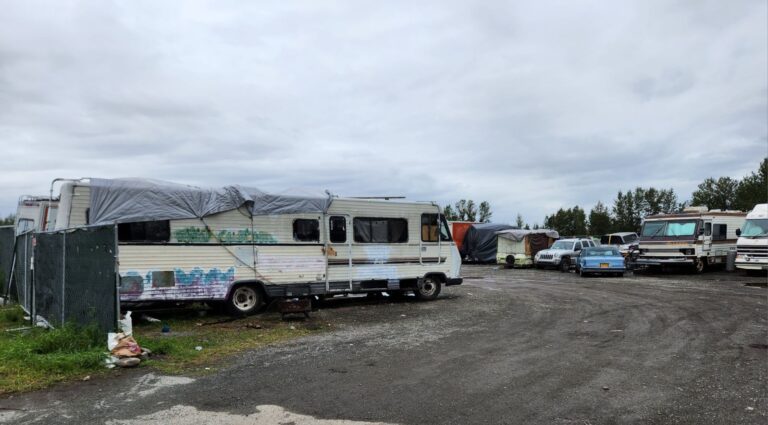
The Anchorage Assembly has a special meeting called for Sept. 5 to pass a resolution stripping $100,000 from the mayor’s navigation center, and reappropriate it to the Anchorage Health Department, Anchorage Police Department, and Anchorage Parks and Recreation to assist with mitigation at large vagrant and homeless encampments. 

Weeks ago, the Assembly sealed the deal, pulling its support for the navigation center, which was to be a place where drug addicts, homeless, and other people down on their luck could find help and temporary housing.

Mayor Dave Bronson negotiated the arrangement to pay for and build the navigation center with the Assembly’s appropriation, under a plan agreed to by him and the Assembly and signed off by both last year.

Other parts of the agreement included homeless hotels, which were a priority of the Assembly. But after the Assembly got the completion of its portion of the deal, it pulled out the support for the navigation center. Now, a massive sprawl of drug-infested camps have popped up around the city, with the homeless and vagrant problem worse than anyone has ever seen it in living memory.

The meeting has just the one item on the agenda unless another is placed “laid on the table” at the last minute. The special meeting will take place from 1-2 pm in the conference room #155 at City Hall, 632 West 6th Ave.

News-Miner eliminates Saturday edition, combines with Sunday

28

The Fairbanks Daily News-Miner eliminated its Saturday edition this weekend and moved to a weekend edition published on Sundays.

The newspaper is the latest to reduce its newsprint editions. It is now owned by the Helen E. Snedden Foundation, which purchased the newspaper in 2016. It remains the second-largest newspaper in Alaska, after the Anchorage Daily News, and is the farthest-north daily newspaper in America.

The announcement of the change was made in early August by Publisher Virginia Farmier, who is also the executive director of the Helen E. Snedden Foundation, nonprofit created in 2012.

The Fairbanks newspaper had $4,511,534 in revenues in 2020, down from $5,394,499 in 2019.

Earlier this year, the Juneau Empire, the third largest newspaper in Alaska, moved to a Wednesday and Saturday print edition. The Anchorage Daily News ceased printing a Saturday edition several years ago, and the Anchorage Press stopped print publication earlier this year.

Report: States with weak marijuana laws see more impaired driving

By CASEY HARPER | THE CENTER SQUARE

A new report found that states with less restrictive marijuana policies have higher incidents of residents driving while high.

A new report shows that states that have legalized or weakened restrictions around high-THC marijuana, either for medical or recreational use, saw 32% more marijuana-impaired driving than states that have not adopted the same policies.

According to the Drug Free America Foundation study, the 18 states with less restrictive marijuana policies have seen far more cases of impaired driving of this kind, something that medical research shows can be very dangerous.

“In 2017, eight states had adopted full recreational marijuana programs (Alaska, California, Colorado, Maine, Massachusetts, Nevada, Oregon, and Washington) and ten states had enacted higher-THC medicinal programs (Connecticut, Delaware, Florida, Illinois, Maryland, Minnesota, New York, Ohio, Rhode Island, and Vermont),” the report said. “Incidentally, seven of these states have since adopted full recreational programs. Adding to the concern is the fact that fatalities in the U.S. from marijuana-impaired drivers have risen dramatically between 2000.”

The report also points out that the potency of marijuana has skyrocketed in recent decades. This can lead to users taking in far more THC than they realize before getting behind the wheel.

“With these new products out there…especially with edibles and things, you might use one edible and not feel anything for the first 15 or 20 minutes, so next thing you know, you’ve eaten seven gummy bears or five cookies, and you don’t know when it’s going to hit you or how bad it’s going to hit you,” Amy Ronshausen, who leads DFAF, told The Center Square.

“And if that’s happening when you are behind the wheel of a car, that’s not a good thing,” she added.

Research from AAA and others has found that marijuana use significantly impairs drivers. On top of that, mixing alcohol and marijuana can create greater effects than either substance taken on its own.

“Research shows that marijuana can impair drivers in a variety of ways,” said AAA, which has conducted its own research backing this idea. “It can affect psychomotor functions such as attention, reaction time and coordination, but generally it appears to affect automated or routine driving more than tasks requiring conscious effort. Further, numerous laboratory-based studies have demonstrated that marijuana use impairs many aspects of cognitive and physical function that are necessary for safe driving.

“Marijuana can decrease car handling, can impair performance and attention while increasing reaction times, following distance and lane deviation,” AAA added.

Ronshausen said while most Americans are aware of the impact that alcohol can have on their driving, there is less awareness about the impact of marijuana.

“The general public, they see marijuana as somehow safer,” Ronshausen said. “We did a really good job at the ‘Don’t drink and drive’ message, but apparently we have not done as well of a job at the impaired driving message overall.

“You have a lot of people who haven’t really used marijuana since they were in college, and today’s marijuana is such a different product,” she added. “It’s such a higher potency. Like all drugs today, they are a higher potency and more pure…”

Ronshausen added people are often taking THC products that are far more potent than they realize.

“And there’s such a wide variety of products out there that do run the spectrum of potency, and with alcohol that’s more understandable,” she said. “You know that there’s going to be a difference between a glass of wine and Everclear, but when you are looking at these products, most people probably don’t look to see or even know, depending on how they are getting their product, what the potency is.”

Use among youth is also an issue.

“It is critical that these results impact future policy debates, especially since enforcement

data shows that between 11 to 23 percent of recreational marijuana sold ends up in the hands of minors,” the DFAF report said. “On top of that, consumption lounges, now legal in seven states (Nevada, New Jersey, New York, New Mexico, Illinois, Colorado, and California), and drive-up pot shops will keep spurring increased occurrences of marijuana intoxication and driving.”