Once the go-to-gal for the GOP, Sen. Cathy Giessel of South Anchorage was the darling of the Democrats on Wednesday afternoon.
She was the star of a reception with AFL-CIO Alaska President Joelle Hall, celebrating the movement of Giessel’s bill, SB 88, out of Senate Finance, which means it will get a floor early this session. Unions have flooded the Alaska Capitol this week to make sure it does keep moving.
Giessel is now the AFL-CIO’s water-carrier, at least in the Senate.
Sen. Cathy Giessel, left, is hugged by AFL-CIO President Joelle Hall for managing to get SB 88, defined pension plan for state employees, out of Finance Committee without adequate fiscal notes.
SB 88 is written for state and local public employees: “An Act relating to the Public Employees’ Retirement System of Alaska and the teachers’ retirement system; providing certain employees an opportunity to choose between the defined benefit and defined contribution plans of the Public Employees’ Retirement System of Alaska and the teachers’ retirement system; and providing for an effective date.”
While existing public employees would have the option of choosing between defined benefits (old-style pensions) and 401K contribution plans, anyone new coming into the Alaska State and teachers employment systems will go into the back-from-the-dead defined benefit program.
It would almost certainly put Alaska in the red and hurt its bonding capacity. Alaska is the only state considering going back to pensions, while other states are sunsetting them. The Alaska defined benefits plan was closed to new entrants in 2006, just before it collapsed under its own weight. States that have these public employee pension plans are going bankrupt.
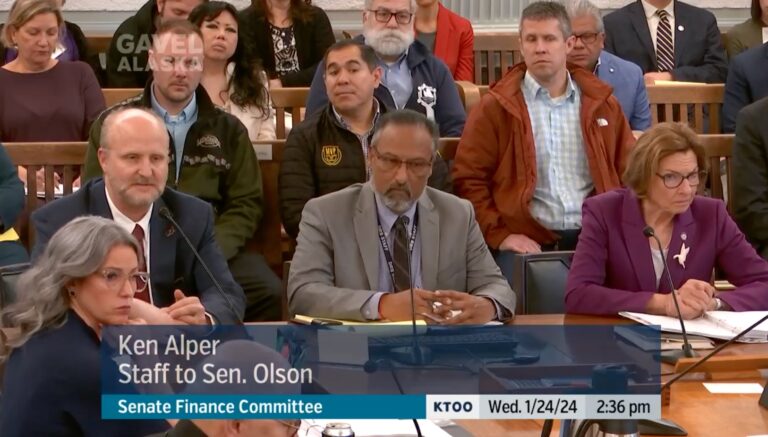
Sen. Burt Stedman pointed out in the committee hearing that the fiscal notes are inadequate.
“I’m just struggling here trying to figure out, because we’ve got dueling actuaries, and we’ve got these fiscal notes. What do we use for thes fiscal note? We should be able to — we’re dealing with 100,000 people, I think — we should be able to put a hopefully a finer point on it. I don’t know what documents to rely on,” he said.
There was dead silence for several seconds. Stedman was the senator who helped get rid of the old defined benefits program and he is co-chair of the Finance Committee, along with Sen. Click Bishop, who favors reviving defined benefits from its grave.
Olson, who was chairing the meeting, bought up to the witness stand his aide, Ken Alper, who has been trying to get an income tax passed on Alaskans and now is endeavoring to reinstate the costly defined benefit plan that would drive up the state’s retirement costs. He gave a lengthy soliloquy but did not answer the question of why the fiscal note was not ready.
Alper said there is a regular agency fiscal note, but that the fiscal notes attached to the actuary are dated May, 2023 and written for the Senate Labor & Commerce Committee’s version of the bill. He said it will be updated, but not until the Finance Committee votes the bill out of committee.
“Because of the nature of the analysis, it’s expected to take over a month,” he said. The sponsors had all summer to update it, but neglected to do so, evidently.
With 11 sponsors who are in the Senate Democrat-dominated majority, the bill will have passed the Senate and be in the House for consideration before the actuary fiscal note is ready.
The 11 cosponsors on the bill are:
Democrats: Senators Jesse Kiehl, Scott Kawasaki, Loki Tobin, Bll Wielechowski, Elvi Gray-Jackson, Forrest Dunbar, Matt Claman, Donny Olson
Republicans: Senators Cathy Giessel, Click Bishop, Gary Stevens
Audio is available for the Wednesday Senate Finance Committee deliberation and vote at this link.
Two days after Anchorage Mayor Dave Bronson officially filed with the Municipal Clerk’s Office, his name still does not appear on the website for the official list of candidates, a website managed by the Clerk, who runs Anchorage Elections.
Others who filed for the March-April ballot for various seats, however, are listed on the website.
For instance, Jennifer Wingard filed for Girdwood Valley Service Area – Seat A on Jan. 24. She appears on the candidate list. Joseph Connolly filed for Glen Alps Service Area – Seat E on Jan. 23, and his name appears on the list.
Frank Angela filed for School Board – Seat F on Jan. 23. He’s listed. So is Patrice Higgins, who filed for a road service board on Jan. 24, and Kristy Hoffman, who also filed on Jan. 24 for a road service seat.
In fact, none of the other candidates who have filed seem to have been lost in the shuffle at the Municipal Clerk’s Office; Must Read Alaska checks the filings daily and has spotted no other irregularities.
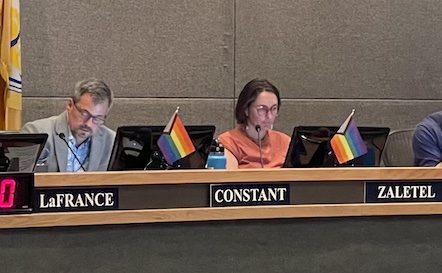
In Anchorage, the City Clerk reports to the Assembly, and the Assembly is headed by Chairman Chris Constant, who is a foe of Bronson. That may be the reason that Municipal Clerk Jamie Heinz is taking the slow lane on Bronson — Constant and several other members of the Democrat-majority Assembly have backed former Assemblywoman Suzanne LaFrance. LaFrance filed for office on Jan. 19 and her name appeared within a few hours on the list the clerk posts for the public on the Election website.
Bronson filed in the middle of the day on Tuesday, Jan. 23. As of Thursday morning, he does not appear as a candidate. Friday is the last day to file for Anchorage offices that will appear on the ballot being mailed to voters on March 13.
As of Jan. 25, the Municipal Clerk has not acknowledged that Mayor Dave Bronson has filed for reelection.
This comes at a time when the Anchorage Assembly has recently passed two ordinances aimed at putting a chill on election observers.
One ordinance, passed in December, makes the creation of a fraudulent public record a Class A misdemeanor. It’s aimed at election workers and volunteers. But there is no mention of not making a public record at all, such as appears to be the case in the Clerk’s Office when it comes to not letting the public know the mayor is a candidate.
The other ordinance, passed by the Assembly this month, sends a chill down the spine of volunteer election observers, who will now be subjected to vast subpoena powers that the Assembly just granted itself with the intent of forcing election observers, who are often present on behalf of a candidate or campaign to ensure fairness, to come before them and undergo an inquisition.
The two ordinances were designed to suppress oversight of the election process in Anchorage.
The oversight for elections will now primarily be the Assembly, with volunteers expressing fear that they might have to hire lawyers should they be subpoenaed.
And the Assembly chair, who is the direct supervisor for the Election Office, has endorsed Bronson’s leading opponent.
The mayor is on his way to Juneau on Thursday morning making the case to the Legislature for the need for funding for infrastructure like the port, and additional funding for homeless services. Must Read Alaska was unable to reach Bronson for comment.
The Alaska Railroad is acting as though they are property owners who can do as they please, simply by being one party to two party right of way (otherwise known as an easement).
Mr. Shively has either been misled, or mischaracterizes what the government sold, and what the Alaska Railroad got. The federal government did not introduce private property interests into the railroad right of way, the federal government sold the land, subject to, the railroad right of way.
What this means, is that the adjacent property owner owns the land to the centerline of the railroad tracks, and the Alaska Railroad has an easement on top of private land (Ninth Circuit Flying Crown). If the railroad stops railroad operations, the right of way, goes away (Brandt SCOTUS 2014).
It’s disingenuous and arrogant to represent that the Alaska Railroad was granted an easement 100 years ago without any specific purpose, and now the railroad can define what the easement is for, in its sole discretion. There is no other easement in existence like this in the United States, where the easement holder gets to determine what happens inside an easement, irrespective of the express written purpose between the parties.
The right of way was spelled out clearly in the original land patents (titles issued by the government) “and there is also reserved to the United States a right of way for the construction of railroads, telegraph and telephone lines in accordance with the Act of March 12, 1914 (38 Stat., 305).”
While the recent Ninth Circuit decision may have provided the Alaska Railroad with an “exclusive easement”, the court noted the easement passed over Flying Crown property, and exclusivity was granted for safety reasons, in the court’s opinion. Like Mr. Shively, I looked up the definition of “exclusive easement,” I came up with a thousand different sources, all stating the same thing: An exclusive easement grants the holder the sole right to use the land for a specific purpose. Mr. Shively evidently believes that includes any purpose.
The Alaska Railroad easement, granted in accordance with the latest railroad easement law at the time, passed in 1875. In footnote 4 of U.S. v. Union Pacific heard by the U.S. Supreme Court in 1957, the court noted that during congressional testimony on the 1875 Act, that Congressman Hawley said, “It simply and only gives the right of way. It merely grants to such railroad companies as may be chartered the right to lay their tracks and run their trains over public lands; it does nothing more.”
In the Brandt case on page 11, The U.S. Supreme Court noted that “only an easement for railroad purposes was granted.” Further on page 17 of the Brandt case, the court noted that “More than 70 years ago, the Government argued before this court that a right of way granted under the 1875 (Railroad) Act was a simple easement.
The Court was persuaded and so ruled. Now the Government argues that such a right is tantamount to a limited fee with an implied reversionary interest. We decline to endorse such a stark change in position………..”
Those court decisions seem a far cry from Mr. Shively’s position that “it (Alaska Railroad) controls the activities in that easement thus allowing it to charge for uses that are not directly tied to rail operations.”
Easements follow the title of the land. Changes to an easement cannot be made unilaterally by one party or another, or even new government laws created after the land was sold by the government. Rights are determined by the plain language of the easement itself.
In the case of the two directors mentioned by Mr. Shively, namely Mr. Reeves suing Mr. Binkley, in 2022 the State of Alaska Supreme Court stated clearly that “when an easement holder seeks to make changes to the land, the easement holder cannot go beyond the express purpose and parameters of the easement. Therefore, the easement holder-not the servient estate owner-was bound by the specific parameters of the easement.” That doesn’t seem to square up with Mr. Shively’s understanding of their easement.
What express purpose does “construction of railroads, telegraph and telephone lines” really mean? Is it as Mr. Shively contends that the Alaska Railroad “controls the activities in that easement thus allowing it to charge for uses that are not directly tied to rail operations and it can determine if a use interferes with its rights even if the entity is not the owner of the land involved.”?
Does that mean any third-party the Alaska Railroad determines gets to use the Alaska Railroad right of way, and they can charge for it? As a most absurd example, then, the Alaska Railroad could even permit and charge a third-party daycare center to operate in the Alaska Railroad easement in someone’s back yard, where that easement may partially be located but unused by the AKRR for railroad purposes, and the underlying land owner would not be able to stop the Alaska Railroad.
Let that sink in. Does that sound fair or neighborly? Maybe in California.
In a 2010 letter from then-Alaska Railroad Chairman John Binkley to Bonnie Wolstad, Mr. Binkley stated, “Unless and until the right-of-way ceases to be used by the State for transportation, communication, or transmission purposes (which is broader than railroad purposes) …….” it would appear Mr. Binkley clearly understood at that time that a railroad right of way was for “railroad purposes” and transportation, communication or transmission purposes was much broader than that. Mr. Binkley was right then, and it still applies today.
The generally accepted terminology for railroad purposes, has to do with railroad operations, which even the 9th Circuit Court of Appeals has partially defined in other railroad cases (specifically Barihona in 2018). In that case the Ninth Circuit listed tracks, rail ties, power lines, communication lines, fuel storage, freight warehouses, gas station and storage tank, in other words uses which are incidental to railroad operations. As long as the railroad used even a little bit of the proposed use for railroad purposes which they authorized a third-party to perform, the court considered it a railroad use.
Changes to a right-of-way (easement) requires the agreement and written consent of the underlying property owner, and the easement holder. Unilateral changes to an easement, by later U.S. laws, State laws, or city laws, or simply by occupation constitute a taking under the 5th amendment to the constitution.
The Alaska Railroad has transmogrified railroad purpose language of “railroad, telegraph and telephone” stated in the original patents (vested legal title), to Mr. Shively’s definition of “allowing it (Alaska Railroad) to charge for uses that are not directly tied to rail operations and it (Alaska Railroad) can determine if a use interferes with its rights.”
Well, Mr. Shively, what about the rights of the underlying and adjacent property owners? Mr. Shively’s definition conflicts with the express purpose of the easement language, and the current board member and former chairman John Binkley’s 2010 letter, and the Supreme Court of the United States, and the Ninth Circuit, and the Supreme Court of Alaska in Mr. Binkley’s case. Too many “ands” to be obvious, I guess.
Mr. Gimarc mentioned Fish Creek Trail and the Long Trail as future third-parties trying to slip into the Alaska Railroad easement as a permitted use. Neither of these uses have a railroad purpose (nor does a daycare), yet the Alaska Railroad thinks they can permit them to operate in the easement. Bicycle trails in railroad easements have been litigated in many courts in the lower 48. Bicycle trails have been determined to be complete changes to the express easement language.
In one case, Toews v. U.S. in 2004, the court stated “It is elementary law that if the Government uses (or authorizes the use of-a point to be considered later) an existing railroad easement for purposes and in a manner not allowed by the grant of the easement, the Government has taken the landowner’s property for the new use. The consent of the railroad to the new use does not change the equation-the railroad cannot give what it does not have.”
Further the court went on to state “And it appears beyond cavil that use of these easements for recreational trail-for walking, hiking, biking……………is not the same use made by a railroad, involving tracks, depots, and the running of trains. The different uses create different burdens.”
Mr. Shively’s contention that Alaska Railroad “controls the activities in that easement thus allowing it to charge for uses that are not directly tied to rail operations…” sounds a lot like “or authorizes the use-of-a point to be considered later” to me.
If it’s Mr. Shively and the Alaska Railroad’s contention, they can do anything they want in the easement they hold, simply because it’s an exclusive easement, it will throw easement law in Alaska into complete chaos. Imagine every utility company that has an exclusive easement, like Chugach Electric, Enstar, AWWU, ACS, and GCI licking their chops to rent out their easements to any Tom, Dick, and Harry they wish, even a daycare.
Respectfully, I think Mr. Shively, the board of the Alaska Railroad, and their management, should reconsider their position. Stating they have respect for their neighbors? I am their neighbor, and I say, not so much.
The Alaska Railroad management, and now apparently the board of directors, has transmogrified a simple easement, into “We can do any damn thing we want, and you can’t stop us.”
So, let’s see if the Alaska Railroad as Mr. Shively maintains, are truly fair and have respect for their neighbors. Here’s the challenge-allow our state courts to determine the nature of the Alaska Railroad easement, and rights between the Alaska Railroad and adjacent private property owners, with a jury of our Alaskan peers.
This has nothing to do with other railroads in other states, this has to do with the behavior of our railroad, operating in our state , with an easement that was defined with an express purpose close to 150 years ago, in lands sold by the federal government to our citizens over the last 100+ years.
Litigating through California, which seems hellbent on destroying the two once beautiful cities of Los Angeles and San Francisco by plunging them into lawlessness and chaos, doesn’t seem fair, or neighborly.
John E. Haxby is an Alaska resident for 50 years, engineer, land developer, investor, and AKRR neighbor.
Closing schools due to a lack of students can be very difficult for parents, students, teachers, and the community. But it is necessary to ensure that most of our dollars go into the classroom — where learning takes place.
The Anchorage School District has tried to close neighborhood elementary schools in the past year, but has faced strong opposition from parents.
Here is the Anchorage School District’s problem in a nutshell.
The total “program capacity” for elementary schools today would hold 26,432 students.
The actual number of students in 2022 was 19,484, a nearly 7,000 student excess capacity.
There is even a further downward trend in the future until the projected number of elementary students is 16,826 in 2027, nearly 10,000 students fewer than the district’s capacity.
How does the Anchorage School District close its excess school infrastructure and ensure that its resources go to the classrooms?
A great place to start is to look at school districts who have effectively done that.
In Colorado, Jefferson County (Jeffco) public schools has successfully closed 16 elementary schools and 4 more are to close next year.
Superintendent Tracy Dorland took her job seriously and made the decision to move forward. The Jeffco School District is larger than the Anchorage School District. Jeffco has 66,500 students with a building capacity of 88,000. Jeffco has 166 schools while Anchorage has 84 schools.
Superintendent Dorland faced many of the same push back from parents that the Anchorage School District faced. Some parents felt that the school was the center of their community and they even had gone to the same school that their children were currently enrolled in.
Many of these parents have an emotional connection to their schools and don’t want to lose that connection regardless of the impact on the Anchorage School District budget.
Some Jeffco parents threatened to remove their kids from the schools. Anchorage parents threatened the same last year.
The closing of a neighborhood school is an emotional event for many parents and students. They feel as if they have lost a “friend.” But military parents go through this every three to four years when they get transferred to a new state or even go overseas.
The younger elementary children may be the most affected emotionally, but they are also the most resilient and will quickly bounce back with new friends, new teachers, and other staff.
Closing a school requires an “All hands on deck” effort by the school districts. The staffs of the closed schools and the receiving schools must participate in helping parents and students with the transition.
The transition to the new schools should be as seamless as possible. The schools that are chosen to be closed must be shown to be surplus and the entire budget savings must be disclosed to the public.
Alaska school districts should not gather input from the community on school closures and then back off due to emotional appeals from parents.
This is what the Anchorage School District did in 2022 when it attempted to close 10 elementary schools. The district cannot keep kicking the can down the road as it did with its budget.
Perhaps the Alaska school boards could show a little chutzpah and actually do the work we are paying them to do. Enrollment is down; consolidation and school closures will save money. Kids will survive.
To commemorate the life of Alaska’s longest-serving congressman, Gov. Mike Dunleavy introduced legislation to rename the Fairbanks International Airport the “Don Young Fairbanks International Airport.”
HB 288(SB 202) honors Young’s lifetime of service to the State of Alaska and advocacy for the construction, maintenance, and safety of the state’s transportation infrastructure, the Governor’s Office said in a statement.
“Don Young’s passing may have marked the end of an era, but his impact will resonate for generations to come,” Dunleavy said in a statement. “The renaming of the Fairbanks International Airport is a fitting tribute to a man who championed the importance of Alaska’s transportation infrastructure and who’s advocacy is benefiting Alaskans and visitors every day.”
Don Young advanced transportation development while serving in both chambers of the Alaska State Legislature and throughout his tenure as the longest-serving Republican congressman in the nation’s history.
As a legislator, Young championed legislation to modernize Alaska’s air commerce system and require that aircraft be outfitted with radio beacon devices for emergency rescue.
In Congress, Young served as chair of the House Transportation and Infrastructure Committee and sponsored numerous bills to reshape infrastructure and safety requirements.
The Anchorage Assembly recently named the Port of Alaska after Don Young, at the request of Mayor Dave Bronson.
The Anchorage Assembly, on a vote of 10-1, decided to approve an extension of cold-weather shelter money for homeless, with the price tag of $2 million more.
Eagle River member Scott Myers was the lone dissenting vote against keeping the former Solid Waste Services building and other shelters open until late spring for the homeless who are hardest to help because of their behavioral issues.
Without the vote, the funds for the indigent, criminal, drug- and alcohol-abusing portion of the homeless population would run out before then, possibly by the end of this month.
With as much snow as Anchorage has accumulated and the time it will take it to melt, the cold weather could last into May.
Mayor Dave Bronson agreed that the shelters must be kept open. He said he had been working with the Assembly on the topic of the periods of deep snow and prolonged cold weather. “As we navigate these challenging weather conditions, I want to voice my strong support for funding the extension of the cold-weather shelter,” he said.
Some 51 people are known to have died in the outdoors in Anchorage in the 2023 calendar year, most of them homeless people with addiction problems. Anchorage temperatures this week are in the low single digits during the day and below zero at night, and by next week, expected to reach -13 at night as the state goes through a cold spell. Those who brave the cold in tents along trails and in greenbelts are experiencing cold-related injuries, such as frostbite.
The $2 million was not all. It was accompanied by a 10-1 vote to ask the Legislature for a $4 million matching appropriation to provide funds to keep the Anchorage shelters operating year-round, not just in cold weather. The Sullivan Arena, which was opened by former Mayor Ethan Berkowitz, has been returned to use as an event venue
The United Way of Anchorage in 2017 said that each homeless person in Anchorage was then costing the public about $60,000per year in public services, including temporary shelter, community services, emergency services, and health. From 2020 to 2023, taxpayers Anchorage spent more than $161 million on the estimated 1,760 homeless individuals, more than $91,000 per homeless person, according to figures from last year.
Former South Carolina Gov. Nikki Haley, defeated by former President Donald Trump in New Hampshire on Tuesday, has vowed to continue her quest for the Republican nomination in the 2024 presidential election.
The voters in the state she once led may be the last remaining hope. While Nevada is next for Republicans, Haley isn’t on the caucus ballot Feb. 8. That makes her home state of South Carolina next on Feb. 24.
“New Hampshire is first in the nation,” Haley said in remarks after Tuesday’s vote. “It’s not last in the nation. This race is far from over. There are dozens of states left to go. And the next one is my sweet state of South Carolina.”
In New Hampshire, Trump picked up 54.4% of the vote to Haley’s 43.3%. Trump is the first Republican presidential candidate to win Iowa and New Hampshire since the states became the first two on the primary calendar in 1976.
In a statement, Americans for Prosperity Action Senior Advisor Emily Seidel said the “results in New Hampshire show that Nikki Haley is closing the gap and that she is the clear alternative for voters who are ready to close the book on the toxic Biden-Trump political era.” However, she acknowledges it “is still an uphill battle.”
“Now all eyes turn to South Carolina, where she has a steeper road ahead,” Seidel said. Americans for Prosperity Action endorsed Haley.
Keith Nahigian, president of Nahigian Strategies, a Republican and a veteran campaign strategist, noted that South Carolina Gov. Henry McMaster, U.S. Sens. Tim Scott and Lindsey Graham and many of the state’s U.S. House members, all Republicans, have endorsed Trump.
“South Carolina is Trump country, and Nikki Haley would need to take it back from him,” Nahigian told The Center Square via email. “Haley would need a win in New Hampshire and then a win in South Carolina in order to keep moving to other states like Michigan and Nevada where she has even fewer resources.
“Losing will put real pressure on her to drop out,” Nahigian added. “Most of the Trump opposition candidates are young and don’t want to damage a potential future run for POTUS because they looked so beatable. They could live to fight another day.”
Zee Cohen-Sanchez, founder and executive director of Sole Strategies, which promotes Democratic campaigns, said New Hampshire’s outcome will influence voting in the South Carolina primary. Before the New Hampshire vote was finalized, Cohen-Sanchez said if Haley comes within 8-10 points of Trump, she is still viable and “has a chance to win South Carolina.”
However, “she will be seriously debilitated by the fact independents who can vote in the New Hampshire primary are not afforded the same rights in South Carolina,” Cohen-Sanchez told The Center Square via email.
“It definitely hurts her that South Carolina Senator Tim Scott endorsed Trump as did other prominent lawmakers,” Cohen-Sanchez said. “Her campaign funds are adequate, and if she can pull off the upset, she will be able to raise significant money from all the Never Trump Republicans.
“Still, it’s almost impossible for her to find a path to victory unless Trump has major health issues or decides to pull out, which is highly unlikely but statistically possible.”
Maybe it’s how they do things in Washington, D.C. these days. But in Alaska, it’s still against the law to campaign in a publicly funded school during school hours.
Rep. Mary Peltola launched her reelection campaign this week and wasted no time hitting the halls and classrooms of North Pole High School, where she invited students to take pictures with her and where she had in tow a camera crew of two to get campaign material for her fliers and website. She also had her campaign manager Anton McParland, who is also her official office’s chief of staff, making both an official salary of well over six figures and a substantial salary from the campaign.
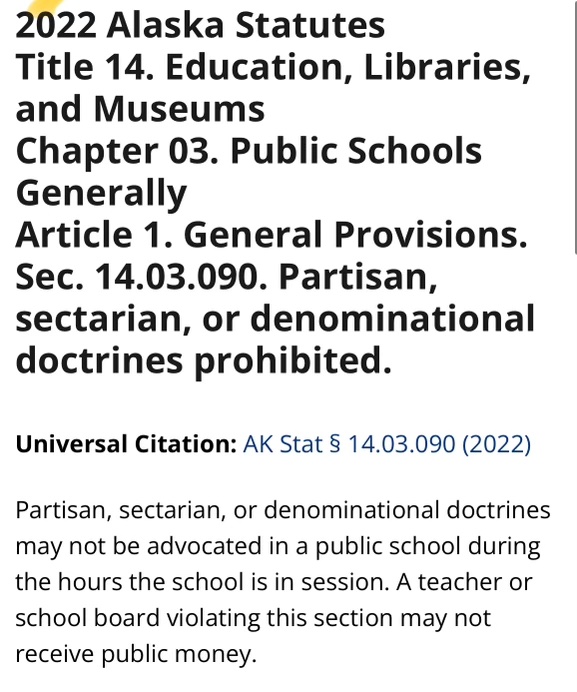
By Alaska statutes, she appears to have broken the law. Politicians are not allowed to campaign on school campuses during school hours.
The Democrat was accompanied by another Democrat candidate — Fairbanks North Star Borough mayoral candidate Grier Hopkins, who posted a photo to his campaign Facebook page of the two candidates, side by side, unabashedly campaigning during school hours. Although it was not his own campaign event, Hopkins was piggybacking on the representative and may have also been breaking the law, since he used the photo in his social media post.
The event was advertised for the school library, but the two politicians toured the school, popped into classrooms to talk to students and visited the automotive class, where Hopkins took the selfie.
Photo credit: Grier Hopkins for Borough Mayor Facebook page.
Alaska Statute says school districts that use their facilities for partisan activities during school hours shall be denied funding.
North Pole is a conservative stronghold in Alaska. Of the 6,256 votes cast in the U.S. Representative race during the general election in 2022, Peltola received 1,563.
Thus, it made no sense for Peltola to set up a meet-and-greet in the conservative town, but rather to take advantage of a captive audience of non-voters and their teachers during school hours, to emphasize her affinity for the National Education Association teachers union, which endorses her and provides her with substantial funding. The education industry represented her fourth-top source of campaign funds in 2022 and the NEA supported her campaign with $10,000.
Mayor Dave Bronson issued a veto for AO2023-133, an ordinance approved by the Assembly on Jan. 16 that gives the Assembly vast subpoena powers that include the ability to subpoena municipal volunteers.
Bronson said that he was concerned about overreach by the Assembly as well as the potential for weaponiazaiton of the subpoena authority.
Upon gaveling in at the regular Assembly meeting on Tuesday, the Assembly overrode the veto by a vote of 9-3.
Bronson said, “The Assembly subpoena process changes voluntary participation into mandatory participation—even in the face of citizen objection. Uncontrolled Assembly subpoena powers will create a chilling effect on citizen volunteers participating in their municipal government.”
The original subpoena power, enacted in the 1990s, referred only to municipal spending and policy. The new powers give the Assembly vast authority to subpoena volunteers on nearly any public matter. If a person refuses the Assembly subpoena, the Assembly can sue and have a judge force the person to appear before the Assembly.
Recently, the Assembly subpoenaed four people who were observers of the municipal elections.
“Citizen participation in Municipal governance is voluntary under normal circumstances. Citizens are encouraged to participate through their Community Councils, Boards and Commissions, public commentary at Assembly meetings, or by contacting their Assembly Member. The Assembly subpoena process changes voluntary participation into mandatory participation—even in the face of citizen objection,” Bronson wrote in his veto explanation.
“Uncontrolled Assembly subpoena powers will create a potential chilling effect on citizen volunteers participating in their municipal government. In a recent incident, four Anchorage residents were subpoenaed by the Assembly in relation to an election matter. Three of them sought legal representation, eventually persuading the Assembly to accept their voluntary appearance at a public meeting instead of a mandated one. For these citizens, the subpoena process itself became a form of punishment or penalty, and the broadening of this process raises deep concerns,” Bronson wrote.
“Moreover, critics argue that the expanded subpoena powers are unnecessary. The Municipality already has a prosecution department for handling misdemeanors. Ultimately, the additional financial burden falls on the Anchorage taxpayer. Because this ordinance allows the Assembly to mandate citizen testimony in an otherwise voluntary public venue, expands Assembly power to subpoena testimony and document production, and imposes additional financial burden on the Anchorage taxpayer, I hereby veto,” he wrote.
Assembly Chairman Chris Constant said the mayor had been giving bad information to the public about the Assembly’s push for subpoena powers.
“And I understand why he’s doing that, giving cover for the fact that we have had an experience where his administration has had actors who have done very abusive things to the public process and we have, in fact, needed to have their testimony so we could understand the genesis of the efforts that were undertaken by these individuals to, in effect, impune our elections, and overturn, effectively, our elections,” Constant said.
The new subpoena power by the Assembly is another step in its march toward taking away the power of the mayor’s office. The mayor and the Assembly represent two very different visions of Anchorage that are nearly always at odds.