Editor’s note: This opinion column first ran in the Wall Street Journal.
We are living in one of the most dangerous times since World War II, as Beijing, Moscow, and Tehran attempt to undermine the free world. Yet rather than maximize our nation’s strengths and weaken our adversaries, the Biden administration is doing the opposite.
Consider its policy on Iran. Under sanctions pressure from the Trump administration, Iranian oil exports in 2020 were at about 200,000 barrels a day, leaving Tehran with about $4 billion in foreign reserves, a small pool relative to the country’s size.
In an effort to appease the mullahs, however, the Biden administration hasn’t enforced comprehensive sanctions since 2021. As a result, Iranian oil exports today are at nearly 1.6 million barrels a day and its regime has been enriched by more than $70 billion. Iran uses this windfall in part to fund its terrorist proxies, including the Houthis, Hamas and Hezbollah. Iranian oil development also allows the regime to deepen its ties with China, which buys about 80% of Iran’s oil exports.
Meantime the Biden administration is doing the reverse at home—weakening America’s domestic energy production by restricting development on two important sites, the National Petroleum Reserve-Alaska and Alaska’s Ambler Mining District.
These measures are suicidal—and lawless. In 1980 Congress directed the interior secretary to “conduct an expeditious program of competitive leasing” in the National Petroleum Reserve-Alaska. The Biden administration is dramatically reinterpreting this law so it can treat those 13 million acres it is locking up as de facto federal wilderness.
The decision, ironically, ignores the desires of many in the Alaska Native community. Elected indigenous leaders from the North Slope of Alaska eight times have requested a meeting with Interior Secretary Deb Haaland to express their opposition to the administration’s new rule. Each time, they’ve been denied. It seems that the Biden administration listens to people of color and indigenous communities only if they align with the administration’s extreme antidevelopment policies.
Orin Seybert, founder, owner, and operator of Peninsula Airways took “his final flight west,” on Friday. He was 87 when he passed.
Seybert was a pioneer in developing the infrastructure and modern aviation transportation framework in Alaska today.
In 1955, Seybert started Pen Air in his home at Pilot Point, beginning with a 1946 Taylorcraft. Penair grew into the largest regional air carrier in the state and was in operation for 65 years. Penair began as a means for transporting local residents to hospitals for care that was unavailable in their communities.
“Orin was a true public servant in his service to his fellow Alaskans,” his family wrote.
Orin was a recipient of the Wright Brothers’ Master Pilot award as well as an inductee of the Alaska Aviation Hall of Fame, among many other accolades.
“He was a respected pilot and businessman who was lucky enough to find his true passion in aviation. He was known as the finest Grumman pilot in the world, and flew his widgeon to all parts of Alaska often times being the only airplane to fly into some of the most remote parts of Alaska. He truly was a legend,” his family said in a statement this weekend.
Later in life, Seybert had a personal passion for the Alaska Aviation Museum to succeed and took pride in helping it achieve growth. The museum showcases an important and unique side of Alaska’s history and development as a state.
“Orin left a tremendous impact on it. Orin was a great historian, who shared many stories, pieces of history, and aviation lore with the museum for preservation,” the family wrote.
“Orin was first and foremost a proud husband, father, brother, and grandfather to over 66 direct family members. He often laughingly joked at family events, ‘I am responsible for this mess.'”
He is preceded in death by his wife of 40 years, Jennie; and his children Andrew, Cecilia; brother Darryl, and mother Clarice.
The U.S. Senate is expected to ratify $95 billion in foreign aid after the House over the weekend passed major funding for Ukraine, Israel and Taiwan as well as a measure forcing Chinese-owned share of TikTok to be sold or the app will be banned in the U.S.
U.S. House Speaker Mike Johnson, R-La., pulled off the feat, but now he faces the fallout from his own party that could cost him his speakership.
The spending plan allotted about $61 billion for Ukraine, about $8 billion meant to bolster Taiwan and the surrounding region mostly from Chinese aggression, as well as about $26.4 billion for Israel, which is at war with terrorist group Hamas and has exchanged fire with Iran.
With every vote, Republican opposition to the Ukraine funding has grown louder, with many pointing out the southern border crisis goes unaddressed even as Ukraine gets more funding.
“Speaker Johnson proved today that the only border he cares about is Ukraine’s,” U.S. Rep. Marjorie Taylor Green, R-Ga., wrote on X, formerly Twitter, over the weekend.
Green has filed a motion to oust Johnson from the speakership.
“Those who voted to fund Ukraine’s borders instead of America’s KNEW for certainty that the separate (unattached to Ukraine) border security was going to die in the Senate, and are now dying for cover – so they’re casting blame,” Rep. Chip Roy, R-Texas, wrote on X. “Own it.”
Johnson said he cannot do his job while worrying about a motion to vacate, and some Democrats have suggested they would vote to save Johnson in the speakership, according to media reports.
“I’ve done what I believe to be the right thing…” Johnson told reporters.
Green told Fox News over the weekend that if Johnson doesn’t resign he will be vacated, but it’s unclear if she will make good on that threat.
Rep. Thomas Massie, R-Ky., has joined Green’s effort to vacate, but he also has called on Johnson to resign so that the motion will not have to be filed.
“This is the U.S. House of Representatives under the direction of Speaker Mike Johnson,” Massie said on X alongside a video clip of Democrats waving Ukrainian flags on the House floor. “Democrats are celebrating his total capitulation with no victory for securing our border.”
Massie also said “Democrats run” Johnson.
Johnson received praise from President Joe Biden after the vote and is expected to sign off on the spending if it makes it to his desk.
“I want to thank Speaker Johnson, Leader Jeffries, and the bipartisan coalition of lawmakers in the House who voted to put our national security first,” Biden said in a statement over the weekend. “I urge the Senate to quickly send this package to my desk so that I can sign it into law and we can quickly send weapons and equipment to Ukraine to meet their urgent battlefield needs.”
Frankly, I am surprised it took this long. On April 12, Superior Court Judge Adolf Zeman ruled that Alaska’s entire correspondence school program, currently educating over 24,000 children, is unconstitutional and must be thrown out entirely. The law, House Bill 278, was enacted in 2013. It took 10 years to mount an attack – a slow roll indeed.
I am not a legal expert and can’t predict how this plays out in the courts. That is for the highly competent lawyers and analysts who are surely pouring over this ruling right now and writing up their own articles. No, I must content myself with a plain, direct understanding of everyday human language.
The ruling hinges on one line in the Alaska Constitution: Article VII, Section 1 of the Alaska State Constitution which states: “… No money shall be paid from public funds for the direct benefit of any religious or other private educational institution.”
It appears that this line was flagged in 2013 and 2014 as problematic for HB 278 and would need “fixing,” but it never was. To me, a lot of interpretations of the words “direct” and “benefit” should be discussed. For example, the direct beneficiary of these public funds could be interpreted as the child getting a quality education, but that’s just my take.
If one had a hostile view of school choice and homeschooling, one could conceivably interpret that sentence as Judge Zeman has interpreted it and throw out the whole system – an outcome even the plaintiffs appeared to recoil from.
But again, I am not a legal expert, and that side of the debate will be ‘front and center’ in the coming months or years.
What I am an expert on (expertise gained empirically, as my grandfather would chuckle) is the public debate that is about to erupt. You can’t throw 24,000 children’s educational foundation down the nearest drain without causing a ripple – the school choice debate is about to break wide open in Alaska. You are about to see editorials, opinions, articles, and the filth that is the comment section of any online platformed source. We will likely see some national coverage, with talking heads shouting from both sides of the aisle, who will all work themselves up, and … well, we know how it goes from there and it won’t be pretty.
This won’t just be a discussion about allotments. To fix this, if it is upheld on appeal, will likely require some sort of Alaska Constitutional remedy. Barring that, possibly legislative implementation language that supersedes judicial parsing of original intent would be in order. And that means that not only will allotments be on the table, but the entire school choice/homeschooling policy of Alaska. Everything is about to become fair game.
So, how should homeschool advocates approach this? I may not have the whole campaign plan, but I have a starting suggestion. Let’s refuse to answer the one question we love to talk about. The one question that drives the heart of every school choice/homeschooler out there. That one question that everybody around us is sick of hearing us rant about. The one question that will be used to separate, divide, and conquer us individually.
That one question: “Why do you homeschool?”
Don’t answer that question. Not in the comments section of social media, not to news reporters, not in articles, not in blogs.
Do. Not. Answer. That. Question!
Why? Because when we start answering why we homeschool, we are giving our opponents the key to dividing us. Maybe one parent lives off-grid and there is no public school available. Our opponents answer: “Fine, we can force students who live within X-distance from a school to attend. Now prove to us where you live and why you can’t get to a public school. If we agree on a plan, fill out this application in triplicate and we’ll proceed with losing your paperwork and … bureaucracy takes over!”
Maybe a parent is concerned with preserving their child’s cultural heritage? Their answer: “Great! We can give people with approved heritages permission to homeschool and the rest can enroll where we tell them to go.”
Maybe a parent has a moral, ethical, or philosophical reason. Their answer: “Sorry, doesn’t fly. But the rest have ‘our’ permission”.
When we start communicating our reasons, we are seeking justification–giving other people permission to agree or disagree with our reasons. And that agreement / disagreement will be used to split us, divide us, mold and shape us.
We have a right to homeschool, enshrined in the Alaskan constitution. Acknowledged in multiple U.S. Supreme Court cases (Meyer v. Nebraska and Farrington v. Tokushige, for example), we don’t need a ‘reason’ and we don’t need anybody to agree with our “reason.” Do not give your reasons, whatever they may be.
Agent Smith of the Matrix kept asking: “Neo, why do you persist?” Any answer would have been attacked, ridiculed, logic-ed away.
Why do I homeschool? Because I choose to.
What do we discuss, if not our reasons for homeschooling? Answer: Focus the debate on allotments.
The topic of allotments is the Achilles heel of our opponent’s attack. Alaska is so remote, so huge, so flung out, that we simply can’t build and staff enough schools to provide a ‘brick-and-mortar’ schoolhouse for every child. It simply cannot be done and to try is wasteful beyond reason.
Thus, some form of remote education MUST be provided for. Per-student allotments — about $3,000 per child per year –seems like a lot of money re-directed from the public education system until we consider how much a borough school district keeps per student.
Last I looked, the school system receives around $18,000 per child per year in Alaska. Subtract the $3,000 that goes to the allotment if that child is homeschooled, and the school system retains the remaining $15,000 and yet doesn’t incur the cost of educating that child. That $15,000 goes directly into the public school system with no additional student cost. One less student in the already overloaded classes. One less student taking up resources.
We hear opponents of school choice argue that the fixed costs are being forfeited. This is a fallacy. The net gain to the school (the $15,000 not transferred as an allotment) far exceeds the per-student fixed cost.Read here for more on this here).
If a student is removed from the correspondence school system, dropped from the roll call and disappears back into private homeschool—which will happen—the entire $18,000 will be lost to a district. This is a likely outcome in Alaska where many of the homeschoolers actually can’t attend public schools, and the remaining likely won’t, regardless of the existence of an allotment.
The Bottom Line: Allotments retain and attract students into the school system, and they actually are a net financial gain for the public school system. Instead of resisting traditional schools, homeschool parents have a reason to engage. These alone should be more than sufficient debate fodder for those who are unsure about the benefits of granting allotments.
Eric Carter has served for 23 years as a Navy submarine officer and is currently in the Reserves. He has a masters of teaching degree from UAA, an engineering degree from Oregon State University and homeschools his 6 children.
The ice on the Tanana River is thinning, but the tripod at Nenana still stands. Breakup might be a few days later than normal this year for the Nenana Ice Classics ticket holders.
As Alaska braces for the annual spring breakup, the National Weather Service has issued a comprehensive forecast indicating a dynamic season ahead. With temperatures expected to remain below normal, particularly in the western regions, and a robust snowpack persisting across northeastern and western Alaska, the stage is set for a potentially eventful breakup period that could include flooding.
Conditions hint at a dynamic breakup in certain areas, and forecasters note that the circumstances are not as favorable as the preceding year’s historic breakup season.
The 2023 season was characterized by numerous significant ice jams and snowmelt floods across the Interior. The potential for localized flooding remains contingent on air temperatures staying cold through the end of April and into early May.
Dynamic breakup, distinguished by cold early spring air followed by rapid warming, could be compounded by above-average headwater snowpack and river ice thicknesses. This type of breakup typically moves downstream in a somewhat linear fashion and is more prone to ice jam flooding.
Ice thickness across the state is reported to be near normal as of April 1, with certain regions exhibiting above-average snowpack. Notably, the Porcupine, Yukon, Lower Kuskokwim, and Copper basins are experiencing well-above-average snowpack levels. However, the interior snowpack is notably less compared to the past two years.
The North Slope region, in particular, has witnessed record-breaking winter precipitation, indicating an above-average snowpack north of the Brooks Range. Conversely, observations in Southcentral Alaska indicate a mix of normal and above-average snowpack levels.
Looking ahead, the climate outlook for the coming weeks suggests a transition from enhanced ridging to moderate troughing over the eastern Bering Sea and Arctic Ocean, potentially leading to below-normal temperatures in the western half of the state and above-normal temperatures in eastern Alaska.
As breakup timing is evaluated based on historical median breakup dates and current conditions, forecasters anticipate breakup to occur slightly later than usual, with western and southwest Alaska expected to experience a delay of 1-4 days.
The National Weather Service underscores the importance of vigilance and preparedness in the face of potential flooding risks. Village flood potential assessments are continuously reassessed based on evolving outlooks and conditions, with the Experimental Product providing detailed estimations of snowmelt runoff volume, flood potential, and forecast breakup dates for various locations across the state. More information is posted at https://www.weather.gov/aprfc/breakupProducts.
The next Spring Breakup Outlook will be published by NWS on April 26.
A coalition of 21 Republican attorneys that includes Alaska Attorney General Treg Taylor has asked a federal judge who ruled against Texas to reconsider in a lawsuit filed over of Department of Homeland Security Secretary Alejandro Mayorkas’ parole policies.
In March, U.S. District Court Judge Drew Tipton of the Southern District of Texas Victoria Division ruled that a coalition of 21 attorneys general led by Texas didn’t have standing to sue. The parole program they sued over is among over a dozen that House Republicans identified as illegal and used as evidence to support their charge to impeach Mayorkas.
In the lawsuit, 20 states argued Mayorkas created an “illegal visa program” to allow up to 30,000 Cubans, Haitians, Nicaraguans and Venezuelans to enter the U.S. a month who otherwise would not qualify under current law.
Mayorkas has argued he has “discretion” to create this and other policies; House Republicans argued he doesn’t. The coalition also argues he doesn’t and sued, saying that Congress authorized parole only “for foreign aliens who meet very specific standards that have not been met in this instance. Yet, contrary to existing law, the program creates a pathway for program participants to apply from their home country and gain lawful status to enter and stay in the U.S. for up to two years, or even longer.”
Florida also sued over this parole program and others separately; two cases are on appeal before the 11th Circuit Court.
The coalition argues that Tipton “applied the wrong standards in evaluating standing,” “engaged in an impermissible accounting exercise,” and “impermissibly evaluated facts occurring after the complaint to find a lack of standing,” among other arguments.
“Most fundamentally, the Opinion applied the wrong standard to determine whether the Plaintiffs had demonstrated that Texas had standing to challenge the CHNV Program,” their motion states.
Texas has suffered an injury, the coalition argues, because state and county funds are spent on illegal foreign nationals to cover health care, education and other welfare benefits they receive. The judge referred to data provided by the Biden administration claiming less illegal foreign nationals entered Texas, ruling that Texas hadn’t suffered an injury and therefore lacked standing.
The coalition pointed to a Fifth Circuit argument that “rejected the relevance of these overall numbers: ‘[F]or purposes of standing, the inquiry is whether the [challenged agency action] caused Texas to have to incur additional financial, law enforcement, and welfare costs, not whether there were generally more enforcement actions year-over-year in the midst of a historic immigration crisis.’”
Attorneys general joining Texas in the coalition represent Alabama, Alaska, Arkansas, Florida, Idaho, Iowa, Kansas, Kentucky, Louisiana, Mississippi, Missouri, Montana, Nebraska, Ohio, Oklahoma, South Carolina, Tennessee, Utah, West Virginia, and Wyoming.
The Biden administration has argued in the multiple lawsuits filed against it that the states suing don’t have standing. Last July, the U.S. Supreme Court ruled that Texas and Louisiana didn’t have standing to challenge another Mayorkas policy that effectively ended most deportations of illegal foreign nationals.
In response, Republican U.S. Reps. Chip Roy of Texas and Dan Bishop of North Carolina filed a bill to give state attorneys general standing to sue the secretary of Homeland Security when the federal government refuses to enforce federal immigration law.
Their bill was similar to one twice filed by U.S. Rep. Bill Posey, R-Fla., which would grant states the authority to enforce federal immigration law when the federal government refuses to do so. Florida Attorney General Ashley Moody also led a coalition of 26 state attorneys general calling on Congress to pass it.
Join host John Quick as he delves into the life and music of Zak Kirkpatrick, a fourth-generation Alaskan, whose journey from boat deckhand to licensed captain is as riveting as his soulful melodies.
In this episode of the Must Read Alaska Show, Kirkpatrick shares insights into his unique upbringing and the influences that shaped his musical career against the rugged backdrop of Alaska’s wilderness. Kirkpatrick was born and raised in Juneau and developed his brand of Alaska-themed indie-country music from a young age.
Zak Kirkpatrick
Discover what ignited Kirkpatrick’s passion for music and how his experiences working on boats and guiding through glacier wilderness informed his creative process. Gain valuable advice as Kirkpatrick offers pearls of wisdom for aspiring musicians looking to navigate the unpredictable waters of a music career.
“Gonna give Rich Men North of Richmond a run for its money!” commented one listener of his new song, “The Outlaws Might Save Us.”
From his humble beginnings to becoming a beacon of inspiration for fellow Alaskans, Kirkpatrick’s story is one of resilience, determination, and an unwavering commitment to his craft. Tune in to explore the melodies of the Last Frontier and embark on a musical journey unlike any other with Zak Kirkpatrick on the Must Read Alaska Show.
It’s been eight years since the Alaska Republican Party has had an in-person state convention during a presidential election year. The 2020 convention was held on a Zoom call due to the Covid pandemic, and, as with others around the country, was only memorable because it was forgettable.
In those eight years, the party has churned through four chairmen — Peter Goldberg, Tuckerman Babcock, Glenn Clary, and Ann Brown.
This year, the election of party officers was electrifying in that it trended younger. A new generation is taking over. At the Hotel Captain Cook in Anchorage, where some 300 delegates gathered this weekend to conduct party business, the younger generation answered the call to serve.
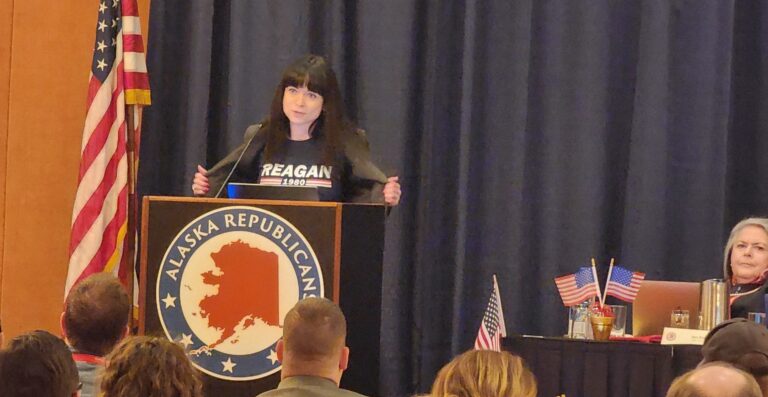
Anchorage Republican Women’s Club President Judy Eledge hugs new Alaska Republican Party Chairwoman Carmela Warfield, wearing a Ronald Reagan t-shirt. Warfield was five years old when Reagan was president.
The candidates for the chairmanship included Nikki Rose, who was the first of the four to declare her intention to run for chair last fall. Others were Carmela Warfield, party Vice Chairman Mike Robbins, and a few weeks ago former state Sen. Jerry Ward declared his nomination. But Carmela Warfield won in a landslide, with about 59% of the vote.
Warfield is 49 years old, one of the youngest party chairs to preside over the Alaska Republicans in years. She is a veteran of volunteer work at the grassroots level, and as a member and president of the Hillside Community Council. She is 20 years younger than outgoing Chairwoman Ann Brown and immediate past chair Glenn Clary. While Brown has been in party leadership for a decade, Clary left the state for career opportunity, allowing Brown, then vice chairwoman, to become chair for the past three years.
Zackary Gottshall, the newly elected vice chairman, is also a quarter century younger than outgoing Vice Chair Robbins, now in his 60s. Gottshall is a veteran of the U.S. Army, in which he served as an intelligence officer. He is the chairman of the Alaska Human Rights Commission. He’s newer to party politics, where Robbins has been involved for years, and was the inaugural chairman for the Trump victory party in 2016 in Washington, D.C.
Trevor Shaw of Ketchikan, who was elected as Alaska Republican Party secretary, is 28, having been born when Democrat Bill Clinton was president. Shaw has been serving as the party’s assistant secretary, and served as parliamentarian during the two-day convention. Shaw has been involved with the Republican Party for a decade and was once the youngest elected member of the Ketchikan School Board.
Brian Hove, the new National Committeeman, is a decade younger than outgoing committeeman, former Lt. Gov. Craig Campbell, who has served for the past two years after the retirement of Mike Tauriainen. Hove has been the party’s regional representative for the Region 4-Anchorage of the ARP and is on the State Executive Committee.
Cynthia Henry of Fairbanks, National Committeewoman for the past decade, was not challenged for her position, and will continue serving on the RNC. She will provide the continuity and historical perspective for all the young Republicans emerging in party leadership roles.
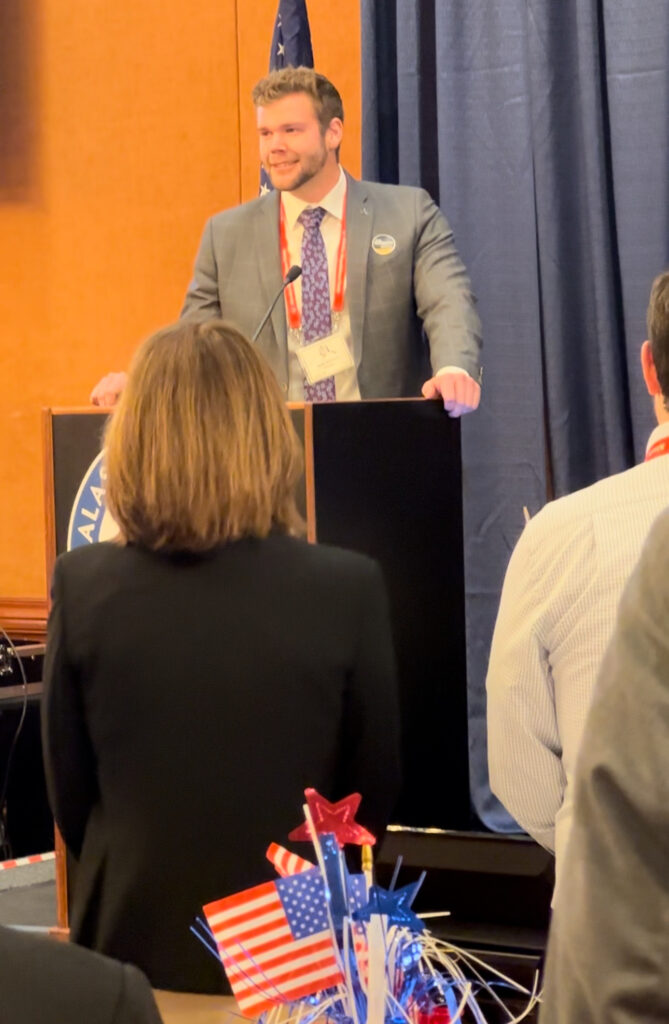
Ryan Sheldon, chair of District 30, led the convention in singing the Star Spangled Banner and the Alaska Flag Song at the Alaska Republican Party’s 2024 convention.
The youth movement was characterized by Talkeetna resident Ryan Sheldon, who is related to former party vice chairman Frank McQueary. Sheldon, 25, led the room in the singing of the National Anthem and the Alaska Flag Song at the outset of the convention, wowing the crowd with his confident and tone-perfect performance.
Sheldon is the newly elected chair of the District 30 Republicans. His district stretches from Port MacKenzie to Healy and Anderson. Overheard among convention-goers were comments about Sheldon being a rising star in Alaska politics, someone who has what it takes to make a great governor some day. Sheldon led the Campaign and Finance committee at the convention and will be involved in fundraising going forward.
Jason Warfield, husband of Chairwoman Carmela Warfield, stepped down as Finance chairman but he will raise money for candidates and will stay involved.
Kevin Fimon, longtime campaign treasurer for candidates such as Gov. Mike Dunleavy, is the new treasurer for the party, replacing Rhonda Boyles, who will serve as assistant treasurer.
Ryan McKee, of Alaska Young Republicans, is the new Finance chairman. He has been leading the state’s grassroots youth efforts in Alaska for a decade, beginning with College Republicans, Anchorage Young Republicans, and Mat-Su Young Republicans. He also was state director for Americans for Prosperity and serves on the national board of Young Republicans.
The Saturday keynote speaker was Nick Begich, candidate for U.S. House, and he was another example of the younger generation of the Alaska Republican Party who are ascending.
Begich, 46, received an overwhelming level of support from the convention, with people cheering and clapping repeatedly during his 45-minute address and question-and-answer period, all given without notes or script.
The youth movement at Alaska Republican Party convention included young parents and their children.
Nancy Dahlstrom, Alaska’s lieutenant governor, age 66, had been the keynote speaker on Friday night, and was received with a polite and respectful response from the party, even though she is endorsed by House Speaker Mike Johnson, Majority Leader Steve Scalise, Gov. Mike Dunleavy, and others.
The convention positive energy was exemplified by Nick Begich at the Alaska Republican Party convention, as members of the convention wore Begich campaign hats and pins during the entire three days.
The convention approved the slate of 29 delegates who will attend the Republican National Convention in Milwaukee, Wisconsin in July, where Donald Trump will presumably be formally nominated as the party’s nominee.
Those delegates include: Cynthia Henry, National Committeewoman, Craig Campbell, National Committeeman, Sheryl Yelsley, Barbara Tyndall, Cheryl Markwood, Patty Wise, George Hall, Kevin Hall, Leona Oberts, Robert Wall, Bryan Scoresby, DeLena Johnson, Earl Lackey, George Rauscher, Robert Hall, Ryan McKee, Dave Bronson, Dave Donley, Dawn Linton Warren, Jamie Allard, Jason Warfield, John Powers, Loran Baxter, Mikaela Emswiler, Portia Erickson, Robin Billet, Tetyana Robbins, and Zack Young. If any of those cannot attend, there are alternates in the queue. Chairwoman Warfield is an automatic delegate as well.
Portia Erickson will chair the Alaska delegation to Milwaukee.
Portia Erickson, who is vice chairwoman of Anchorage Republican Women’s Club, is the delegation chairwoman. Trevor Shaw is the aide for the delegation going to Republican National Convention.
Trevor Shaw will be the delegation aide to Milwaukee.
Also chosen during the convention were the three electors for the Alaska Republican Party. Those are the three who will cast the Electoral College vote for Alaska, after the November election is certified. The electors are Ron Johnson of the Mat-Su Valley, Rick Whitbeck of Anchorage, Eileen Becker of Homer, and alternate elector Gloria Shriver of Anchorage.
The delegates on Saturday voted on numerous resolutions that came out of committees that had met the day before. They included everything from the sanctity of life to the support for commonsense energy policy.
ARP Chairwoman Carmela Warfield said the positive energy that built during the convention was one of its most notable characteristics.
“I feel like we’ve worked hard to bring our young Republican alongside our more experienced Republicans to bring our party together and move into the future,” she said, adding that one of her goals when she ran for party chair is to follow President Ronald Reagan’s 11th commandment: Thou shall not speak ill of a fellow Republican.
From her website set up earlier this spring to promote her candidacy for chair, Warfield says, “The Alaska Republican Party must focus its efforts to expand its reach and membership, including recruiting new and younger members who share our core values and principles …”
On Sunday morning, Must Read Alaska reached out to Warfield, who expressed her appreciation for everyone who participated in the convention and said that she will work hard to bring the party together in a positive way.
Alaska Republican Party convention delegates elected a new slate of leaders at its convention in Anchorage this weekend. The new officers are:
Chair: Carmela Warfield of South Anchorage, who won overwhelmingly in a race that had three other candidates that included Jerry Ward, Nikki Rose, and Mike Robbins.
An enthusiastic crowd welcomes the new Alaska Republican Party Chairwoman, Carmela Warfield, who won by a landslide on April 20, 2024 in Anchorage.
National Committeewoman: incumbent Cynthia Henry, Fairbanks.
National Committeeman: Brian Hove, Anchorage, replacing outgoing National Committeeman Craig Campbell
Secretary: Trevor Shaw, Ketchikan
Assistant Secretary: Cheryl Markwood, Fairbanks
Over 300 delegates have been meeting for two days at the Hotel Captain Cook to vote of platform and resolutions, rule changes, delegates to the Republican National Convention, and to hear from candidates for Congress Nick Begich and Nancy Dahlstrom.