After a successful convention with Alaska Republicans, congressional candidate Nick Begich changed clothes and headed to the airport, destination: Kodiak.
From there, Vertigo Air transported Begich to the Uyak Bay area, where he had a tag to hunt Kodiak brown bear. He was accompanied by friend Pat McCollum of Wasilla, husband of Mat-Su School Board member Kathy McCollum.
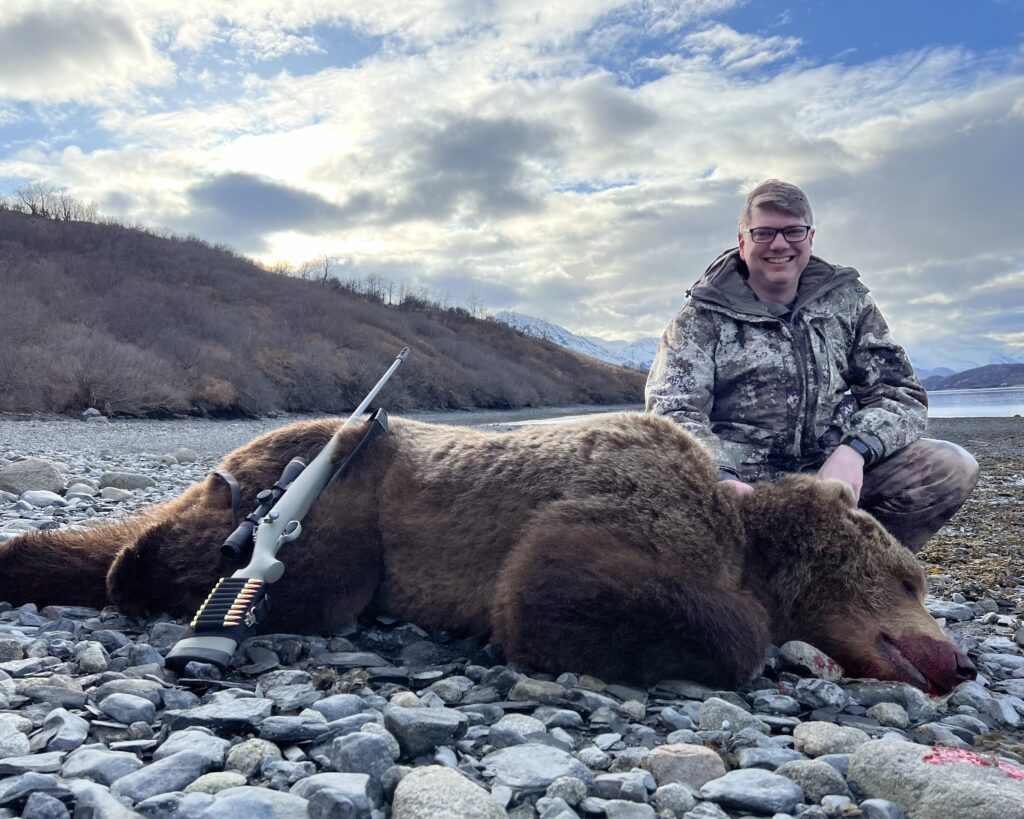
The next day, Begich bagged a Kodiak bear, taking the shot at about 100 yards. One shot took the bear down instantly, hitting right at the shoulder.
Nick Begich and the Kodiak brown bear taken this week in a successful hunt.
After having the hide and skull checked by Alaska Department of Fish and Game personnel, who removed a tooth and hair samples for a long-term study, the bear was “sealed” legally and upon returning to Anchorage, Begich took the hide and skull to famed taxidermist Dan Williams in the Mat-Su Valley.
Begich said he used a Kimber Montana .300 Win. Mag., using Nosler 190-grain, AccuBond long-range, trophy-grade ammunition.
He then returned to the campaign trail, preparing for an event at Bell’s Nursery on Tuesday evening in Anchorage.
A Kodiak brown bear hunt is often a once-in-a-lifetime opportunity and for many hunters represents the pinnacle of the sport.
“I’m proud to live in a state with such abundant wildlife resources. It’s critical that we maintain our hunting opportunities in the years ahead through proper game management, conservation, and maintaining access to public lands. Alaska truly is The Great Land!” Begich wrote on his Facebook feed.
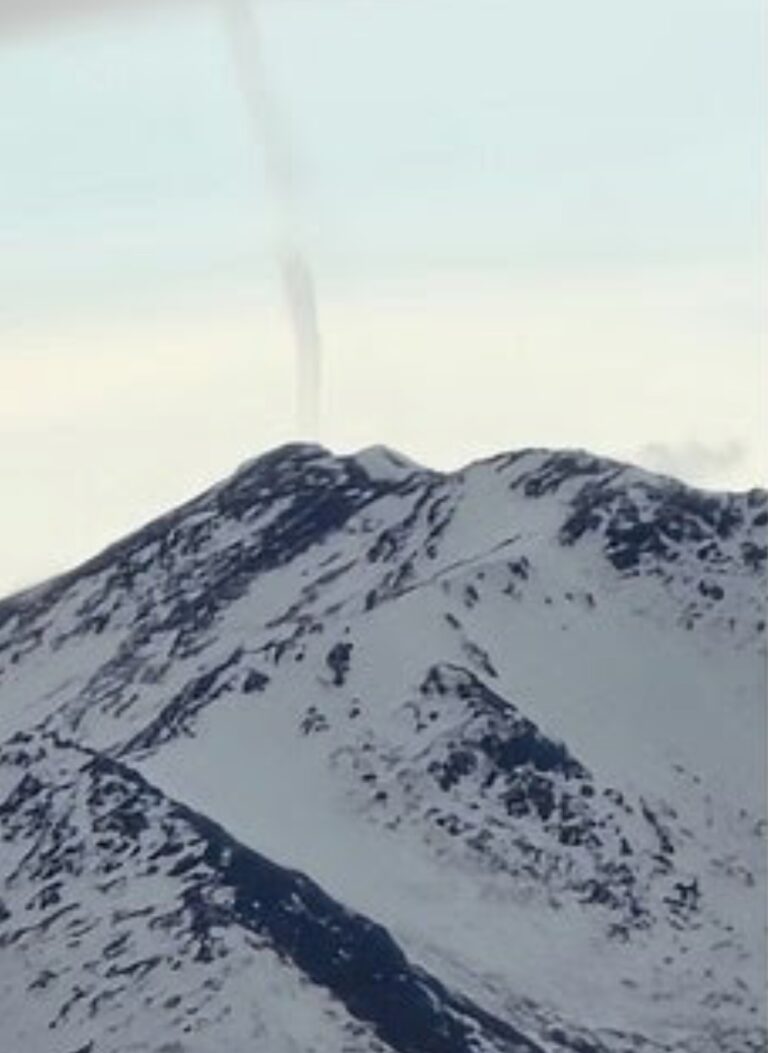
It happens rarely in Alaska, but on April 20, a land spout tornado was spotted at the 3,500-foot level near Wolverine Peak in Chugach State Park.
Photographs by Geremy Clarion were distributed by the National Weather Service Anchorage and the National Oceanographic and Atmospheric Administration, which verified the atmospheric event. It may be the fifth recorded tornado since statehood, according to some reports.
The World Meteorological Atlas says that snownados are “very rare”, particularly in lowland areas, but are occasionally seen in mountains, which are subject to more complex wind patterns. In Alaska’s vast mountainous landscape and small population, a brief tornado would not be easy to spot, much less capture by camera lens.
A snownado occurred in the Shetland Islands of Scotland last year and was captured on video, seen at The Weather Channel.
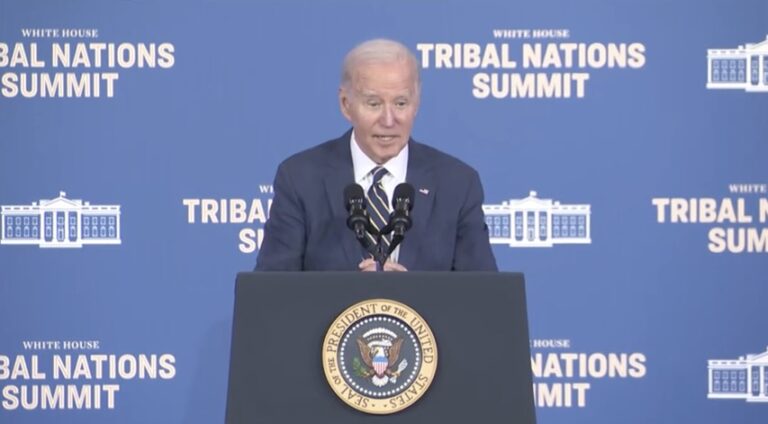
From the frequency of the attacks, one would think President Joe Biden has a personal vendetta against Alaska. In reality, he’s just trying to do anything he can to live at 1600 Pennsylvania Avenue for another four years. Even if that means continuing to harm the people of my state.
As Earth Day approached, Biden took three substantial actions in the two weeks prior — all targeting Alaska’s resource base. Recent polling shows young, climate-obsessed voters between 18-29 abandoning the president in droves, with the gap between he and President Trump down to 13 points, from a 30-point advantage at this time in 2020.
Those voters’ collective shrills have railed against the very few Biden decisions to allow traditional energy projects to move forward, including the Willow oil and gas development in Alaska. Something had to be done to help bring them back, so Team Biden went into action.
To begin with, in a game of “pass-the-buck,” the U.S. Army Corps of Engineers rejected an appeal from the Pebble Mine’s developers April 15, deciding instead that the Environmental Protection Agency’s (EPA) 2023 veto of the project’s clean water permit was an action they couldn’t overturn.
Pebble is a copper, gold, molybdenum and rhenium asset that is housed completely on Alaskan land. It would bring up to 1,000 full-time jobs to an area of the state that seasonally has unemployment numbers averaging more than 10%. The economics of the mine – worth $350-500 billion in 2008 dollars and market conditions – could approach $1 trillion with today’s increased mineral prices. It has been fought for nearly two decades by environmental organizations, who will now see how the legal battle over Pebble will play out in federal court.
Then, the Department of Interior announced April 19 that it was making permanent the September 2023 temporary ban on all types of development for over 13 million acres in the National Petroleum Reserve-Alaska (NPR-A), an Indiana-sized part of Alaska’s North Slope, and the home to many of its more recent oil and gas finds.
Even before that announcement, Alaska’s bipartisan Congressional delegation, the Iñupiat Alaska Natives who live across the North Slope and the Alaska Legislature had tried to make their case for removing the protections. Nonetheless, with the decision, the vocal minority opposing NPR-A development won, and Alaskans lost.
That’s a whole lot of canceling for Alaska, especially when you consider much of it is for the components Biden needs for his green transition.
Doubling up on bad news for Alaska, the Interior Department administratively reversed course on a previously-approved 211-mile road to Alaska’s Ambler Access Project, showing they are simply anti-production.
Why else kill access to the Ambler Mining District, a federally authorized area known for decades to hold massive amounts of copper and other minerals needed to”go green?” Talk about a cancel culture.
From the day Biden assumed office, Alaska’s resource industry has been a key target of the his administration, with over 60 administrative and executive orders, or one action less than every three weeks in his term.
The actions have shuttered congressionally-approved projects from Alaska’s North Slope to its Southeast panhandle. They’ve put thousands of existing Alaskan jobs at risk, with thousands more potential ones placed in limbo. In fact, the only thing Joe Biden will mine in Alaska is feeble credibility with his green friends.
Between the NPR-A opportunities, Pebble and Ambler’s proposed projects, well over 5,000 jobs are now lost to Joe Biden’s pandering. But an equal number of climate-centric voters could have been even more disillusioned with the president during a key stretch of his reelection campaign, and right now, they’re more important than jobs, revenues and energy security.
Too bad the president would rather win an election than do what is right for Alaska and America.
Rick Whitbeck is the Alaska State Director for Power The Future, a national nonprofit organization that advocates for American energy jobs and fights back against economy-killing and family-destroying environmental extremism. Contact him at [email protected] and follow him on X (formerly Twitter) @PTFAlaska.This column first appeared in The Daily Caller.
The DC-54 aircraft that crashed on Tuesday seven miles from the Fairbanks International Airport was a Douglas 54-D Skymaster, owned and operated by Alaska Air Fuel, and operating as a bulk fuel cargo plane.
The plane was en route to Kobuk with 3,200 gallons of heating fuel when a wing caught fire and the engine exploded midair, shortly after takeoff. The pilots attempted to return to the airport when the plane crashed and an explosive fire consumed the wreckage and fuel along the banks of the Tanana River, which is still frozen.
Both occupants — pilot and co-pilot — are presumed dead. The names of the souls onboard have not been released; their remains will be sent to the State Medical Examiner’s Office for identification.
The tail number of the plane is N3054V. The aircraft is known to have had Pratt and Whitney R-2000 engines.
The plane crash is seen in a video that was posted online by a farmer at Rosie Creek Farm, who had a security camera mounted in such a way that it that caught the event.
Security camera shows cargo plane crash near Fairbanks, Alaska, killing both pilots pic.twitter.com/8mWUEXd6ws
Listen to the Fairbanks International Airport control tower audio of the takeoff communications and then hear the pilots and air controllers respond as the disaster unfolds at this link, where at minute 1:12, a voice can be heard saying, “Tell ’em I love ’em, man, tell ’em I love ’em.”
The National Transportation Safety Board will release a preliminary report 30 days after the accident, and a final report within one to two years.
When I last wrote about Huna Totem Corporation’s cruise ship dock projectin November, over four years had passed since the Juneau subport property on which the project was to be located was purchased by Norwegian Cruise Lines. Over 15 months had passed since Huna Totem Corporation took over the project, now named Aak’w Landing. Numerous studies, public meetings and permitting steps have transpired in the interim.
Now, as Aak’ Landing final approval inches closer to the finish line, the Juneau Assembly seems reluctant to commit its support and the naysayers have gotten more shrill.
After spending millions of dollars and years in the process, how much longer will the sponsors of the project be required to wait?
In August 2023, the Juneau Planning Commission authorized a conditional use permit for the dock project as well as approving a permit for the uplands improvements.
Shortly thereafter, Juneau resident Karla Hart appealed the Planning Commission decision citing inadequate public outreach and incomplete study and analysis. The Assembly agreed to accept the appeal and hired a hearing officer to adjudicate the case. More delay ensued when Hart objected to the appointment of the hearing officer who was eventually replaced.
Hart, a long-time anti-cruise activist, has made news before. In 2021, she filed a ballot petition that would have banned large cruise ships from coming to Juneau. The action would have resulted in, according to some estimates, a 74% decrease in cruise passengers and an annual loss of $162 million to Juneau businesses.
The petition failed to garner enough signatures to qualify for the ballot.
But Hart hasn’t given up. She recently filed another petition to ban large cruise ships from Juneau on Saturdays and the 4th of July. But, not to worry because, as her group held a rally in Marine Park in early April to “greet” the first cruise ship of the season, Hart was quoted in the Juneau Empireas saying, “We’re not against anything…”
A decision on Hart’s appeal could be forthcoming during a scheduled Assembly meeting and executive session on April 29.
The recent welcome news that the US Coast Guard will homeport an icebreaker in Juneau has complicated the process in some people’s minds. Even though the icebreaker’s arrival is years away and faces additional planning and funding issues, it has been raised as another excuse for activists to justify delaying dock approval.
However, it appears that Coast Guard and cruise ship activities are compatible, and that the adjacent NOAA dock provides more than enough room for the proposed icebreaker.
So, the process grinds on as city officials seem hesitant to give the project the priority it deserves.
Most significantly, the Assembly has continued to drag its feet on a decision to approve a lease of the city-owned tidelands that Huna Totem will need for the project.
The Assembly recently added another layer of bureaucracy to the process by realigning internal municipal responsibilities to allow supervision over cruise docks to the tourism director. Nevertheless, in removing the responsibility for reviewing the tidelands lease from the Docks and Harbors department, where it traditionally has resided, the Assembly now has the direct obligation to expedite the process. Any conditions the Assembly considers necessary can be included in the tidelands lease. There’s no reason to delay further deliberation and a decision on the lease.
The importance of this project cannot be overstated. The community’s aging and declining population signal problems ahead. Juneau’s cost of living is still a deterrent to would-be job hunters. Plummeting student populations have forced the Juneau School District to close schools and trim expenses.
To reverse these negative trends, Juneau’s economy must grow to spread the tax burden more widely and provide more jobs for young working families.
While homeporting an icebreaker in Juneau will help, it won’t be nearly enough. Juneau needs the potential economic stimulus and tax revenues the $150 million private investment the Aak’w Landing project will bring to the community.
The irony is that the Aak’w Landing dock will actually help mitigate downtown congestion and reduce ship emissions, all with no increase in the number of large ships now visiting Juneau.
Isn’t that what the anti-cruise crusaders want?
After retiring as the senior vice president in charge of business banking for Key Bank in Alaska, Win Gruening became a regular opinion page columnist for the Juneau Empire. He was born and raised in Juneau and graduated from the U.S. Air Force Academy in 1970. He is involved in various local and statewide organizations.
In this episode of the Must Read Alaska Show, host John Quick welcomes Jubilee Underwood, a dedicated Matanuska-Susitna Valley resident and school board president, as she shares her journey from local advocacy to political candidacy.
Underwood discusses her successful efforts to end mask mandates for children just two months after joining the school board and reveals her motivations for running for the state House of Representatives. She offers invaluable advice for anyone considering a entering the arena of public service, emphasizing her interest in establishing term limits and representing community values.
“It really was the most comfortable and fun interview I’ve done so far,” Underwood said after the show. “It was like talking to a friend, just like a living room coffee chat.”
Tune in to hear how Underwood champions conservative values, fiscal responsibility, and the voice of the people in her pursuit to enhance the economic health and prosperity of Wasilla, Alaska, and beyond.
Whether you’re a local resident or interested in grassroots political movements, this episode provides a firsthand look at effective community leadership and the power of civic engagement.
To celebrate Earth Day, Rep. Mary Peltola touted Alaska getting $125 million out of a $7 billion grant package from the federal government for solar energy development. It was an infinitesimal win in a sea of losses handed to her and Alaska from the Biden Administration.
“Investing in energy projects across the board–solar, wind, hydro and more–lowers utility bills for Alaska families and creates new jobs!” said Peltola. “I’m proud to have advocated for this funding and to be able to bring it home to our Alaska.”
The amount Alaska is getting is 1.78% of the entire solar federal grant award, which will be used to put solar panels on low-income government-subsidized housing and to add solar capabilities to villages for spring, summer, and fall seasons, when the sun is available to them.
That comes down to a benefit of about $170 in federal grants per Alaskan, but the project is going to Alaskans who, by and large, do not pay taxes. The money is going to rural Alaska and government housing projects, but coming out of the pockets who work and pay federal taxes.
The solar grants were announced just a few days after the Biden Administration took final action to shut down 13 million acres of the National Petroleum Reserve Alaska, and after Joe Biden also announced his administration will not allow a right-of-way through federal land to access state mining claims near Ambler.
If this was the show “Let’s Make A Deal,” then Alaskans would the proud owner of a toaster instead of a new Camaro.
The Ambler Mining District is an area rich in the minerals needed to make clean energy products such as solar panels.
The mine construction alone would have provided 2,777 direct jobs and $286 million in wages annually, with another 2,034 indirect jobs with $108 million in wages annually. Once operating, the mine would provide 495 direct jobs with $72 million in wages annually and another 3,434 indirect jobs with $228 million in wages annually.
The right-of-way construction would have provide 360 direct jobs and 81 jobs for road operations for the operations and maintenance of the road.
The solar panel project that Peltola is heralding will provide tens of jobs and most of them out of state.
The panels will be constructed out of state, shipped to the state and installed by experts from out of state or from Anchorage. Maintenance on these rural projects will be provided by out-of-state or Anchorage-based contractors, but will depend on villages having the funds to repair the panels, should they malfunction.
Most solar panels have warranties for 25 years. The average break even point for solar panel energy savings occurs six to 10 years after installation in urban areas.
At the end of their lifespan, which sometimes comes after a hailstorm destroys them, solar panels can be recycled at glass recycling facilities, where their glass and metal frames can be recycled. On March 15, thousands of solar panels in Texas were destroyed in a hailstorm.
But in rural Alaska, shipping glass panels back to Anchorage for recycling is another cost that will be a factor within just a few years. The disposal of the associated batteries will be another matter in rural Alaska.
Sunlight is a seasonal commodity in Alaska. Anchorage has an average annual solar radiation value of 3.65 kilowatt hours per square meter per day. The month with the highest historical solar radition values in Anchorage is June with an average of 6.21 kWh/m2/day, followed by May at 6.16 kWh/m2/day and July at 5.68 kWh/m2/day.
There is nothing more important that to secure increased natural gas production in Cook Inlet in order to give Alaska the time to work out what the replacement primary fuel source will be in our future (it could be more natural gas).
Increased production of Cook Inlet natural gas is much more important than contracting for LNG to be shipped in to Cook Inlet, and would be more expedient than building a new pipeline from Prudhoe Bay to South Central Alaska, although shipping LNG into Alaska seems to be solution selected by those in position to make such decisions. I hope that efforts are not abandoned to find a way through to increased production of Cook Inlet Natural gas.
There are working groups dedicated to studying many different energy sources that might benefit Alaska in the future: micro-nuclear reactors, geothermal energy, Cook Inlet tidal power, and hydrogen. These all could be used in remote communities as well as for the Railbelt electrical system. But the timelines are long enough for each of these so that none will be ready to provide Railbelt energy until current production of Cook Inlet gas will have decreased too much to sustain the system.
Since this brings up “sustainability,” I will point out that wind and solar energy are proving not to be viable for a sustainable energy future. Look at California, with rolling brownouts, curtailed EV charging and forced reduced energy consumption. Without coal, natural gas and nuclear power plants there is not enough electrical energy produced to support the system in California. For those of us in Alaska, this is a critical concern, as many people can perish in the cold dark winter when energy supplies are at risk.
I have been very supportive of wind and solar installations in Alaska over the past 15 years, where the buyer (end user) has accepted the cost and computed “return on investment” before proceeding with the installation. I am all for utility scale wind and solar installations as long as the independent power producer and the electric utility have negotiated the price and conditions of operation, that will ensure no negative impact on the electric utility. This is a much better approach than mandated installation of variable energy sources that have been demonstrated to provide more expensive electricity and less reliable electricity.
The negative impact of ESG (environmental, social, governance) influences on funding of new Cook Inlet Gas production wells, and the negative impact that our federal government has had on availability of new gas leases has also worked against our sustainable “natural gas” energy source, to leave Alaska in a vulnerable state. There has been opportunity to encourage more rapid wind and solar installation on the Railbelt, if the citizens of Alaska would have supported the development of pumped hydroelectric facilities, or supported keeping the Eklutna Lake power source with ability to convert it to a pumped hydro facility. A reliable, cheap, energy source should be considered as more valuable than a few salmon spawning in a lake.
What is even more disturbing is that with the value that high density energy production (e.g. hydroelectric) of a pumped hydro system that the Eklutna Lakes could be developed for, which would be able to fund construction of flowing water path for salmon into Eklutna Lake. With pumped hydro, the level of the lake would be maintained at a higher level than is provided by the current project. We can subsist on the salmon, but we can prosper with high-density energy.
The Regional Utilities on the Railbelt system are each developing plans for how they each can accommodate alternate energy connections and how they can maintain stability, provide resiliency and cheap energy to their customers. The transmission line upgrade is an interregional effort that the State of Alaska will have responsibility for, but which must be properly integrated into the systems each of the regional utilities are developing. This will be another multiyear project.
“Cheap energy” is the key to keeping living costs at a reasonable level and to promote industrial development that is necessary to enhance our economy. With the Federal interference in North Slope oil and gas production projects, which have greatly stifled the development of new finds, with most delayed and some canceled because of the war on hydrocarbon fuels.
Gov. Bill Walker had his hand in the halted Mustang project with his blocking of tax incentives which would have allowed Mustang to progress the project. Without all of the interferences we might be approaching a million barrels per day of production on the North Slope. That would be of great help to the legislature to build a state budget. If we cannot depend on our gas and oil production we need to develop other resource extraction and exploitation to find ways to fund Alaska state operations and for projects and jobs for Alaskans to work at.
A March 2024 report from the National Renewable Energy Laboratory entitled “Achieving an 80% Renewable Portfolio in Alaska’s Railbelt: Cost Analysis” provides cost analysis that shows $1 billion per year can be saved in fuel costs once there are 80% renewable sources on the Railbelt by 2040.
The problem with this kind of analysis is that there is no stepwise plan on how effectively, reliably, and safely this result can be achieved. This is the planning the regional utilities (Chugach Electric Association, Homer Electric Association, Golden Valley Electric Association, Matanuska Electric Association, and City of Seward Electric Department) are doing now before they jump into projects that might fail if not properly approached.
The analysis is based on a significant increase in Railbelt fuel supply and on adoption of Renewable Portfolio Standards, which would provide a mandated rate of increase of renewable energy sources into the system. This approach probably won’t end up with the “cheap energy” we desire.
With cheap energy, we could provide power for the refining of mined ore in Alaska and thus provide more income to flow to Alaska, or we could have some value added manufacturing that would provide more jobs and result in more cash flow into the State. To have this in our future we need to keep our energy flowing from Cook Inlet gas so that we can get to sensible energy future that will result in cheap energy, with sustainability and resiliency.
Let’s encourage our legislators to take the actions that will result in increased production of Cook Inlet natural gas. And for those who have board election at your utility, vote for those who support the reasonable and responsible development of your utility. Vote in those who support cheap energy.
Robert Seitz is a professional electrical engineer and lifelong Alaskan.
An Eagle River town hall meeting with legislators on April 13 was focused largely on education issues. There were lots of union members and officials there from the National Education Association-Alaska wearing “Red for Ed” shirts.
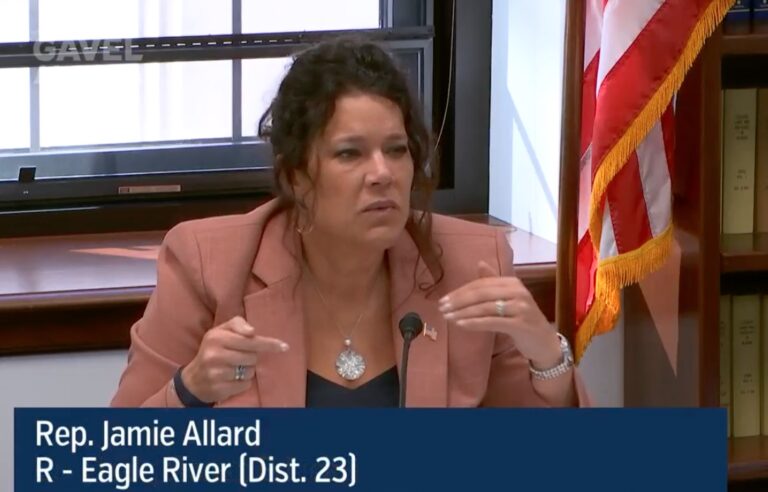
In attendance were Rep. Dan Saddler and Sen. Kelly Merrick. Rep. Jamie Allard was stuck in Juneau as the co-chair of the House Education Committee, with committee work that weekend.
With about 50 people in the room, and with a question-and-answer format, one teacher rose and called out Allard’s children, who have attended Eagle River schools.
“Hi, I’m Erica Arnold. I’m a lifelong Alaskan, Chugiak High School graduate, proud public school teacher at Ravenwood Elementary. I was very much looking forward to also speaking to Ms. Allard, so disappointed that she’s not here, specifically because her children went to Ravenwood – and when her children were in third grade, there was a class of 18 of third graders. Right now, what we have is classes of 28, 29, third grade is 30 and 31 kids in the class…”
Arnold was using the children of Rep. Allard to make the argument that more baked-in permanent funding, through a base student allocation from the state, is needed for schools.
A few in the audience were shocked that a teacher would dive into the school records of a sitting legislator’s children, and then give those details out to the public. One attendee told Must Read Alaska, “The only way she could have known that is if she had been rummaging around in those children’s records. These are minors and are being brought into a political discussion, and should never be brought in for any reason, but especially since Rep. Allard wasn’t there.”
Another noted, “It’s dirty politics to bring in someone’s kids like that.”
Parents have recourse, however, when teachers misbehave. The Professional Teaching Practices Commission is set up to respond and handle such ethical violations. Alaskans who feel a teacher has violated the code of ethics, such as teacher Erica Arnold doxxing (giving out private information) about children of a legislator or anyone else, can file a complaint.