Anchorage Superior Court Judge Laura Hartz, appointed by Gov. Mike Dunleavy, has allowed to stand the campaign violation fines levied in January by the Alaska Public Offices Commission against the group challenging Alaska’s ranked choice voting system.
The repeal of ranked choice voting will be on November’s general election ballot.
The Alaskans for Honest Elections was successful in getting enough signatures to get the question on the ballot in November, giving Alaska voters another chance to consider whether they want to use ranked choice voting and nonpartisan primaries as their method to elect people to state and federal offices. But their handling of their campaign finances was lacking and exposed them to a complaint with Alaska Public Offices Commission.
The dark-money group Alaskans for Better Elections, which created the final-four primary and ranked choice voting general, had originally filed that complaint, saying that Alaskans for Honest Elections, Phil Izon, Art Mathias, and Wellsprings Fellowship violated campaign finance laws by not accurately reporting the pathway of a major donation to the group’s signature-gathering effort.
After the complaint was filed, APOC reviewed the facts and issued one of the largest penalties in APOC memory: $94,610.20.
The fine can be compared to a 2021 fine that APOC levied against the campaign of Mayor Dave Bronson, who was fined $38,500 by the regulatory agency.
In 2020, APOC fined Rep. Lance Pruitt over $1 million, but then reduced it by 99% and ultimately fined him $10,222.
In 2014, Rep. Chris Tuck was fined $14,000 for campaign reporting errors.
But for Alaskans for Honest Elections, which wants to repeal 2020’s Ballot Measure 2, APOC determined that the full court press was appropriate. Mathias contributed $90,000 to the Ranked Choice Education Association, which then gave the money to Alaskans for Honest Elections. The source of the original funds was not clear to the public.
Judge Hartz wrote, “There is no constitutional right to make anonymous contributions for the purpose of influencing the outcome of an election. There is likewise no right to contribute through an intermediary or in the name of another, and the court declines to create such a right.”
Hartz also wrote that the Alaskans for Honest Elections claim that “true source reporting does not apply to ballot initiatives misreads the admittedly confusing but ultimately plain language of .065(c) and ignores the broader statutory framework referenced in the statute. Appellants’ reading of the statute renders meaningless multiple subsections of AS 15.13.040 and 2 AAC 50.352 in full. Courts ‘generally disfavor statutory constructions that reach absurd results.'”
The judged concluded that Alaska’s true source reporting statute and related provisions are narrowly tailored to the government’s “substantial interest” in having an informed electorate by making publicly available to voters the true source of election funds.
“Courts have recognized that knowing the sources of election spending ultimately informs voters’ decisions, prevents groups from ‘hiding behind dubious and misleading names’ and likewise prevents individuals from hiding in anonymity. The Alaska Supreme Court has likewise held that ‘[w]hen citizens vote on the basis of misinformation, or a lack of relevant information, the decision-making process on which our government ultimately rests suffers.'”
Alaskans for Better Elections asked the judge to impose triple damages on Alaskans for Honest Elections, but was denied.
Three clubs in three days. The Kenai Peninsula Republican Women have passed a resolution similar to one passed by the Republican Women of Fairbanks and the Valley Republican Women of Alaska, giving their full endorsement to both Donald Trump for president and Nick Begich for Congress. The group held a fundraiser for Nick Begich in the fall, and their support hasn’t wavered.
The resolutions from the women’s clubs are a direct response to the endorsement made by Trump for Nancy Dahlstrom, who filled to run for Congress in November, a half a year after Begich was already in the race. Both are Republicans.
The Kenai resolution is as follows:
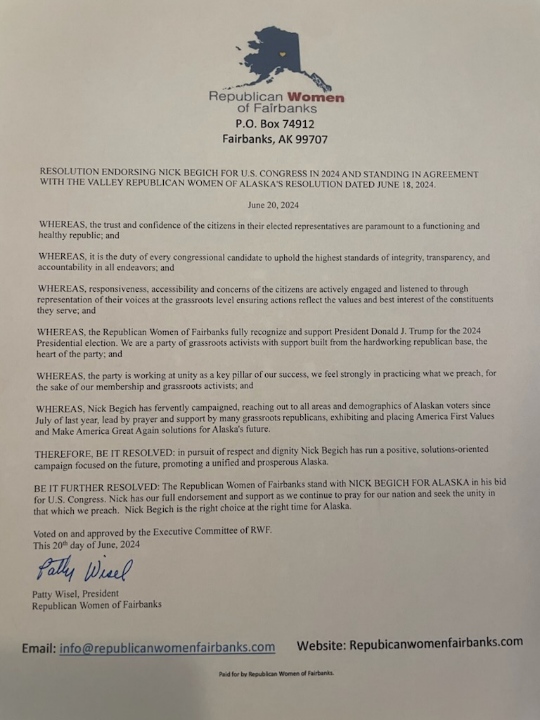
WHEREAS, the trust and confidence of the citizens in their elected representatives are paramount to a functioning and healthy republic; and
WHEREAS, every congressional candidate has a duty to maintain the highest standards of integrity, transparency, and accountability in all pursuits; and
WHEREAS, responsiveness, accessibility and concerns of the citizens are actively engaged and heeded through representation of their voices at the grass roots level ensuring actions reflect the values and best interest of the constituents they serve; and
WHEREAS, Kenai Peninsula Republican Women (KPRW) completely recognizes and supports President Donald J. Trump for the 2024 Presidential election. We are a party rooted in grassroots activism, deriving support from the dedicated Republican base, the very heart of our party, and
WHEREAS, considering the party’s commitment to unity as a cornerstone of our success, we strongly believe in leading by example, for the benefit of our members.
WHEREAS, candidate Nick Begich has passionately campaigned, reaching out to all areas and demographics of Alaskan voters since July 2023, lead by prayer and support by many grassroots republicans exhibiting and placing America First Values and Make America Great Again solutions for Alaska’s future; and
THEREFORE, BE IT RESOLVED: In pursuit of respect and dignity, Nick Begich has run a positive, solutions-oriented campaign focused on the future of our State, advancing a cohesive and thriving Alaska.
BE IT FURTHER RESOLVED: Kenai Peninsula Republican Women, established in 2001, stands with Nick Begich for Alaska in his bid for U.S. Congress. We wholeheartedly endorse and support Nick, while praying for our nation’s unity, which we advocate. Nick Begich is the ideal choice for Alaska at this critical juncture.
Readers may remember Rep. Dr. Rich McCormick, the Georgia Republican who served on the House Select Subcommittee on the Coronavirus Pandemic, when he stated “EcoHealth [Alliance] violated the terms of its NIH grant when it failed to produce laboratory notebooks with data about the WIV’s gain-of-function research.”
And who was the person behind all that gain-of-function research? That was Dr. Peter Daszak through National Institute of Health funding that was authorized by none other than Dr. Anthony Fauci, the former director of National Institute of Allergy and Infectious Diseases and one of the core creators of Covid-19 policies in the Trump and Biden Administrations.
Here were the key takeaways from the hearing with Dr. Fauci, according to the House Oversight Committee’s own summary:
Dr. Fauci showed no remorse for the millions of lives affected by his divisive rhetoric and his unscientific policies. He did not apologize to the thousands of Americans who lost their jobs because they refused the novel vaccine, nor did he apologize to children experiencing severe leaning loss as a result of actions he promoted.
Dr. Fauci confirmed that his Senior Advisor — Dr. David Morens — violated official NIH policies and potentially broke federal law. Evidence obtained by the Select Subcommittee suggests that Dr. Morens deliberately obstructed the Select Subcommittee’s investigation into the origins of COVID-19, unlawfully deleted federal COVID-19 records, and shared nonpublic information about National Institutes of Health (NIH) grant processes with his “best-friend” EcoHealth Alliance, Inc. (EcoHealth) President Dr. Peter Daszak.
Dr. Fauci maintained his misleading claim that the NIH never funded gain-of-function research in Wuhan, China. In 2021, he told Sen. Rand Paul that “the NIH has not ever and does not now fund gain-of-function research in the Wuhan Institute of Virology.” During yesterday’s hearing, Dr. Fauci doubled down on his previous claim by stating “the NIH did not fund gain-of-function research at the Wuhan Institute of Virology.” Notably, former Acting NIH Director Dr. Lawrence Tabak told the Select Subcommittee recently that the NIH did, in fact, fund gain-of-function research in Wuhan.
Dr. Fauci agreed with the Select Subcommittee that EcoHealth and its president, Dr. Peter Daszak, should never again receive a single cent from the U.S. taxpayer. Two weeks after the Select Subcommittee released evidence of EcoHealth’s contempt for the American people, its flagrant disregard for the risks associated with gain-of-function research, and its willful violation of the terms of its NIH grant, the Department of Health and Human Services commenced formal debarment proceedings against the organization and its president.
Dr. Fauci corrected his previous testimony that his staff did not possess conflicts of interest. During his transcribed interview he claimed, “the only people that I am involved with is my own staff, who we’ve mentioned many times in this discussion, who don’t have a conflict of interest.” During yesterday’s hearing, he changed his tune testifying that Dr. Morens “definitely had a conflict of interest.”
Dr. Fauci publicly acknowledged that the lab leak hypothesis was possible and not a conspiracy theory. Yesterday, he told Rep. Jim Jordan (R-Ohio) that he falsely claimed that he has kept an “open mind” about the origins of the pandemic. This comes nearly four years after prompting the publication of the now infamous “Proximal Origin” paper that attempted to vilify and disprove the lab leak hypothesis.
Somebody in Congress was evidently listening when the testimony to the Select Subcommittee on the Coronavirus Pandemic occurred.
Sen. Joni Ernst, a Republican from Iowa, was listening. The Senate Armed Services Committee has unanimously passed her amendment to the 2025 National Defense Authorization Act (NDAA) “to close all potential pathways for EcoHealth Alliance to receive further federal defense funding.”
Ernst added this to the National Defense Authorization Act after National Institutes of Health Principal Deputy Director Lawrence Tabak half-admitted that EcoHealth Alliance did indeed conduct gain-of-function research with our money, but it was “generic.”
Dr. Bryce Nickels, a professor of genetics at Rutgers University and co-founder of the pandemic oversight group “Biosafety Now,” told the Washington Post, “Tabak was engaging in the usual obfuscation and semantic manipulation that is so frustrating and pointless.”
These experiments at Wuhan Virology Institute produced much more infectious variants than what could occur naturally if bats had transmittedthe Covid-19 virus, some virologists say.
The Senate Armed Services Committee unanimously passed Sen. Ernst’s amendment. That speaks volumes.
While the Department of Health and Human Services in May suspendedfederal funding to EcoHealth Alliance and started debarment proceedings that would ban this group and Dr. Daszak from receiving funding for three years, Ernst’s amendment takes the ban a step further: If passed, it will not only ban EcoHealth Alliance but any subsidiary of the disgraced group from future defense funding.
“Defense dollars should be spent protecting our country, not paying for more of EcoHealth’s batty experiments,” Ernst told the Washington Free Beacon. “This shady organization has managed to avoid accountability time and time again. My amendment slams the door shut on any possibility for deep state bureaucrats to find another roundabout way to restore funding for the group’s risky research.”
If this Senate NDAA ban is successful, EcoHealth Alliance’s bottom line could be severely affected. EcoHealth Alliance heavily depends on federal funds, receiving more than $94 million in taxpayer dollars since 2008. This same group gave $600,000 of that funding to the Wuhan Institute of Virology for experiments on viruses that looked a lot like the ones that caused Covid-19.
Before I get too excited and do a victory lap, I am aware of EcoHealth Alliance’s ability to weasel out of federal funding bans. President Donald Trump suspended the group’s research funds in 2020. President Joe Biden reversed that funding ban in 2023, but suddenly banned them again in May. EcoHealth Alliance is working its K Street magic to get off the ‘banned” list.
Senator Ernst tried asimilar resolution in an 2024 version of the NDAA bill that made it through both the House and the Senate. But it didn’t make it into the final version—it was a last minute decision behind closed doors to remove it.
It’s unknown if this 2025 amendment will meet the same demise. Yet I am hopeful.After Tabak testified, Congress and President Biden seem unified in their opposition.
We are one step closer to solving the issues surrounding Covid and how it came to be a disease created that killed over 6 million people worldwide, including one million Americans. But there is much more work that needs to be done. There are bureaucrats who need to be held accountable for the harm done.
And time will tell if America has the political will to hold all accountable for this horrible travesty.
Linda Boyle, RN, MSN, DM, was formerly the chief nurse for the 3rd Medical Group, JBER, and was the interim director of the Alaska VA. Most recently, she served as Director for Central Alabama VA Healthcare System. She is the director of the Alaska Covid Alliance.
A U.S. citizen does not have a fundamental liberty interest in her noncitizen spouse being admitted to the country, the U.S. Supreme Court ruled on Friday. Especially if that spouse is associated with a deadly gang and is reasonably thought to intend to break the law in the United States.
In Department of State v. Munoz, the justices were asked if Sandra Munoz, a U.S. citizen in Los Angeles, could invoke a “fundamental right of marriage.” The State Department does not deny that Muñoz (who is already married) has that fundamental right, but Munoz further claimed the right to reside with her noncitizen spouse in the United States — a man whom officials believe belongs to an international criminal gang.
Munoz is described as a prominent civil rights attorney in Los Angeles. Her husband, Luis Asensio-Cordero, is El Salvadoran, and during his interview with the consulate, officials conducted a body search and found tattoos indicating he is a member of the MS-13 gang. They denied him a green card.
“After conducting several interviews with Asencio-Cordero, a consular officer denied his application, citing §1182(a)(3)(A)(ii), a provision that renders inadmissible a noncitizen whom the officer ‘knows, or has reasonable ground to believe, seeks to enter the United States to engage solely, principally, or incidentally in’ certain specified offenses or ‘any other unlawful activity,’” the decision explained. Asencio-Cordero guessed that he was denied a visa based on a finding that he was a member of MS–13, a transnational criminal gang.
El Salvador is known to be infested with criminal gangs, with many members committing crimes in the United States.
Although Asencio-Cordero disavowed any gang membership and he and Muñoz pressed the consulate to reconsider the officer’s finding, the ruling stood, so they appealed to the Department of State, which agreed with the consulate’s determination. Asencio-Cordero and Muñoz then sued the Department of State and others (collectively, State Department), claiming that it had abridged Muñoz’s constitutional liberty interest in her husband’s visa application by failing to give a sufficient reason why Asencio-Cordero is inadmissible under the “unlawful activity” bar. The Department of State said it is not required to give a reason. The District Court granted summary judgment to the State Department, but the Ninth Circuit vacated the judgment, holding that Muñoz had a constitutionally protected liberty interest in her husband’s visa application.
The Supreme Court has overturned that ruling in an opinion written by Justice Amy Coney Barrett.
The 6-3 vote was opposed by Justices Sonia Sotomayor, Elena Kagan, and Ketanji Jackson, the Democrat-appointed liberal women of the court who interpret then Constitution as granting the right to marry a gang member who is a non-citizen and then move that person to the United States to engaged in felonies.
In my column in Must Read Alaska, on May 31, I shared my review of temperature data from that claims that Alaska is warming two- to four-times faster than the rest of the planet. In that column I described how I found there is not a problem of increased warming but a lack of extreme cold.
Then in my June 7 column I shared information about the history of Glacier Bay and a paper that shows that CO2 and other greenhouse gas molecules cannot have much effect even with a doubling of the current concentration in the atmosphere.
If Alaska is not really warming at a high rate, we can take time to make some assessments on what we really need to work on that is most affected by the slight warming we have had.
The outcome of research reported in “Infrared Forcing by Greenhouse Gases” by W. A. van Wijngaarden and W. Happer demonstrates there cannot have been and cannot be any great warming as the result of greenhouse gas emissions from the burning of hydrocarbon fuels. So it is time to resist, to fight against the global efforts to alter our energy makeup and focus on cheap energy and the economy.
It is time to consider that our warming has just been a recovery from the Little Ice Age and normal variability of weather.
In Alaska, there is no reason to stop our efforts to use renewable and alternate energy sources, as much of Alaska is remote, and does not have hydrocarbon fuels nearby, so can benefit greatly from the development of wind, solar and hydroelectric power.
We should not be forced, however, to prematurely abandon the energy sources which will provide Alaska with a viable economy and ability for citizens of Alaska to survive the cold winters with a sustainable energy source for the Railbelt, natural gas, coal and crude oil. We can still welcome whatever other energy sources that can provide cheap energy to all our communities and industries throughout Alaska.
It is time ensure the science used to provide guidance for U.S. and state policies is real science and not the political science pushed by the IPCC and other global organizations. For too long any research aimed against greenhouse gas warming has been denied funding or a part of any discussion. Those scientists and engineers with opposing ideas are speaking out and publishing and should now be assured a place at the energy table at our Universities and government policy groups.
The basis for this “PETITION TO COMPLETE A SUPPLEMENTAL ENVRONMENTAL IMPACT STATEMENT FOR THE TRANS-ALASKA PIPELINE SYSTEM & PLAN FOR DISMANTLEMENT, REMOVAL, & RESTORATION” is the misguided concern about warming from greenhouse gas emissions from burning of fossil (hydrocarbon) fuels.
Since Alaska isn’t warming at the high rate claimed by the USDA compared to average annual temperatures in past records, it is time to provide a more scientific analysis of Alaska data by unbiased researchers so we can determine what conditions we have to deal with and direct our efforts to what is important.
If we start with what we know about the impact of the Little Ice Age and assume the sun provided the energy to warm the planet back from the extreme low temperature experienced 300 years ago, we should end up with a better understanding of our environmental status.
I have also found that the same comparison of average annual temperature values are used to declare “the oceans are boiling,” when comparison of data with on line sea surface temperature values (for both the Pacific and Atlantic Oceans) were usually 4 degrees below normal, with some at or just above normal for that day.
The average annual ocean temperature values also have a “lack of cold temperature” over the recent past as the northern waters are less cold because of the diminished contact with ice. My review of the Arctic ice pack records indicate that the ice pack could be recovering as it is gathering more multiyear ice each year, and does not have an annual decrease of any extent.
And just what is an average annual temperature for this planet? I can’t image any credible manner in which such a value can be reliably achieved. It is time to cease publishing this type of data, and the misleading conclusions developed from them.
The Trans Alaska Pipeline System is our economic engine and we need to get it back up to running at a rate that will benefit all Alaska. Without all the interference from our current federal administration, we should have had a flow rate up to 1 million bpd upon completion of Willow, Pikka, ANWR and others that have been stalled.
So as you enter this fracas please approach this with more passion that you did the call to remove all impediments to the increased production of Cook Inlet gas. We still need to get this moved forward as quickly as we can. Tomorrow would not be too soon. The apparent lack of interest in the recent Cook Inlet leases does not truly represent real attitudes but does result from the ESG-biased financial decisions. I was disappointed that the Reduced Royalty on Cook Inlet gas did not move forward.
As we enter this fight please don’t attack the entrepreneurs who have provided wind, solar, and battery energy storage, as they do benefit the system. We got here by not mandating such alterations. We will need all the energy innovations that can provide benefit somewhere in Alaska.
Robert Seitz is an electrical engineer and lifelong Alaskan.
The North Pole City Council voted to relieve Mayor Mike Welch of his duties. The vote came after an executive session that occurred Monday, after complaints and revelations about poor management at the city.
Mayor Pro Tem Chandra Clack has moved to the mayor’s seat after the unanimous decision, which included Welch himself voting in favor of the motion. The next election for mayor comes in October, and Clack will serve until then unless other developments occur.
Welch had serious health conditions involving a concussion last year that forced him to take medical leave for several months, but he returned to work in April. The structure of the mayor’s office in North Pole is that the mayor runs the city’s day-to-day operations, and numerous complaints have arisen during his tenure involving procurement irregularities and access that his wife had to what are described as secure areas of city offices. He said his memory was shaky on aspects of those procurement irregularities. Some of the other issues the council was worried about were discussed in the meeting, the video of which is below:
Welch moved to North Pole in 1999 and was elected to the city council in 2005, and elected in 2008. In 2018, he was elected mayor and he was reelected in 2021. Welch filed this spring to run against House Rep. Mike Prax. Both are members of the Republican Party.
Chandra Cleck was born in Fairbanks before statehood and has been active in the Fairbanks and North Pole communities, serving on the board of Golden Valley Electric Association, running her own daycare center, and working as a substitute teacher. She is also involved with a pregnancy center devoted to saving unborn lives.
The U.S. Supreme Court has upheld a federal gun law, rejecting the challenge of its constitutionality by a man who was federally banned from possession of a gun due to being subject to a restraining order in a domestic violence case.
The court heard the case of U.S. v. Rahimi in November, delving into the complex issue of what constitutes “dangerousness,” and how it pertains to Second Amendment protections. Its ruling was issued Friday.
The question before the Court revolved around whether a person such as Zackey Rahimi, who is subject to domestic-violence restraining orders, should be barred from possessing firearms under federal law.
The mainstream media, including the New York Times and POLITICO, falsely reported that domestic abusers cannot possess guns, while the ruling clearly applies only to those with restraining orders.
Chief Justice John Roberts, writing the 32-page opinion for the majority, said that the law applies common sense.
“When an individual has been found by a court to pose a credible threat to the physical safety of another, that individual may be temporarily disarmed consistent with the Second Amendment,” he wrote.
“Since the Founding, the Nation’s firearm laws have included regulations to stop individuals who threaten physical harm to others from misusing firearms. As applied to the facts here, Section 922(g)(8) fits within this tradition,” Roberts wrote.
“The right to keep and bear arms is among the ‘fundamental rights necessary to our system of ordered liberty,’” he wrote, citing McDonald v. Chicago, 561 U. S. 742, 778. “That right, however, ‘is not unlimited.” …
In an important aside, Roberts added that the Second Amendment does not jut apply to the muskets that were in use when the Constitution was ratified.
“The reach of the Second Amendment is not limited only to those arms that were in existence at the Founding. Heller, 554 U. S., at 582. Rather, it “extends, prima facie, to all instruments that constitute bearable arms, even those that were not [yet] in existence.” Ibid. By that same logic, the Second Amendment permits more than just regulations identical to those existing in 1791,” Roberts wrote.
Throughout the arguments in November, the Justices showed interest in the history of domestic violence in the United States and the specific terms of the federal gun ban for those under restraining orders.
However, the discussion by the justices had repeatedly circled back to the fundamental query of what specific conduct might cancel a person’s Second Amendment rights to possess firearms. At the time of the discussion, the majority of the court appeared inclined to uphold the federal law in question.
Friday’s decision reverses a lower court ruling that found the law to be in violation of the Second Amendment.
In the Spring of 1985, I was a visiting scholar at the Slavic Reference Services of Russian, East European, and Eurasian Center of the University of Illinois at Urbana-Champaign. Evidently, this Center is known for the largest collection of the Slavic primary and secondary sources in the United States and, I was told, presumably the third largest Slavic collection in the world.
The late Dr. Ralph Fisher was the founder and a champion for building the Slavic collection at the University of Illinois Library. Thanks to Dr. Fisher’s vision, the University Library and Slavic Reference Service provide a consummate collection and outstanding research support service to scholars around the world.
In the 1970s through 1980s, there were nearly 50 Russian Centers in the United States, mostly established by and affiliated with prestigious universities and colleges (e.g., Harvard, Berkeley, Georgetown, Indiana, Bryn Mawr College, etc.). Most of these Centers were funded and supported by the U.S. State and Defense Departments, and some private donors.
From the mid-1980s, under the ruling of the U.S.S.R.’s Chairman of the Communist Party Mikhail Gorbachev, the world faced a new chapter of the international dynamic, namely: the introduction of Glasnost (social openness) and Perestroika (economic restructuring from the planned and command economy to a free market economy) in the former Soviet Union. These progressive socio-economic changes in the former Soviet Union had a fundamental effect on how Soviets viewed the West and, subsequently, vice versa.
While I was at the Russian Center in Illinois, in one of my frank conversations with Dr. Fisher, he speculated that the end of the Cold War would result in a decrease of funding for the Russian Centers nationwide and the ultimate emergence of people-to-people unmitigated exchanges. And he was right.
In the mid/late-1980s, an international popularity of Mikhail Gorbachev was greater than “rock stars” worldwide; various peace-seeking organizations and social activists were excited about new socio-economic prospects with the Soviets and by early 1990s my academic courses (i.e., Soviet Ethnography and Culture, Soviet Character in the Soviet Literature, How Soviets View the World) became obsolete and somewhat inadequate, except for the Russian History and Russian Language courses.
In fact, for the most part, Russian experts and Sovietologists in the West found themselves antiquated; the sudden social activists and amateur historians claimed to be the new voices in Soviet affairs and history.
During the Cold War (1946 to 1991), Alaska was the only State in the U.S. that restricted travel for Soviet citizens, apart for limited scientific or academic exchanges or the official visits of the Soviet governmental representatives under auspices of the International Research Exchange Board or the U.S. State Department. Reciprocally, Siberia and some security-sensitive locations in the Russian Far East were also out of reach for the U.S. citizens.
Nevertheless, in April of 1986, Genady Gerasimov became one of the first post-World War II Soviet officials to visit Alaska. Gerasimov was a career journalist and editor of Moscow News, one of the largest newspapers in the former Soviet Union, which was published in dozens of languages and distributed worldwide accordingly.
Like all editors of the major newspapers in the former Soviet Union, Gerasimov was closely associated with Politburo (the principal policy-making committee) and the high-ranking officials of the Soviet Union Communist Party.
Sitka was Genady Gerasimov’s first stop in Alaska. Then I was employed as an archaeologist by the Tongass National Forest Service and as an adjunct assistant professor of Russian Studies at the Islands Community College in Sitka (today University of Alaska Southeast). Sitka city officials held a modest reception in honor of Gerasimov’s visit to Claudette Bechovech’s residence. Claudette Bechovec was a long-time resident of Sitka; she was married to Mr. Bechovec—a resistance fighter against Nazi Germany in Yugoslavia during WWII.
At one point during a rather unassuming reception, Gerasimov approached me, “Sasha, please would you ask the organizers to accommodate me in the hotel. I don’t want to cause any inconveniences to gracious hosts.” I quickly conveyed Gerasimov’s concerns to a seemingly reception organizer. “Oh, no,” he responded. “Bechovecs are members of the Communist Party, and they have a gun. He will be safe with Bechovecs and comfortable on this sofa,” he continued, pointing to the saggy sofa in the corner of the living room. So, I cautiously explained to Gerasimov that his request couldn’t be accommodated on such short notice.
The next day, Gerasimov pursued his travel to Juneau for meetings with the State officials and several enthusiastic activists who were preliminary engaged in the negotiation for cultural exchanges with the Soviet counterparts. Incidentally, Gerasimov’s visit to Alaska coincided with the tragic Chernobyl Nuclear Power Plant accident on April 26, 1986. As a result, Gerasimov abruptly returned to his home country.
Soon after Gerasimov’s visit to Alaska, he was appointed to the position of Foreign Affairs Spokesman for Mikhail Gorbachev. In the late 1980s, Genady Gerasimov visited Alaska several times; he was fond of Alaskans and instrumental in fostering Alaska-Russian relations.
Genady Gerasimov’s diplomatic visits to Alaska in the 1980s were the beginning of people-to-people Alaska-Russian relations; later followed by extensive development in various social, cultural and economic spheres between two regions. Alaska-Russian communication was interrupted by the Russian annexation of the Crimean Peninsula in 2014. Historically, however, Alaska has always experienced boom-and-bust socio-economic developments, much like boom-and-bust Alaska-Russian relations.
Alexander B. Dolitsky was born and raised in Kiev in the former Soviet Union. He received an M.A. in history from Kiev Pedagogical Institute, Ukraine, in 1976; an M.A. in anthropology and archaeology from Brown University in 1983; and was enroled in the Ph.D. program in Anthropology at Bryn Mawr College from 1983 to 1985, where he was also a lecturer in the Russian Center. In the U.S.S.R., he was a social studies teacher for three years, and an archaeologist for five years for the Ukranian Academy of Sciences. In 1978, he settled in the United States. Dolitsky visited Alaska for the first time in 1981, while conducting field research for graduate school at Brown. He lived first in Sitka in 1985 and then settled in Juneau in 1986. From 1985 to 1987, he was a U.S. Forest Service archaeologist and social scientist. He was an Adjunct Assistant Professor of Russian Studies at the University of Alaska Southeast from 1985 to 1999; Social Studies Instructor at the Alyeska Central School, Alaska Department of Education from 1988 to 2006; and has been the Director of the Alaska-Siberia Research Center (see www.aksrc.homestead.com) from 1990 to present. He has conducted about 30 field studies in various areas of the former Soviet Union (including Siberia), Central Asia, South America, Eastern Europe and the United States (including Alaska). Dolitsky has been a lecturer on the World Discoverer, Spirit of Oceanus, andClipper Odyssey vessels in the Arctic and sub-Arctic regions. He was the Project Manager for the WWII Alaska-Siberia Lend Lease Memorial, which was erected in Fairbanks in 2006. He has published extensively in the fields of anthropology, history, archaeology, and ethnography. His more recent publications include Fairy Tales and Myths of the Bering Strait Chukchi, Ancient Tales of Kamchatka; Tales and Legends of the Yupik Eskimos of Siberia; Old Russia in Modern America: Russian Old Believers in Alaska; Allies in Wartime: The Alaska-Siberia Airway During WWII; Spirit of the Siberian Tiger: Folktales of the Russian Far East; Living Wisdom of the Far North: Tales and Legends from Chukotka and Alaska; Pipeline to Russia; The Alaska-Siberia Air Route in WWII; and Old Russia in Modern America: Living Traditions of the Russian Old Believers; Ancient Tales of Chukotka, and Ancient Tales of Kamchatka.
There appears to be a counter movement afoot in Alaska — a pro-Trump voter who is not going along with the Trump endorsement of Nancy Dahlstrom for Congress.
First it was the solid-red Mat-Su Valley. Now, for the second time in two days, a major Republican club in Alaska has gone against Monday’s Trump endorsement and instead come out with a strong endorsement of Nick Begich for Congress.
The Republican Women of Fairbanks issued their resolution on Thursday.
The resolution is similar to the one passed by the Valley Republican Women of Alaska on Tuesday, reiterating that the club supports Trump for president and that “Nick Begich is the right choice at the right time for Alaska.”
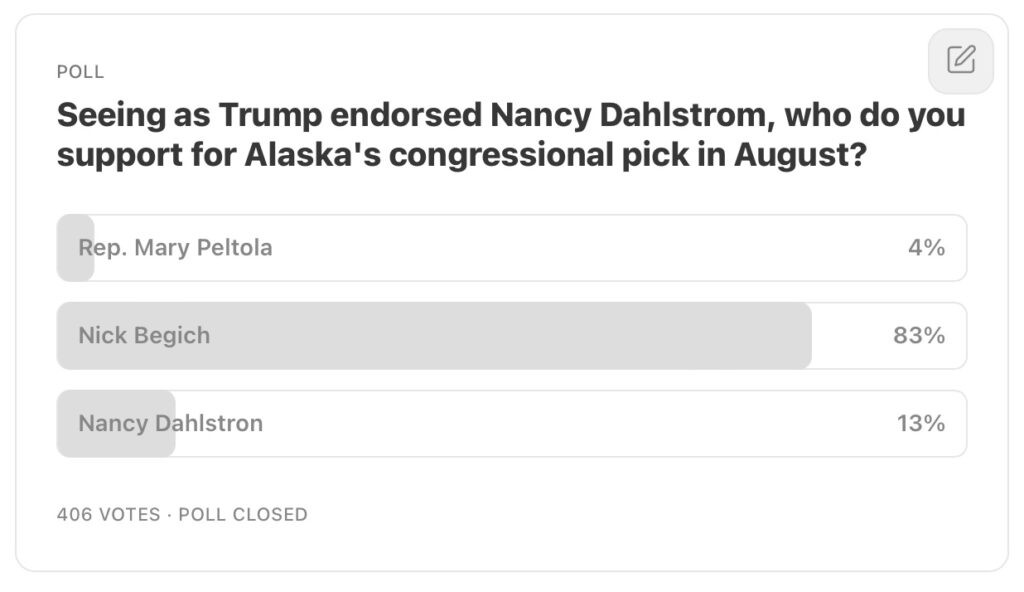
The trend is also seen in a pair of polls that asked (mainly conservative) Alaskans on Monday who they favored for Congress. In that poll, Nick Begich was favored by 85% of Must Read Alaska readers who took part.
After the Trump endorsement on Monday, MRAK tried a slightly different question: “Seeing as Trump endorsed Nancy Dahlstrom who do you support for Alaska’s congressional pick in August?” The results are 83% for Nick Begich. The poll closed Thursday morning.
One-day poll results from the Wednesday, June 19 Must Read Alaska newsletter.
Both candidates have their supporters: While Dahlstrom has the Trump endorsement and is endorsed by Gov. Mike Dunleavy and the National Republican Congressional Committee, Begich has the endorsement of the House Freedom Caucus, Sen. Mike Lee, Rep. Byron Donalds, and Rep. Scott Perry, as well as Vivek Ramaswamy, business entrepreneur and former candidate for president.
Now, he has the full-throated support of two of the grassroots women’s clubs that make up the strength of the Alaska Republican Party.
Since 2022, Alaska has had what is called a non-partisan primary, which means candidates from all parties share the same ballot. For the seat now occupied by Democrat Rep. Mary Peltola, there are 12 registered candidates. There are 61 days until the Aug. 20 Alaska primary election.
The final four with the most votes from the primary ballot will continue on to the Nov. 5 general election.