In my October 26 analysis of the Alaska Municipal League, I asked what protects independent judgment when outside organizations gain access to public officials. The education funding task force’s November 9 draft gives Alaskans another reason to follow the paperwork.
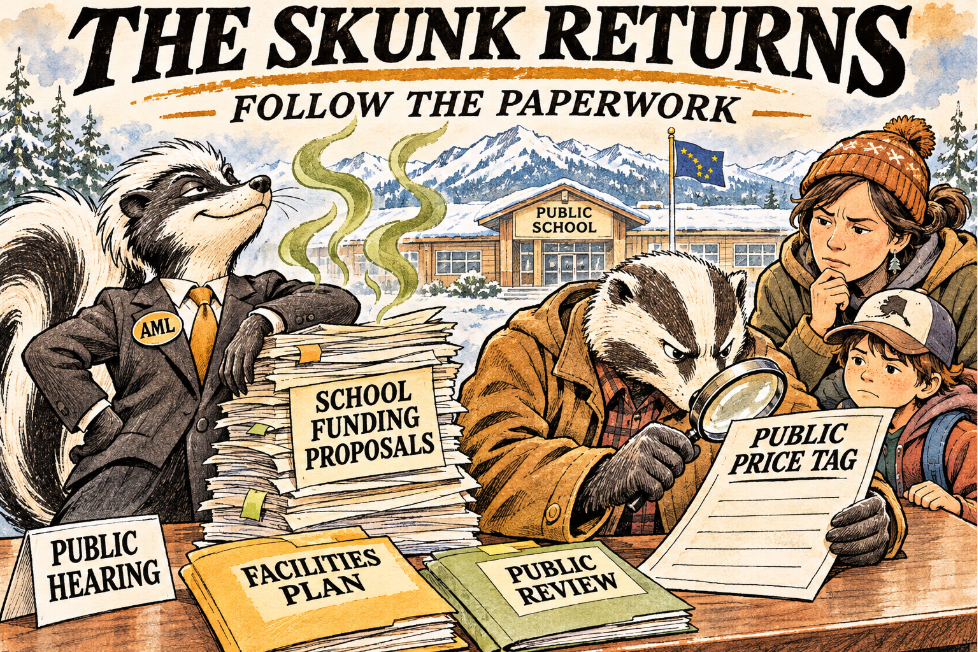
The skunk is back. To my nose, this smells like another expansion of institutional influence before the public has received the full bill. That is my judgment about the policy process. The documents establish an advocacy trail; they do not establish a purchased vote or criminal wrongdoing.
The Alaska Municipal League is a nongovernmental membership organization representing municipal interests. It can advocate. Legislators remain responsible for independently testing its proposals against the interests of all Alaskans— including families choosing education outside traditional classrooms.
AML’s Resolution 2026-01, adopted December 12, 2025, sought inflation-linked school funding, a dedicated facilities allocation, and predictable school bond reimbursement. AML subsequently published a detailed facilities-funding design. Now, page 7 of the task force report recommends a separate allocation for facility operations, management, and lifecycle renewal. Its footnote expressly credits an AML document explaining such an allocation.

That is a visible path from an organization’s policy agenda to a legislative recommendation. It warrants examination of collaboration, access, and independent review. It does not mean every provision originated with AML.
The missing price tag deserves attention. AML’s published design illustrates statewide annual facilities allocations ranging from $187 million to $499 million, depending on assumptions about eligible space and operating costs. These are scenarios, not a verified appropriation request or a calculation of net new spending. The model includes energy, so its figures cannot simply be added to the task force’s separate $88 million FY2028 energy estimate.
Which existing appropriations would be replaced? Which would remain? What would municipalities save, and what would state taxpayers assume? Publish that reconciliation before creating a new funding stream.
The task force reports a $535 million maintenance backlog. That is an existing need, not an annual bill. With a contractor’s background, I understand that neglected roofs, boilers, and fire systems become more expensive. Preventive maintenance can protect public investments. But safe schools require disciplined management as well as money.
To its credit, AML’s detailed design includes space limits, preventive-maintenance conditions, and provisions intended to avoid duplicating capital funding. Those safeguards deserve scrutiny and enforceable implementation. The design also supplies draft statutory language, showing how this advocacy could become law.
Meanwhile, families choosing alternatives should read page 9 carefully. The task force recommends increasing the district indirect-cost cap above 4 percent for charter schools. Without an offset, allowing districts to retain more can leave less for charter instruction. It also calls for reviewing correspondence-school exemptions and bringing public correspondence programs into a broader brick-and-mortar framework. The eventual effect depends on legislation, but the direction deserves public debate now.
I am not attributing those provisions to AML without evidence. I am asking why the package advances more support for physical facilities while leaving unresolved how alternative programs will share fairly in new funding and preserve their flexibility.
The report describes nine public meetings and school visits. Those are activities. Where is the combined implementation budget? Where are the estimated taxpayer savings, building-utilization targets, and measurable educational improvements? How many additional children should become proficient readers, and by when?
The draft does not provide that complete accounting. An unmeasured benefit is not necessarily a nonexistent benefit. But proposed spending is not proof of public value either.
Before these recommendations become legislation, Alaskans should demand five things: release the referenced Appendix B missing from this ten-page copy; publish the proposal’s authors and supporting submissions; provide five- and ten-year costs net of existing funding; disclose district-by-district effects on traditional, charter, and correspondence education; and establish public measures of safety, savings, and student progress.
AML should explain its proposals. The task force should explain what it accepted and why. Legislators should show whose interests benefit, what safeguards apply, and what ordinary families receive for their money.
My skunk symbolizes suspicion that deserves investigation. My badger symbolizes citizens who will keep digging until the records answer the questions.
Before Alaska signs another check, let the public see the whole bill—and the results it is supposed to buy.
Sources
- Alaska Joint Legislative Task Force on Education Funding, November 9, 2026 draft, https://alaskasenate.org/documents/TFEF-Recommendations-11-09-2026.pdf
- Alaska Municipal League Resolution 2026-01: https://www.akml.org/wp-content/uploads/2025/12/Resolution-2026-01-Stabilize-K-12-funding.pdf
- Alaska Municipal League. Designing a Base Facilities Allocation for Alaska School Districts, 2026, https://www.akml.org/wp-content/uploads/2026/06/Designing-a-Base-Facilities-Allocation-for-Alaska-School-Districts-1.pdf