Friday, August 7, 2026
Home Blog Page 420

Win Gruening: A strong, independent community hospital is important to Juneau

By WIN GRUENING

Juneau’s city-owned Bartlett Regional Hospital is in the news, presenting the community with yet another challenging situation.

According to hospital officials, over the last five years, competitive pressures and inflationary increases have contributed to a deterioration in financial performance. Additionally, the pandemic accelerated the movement of medical treatments to out-patient facilities, which insurers reimburse at much lower rates.

BRH is losing about $1 million per month and without trimming costs or finding other revenue sources, the hospital will run out of cash and could be forced to close within three years.

While it’s possible that the hospital could be sold, it’s doubtful it would survive in the same configuration or offer the same services as it does now.

And therein lies the conundrum facing city leaders.

Selling the hospital or curtailing non-core programs and services will resolve the immediate financial challenges now but present less quantifiable social service challenges in the future.

Community outreach events on June 4 and June 10 generated significant public testimony about Bartlett programs and services being considered for elimination or reduced service. Those programs include hospice and home health services; Rainforest Recovery Center (a 16-bed residential and outpatient treatment program); Bartlett Outpatient Psychiatric Services; Crisis Observation Services Crisis Residential and Stabilization Services for Adults and Adolescents; and the Aurora Behavioral Health Center (serving autism patients).

While these services are deemed non-core programs, all received passionate support as high-need services without suitable local alternatives. Annual losses attributed to each program ranged from $813,000 for hospice and home care to almost $4 million for Rainforest Recovery Center. 

The increasing competition from Southeast Alaska Health Consortium is also a factor. Originally funded by the Indian Health Service and intended to provide medical care to the Native community, SEARHC has aggressively expanded its facilities throughout the region. With over 1,200 employees, they now serve 27 communities throughout Southeast Alaska including Juneau. In Sitka and Wrangell, SEARHC operates both local hospitals after financial pressures compelled city governments to cede control. 

SEARHC now offers pharmacy services, dental care, primary care, specialty care, imaging, and laboratory services to all Southeast residents, not just Native patients. Their urgent care clinic in Juneau competes directly with BRH’s emergency room. SEARHC’s newly expanded facilities in Juneau may soon compete with the hospital’s short-stay surgery center – one of Bartlett’s largest revenue producers.

Some testifiers noted that SEARHC does not compete with other medical providers on a level playing field. Indian Health Service funding amounted to about $85 million last year, which SEARHC received through the Alaska Tribal Health Compact to treat Native clients. However, SEARHC also billed over $100 million to Medicaid and Medicare for many of those patients, effectively “double-dipping” to add to their profit margin. 

BRH statistics reflect that 50% of Rainforest Recovery Center patients are SEARHC beneficiaries but the hospital receives no reimbursements from SEARHC for their care. SEARHC can choose to “cherry-pick” more lucrative medical services to offer while deciding to avoid the financial drag of services that may be money-losers.

SEARHC’s 15-person board includes representatives from all over the region. Neither SEARHC’s board meetings nor its records are open to the public except for limited financial disclosures.

In contrast, Bartlett Regional Hospital is a public entity with full transparency in all its operations. Bartlett board members, appointed by the City and Borough of Juneau Assembly, are from Juneau and must be responsive directly to citizens. BRH is therefore more likely to address Juneau’s health concerns and challenges and tailor its services to meet the specific needs of the local population it serves.

There’s no guarantee that any Bartlett Regional Hospital medical service now being provided will be offered if the hospital is sold to SEARHC or any other outside entity. Only the citizens of Juneau and their elected leaders can ensure that these services are provided and funded.

This is just one of several challenges facing the community. The fate of Juneau’s hospital should be a top priority for the current Assembly, and any new members elected on October 1.

After retiring as the senior vice president in charge of business banking for Key Bank in Alaska, Win Gruening became a regular opinion page columnist for the Juneau Empire. He was born and raised in Juneau and graduated from the U.S. Air Force Academy in 1970. He is involved in various local and statewide organizations.

Greg Sarber: Who benefits from Alaska’s minimum wage initiative?

By GREG SARBER

Alaskans will vote on a ballot initiative this November proposing to raise the minimum wage to $13 an hour next year, which then would jump to $15 per hour by 2027.  

When a similar law was passed in California it resulted in the loss of jobs for low-income workers. 

It is also important to note that current wages for entry-level jobs in Alaska are already higher than what this legislation will achieve.  We should ask ourselves why we are voting to enact a law that is not needed and who else might benefit from it.

California passed a similar new minimum wage law that went into effect on April 1 of this year.  I covered that in a previous article, which you can read at this link. 

However, as a brief update, since California’s new minimum wage has gone into effect, over 10,000 low-wage workers have been fired from their jobs because their employers could not afford to pay the new higher wage or found cheaper alternatives like automation to replace workers.  Instead of helping employees, the new law put them out of work and into the unemployment line.  I wonder what all of these now unemployed workers in California might say to the politicians who passed this legislation.   

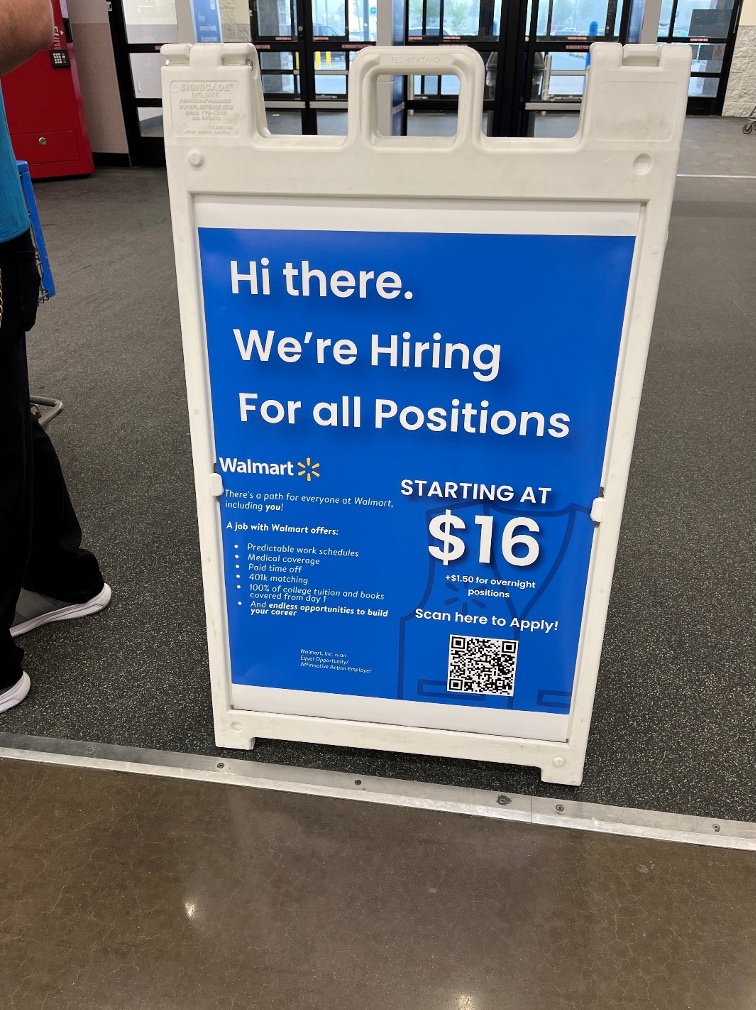
The second issue is the need for this law in the first place. On Sunday, I stopped by the Kenai Walmart. This business provides entry-level jobs, and their employees are the likely target of the new minimum wage initiative. Prominently displayed at the entrance to the store is a sign advertising that they were hiring and offering a starting wage of $16 per hour. 

That wage is already higher than what is required in the ballot initiative, even when it goes into full effect in 2027. 

It isn’t just Walmart. A relative of mine found a summer job in Homer and every business she talked to pays more than Walmart does.

There are entry-level jobs available today in Alaska that pay far more than what this proposed minimum wage initiative accomplishes.  While I have only given a couple of examples from the Kenai Peninsula, it looks like job demand has created a need for employers to pay higher than the current minimum wage to attract employees. That is how the capitalist system is supposed to work.  

How about the other side of that argument? What happens when job demand does not create higher wages, but they are forced on businesses anyway?  

That example was in the news this week. It involves employees of a small business called The OCF Coffee House, a small chain of coffee shops in Philadelphia.  The employees decided they wanted more money for doing the same job, so they unionized and demanded higher wages.  

The business owner concluded that he couldn’t raise coffee prices and would be unprofitable to pay higher wages to employees, so they closed the three shops. Now all the workers are unemployed. The lesson from this incident is that the best way to get a higher wage is to look for a better job, not trying to force an employer to pay more for the same work. 

If this ballot initiative is not needed in Alaska, we should ask Cui Bono: Latin for “who benefits?”

Let’s look at who sponsored this initiative. Two of its three sponsors are Democrats. Ed Flanagan was the commissioner of the Alaska Department of Labor in the Democrat Tony Knowles Administration. Genevieve Mina is the Democrat representative for Alaska House District 19 who is running for reelection this year.

Since Rep. Mina feels so strongly about the issue of minimum wages paid in Alaska, I have to wonder why she didn’t introduce it as a bill in the Legislature. Instead, Rep. Mina chose to sponsor it as an initiative. The initiative process in our state constitution is designed so that citizens can bypass the legislature to enact legislation from the grassroots. The sponsorship of this initiative by Mina and Flanagan makes it appear that this is not a grassroots movement, but was instead a partisan effort from leaders of the Democrat party.  

We should ask if the Democrat party is the prime beneficiary of this initiative process.  You can bet Democrats will campaign on this issue in the upcoming primary and general elections.  They will pretend to be the friend of low-wage workers, despite this legislation being potentially harmful to them like it was in California, and despite it being unnecessary because wages have already grown higher than what this initiative accomplishes.

Call me a cynic but lying to low-wage workers with the promise of helping them economically, despite not actually doing so is a pretty despicable thing to do.

Greg Sarber is a board member of Alaska Gold Communications, the parent company to Must Read Alaska.

Department of Interior report documents the harm that dams caused Northwest tribes

In an extensive document published this week, the Department of Interior says that the government was built dams on the Columbia River that harmed the tribes in the region. It is an admission of governmental guilt.

Dams blocked fish migration and flooded thousands of acres, as hydropower was delivered to a growing population of the Northwest.

Washington residents get 60% of their electricity from hydropower from these dams, but in the quest to restore salmon and habitat, the Gov. Inslee Administration is pushing for the removal of some of the dams; now the federal government may do the same, as this report will become part of tribes’ litigation against the dams and the federal agencies that built them.

Washington leads the nation in electricity generation from hydroelectric power. In fact, it accounts for about 25% of the nation’s total hydroelectric generation, according to the Energy Information Administration. The dozens of dams in the Columbia basin watershed are also critical to the nation’s food supply.

“Acknowledging the devastating impact of federal hydropower dams on Tribal communities is essential to our efforts to heal and ensure that salmon are restored to their ancestral waters,” said Interior Secretary Deb Haaland.

The 70-page report is at this link.

The Biden Administration’s in December announced a 10-year plan based on an agreement with tribes and state leaders to include removing four dams on the Snake River, part of the Columbia River watershed. The plan comes with a promise of more than $1 billion, plus previously appropriated billions. The removal of the dams is expected to take 10 years.

Washington has been using more and more electricity as electric vehicles become popular in the state. According to the Washington Department of Ecology, 20% of all vehicles sold in Washington last year. were EVs, more than twice the national average of 9.5%. Inslee has signed a law banning the sale of any new gas-powered car in the state after 2035, pushing more and more consumers to turn to hydropower to fuel their vehicles, at the same time dams providing power may be dismantled.

The average residential electricity rate in Washington is low due to hydropower. It averages 13 cents/kWh, which is 26% lower than the national average rate of 17 cents/kWh.

In Anchorage, the Democrat-run Assembly is also also working on a plan to force the removal of the Eklutna River dam, which provides up to 25% of electricity to Anchorage and provides power to the Mat-Su Borough; it also provides the majority of the city’s water supply.

The push for hydropower project removal is coming at the same time the Biden Administration has also set extreme goals for phasing out all vehicles that are not powered by electric batteries.

Climate activists paint Stonehenge orange

Climate protesters from Just Stop Oil sprayed orange paint on ancient Stonehenge in southern England. Two protesters were arrested in what Prime Minister Rishi Sunak called a “disgraceful act of vandalism.”

Just Stop Oil is an international group that has spray painted other things orange, like private airplanes and public buildings. The group says the pigment is made of corn flour and will wash away in the rain. As its name indicates, it wants an immediate end to all oil, gas, and coal production.

Stonehenge is a 5,000-year-old circle of stones that is one of the world’s most famous prehistoric sites, thought to have been built around 2,500 B.C. It is a World Heritage Site.

According to Just Stop Oil’s website, the pigment was made of an “orange cornflour” that will wash away in the rain.

The group recently took responsibility for smashing the glass protecting the original copy of the Magna Carta at the British Museum in London.

Tim Barto: So long to the Say Hey Kid

By TIM BARTO

“It was Willie, Mickey and the Duke, Say hey, say hey, say hey”

~ “Talkin’ Baseball,” a song by Terry Cashman

One of the all-time great baseball players passed away Tuesday. Willie Mays, who roamed centerfield for 23 seasons with the New York/San Franciso Giants and the New York Mets died at age 93. 

Starting his professional career in the Negro Leagues, then earning Rookie of the Year honors in his first season in the Majors, followed up by two years of service in the U.S. Army. Upon his return, Mays became a perennial All-Star, winning two Most Valuable Player awards and a World Series championship. He was elected to the Baseball Hall of Fame in 1979.

Mays earned the nickname “The Say Hey Kid” because as a rookie he had difficulty remembering peoples’ names, so he would simply say, “Say Hey” when someone recognized him. It caught on and became part of baseball lore for one of the best five-tool players to don a uniform.

A five-tool player is a rare commodity. It means a player has 1) good fielding skills and 2) a strong throwing arm, and can 3) hit for average, 4) hit for power, and 5) run the bases well.

Willie Mays was a the perfect example of a five-tool player; so much so that many fans consider him the best all-around player the game has ever seen. 

As a teenager, my teammate Jim idolized Willie Mays; so, of course I would always tell him that he was probably the third-best centerfielder of all-time, right behind Mickey Mantle and Joe DiMaggio. This wasn’t said because I necessarily believed it (and most certainly not because I was a Yankees fan – I wasn’t), but because it rattled Jim’s cage and set him off on a tangent. And that – as with many a baseball argument – was the whole point. We’d argue back and forth, in between taking ground balls during freshman baseball practice, and I’d laugh . . . .until Jim threatened me with bodily harm. 

“Alright, alright. He was better than DiMaggio,” I would concede, “but not Mantle. Mickey wouldn’t have had to catch Vic Wertz flyball behind his back because he was fast enough to get in front of it.” This type of verbal heresy would cause Jim to respond with a flurry of expletives, much of which my naivete prevented me from understanding until I was an upperclassman.

Passionate and wholly unproveable debates are the prerogative of diehard baseball fans, and the ones over who was the best centerfielder or the best all-around player are the most fun. Ken Griffey Jr. is now added to that mix, and we older fans bristle at the audacity of young fans to challenge the sanctity of DiMaggio-Mantle-Mays debate. 

When I was a young boy in the late 1960s, my family moved from Ohio to the South Bay Area of California. I continued to root for Cincinnati, but the Giants played less than an hour’s drive north, so my Dad took us Candlestick Park to watch baseball (and to Oakland, across the bay, to watch the A’s). Even though Mays was in the twilight of his career, he was by far the most popular player and the face of the franchise. While most every team in the Major Leagues had a pink-skinned bobblehead representing their team, the Giants’ bobblehead had dark skin, and it was assumed that was an homage to Willie. 

In the summer of 1970, Mays was approaching 3,000 hits in his career. We went camping and, as usual, took a transistor radio with us so we could listen to games around the campsite. My big brother’s pretend favorite team, the Montreal Expos, were playing the Giants at home the day that Mays was sitting on 2,999. So engrossed in the moment, I hadn’t noticed that nearby campers caught wind of the broadcast and inched their way over to our site to listen in. When Mays punched the ball through for hit number 3,000, a cheer went up and it was only then that I noticed our camping neighbors were standing around listening.

After 21 and a half seasons with the Giants (in New York until 1957, and in San Franciso until 1972), Willie Mays was traded to the New York Mets. It was an attempt to allow him finish his career in the city in which it began, and it was an unpleasant experience, as Willie’s age began to show. He dropped flyballs and barely hit .200 in his final season, 1973. But the Mets won an improbable pennant, beating a far more talented Reds team in the National League playoffs to earn a trip to the World Series against the Oakland A’s. Willie, in a twist of irony, was returning to the Bay Area to finish out his career. 

My Dad purchased tickets to the Series as business perks, but allowed me to attend three games, including the game seven finale that would determine baseball’s champions. Late in the game, Mays came to the plate, and many fans (especially a star-struck eleven-year-old) figured this would be the great Willie Mays’ final at bat. He fouled off a pitch, and I recall thinking, “some lucky S.O.B. in the stands just caught a ball from Willie’s last at bat.” 

What a privilege is was to have seen in person one of the most talented baseball players ever (not as talented as Mickey Mantle, Jim, but pretty darn great). 

Tim Barto’s first love is baseball, and served as president and coach of the Chugiak-Eagle River Chinooks of the Alaska Baseball League. When not watching the Chinooks, he finds time to serve as vice president of Alaska Family Council. He wishes he still had that Willie Mays bobblehead from his youth.

Listicle: Days when the federal and city governments won’t work for you

Federal holidays, since Joe Biden became president, now equal 11 days, plus one an additional day for those working in Washington, D.C. on Inauguration Day every four years. That is on top of the minimum 13 days of personal leave and 13 days of sick leave for workers at the 0-3 years of service level, and 26 days of personal leave and 13 days of sick leave for those with 15 years or more of federal service. Some federal government workers now. get 50 days of vacation/sick leave per year.

Here are the federal holidays, including Juneteenth, June 19, which was added by Biden in 2021:

  • New Year’s Day January 1
  • Martin Luther King’s Birthday 3rd Monday in January
  • Washington’s Birthday 3rd Monday in February
  • Memorial Day last Monday in May
  • Juneteenth National Independence Day June 19
  • Independence Day July 4
  • Labor Day 1st Monday in September
  • Columbus Day 2nd Monday in October
  • Veterans’ Day November 11
  • Thanksgiving Day 4th Thursday in November
  • Christmas Day December 25

Here are the 14 days when the Municipality of Anchorage won’t work. Juneteenth was added in 2023:

New Years DayJanuary 1st
 Martin Luther King Jr. Day3rd Monday in January
 President’s Day 3rd Monday in February
 Seward’s Day Last Monday in March 
 Memorial DayLast Monday in May
 Juneteenth June 19th
 Independence Day July 4th
 Labor Day 1st Monday in September
 Indigenous Peoples’ Day 2nd Monday in October​
 Veteran’s DayNovember 11th
 Thanksgiving4th Thursday in November
 Day after Thanksgiving4th Friday in November
 Christmas EveInterruptions on December 24th
 ChristmasDecember 25th​

City and Borough of Juneau’s days off:

New Year’s Day – Monday, January 1

Martin Luther King Jr. Birthday – Monday, January 15

President’s Day – Monday, February 19

Seward’s Day – Monday, March 25

Memorial Day – Monday, May 27

Independence Day -Thursday, July 4

Labor Day – Monday, September 2

Alaska Day – Friday, October 18

Veterans Day – Monday, November 11th

Thanksgiving – Thursday, November 28

Day After Thanksgiving – Friday, November 29

Christmas – Monday, December 25th

Justice Department says Alaska violating rights of disabled voters

The Justice Department announced its findings that Alaska Division of Elections violated Title II of the Americans with Disabilities Act by failing to provide an accessible ballot for in-person voting, selecting inaccessible polling places for federal, state, and local elections and for maintaining an inaccessible elections website.

The ADA requires that states’ voting services, programs and activities be accessible to individuals with disabilities.  

For REAA elections in Alaska — the rural unorganized boroughs for education board elections — the Justice Department complains that the state does not provide an accessible voting machine in any polling station and only provides paper ballots with offers of assistance from poll workers.

“Voters with disabilities faced obstacles voting in the October 2023 REAA election in which only paper ballots were available. One voter with a vision disability, after being told that no magnification device was available, required assistance to vote using a
paper ballot. Another voter with disabilities who has difficulty walking, moving, writing, and talking struggled to complete the paperwork but poll workers failed to offer any assistance. Both voters stated that they would have preferred voting on an accessible machine, privately andindependently, but no accessible machine was available,” the complaint says.

“During federal and state elections, the State offers absentee in-person and Election Day voting. It provides in-person early voting in Juneau, the Anchorage area (Anchorage, Wasilla, Eagle River, and Palmer), Fairbanks, Nome, Homer, and Soldotna. Although the state claims that it provides accessible machines during early voting and on Election Day, not all early voting
and Election Day sites had an accessible machine and at some sites the accessible machine was not operational. The State does not provide accessible voting machines at absentee in-person voting sites,” the Justice Department complaint said.

“For too long, people with disabilities have been denied the fundamental rights and freedoms that citizens of our democracy possess, including the opportunity to fully participate in the voting process,” said Assistant Attorney General Kristen Clarke of the Justice Department’s Civil Rights Division. “The Justice Department is fully committed to enforcing the ADA to make sure that individuals with disabilities have an equal opportunity to vote, including by voting privately and independently like everyone else.”

“Voting is a fundamental right for all American citizens and ensuring they have full access to the election process is a hallmark of our democracy,” said U.S. Attorney S. Lane Tucker for the District of Alaska. “The U.S. Attorney’s Office will continue to collaborate with the Justice Department’s Civil Rights Division to work toward accessibility in voting for all Alaskans.”

The department opened its investigation in response to complaints from individuals with disabilities in Alaska alleging accessibility issues.

Voters with disabilities reported that they could not vote privately and independently because accessible voting machines were unavailable or did not work, that they encountered inaccessible polling places and that they could not obtain key election information on the state’s election website.

The Alaska investigation is part of the department’s ADA Voting Initiative, which focuses on protecting the voting rights of individuals with disabilities across the country.

Come one, come all, round II: Biden offers amnesty to an estimated half-million illegal residents

The plan to add more Democrat voters to the states continues in the Biden Administration, as hundreds of thousands of undocumented immigrants who have lived in the country for at least 10 and who are married to American citizens are going to be granted amnesty, the president announced Tuesday.

That means people who have been in the country criminally for 10 years need to hurry up and find a spouse.

Those who are approved after a Department of Homeland Security case-by-case assessment of their application will be afforded a three-year period to apply for permanent residency. They will be allowed to remain in the United States and be eligible for work authorization for up to three years. This will apply to all married couples who are eligible, Biden said.

“This action will protect approximately half a million spouses of U.S. citizens, and approximately 50,000 noncitizen children under the age of 21 whose parent is married to a U.S. citizen,” the White House said.

It’s a mixed message for those who are planning border incursions into the United States. Earlier this month, Biden announced he was cracking down on illegal immigration, including denying asylum applications whenever the number of border incursions is “high.”

During his presidency, illegal immigration is at an all time high. Some 7.2 million illegals have entered the country during the Biden Administration’s three-and-a-half-year presidency, which is greater than the population of 36 states.

In 2023 alone, Biden’s border policies led to more than 2.4 million illegal immigrants crossing the U.S. Mexico border.

Between January and May of this year, some 1.39 million illegal immigrants from 177 countries traveled through Mexico to reach the United States, according to Mexico’s National Institute of Migration, a government agency. Most of them were from Central American countries, with the leading feeder of illegal immigrants Venezuela, with 380,000, followed by Guatemala, Honduras, Ecuador, and Haiti, all of which are heavily populated by violent gangs and drug traffickers. Others are coming from China, India, Mauritania, and Angola, according to the Mexican government.

Some critics see this new policy as part of Biden’s attempt to win Hispanic voters. But with the 193 countries recognized by the United Nations, the immigrants coming from 177 countries through Mexico to the U.S. means that virtually the entire world is using Mexico as its staging ground.

Anchorage Assembly has new proposal to eliminate single-dwelling zoning across the city

A controversial proposal to rezone much of Anchorage into an “anything goes” scheme has been greatly simplified by three members of the Assembly. Now, it’s about allowing up to three dwellings per residential lot in every residential neighborhood, rather than the previous plan of “any residential type in any neighborhood.” The prior goal of packing Anchorage with density has been scaled back.

Assembly members Anna Brawley, Daniel Volland and Meg Zaletel announced the new, substitute version (version S-1) of AO 2023-87, which they say reflects feedback they have received. The vast amount of public feedback to the proposed ordinance was negative.

The change in zoning is meant to reflect changing demographics, the new version says. Fewer people of childbearing years are having children and Anchorage has an aging population of Baby Boomers, “a larger proportion of people living alone, and a continuing outflow of working-age adults and families leaving Anchorage and Alaska, particularly over the last decade,” the document explains. “Additionally, the Municipality’s own 2012 Anchorage Housing Market Analysis found that ‘given the historic density of development and rate of redevelopment, the Anchorage Bowl does not have sufficient vacant buildable residential land to accommodate the demand for housing units forecasted over the next 20 years,’” the members of the Assembly wrote.

The Assembly has been working on develop “diversity, equity, inclusion” zoning in Anchorage since last year when AO 2023-66 was introduced to create densely packed neighborhoods throughout the city. Originally, the plan was to have essentially just two zones — housing of any sort and commercial. That meant someone could build an apartment building in the middle of a single-family neighborhood, thus drastically changing not just the personality of the neighborhood, but the level of noise, traffic, and ability to move snow around cars and trash containers in the long Anchorage winters.

The proposed 2023-87 replaced 2023-66 when the former proposal ran into strong public opposition.

The new version of 2023-87 reverses most of the changes proposed through the original plan, including the consolidation of residential zones, and focuses on a single policy objective: Eliminating all single-family zoning in the Anchorage Bowl.

“Things can quickly become overly complicated between legislative drafting and the robust public process, so let’s keep it simple,” said Assemblyman Volland, who added that the new version will be introduced at the June 25 regular meeting of the Assembly. “This new version makes ‘Two-Family Dwellings’ a permitted use by-right in every residential zone and redefines ‘Two-Family Dwellings’ to include detached structures.”

“There’s a brilliance in simplicity,” said Assembly Vice Chair Zaletel. “By making two simple changes—permitting up to three units (two primary and one accessory) by-right where one unit currently exists and allowing dwelling units to be multiple structures—we provide flexibility in current code that empowers more housing.”

The new version also somewhat addresses the snow-removal and storage problem that was created and never addressed by the old proposed ordinance. Anchorage is a snow city and neighborhoods are already challenged by not having enough places in densely packed neighborhoods for snowplows to store snow.

“The public process behind the HOME Initiative has been enlightening,” said Assemblywoman Brawley. “We set out with an ambitious goal to simplify our residential zoning code and make it easier to build housing. Among points of contention, the public process revealed where stakeholders could find consensus. The new version focuses on our points of consensus and sheds the baggage of our disagreements so we can be bold together.” 

The ordinance would have the Planning Commission develop the specific rules around the new zoning plan and the public process may stretch on for many months on this new proposal.