Tuesday, August 4, 2026
Home Blog Page 377

Margaret Nelson: Buying or selling a home? The commission you pay is changing

By MARGARET NELSON

For decades real estate agents across the country, and here in Alaska, have been splitting a commission fee paid by the seller of 5 to 7%. Not anymore. Changes resulting from a legal settlement go into effect today, which may end up costing more for a buyer to purchase a home, and less for a seller to sell.

As of today, Alaska sellers will not “automatically” be offering to pay the commissions for licensees (agents are called licensees in Alaska) who represent buyers. This change is happening across the United States as the National Association of Realtors (NAR) and Multiple Listing Services (MLS) agreed to new rules to settle class action lawsuits brought in 2023 that accused them of keeping commissions artificially high. The Realtors agreed to pay $418 million in the next four years to home buyers, of which our local Alaska MLS is participating, as well as change some of its practices. All denied any wrongdoing.

­­­­­­­­­­­­­­­­­New Real Estate Rules

  • Buyers & sellers negotiate commissions
  • Buyers may pay their licensee fee
  • Sellers cannot list commission to buyer licensee in MLS
  • Buyers must sign a representation agreement outlining fees & services 

Prior to the lawsuit, it was customary for an Alaska home seller to pay between 5% and 7% commission on the sale, which was then split between the seller’s licensee and the buyer’s licensee.

Under the new rules, sellers no longer have to pay a buyer’s licensee at all, can agree to pay it, or only pay a portion. It’s all negotiable. Buyers will then have to pay the buyer’s licensee’s commission not covered by the seller. Both buyer and seller are free to negotiate those fees with their licensees. While commissions were always negotiable, this brings more clarity to the process.

Buying or selling a home is already confusing to most and the process gets more complicated every year. I predict that this will have the most impact on buyers who already have to come up with down payment funds and closing costs. Add a commission onto their plate and homebuyers will have difficulty coming with the funds. This situation is exacerbated, since mortgage lending rules do not allow commissions in loan closing costs. 

Thousands of dollars are at stake, so it will be more important for the buyers and sellers to understand how commission plays a role in buying or selling a home.

In Anchorage, the average sale price of a home in 2024 is $366,600, according to Alaska MLS. Based upon a 5% commission that translates into $18,330, which in the past was split between the buyer’s and seller’s licensee.

Now the seller could be paying less, but the buyer, who in the past has normally not paid any of the costs, would pay more and in this case up to $9,000 more.

What this means for buyers

Under the settlement, buyers will be required to sign a written agreement with your licensee which details commissions and/or fees. This agreement essentially states that licensees do not work for free and what the licensees expect to be paid for the services representing you as a buyer. I

f your buyer’s representative is unsuccessful in getting the seller to pay all or part of the commission, through negotiations, the licensee will expect the buyer to pay for buyer’s representation services. Buyers and their licensee will agree on what services will be performed and at what rate of pay. The pay can be via commission, an hourly rate or a fixed fee. Again, it’s all negotiated. 

What this means for sellers

As part of the NAR settlement agreement, Sellers are no longer required to compensate buyer’s licensees, and if they agree to do so, they do not have to tell in advance what they are willing to pay buyers’ licensees. That commission cannot be posted in MLS listings, per the settlement.

Allegedly the prior practice was “anti-competitive”, and consumer advocates argued that it left sellers paying the full commission. And they said buyers were not taking advantage of their bargaining power but relied on selling licensees to control that part of the transaction. Time will tell how this plays out.

In the near term, not much will change as the industry learns to deal with the new rules moving forward. But I do expect that buying a home will become more expensive while selling a home will become less expensive. Some argue home prices will drop and others that this system means licensees will make less money on the transaction. I believe other factors such as limited supply of homes and the interest rates will be mitigating factors. Nonetheless, buyers and sellers will need to learn the nuances of all the fees they pay in buying and selling their homes.

My advice to all my clients — buyers and sellers — is the same as it has always been: Make sure you interview real estate licensees to determine can successfully work with them on a complex transaction. This purchase for most people is the largest single transaction in their lives. A thorough understanding of the service you will obtain, and the fees involved for those services is most important. 

Margaret Nelson is a real estate investor and broker/owner of Denali Real Estate headquartered in Anchorage. She has more than 30 years’ experience in residential and commercial real estate and property management. 

Jesse Sumner: Open primary and ranked-choice voting is good for conservatives, Wasilla, and Alaska

By REP. JESSE SUMNER

I was born and raised in the Mat-Su Valley, am a proud supporter of President Donald Trump, and I believe the open primary and ranked choice voting system benefits Alaska conservatives—especially in Wasilla.

I’ve always believed in the values that make Alaska unique: independence, resilience, and fairness. Our state’s electoral system should reflect these values, ensuring that every Alaskan’s voice is heard and that our leaders represent the broadest possible support. Open primaries and ranked choice voting (RCV) are the best ways to achieve this, and as a Republican, I’ve seen firsthand how these systems benefit our party and our state.

I grew up in Wasilla, with my mom working as a geologist and my dad building homes. My upbringing taught me the value of hard work and self-reliance—values that have always resonated with me. After college, I returned home to contribute to our community, eventually running for the assembly, then the legislature. Serving in public office has been an eye-opener, showing me just how challenging it can be to get things done in government. But I’ve always believed that less regulation and smaller government are the best ways to let people live their lives freely and prosperously.

These beliefs are why I’m such a strong advocate for open primaries and ranked choice voting. In the 2022 House races, Republicans Julie Coulombe and Tom McKay won their seats thanks to RCV, which helped our party secure a majority in the House. This led to a historic moment for Wasilla, with Cathy Tilton becoming the first House Speaker from our community. For the first time in more than six years, Republicans have a majority in the House. Open primaries and RCV made it possible for us to come together and form a majority caucus.

The critics who claim RCV doesn’t work for conservatives are simply wrong. If we look back at past elections, it’s clear that RCV could have prevented some significant Democratic victories. Take the 1994 gubernatorial race, where Tony Knowles won by just 0.3% over Republican Jim Campbell. With RCV in place, the 38,000 voters who chose other candidates would have had their second and third choices counted, likely swinging the election in Campbell’s favor. Similarly, in the 2008 U.S. Senate race, Senator Ted Stevens lost by 1.3% to Mark Begich. Many of the 18,000 voters who supported third-party candidates would have likely ranked Stevens as their second choice, giving him the edge he needed to win.

Open primaries and RCV don’t just benefit individual candidates—they benefit our entire party and the principles we stand for. These systems ensure that conservative candidates can build broad coalitions of support, preventing vote-splitting that could allow a liberal candidate to win with less than 50% of the vote. This is especially important in a state like Alaska, where many residents, like me, value small government, limited regulation, and the freedom to live our lives without unnecessary government interference.

Some argue that Republicans should drop out after the primary if they get fewer votes, but that would be a mistake and lead to history repeating itself. We don’t want a repeat of 2022, when the U.S House seat went to a Democrat. In an RCV election, even if someone doesn’t rank you first, their vote can still count for you in later rounds. This is why it’s crucial for Republicans to stay in the race and continue to fight for every vote.

At the end of the day, open primaries and ranked choice voting are tools that allow conservatives to consistently control state government—because whether they’re affiliated with a party or not, most Alaskans lean conservative. If you believe in small government and personal freedom, the open primary and ranked choice voting system is essential to preserving Alaska’s unique spirit.

Jesse Sumner is a state House representative. He lives in Wasilla with his wife and children.

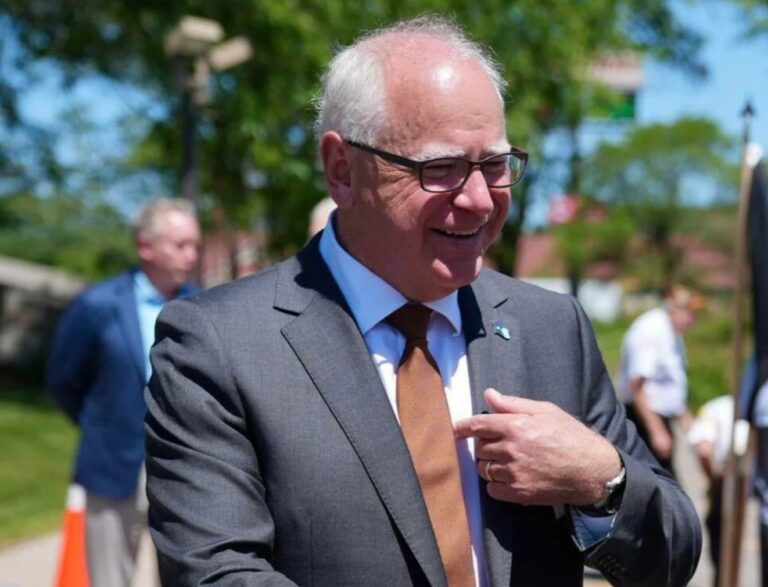
Bob Griffin: Gov. Tim Walz proves there’s no such thing as a free lunch with his education ruination

By BOB GRIFFIN

Vice presidential candidate Gov. Tim Walz is praised by the Left for providing breakfasts and lunches for Minnesota school children, regardless of their income level.

Maybe those resources going to pay for free lunches and breakfast for rich kids would have been better used to teach Minnesota kids to read. 

The year before Walz was elected governor, reading scores in Minnesota were not great. But under his watch, they’ve gotten much, much worse. 

Between 2017 and 2022, Minnesota dropped from 33rd in to 46th in the country in 4th grade reading for kids who qualified for free or reduced lunch, according to the U.S. Department of Education’s Nation Assessment of Educational Progress or NAEP test.

Upper/middle-income Minnesota 4th graders fared no better — dropping from 23rd to 40th in the U.S. 

The trend also impacted Minnesota’s middle schoolers. Low-income Minnesota 8th graders dropped from 39th to 46th, while the upper/middle-income students dropped from 17th to 33rd. Under Gov. Walz’s watch, the average Minnesota student saw a scale score decline more than double the U.S. average “Covid learning-loss” assessments in reading.

According to a recent Rutgers study, Minnesota has one of the most adequately funded school systems in the country, contributing 3.65% of the state GDP to K-12 education.

In 2022, Florida spent only 2.78% of their state GDP on K-12 (lowest in the nation) and they ranked 1st in in low-income 4th grade NAEP reading and 3rd for upper/middle income kids. Florida 8th graders ranked 5th and 20th respectively.    

Free breakfast and lunches for all Minnesota school for kids who don’t already qualify for federally subsidized school meals is costing Minnesota taxpayers and additional $480 million over the next two years. Those resources could provide a lot of reading support to help stem the implosion of Minnesota reading scores. 

The bottom line is: It’s a matter of prioritization of scarce resources. Giving rich kids free food might seem like a nice gesture. But early childhood literacy has to be a higher priority. 

Bob Griffin is a former member of the Alaska Board of Education and an education advocate.

Supreme Courts puts on hold Biden’s Title IX rewrite that allowed boys into girls’ locker rooms

The Supreme Court voted Friday against the Biden Administration emergency request to enforce a new interpretation of Title IX, to include protections from discrimination for transgender students. The ruling puts the entire Biden plan on hold temporarily.

The Biden rule, which went into effect Aug. 1, permitted boys and men in to use bathrooms designed and designated for women in schools and colleges. The Biden interpretation extended to locker rooms and school dormitories in 10 states, where there are now state-level and local-level rules in place to prevent it. Some legal scholars said it opened the door for allowing boys to compete in girls’ divisions in sport.s

The Biden Administration rewrote Title IX to say that the meaning of “sex” includes the meaning of gender identity.

The vote was 5-4, with Justice Sonia Sotomayor dissenting, joined by Justices Elena Kagan, Neil Gorsuch, and Ketanji Brown Jackson.

“Not all Supreme Court justices know what a woman is, but today enough did, and that’s a win worth celebrating.This is a win for women, free speech, the rule of law, and common sense. Onward!” said women’s advocate Riley Gaines.

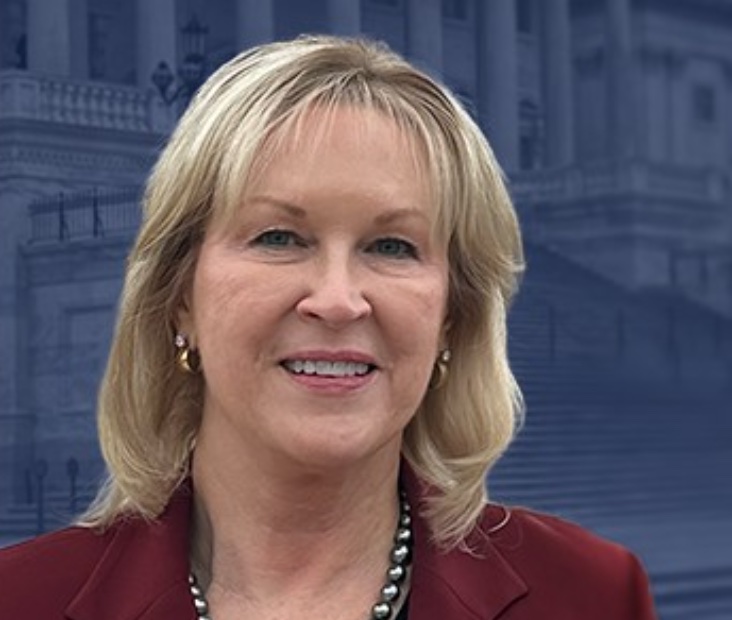
Dan Fagan: How Dahlstrom worked the playbook for climbing the political ladder

By DAN FAGAN

Here’s the playbook for many legislators: Once out of office, score a job with a fat paycheck, one dependent on government bloat, largess, and wasteful spending.

A job like military advisor to the governor. Can you imagine filling a 40-hour work week as the governor’s military advisor?

Alaska state government jobs pay well with little accountability and iron clad job security.

The state has close to 700 public employees per 10,000 residents. That’s more than forty-eight other states.

One in four Alaska employees work for government.

Alaska spends north of $21,000 on state government per capita. That’s the highest in the nation and close to double what 40 other states spend on state government. Idaho spends one-third of what Alaska does on state government.

Back in 2010, Nancy Dahlstrom, after serving in the Legislature, decided to get in on the easy money state government job train.

Then-Gov. Sean Parnell made Dahlstrom his “Senior Military Advisor. “

I asked Republican Gov. Michael Dunleavy’s spokesperson, Jeff Turner, if the position of military advisor still exists. It does not.

“The governor has Gen. (Torrence) Saxe who is more qualified to advise the governor on issues relating to the military,” said Turner.  

Parnell, also a Republican, had adjunct Gen. Thomas Katkus to advise him in 2010. Apparently, he needed Dahlstrom too.

Unfortunately for Dahlstrom, she had to give up her easy on the workload $96,000 per year job shortly after Parnell handed it to her.

The Alaska Constitution prohibits legislators from accepting jobs created while they were in office.

Parnell at the time told the Anchorage Daily News he waited to talk to Dahlstrom about the job until after the session. But Dahlstrom told me otherwise. She admitted the governor first talked with her about the job several months prior.

That’s a huge conflict of interest because Dahlstrom was still in the Legislature and held the powerful position of Rules Committee chair. The Rules chair is uniquely positioned to block or advance legislation, including the governor’s legislation.

Dahlstrom knew Parnell was going to give her this high paying job after the session was over. She had to know blocking any of Parnell’s legislation as Rules Chair could jeopardize her upcoming sweet $96,000 a year salary.

Then gubernatorial candidate and Republican Ralph Samuels told the Daily News Parnell clearly broke the law by giving Dahlstrom the job.   

“This whole sorry episode reeks of politics as usual, doling out highly paid, made-up jobs to political friends. But in this case, what is most troubling is the governor’s clear intent to sidestep the Constitution,” Samuels said.

At first, Parnell’s Attorney General Dan Sullivan, now U.S. senator, gave the governor the green light on the Dahlstrom hiring. But changed his position after I challenged him on his legal opinion.  

Here’s how the Anchorage Daily News reported it in 2010:

“KFQD talk-radio host Dan Fagan began to hammer Parnell on (his legal opinion) last month. The attorney general then came on Fagan’s radio show and said his department’s analysis wasn’t thorough and he would do a more complete one.”

After Sullivan’s “more thorough review” he changed his legal opinion on the Dahlstrom hiring.

In defense of Dahlstrom, when I talked with her, she seemed oblivious to the glaring conflict of interest with her serving as Rules chair, while knowing her potential future boss was willing to dole out almost $100,000 a year to her after the session.

When Dahlstrom admitted to me it had been months since she and the governor discussed her future job, she didn’t seem to be worried about hiding anything.

And there is no way to know if Dahlstrom used her power as Rules chair to benefit her future boss instead of her Eagle River constituents.

Keep in mind Juneau was awash in cash during this time. Only four years prior former Gov. Sarah Palin signed her massive tax increase, ACES.

State politicians, including Parnell, couldn’t find enough ways to spend all the money transferred out of the private sector and into wasteful state government.

It got so bad that the state offered free airfare to any Alaskan willing to fly to Anchorage and attend a game at the then- fledgling Great Alaska Shootout basketball tournament.

The big concern is not the illegal job offer or even the $96,000 heading Dahlstrom’s way.

It’s that as Rules chair, Dahlstrom had a giant financial incentive to do the bidding of the governor instead of her constituents.  

Dan Fagan hosts a radio show on KVNT 1020 AM, 92 FM in Eagle River and North Anchorage, 104.5 FM in South Anchorage and globally on KVNT.com from 7 to 9 AM.

AFL-CIO flyer supports Rep. Mary Peltola and who?

A door-hanger campaign flyer going around District 10 in Anchorage has a curious combination of candidates. The flyer is produced by the AFL-CIO and supports Rep. Mary Peltola in the Congressional race. But in the Alaska House race, the union supports Chuck Kopp, a Republican who is challenging Republican Rep. Craig Johnson.

Kopp is what is often referred to as a false-flag Republican. He opposes more of the Republican platform than he supports it.

Kopp was in the House starting in 2017, but was beat by Republican Rep. Tom McKay in the primary in 2020, losing 61-39. He is a retired police officer and active proponent of public employee unions. Now he’s taking on the Rules Committee chairman of the House, after having spent the lasts few years working as a political consultant for liberal candidates with his company “Winfluence Strategies.”

He has promoted the likes of Rep. Andy Josephson and Sen. Cathy Giessel and the Anchorage Daily News features his opinion pieces regularly, as he has laid the foundation for his return to elected politics. It appears that he would not be a fit for the Republican majority, however, since he has aligned so closely with Democrats.

In late 2018, Kopp, along with Rep. Jennifer Johnston, Rep. Louise Stutes, and Rep. Gary Knopp led a breakaway group from the elected Republican Majority. 

They installed Rep. Bryce Edgmon as House Speaker. Edgmon, a Democrat, agreed to change his party registration to “undeclared,” to give the Republicans political cover. 

In that organization, Kopp became the powerful chair of the Rules Committee. A year and a half later, he was trying to put together an organization that would make him Speaker. Now, he’s tying to unseat the current Rules chair.

The flyer also promotes “Yes” on Ballot Measure 1, raising the minimum wage.

Throw away the key: Under Dahlstrom, innocent Alaskans weren’t allowed to make bail during Covid

Joe Smith was arrested, processed, and arraigned in the summer of 2020. His week went from normal to something out of a Franz Kafka novel after he entered the state prison system.

It was at the height of the Covid pandemic and although Smith could make his nominal bail of $2,500 without any trouble, he was instead thrown into a medical segregation ward of the Alaska prison system, told that he may have come into contact with someone who had Covid, and thus was denied any ability to make bail.

Smith, whose name has been changed because his case is still pending, said he was in a prison cell designed for two men, but which had eight men crowded into it. They were in the same situation — medical isolation because they may have been in contact with someone who had Covid. Some had even been released by the judge on their own recognizance but were imprisoned anyway by the Department of Corrections.

Smith was held for four days, and when his personal attorney called to find out what happened to him, the prison system, run by then Commissioner Nancy Dahlstrom, said they didn’t have him and they didn’t know where he was.

One of his best friends called the Anchorage detention facility, ready to post the bail for him, and asked where he was. He was told the same thing: The Department of Corrections simply didn’t know. Must Read Alaska verified this information with the friend, who is known to the author.

While in that crowded cell, Smith, a successful businessman, wrote a habeas corpus — a legal demand that he be brought before a judge or into court to secure his release or show what lawful grounds the Department of Corrections had for his detention. He gave it to a prison guard … but the Alaska Court System never received it. It went into the black hole of the prison system.

Smith gave Must Read Alaska permission to tell his story. He was prompted to reach out after reading about how then-Commissioner Dahlstrom forced prisoners in 2021 to get Covid shots, or she would deny them the right to see their family members or their lawyers.

Smith, a leading figure known to many in Alaska, said he would sign an affidavit to back up his claims that his constitutional rights were violated by the Department of Corrections.

Smith said it wasn’t just him; at least 20 other men he met during those four days also had their constitutional rights violated by the Department of Corrections in the same manner.

Smith has no other prior violations except a couple of speeding tickets, and this has also been verified by this author. The experience was eye-opening for him. During four days of being “disappeared” by the Department of Corrections, he had no way of knowing if he’d ever see freedom again.

While Smith, who says he is confident he will be exonerated once his case is heard, was shocked at how quickly life can become Kafkaesque in the prison system.

Dahlstrom, meanwhile, has since become lieutenant governor and is now running for Congress on a conservative platform.

Coercion: Dahlstrom withheld family, lawyer visits for prisoners unless inmates first got the Covid shot

Many conservatives have had criticisms of Nancy Dahlstrom, who is running for Congress and simultaneously serving as lieutenant governor of Alaska.

One of the criticisms is that she hasn’t really done anything. Dahlstrom filed for Congress in November after serving as lieutenant governor for a year. Before that, she was the top official at the Alaska Department of Corrections.

But while she was commissioner of the Department of Corrections for Gov. Mike Dunleavy, she was in charge of a vast many lives during the Covid pandemic. Back then, she made sure prisoners were not allowed to see their families or lawyers for over a year.

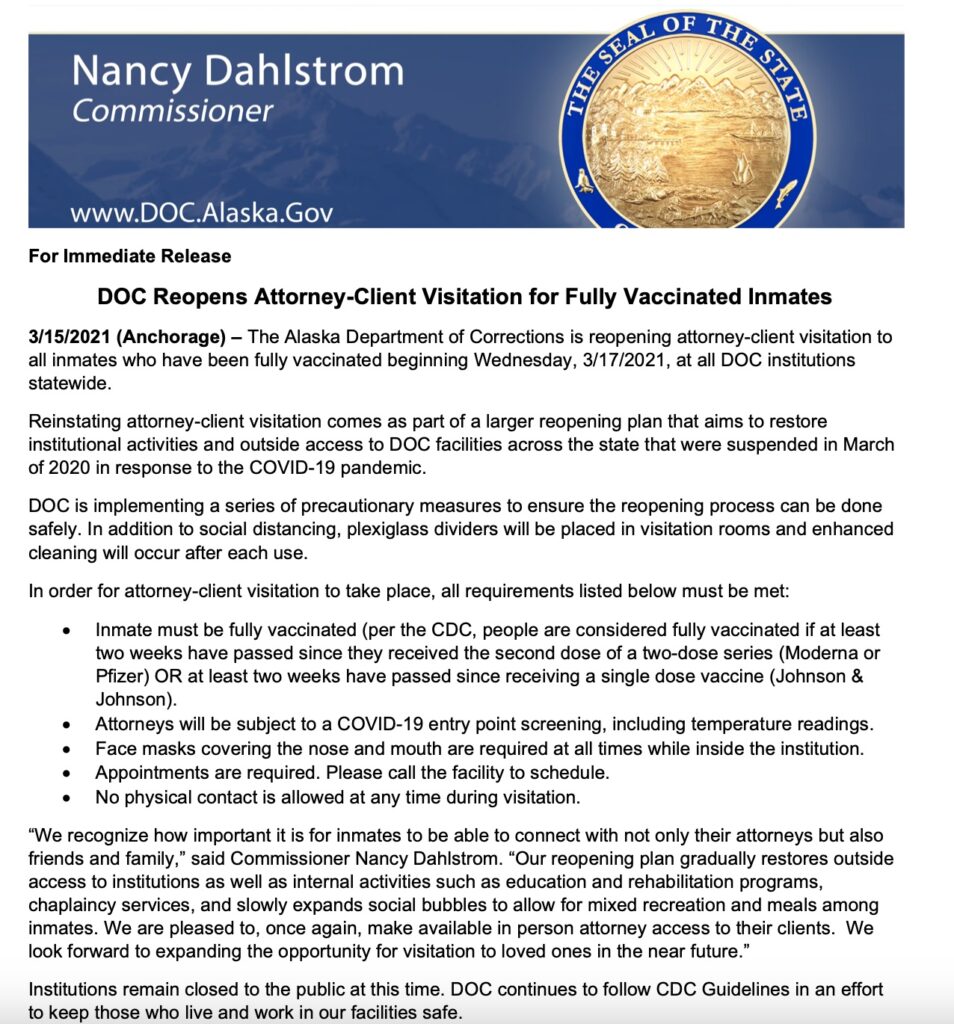
When she finally eased up on what was a hard year of extraordinary confinement for many, Dalhstrom put in a condition: Prisoners could only see their families if the prisoners got the full series of Covid shots and waited two weeks.

This was a form of medical coercion.

Prisoners could not see their children. They could not see their wives or husbands. Not their mothers, fathers, sisters, or brothers. They could see no one from outside the prison unless they submitted to what was being marketed by the federal government and Big Pharma.

The coercion demanding they take the needle if they wanted to ever see their loved ones again is all laid out in the press release from April 19, 2021:

That means for over two years, some prisoners didn’t get to see anyone who cared about them unless they took the shot. Few of them would have had the information needed to make an informed choice.

Under the policy, even the inmates that were fully vaccinated were not allowed to hug their visitor or even touch them. Visitors had to undergo screening procedures and wear a mask at all times.

Dahlstrom also prevented prisoners from seeing their lawyers, saying that in order to see their attorney, they would have to get the full Covid shot series.

Anchorage Superior Court Judge Una Grandbhir put an injunction on Dahlstrom’s no-lawyer order after a group of attorneys sought injunctive relief. After all, there are constitutional questions about being locked up and not being able to consult an attorney.

Back then, the public and public officials were frightened by the Covid pandemic, which came from Wuhan, China, and the information they were receiving from the federal government in 2020 and 2021 was dire.

Like the Biden Administration, some Republican officials made decisions based on the advice of health officials like Dr. Anthony Fauci,  chief medical advisor to the president from 2021 to 2022. Some may have made decisions they later might have come to regret. They were scared, decided to play it safe, and thought they were doing the right thing, based on the information they had.

Dahlstrom was one of those who was tasked with making such life-altering decisions and these were the decisions she made. No announcement has ever been made by the department rescinding the Covid vaccine mandate.

Dahlstrom won’t commit to dropping out if she comes in as second Republican, refuses to say if she supports ranked-choice voting

It’s now in writing. Nancy Dahlstrom, who has just one endorsement in Alaska — Gov. Mike Dunleavy — said she will not commit to dropping out of the race if she is the second-place Republican finisher after Tuesday’s primary election votes are counted.

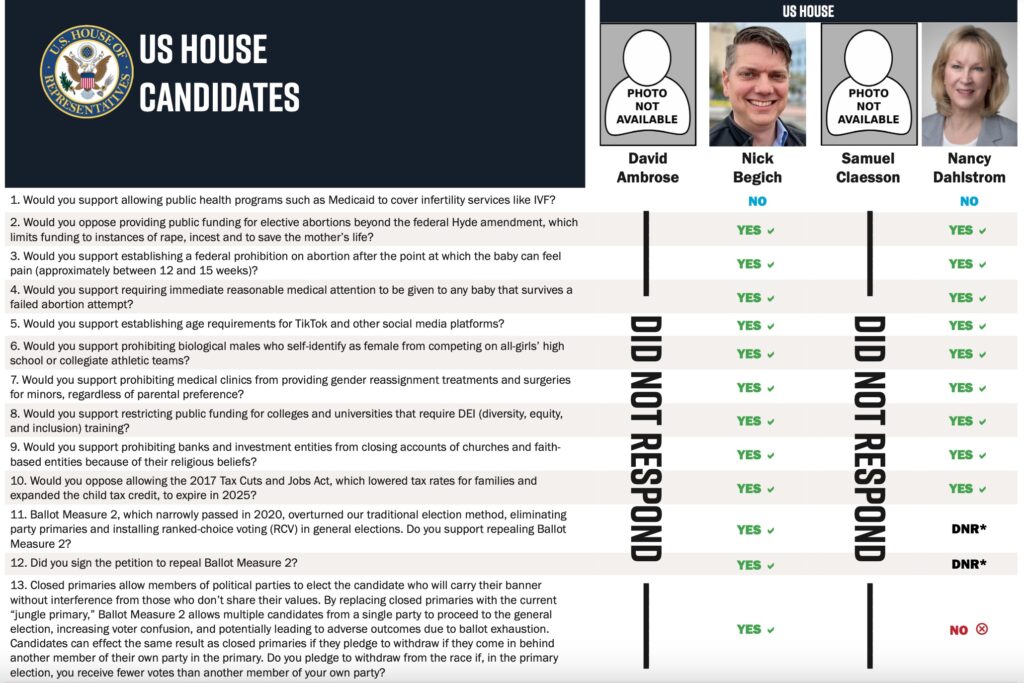
The Alaska Family Council issued its 2024 voter guide this week, asking the candidates a number of questions that are of interest to conservatives. Naturally, the Democrats and some Republicans did not answer the questions in the survey.

But congressional candidates Nick Begich and Dahlstrom did. Dahlstrom answered most of questions. She would not commit to whether she supports ranked-choice voting in Alaska. And she would not commit to dropping if she is not a viable candidate for the general election.

Here’s the comparison between the leading Republican candidates:

Rep. Mary Peltola did not respond to the survey. Read the entire survey and see the other candidate responses at this link.

As of Tuesday, 36% of Republican district committees have endorsed Begich for Congress. None has endorsed Dahlstrom. The primary election ends at 8 p.m. Aug. 20. Learn how to vote absentee or vote early at this link.