The U.S. Army on Sept. 12 sent 130 paratroopers and portions of three Army units, along with a M142 mobile artillery rocket system to Shemya Island, a small island in the western Aleutians, as a show of force after several Russian and Chinese military jets patrolled the area.
Shemya is about 1,200 miles southwest of Anchorage and is one of the farthest west islands in the Aleutian chain; it is on HDT — Hawaii-Aleutian Daylight Time. The windswept tundra island is 2.73 miles long and 4.32 miles wide. A U.S. Air force radar, surveillant, weather station, and 10,000-foot runway opened on Shemya during World War II and is still in operation as Eareckson Air Station, mostly as a refueling stopover for the military. In 2018 a Delta Airlines flight made an emergency landing there en route from Beijing to Seattle after encountering mechanical troubles.
Troops with the 11th Airborne Division and the 1st and 3rd Multi Domain Task Forces, were deployed to Shemya Island during this September military activity after increased presence of Chinese and Russian war ships over the summer.
“As the number of adversarial exercises increases around Alaska and throughout the region, including June’s joint Russian-Chinese bomber patrol, the operation to Shemya Island demonstrates the division’s ability to respond to events in the Indo-Pacific or across the globe, with a ready, lethal force within hours,” said Maj. Gen. Joseph Hilbert, commanding general of the 11th Airborne Division.
The division, stationed at Joint Base Elmendorf-Richardson and Fort Wainwright, defends the northern- and western-most reaches of the U.S., as well as the Arctic.
In addition, the 11th Airborne Division is also assigned to U.S. INDOPACIFIC Command, the Department of Defense’s priority theater and an area representing more than 50% of the world’s population.
“Testing ourselves with this operation and others like it is critical to our nation’s defense and the preservation of a free and open Indo-Pacific,” said Hilbert. “Our ability to deploy combat-credible forces quickly and effectively to any location, no matter how remote, is critical to supporting the nation and our strong relationships with allies and partner nations.”
With early voting now underway in Fairbanks for local elections, the League of Woman Voters of Tanana Valley held its candidate forum for the School Board, Borough Assembly, and mayoral candidates on Friday.
The “hot button issues” that were notable for the Fairbanks North Star Borough Assembly candidates involved fiscal issues, public testimony, and property rights.
Miguel Ramirez, Tammie Wilson, and Jimi Cash kept the focus on supporting the tax revenue cap, and also mentioned the lack of decorum by some current Assembly members during public testimony, and the importance of private property rights.
The decorum issue has been raised by current members of the FNSB assembly and school board earlier. At the heart of the matter is that citizens come into the Assembly or School Board chamber and spend hours testifying to on issues of the day, only to have members of the elected bodies ignore them. One member — Kristen Kelly — uses Assembly time to badger and argue with the public member who is testifying.
During the candidate forum, Assembly members David Guttenberg, Kristen Kelly, and candidate Garret Armstrong favored eliminating the Assembly time set aside for asking questions of testifiers. All three lauded the assemblies in Anchorage and Juneau for putting strict sideboards on public testimony.
In contrast, Ramirez and Wilson said that people in the borough felt their testimony was routinely ignored and that they were made to feel like criminals by certain Assembly members, such as Kristen Kelly.
Ramirez, Wilson, and Cash highlighted that the Assembly has repeatedly ignored public testimony.
For instance, there had been extensive testimony against the recent special election to raise taxes, yet the Assembly voted to hold the election anyway.
There had also been significant testimony by veterinarians and animal rights activists on the cost and actually harmful elements of the animal shelter replacement project (aka puppy palace), and yet more money was allocated to the project.
Three Assembly meetings were dominated by public testimony opposing forming a committee to study mail-in voting. Finally, the Assembly voted down the resolution, pushed by Assembly Presiding Office Savannah Fletcher, after key members of the community made it clear the public was tired of being ignored.
Ramirez, Wilson, and Cash also took the current Assembly to task over fiscal matters. All three emphasized the bloated budget for the $33 million animal shelter replacement project, a facility they say will not meet the needs of the community and which has been opposed by both fiscal conservatives and animal rights groups.
Jimi Cash, who is in commercial construction, stated the cost of the proposed project is ridiculous, and Ramirez agreed the animal shelter price tag is excessive.
Kristen Kelly, David Guttenberg, and Garret Armstrong support the project. Armstrong talked about how his friend’s driveway was expensive and that costs may be escalating for the animal shelter if it doesn’t get built soon. Kelly supported expansion of borough services into pickleball courts, trails, and other leisure activities.
Kelly, Guttenberg, and Armstrong are not supportive of private property rights. In her closing statements, Kelly specifically stated that property rights are “fringe politics.”
Guttenberg, in his closing statements, repeated Kelly’s points, stating that borough governments should not be operating on political ideologies.
Armstrong echoed their sentiments and mentioned his support for running trail easements through private property. Under the current policies in the FNSB, trail easements are required for those who wish to subdivide, even if there is no demand for a trail in the area.
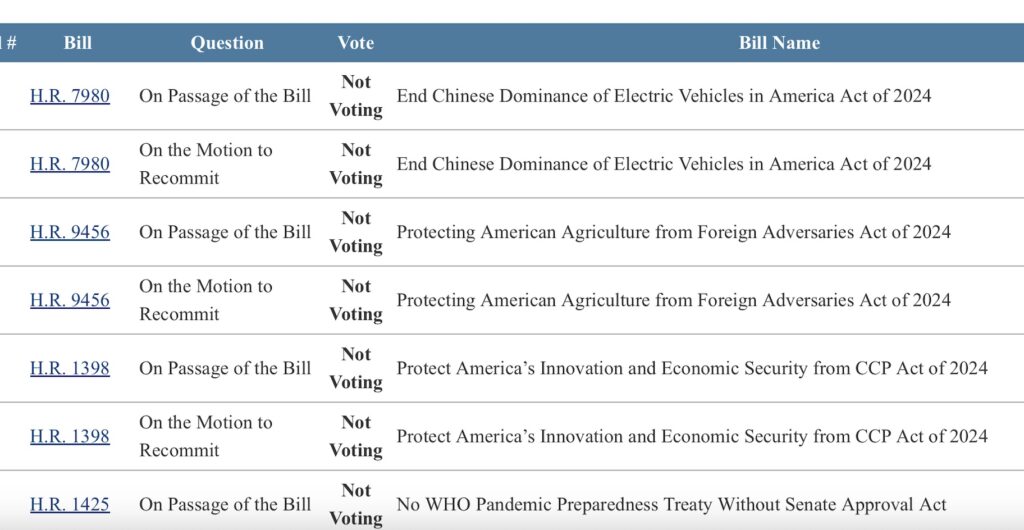
Over the past 100 votes taken in the U.S. House of Representatives, Alaska often has had no one present to represent them. Alaska has been unrepresented for 40 of the last 100 votes taken, as Rep. Mary Peltola has gone missing. She was absent for votes on everything from protecting America from foreign adversaries to finding Attorney General Merrick Garland in contempt of Congress.
Last week she said she would be gone all week to abide by a Yup’ik tradition of spending a whole week celebrating the life of her late husband on the one-year anniversary of his death. It was cultural. However, she was actually campaigning much of the week, according to her subsequent social media posts.
In July, she was not voting because cutting and smoking fish with her family — again, saying this is a cultural tradition that required her to be there to feed her family, which is made up of mostly able-bodied people. She gets $174,000 per year salary for being a member of Congress and all her travel is free.
Her congressional colleagues were voting on issues like the Safeguard American Voter Eligibility Act, which strengthens voting security. They voted on the Refrigerator Freedom Act, which places limits on the authority of the Department of Energy to enforce onerous energy standards for refrigerators, refrigerator-freezers, and freezers unless the standards are technologically feasible and economically justified.
She missed votes on the Department of Homeland Security’s “DHS Restrictions on Confucius Institutes and Chinese Entities of Concern Act.” She also missed other votes relating to China.
Her voting record this summer is nothing to write home about. It looks a lot like this:
Although Peltola told Alaskans she was using the week for cultural traditions, she posted numerous photos of herself on social media at fundraisers, including photos of fundraisers posted on Sept. 12, the exact one year anniversary of Gene Peltola Jr.’s death.
House Rule III, clause 1, “Voting” reads: “Every Member shall be present within the Hall of the House during its sitting, unless excused or necessarily prevented, and shall vote on each question put, unless having a direct personal or pecuniary interest in the event of such question.”
Statute (2 USC 5306) permits the chief administrative officer to deduct from members’ monthly salaries “for each day that [s]he has been absent from the House,” unless the member “assigns as the reason for such absence the sickness of himself or of some family member.” None of that seems to apply to Rep. Peltola, who just has not shown up to the office for 40% of the time the entire summer.
After a social media threat incident gave a scare to families with students who attend Bartlett High School, the Anchorage School District has sent a note to families in the district, imploring them to not share potential threats online.
The threat was perceived to pertain to Bartlett, but may have originated from out of state and may have related to a different school. It also may have been a false threat. Whichever the case, it caused the principal of Bartlett to call for more safety officer presence on Monday.
“In recent weeks, school districts across the country, including the Anchorage School District (ASD), have faced an alarming number of false threats that have disrupted school operations and caused unnecessary fear within our communities. ASD and our partners in local law enforcement are committed to ensuring the safety of students and staff, and we take all threats seriously. We are urging parents and students to be vigilant and mindful of how they handle potential threats,” the school district wrote to parents.
If you come across a potential threat, please include the following information when you report it to your school or the Anchorage Police Department, the district said:
Identify the social media platform where the threat was posted.
Record the date, time, and account name.
Capture screenshots if available and note any witnesses.
Detail the date of the alleged threat, the nature of the threat, and any specific schools or individuals mentioned.
The school district asked people to not repost the threat-related content on social media but to notify authorities so they can see if the threat has credibility.
How to Report Threats:
Contact APD immediately for urgent or imminent threats by calling 9-1-1.
Use STOPiT, the district’s anonymous reporting tool.
Students and parents are encouraged to report concerns to their teachers or principals.
“In order to effectively utilize school district and law enforcement resources, we ask parents to monitor their children’s social media accounts to ensure that students report concerns directly to the school or to law enforcement and not repost them on social media or share with classmates,” the district’s letter to parents stated.
Parents were also encouraged to have ongoing conversations with their children about responsible use of social media, including:
The importance of not sharing or reposting unverified information.
Reporting any concerning content directly to adults, school officials, or law enforcement.
Understanding that threats, even those made in jest, are serious and can have severe legal consequences.
Four people on a Yute Commuter Service plane from Bethel to St. Mary’s went down on Sunday night, killing all aboard, just short of the St. Mary’s runway.
The Alaska Rescue Coordination Center contacted the Alaska State Troopers about the overdue aircraft. St. Mary’s-based Alaska State Troopers responded to the last known location of the aircraft and located the crashed Cessna T207 and four deceased adult males at the wreckage site approximately ½ mile from the runway.
Wildlife Troopers and U.S. Fish and Wildlife Officers responded to assist with transporting the men’s bodies to the roadway so that they could be transported to the State Medical Examiner’s Office for autopsy. The identities of the deceased men will be released once they have been positively identified and next of kin have been notified, the Troopers said in a statement.
It was the third fatal air crash in three days in the state. On Friday, two died when their plane crashed into Tustemena Lake on the Kenai Peninsula, and on Saturday a man piloting an experimental aircraft crashed in Wasilla. The National Transportation Safety Board will be investigating all three crashes.
After another assassination attempt on Donald Trump occurred on Sunday, while he was playing a round of golf, some of Alaska’s political leaders took to social media to issue statements about the matter.
Sen. Dan Sullivan was the first to comment: “We’re very grateful that @realDonaldTrump & his family are safe after another assassination attempt. We’re also grateful that our law enforcement officers responded bravely & rapidly to this despicable threat against President Trump’s life.”
Two hours later, Sen. Lisa Murkowski wrote: “I am very relieved that former President Trump is unharmed following what appears to be yet another assassination attempt and commend the Secret Service for their quick action that saved lives. We must come together as a nation and condemn political violence in any form.”
Rep. Mary Peltola, two hours later, had nearly the exact response as Murkowski: “I’m relieved President Trump, his family, and his team are safe and were unharmed from a second assassination attempt. We must all come together to condemn political violence in any and every form and focus on the issues that unite us as Americans.”
Republican congressional candidate Nick Begich wrote this statement: “Nothing will stop the effort to restore the American Dream, to ensure the American way of life, to put the people of America First. Today we saw yet another attempted assassination of President Trump, but I am 100% certain when I say, nothing will slow this man down. May God continue to protect President Trump and bless our nation.”
Gov. Mike Dunleavyissued no comment. issued a comment Monday: “First Lady Rose and I offer President Trump and his entire family our thoughts and prayers after this second attempt on the President’s life. We wish to thank the Secret Service and others tasked with protecting President Trump for their swift actions, including the quick apprehension of the suspect, with no reported injuries. This unprecedented second attempt ended without injuries, and an individual has been arrested. We will allow the investigation to proceed and will await the findings before making any additional statements.”
The chairman of the Anchorage Assembly did comment on X/Twitter, by republishing a comment from other persons that he evidently agrees with.
Assembly Chair Chris Constant’s comments:
The Alaska Republican Party’s statement: “Thank God President Trump is safe. Violence has absolutely no place in our country’s politics – it should be condemned by everyone regardless of their political beliefs and the terrible & irresponsible rhetoric against our candidate that continues to incite it must stop. The Alaska Republican Party stands with President Trump. May God bless President Trump, may God bless America and may God bless Alaska.”
The Alaska Democratic Party’s statement: No statement issued.
Meanwhile, the Florida Republican congressional delegation is asking why the U.S. Secret Service again failed to secure the perimeter around former President Donald Trump, allowing another shooter to come within several hundred yards of the president armed with an AK-47 style rifle.
The Florida delegation is also calling out Democrats like Chris Constant for suggesting that Trump brought it on himself and for blaming Republicans when the shooter was a Democrat and Democrats have for years said Trump “is a threat to democracy.” Florida Gov. Ron DeSantis opened a state investigation into the situation that led to a lapse in security, indicating he has lost faith in the federal government’s ability to investigate these repeated failures to protect President Trump.
The case of Marbury v. Madison(1803) introduced the doctrine of judicial review, a concept crafted by the Marshall Court to assess the constitutionality of actions taken by the legislative and executive branches.
Some viewed this as the court claiming the power to legislate. Chief Justice John Marshall meticulously established the doctrine as a crucial addition to the system of “checks and balances” designed to prevent any single branch of the federal government from becoming too powerful.
Chief Justice Marshall articulated the U.S. Supreme Court’s role in Marbury, stating, “It is emphatically the province and duty of the judicial department to say what the law is,” emphasizing the importance of respecting the legislature’s intent. However, the unintended consequences of Marbury led to a variety of interpretive philosophies, including judicial pragmatism. Judicial pragmatists see the Constitution as a living document that should evolve to meet new and unforeseen circumstances.
In contrast, we are reminded of Associate Justice Antonin Scalia’s statement, “It’s not a living constitution; it’s a dead constitution. The constitution is not a living organism; the constitution is the law.”
Marbury established both the supremacy of the U.S. Constitution and the authority of the court to interpret it under the Constitution’s ascendancy.
More than a hundred years later, the doctrine of severability emerged. As the court encountered more cases, it faced instances where only parts of a statute were unconstitutional. The question arose: Should the entire statute be struck down or only the offending provisions?
The doctrine of severability has been more subjective than objective jurisprudence scholarship. In the early 20th century, the court began to hold that if a statute contained both valid and invalid parts, the valid parts could be upheld. The decision to sever unconstitutional parts of a statute hinged on whether the legislature would have passed the law without the invalid parts. Thus, the doctrine of severability took shape, sparking similar criticism of the court legislating from the bench.
NLRB v. Jones & Laughlin Steel Corp. (1937) exemplifies the court “legislating from the bench” by using the doctrine of severability. Traditionally, the doctrine addressed whether the valid portions of a statute could stand independently when other parts were unconstitutional. NLRB expanded this concept, not by addressing different parts of a single statute, but by examining how provisions of the U.S. Constitution could be reinterpreted and applied to federal regulatory power. The case expanded the scope of the Commerce Clause and the federal government’s regulatory power over activities previously considered within the states’ domain.
Prior to NLRB, the Commerce Clause was interpreted more narrowly, confining federal regulation to direct interstate commerce activities. In NLRB, the court upheld the National Labor Relations Act (NLRA), which allowed federal regulation of labor relations in industries that could indirectly affect interstate commerce. This marked a significant shift in constitutional interpretation.
The court’s interpretation extended federal power to regulate intrastate activities based on their potential impact on interstate commerce, effectively creating a new framework for the federal government’s role. This decision legitimized the New Deal era’s regulatory regime, fundamentally altering the balance of power between the federal government and the states and allowing for a broad range of federal economic regulations. This resulted in the continued growth of the unelected federal bureaucracy and destroying states sovereignty.
The dissenting justices in NLRB expressed concerns about the court’s role in altering the federal-state power dynamic. They argued that the majority’s decision represented an overreach and a departure from the constitutional limits placed on federal authority. The framers intended a limited federal government with enumerated powers. By interpreting the Commerce Clause to allow extensive federal regulation, the Court stepped into a legislative role, determining policy outcomes rather than interpreting the law.
Dobbs v. Jackson Women’s Health Organization (2022) overturned the federal constitutional protection of abortion rights established in Roe v. Wade (1973), effectively returning the authority to regulate or ban abortion to the states.
Dobbs is unique in federal jurisprudence, marking the first instance in the almost 235-year history of federal jurisprudence where a previously recognized federal constitutional right was overturned and returned to the states, altering the balance of power between federal and state governments and honoring the 10thAmendment.
Unlike NLRB, Dobbs concluded that there was no constitutional protection for rights not explicitly found in the Constitution. Conversely, Roe v. Wade was a significant undertaking by Associate Justice Blackmun to establish a new set of legal standards not explicitly outlined in the Constitution, effectively overriding the intent of the Texas legislature.
NLRB and Roe both represent cases when the court found rights to fit the narrative of the issue and not the law, creating government manipulation rather than the protection of rights. NLRB marked the beginning of a change in the Supreme Court’s approach to jurisprudence. The court began upholding state and federal economic legislation, expanding the interpretation of the Constitution to allow for greater federal regulatory power during the impacts of the Great Depression even when it negatively impacted constitutionally guaranteed rights.
Similarly, Roe established a woman’s right to an abortion within the right to privacy erroneously found in the Fourteenth Amendment, creating a new legal framework for abortion rights across the United States and superseding state laws that regulated or banned abortion.
The comparison between these landmark cases reveals a shift from the court’s historical role of interpreting the Constitution to one of crafting new rights and legislation not explicitly found within the text. With Dobbs, the pendulum may indeed be swinging back, revisiting the balance of power between federal and state governments and challenging the Court’s role in shaping policy and rights. The evolution of judicial philosophy from Marbury to NLRB to Roe and now to Dobbs highlights the ongoing debate over the extent of judicial power and the interpretation of the Constitution in a modern context.
Subjective interpretation of guiding documents, such as the U.S. Constitution, introduces ambiguity and inconsistency, undermining the stability and integrity of the legal and organizational frameworks they establish. To maintain the rule of law and the original intent of these documents, it is essential to adhere to a textual and objective interpretation. This ensures that the documents remain true to their purpose and protect the rights and interests they are designed to safeguard.
Michael Tavoliero is a senior contributor at Must Read Alaska.
A social media message warning of danger at “Bartlett” has prompted the principal of Bartlett High School in Anchorage to take precautions for Monday.
Principal Val Baalerud wrote to parents on Sunday evening regarding a social media post indicating a potential threat to “BHS.”
“At this time there is no reason to believe that this is a reference to Bartlett High School, and it has been discovered that the threat originated out of state. Please know we are working with our partners in APF to resolve this issue,” she wrote.
There are Bartlett High Schools in other states, including Tennessee and Illinois. There are even more BHS-initialed schools across the country.
Baalerud said that out an abundance of caution, “we will have additional SRO [school safety officer] presence at school tomorrow.”
The school will also be delaying its planned safety drills for Monday.
Baalerud said she was grateful to parents who brought forward the concerns: “See something, say something is more than a mantra, it is what we must do to keep each other safe.”
The Alaska Republican Party gathered for its quarterly meeting in Fairbanks and made numerous endorsements this week. We have reported already that Nick Begich was endorsed for Congress, Jared Goecker was endorsed for the Eagle River state Senate seat, and Rep. Jamie Allard was endorsed for House District 23.
In addition, here are some of the other candidates and incumbents who received endorsements:
Rep. Cathy Tilton, House District 26 – Wasilla and MatSu. Tilton, first elected in 2014, is unopposed and is the House Speaker.
Rep. Craig Johnson, House District 28, South Anchorage. Johnson is being challenged by a Republican who is in poor standing with conservatives — former Rep. Chuck Kopp, who was one of the defenders of the catch-and-release crime bill SB 91 when he served in office.
Rep. Stanley Wright, House District 22, East Anchorage.
Elexie Moore, running for House District 28, Wasilla, for the seat being vacated by Rep. Jesse Sumner.
Rep. Sarah Vance, House District 6, Homer.
Jeremy Bynum, House District 1, Ketchikan, running for the seat being vacated by Rep. Daniel Ortiz.
Heather Gottschall, House District 13, Anchorage, running against longtime Democrat incumbent Rep. Andy Josephson.
Rep. Frank Tomaszewski, House District 34, Fairbanks, running for reelection.
Rep. DeLena Johnson, House District 25, greater Palmer area, running for reelection, unopposed.
Some Republicans did not get endorsed because their districts didn’t get organized to request the endorsement from the entire party.