Tuesday, October 20, 2026
Home Blog Page 298

Barbara Haney: Roundabouts in Fairbanks? Think through the winter traffic patterns first

20

By BARBARA HANEY, Ph.D.

Note: I write as a resident of the Nordale area; I don’t represent the Fairbanks North Star Borough Assembly in this column.

I am registering my objection to the proposed roundabout at the intersection of Nordale Road and Peede Road in Fairbanks.

I am not an “anti-round about” person; I think this type of traffic configuration works well with residential- retail-office type traffic in congested areas.

However, this type of configuration does not work well for intersections with significant truck and heavy equipment traffic and is not compatible with the type of traffic that often travels through the Nordale-Peede intersection. Further, the economic activity in the area is not compatible with roundabout traffic. Other safety strategies including improving visibility of traffic signs, turn lanes, grade changes, and speed limit changes would likely improve that intersection and should be considered before the roundabout configuration is considered.

The data to justify the project was requested and summarized in a table at the end of this tome. According to the traffic data made available by the Department of Transportation, there have been roughly two accidents a year over the 5-year period between 2017 and 2021 at the Nordale-Peede intersection.

Unlike Peede-Badger and Nordale-Badger where there have been fatalities, there have been no fatalities or injuries reported in the area. The overwhelming number of accidents are Eastbound on Peede and are due to a failure to stop at the intersection.

First-responders who have attended accidents at the intersection have indicated that the prevailing comment concerned visibility of the intersection. The intersection seemed to “come out of nowhere.” A sight visit to the area would make the visibility challenge abundantly clear. The comments in the DOT data seem to bear out the visibility issue. Vegetation and overgrowth are clearly a problem for drivers east bound on Peede; the stop sign at the intersection is just not visible until a driver is past Lolla Mae. This gives very little opportunity for motorists to brake.

I requested the traffic data and received the raw data set from DOT. I sorted the data by year, and removed traffic that was not explicitly at that intersection. Freeman Road, Lindsbourg, Cloverleaf, Nordale-Badger, Badger-Peede, the Alyeska yard, moose & mailbox incidents were removed from the data. The data was then sorted by year to see the frequency of events. The data is at the end of this column.

In examining the pictures above, the first picture was taken just before the intersection of Lolla Mae St and Peede Road, approaching the sign. The second picture is just after Lolla Mae St. and Peede. The stop sign at Nordale-Peede is covered by vegetation and is not visible. The stop sign is only visible after passing Lolla Mae Street. This gives drivers little time to reduce speed and stop. Foliage mitigation, such as cutting down trees, would be improve visibility immensely.

Furthermore, there is no indication that the intersection is a 2-way stop. Drivers who are not familiar with the area often assume that Nordale-Peede is a 4-way stop.

Signage indicating that cross traffic does not stop on the Nordale Road sign would be beneficial and alert drivers that the traffic on Nordale does not stop and to exercise patience would be helpful to people unfamiliar with the area.

Further, the data supports increasing visibility of the stop sign rather than a new configuration. In examining the data relevant to the project, “did not see stop sign” is a frequent cause of accidents. It would be far cheaper to chop down or trim the trees to improve stop sign visibility rather than construct a roundabout. There were no fatalities reported at this intersection. In contrast, there are intersections along Badger Road that have had significantly more accidents and fatalities. Problem intersections include Badger- Plack, Badger Nordale, and Badger-Peede. It would be more productive to use HSIP funds on those projects rather than a roundabout at Nordale-Peede.

Other configuration challenges

There are other configuration challenges at the Nordale-Peede intersection that could be addressed. These involve grade changes and line of sight during the winter months. Addressing these grade changes might also be helpful.

Peede sits much lower than Nordale. In vehicles that sit lower, such as sedan and compact vehicles, the view can easily be obstructed. A year ago there was extensive utility work by Golden Valley Electric Association near the intersection, and heavy equipment was often parked near that intersection. On a few occasions, this created a line-of-sight challenge for drivers.

Similarly, west-bound drivers crossing Nordale often contend with telecommunication trucks at the intersection. Snowberms also reduce visibility at the intersection, as they did in the winters of 2002-2023.

While these are temporary challenges, great care should be taken in considering the data against these projects where there were some line-of-sight challenges.

Road grade has also presented maintenance challenges. During the ice storm in December of 2022, DOT’s had significant equipment failures (ice breaker) that limited maintenance operations on both roads. Due to grade changes, a “small berm” on Nordale can appear to be a mountain when viewed from Peede. Further, the grade change from Nordale to Peede causes frost to accumulate on Peede, making it difficult for drivers to gain traction.

There is a similar road grade challenge at the intersection of Peede and Badger. Thus, it may be worthwhile examining changes to the road grade on Peede which would help both intersections rather than a roundabout.

Roundabout would be incompatible with traffic mix

The Nordale-Peede intersection is a major intersection used by recreational traffic. The Nordale Boat launch, the Peede snowmobile trail to Chena Lakes, Mushing on the Chena River (Yukon Quest), snow machine and four-wheeler trail use on the “Nordale Flats” is extensive. This results in a significant amount of traffic that involves trucks pulling trailers. Roundabouts can be difficult to navigate with trailers, particularly in icy conditions. Further, others seeking to enter the roundabout may not see an empty trailer being pulled by a truck and they enter the roundabout prematurely, resulting in accidents.

In addition, there is significant use of heavy equipment in Nordale – and only a small fraction is associated with the Alyeska yard. There are gravel pits in the area that are an important source for both private residents and DOT.

It is not unusual to see a forest mulcher on a lowboy trailer to clear timber. It is not uncommon to see logs being hauled to one of the various mills for processing. There are several shops in the area that cater to the repair of large commercial diesel engines that are often attached to large equipment. The Nordale area is an access point to various private lands and public owned lands which hold significant timber interests. Construction of a roundabout at Nordale-Peede would be a major impediment to the continued success of local businesses and the development of timber and gravel resources in that area.

There is extensive use of the GVEA easements by motorized recreational users. The utility corridors along Peede and Nordale are used extensively by ATVs and snowmachines year around to go to Badger Gas, the Peede Fishing area, and the bus stop. A roundabout would greatly disrupt that traffic and provide an incentive for users to cross Nordale at Ravenbell rather than Peede. This increase in traffic would increase the cost of maintenance of the Borda Road Service area.

A roundabout would also increase traffic in the Borda Road Service Area in other ways, raising maintenance costs. Recreational traffic, either on ATV or trucks with boat trailers, would seek ways to avoid the roundabout, irrespective of its construction. To avoid the roundabout, there would be an incentive to take Cloverleaf Dr. from Nordale to Peede, then Dakota St. to Ravenbell St. and back to Nordale. These roads are part of a borough road service area and maintained by property owners and their property tax funds.

The increased traffic will increase maintenance costs and make it burdensome for property owners in the area.

Prospects for Economic Development

Because of the traffic mix, it would be detrimental to the economic development and recreational prospects of this important part of the region. The area relies heavily on truck and heavy equipment traffic which is not compatible with a roundabout. The area has an extremely strong and vibrant role in recreational traffic. The area has significant heavy equipment traffic. Minor improvements such as a lighted stop sign in a visible location, signage warning drivers on Peede that cross traffic does not stop, a flashing light, reduction in vegetation and snowberms, & reductions in speed limits are all things that would improve the intersection for far less than the cost of a roundabout.

Constructing a roundabout will not improve visibility, nor will it address the road grade challenges that exist on Peede. Even a roundabout must be visible to be used successfully. While a roundabout could be built to accommodate truck traffic, it would require significantly more land than is under the current DOT easement. It would be a very heavy hand to solve a problem that can be readily remedied with simpler strategies.

Improvements & HSIP Priorities

There are several lower cost options that can be pursued to improve the safety of the intersection. Removing vegetation, improving visibility of traffic signs, indicating cross traffic does not stop to east bound drivers on Peede are all lower cost measures. Speed limit changes could also help.

HSIP funds are for intersections with high fatalities, not minor traffic incidents. There are several intersections in Badger-Nordale area that are far more worthy of consideration of large scale HSIP funds. To propose a roundabout at Nordale-Peede two weeks before the wake of a family that died on Badger on Dec. 3 seems a bit tone deaf by DOT to the community.

I strongly urge DOT to reconsider the Nordale-Peede roundabout project. It should not be adopted into the transportation plan by Fast Planning or the DOT.

Barbara Haney, Ph.D. is a resident of Fairbanks and serves on the borough Assembly but is writing in the capacity of a private citizen.

Sample of data set.

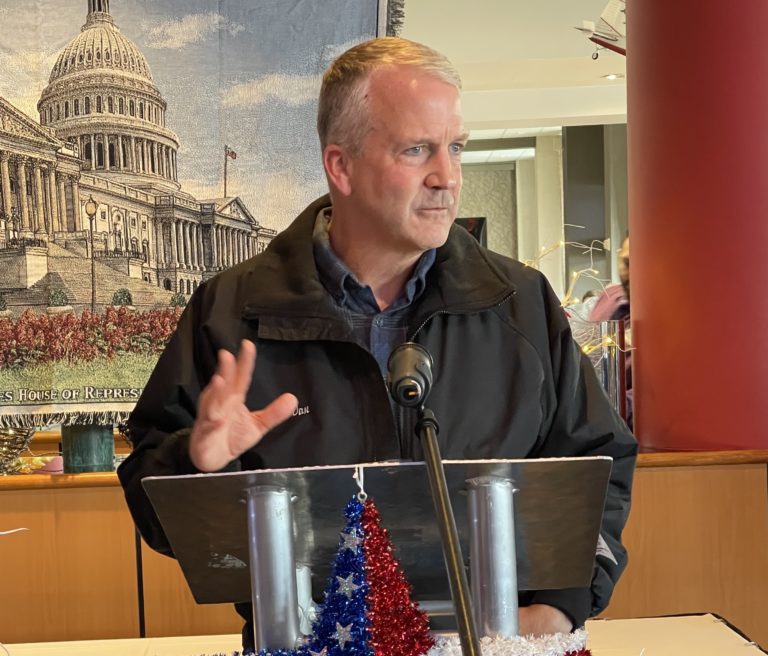
Dunleavy at Mar-a-Lago with Republican governors and Trump

Gov. Mike Dunleavy was with the Trump transition team in Mar-a-Lago, President Donald Trump’s home in Florida. He was with a group in a press conference led by Gov. Ron DeSantis, who told reporters that if California Gov. Gavin Newsom was a Republican, he would be “nailed to the wall” over that state’s response to wildfires.

Dunleavy was with a group of Republican governors invited by Trump to meet with him before he takes office on Jan. 20.

Dining with Trump on Thursday were 22 of the 27 Republican governors, who engaged with him in a discussion of how to drive forward the America First agenda. A few could not attend due to the massive snowstorm impacting their states.

Montana Gov. Greg Gianforte told reporters “It’s been a long period without cooperation from Washington, so, we’re looking forward to the new administration coming in. We have a lot of business to get done on behalf of our states. We’re just pleased to be here to meet with the president.”

On Wednesday, Trump held a meeting Republican senators on Capitol Hill on Wednesday, which included Alaska Sen. Dan Sullivan. Sen. Lisa Murkowski did not attend that meeting.

Sullivan, however, was able to bring up Alaska issues with Trump during the meeting.

In the video above, Gov. Ron DeSantis told reporters gathered outside, “If Newsom was a Republican, you guys would go try to — you would have him nailed to the wall for what they are doing over there. I know, we’ve dealt with it. We just assume in Florida, anytime something happens, it’s going to be politicized by the media. So you guys sitting in judgment of Donald Trump, I mean, excuse me, I think your track record of politicizing these things is very, very bad.”

“What I’m telling you is you guys are trying to make an issue of it when I have watched from this seat — in fact, when I got elected governor, I was meeting with some other Republican governors and what they would say is, ‘Hey, if you have a natural disaster, just know media is coming at you, they’re going to do it,’” DeSantis said. “It’s not the same. That mayor of L.A., if that were a Republican mayor, I can only imagine what that would do. I mean, you know fires are a high risk and you try to go to Africa or wherever she was, to go on some type of voyage? You should have been there preparing and doing that. And yet I don’t see a lot of heat being directed in that thing.”

Sullivan votes in support of Laken Riley Act to stop Biden’s ‘dereliction of duty’ on immigration

26

The Laken Riley Act, legislation designed to prevent crimes committed by illegal aliens, cleared a critical hurdle in the Senate with an 84-9 vote on its first procedural test of the new legislative year.

The legislation, introduced by Sen. Katie Britt of Alabama and Congressman Mike Collins of Georgia, has suddenly gained significant Democrat support, with 33 Senate Democrats joining all present Republicans to move it forward. The Senate is now controlled by Republicans, who are moving their legislation, some of it for a second time. Only nine Democrats voted against advancing the legislation.

Alaska Sen. Dan Sullivan, a co-sponsor of the bill, expressed his gratitude for the quick progress on the bill, which he described as a vital step toward restoring accountability in immigration enforcement. Sen. Lisa Murkowski did not vote on the bill.

A similar bill had passed in the House of Representatives on Wednesday, with the support of Alaska Congressman Nick Begich III.

Named in honor of 22-year-old Laken Riley, who was killed by a criminal illegal immigrant last year, the legislation mandates that U.S. Immigration and Customs Enforcement detain undocumented immigrants accused of theft, burglary, larceny, or shoplifting. The bill stipulates that these individuals remain in detention until they are deported to prevent them from reoffending.

Additionally, the act grants states the authority to pursue civil actions against federal officials who fail to enforce immigration laws or violate statutory obligations.

Sen. Sullivan attributed the rise in crime and drug trafficking, including fentanyl distribution, to what he called a “complete dereliction of duty” by the Biden Administration. He stated that the border policies implemented over the last four years have exacerbated national security, health, and humanitarian crises.

“The consequences of the largest invasion of illegal aliens in American history – which began four years ago – are a tragedy and represent a complete dereliction of duty by President Biden,” Sullivan said. “The Biden administration’s border policies, which included deliberate orders to ignore federal law, have created a national security, health, humanitarian, and crime crisis of epic proportions. Laken Riley should still be alive today. So should thousands more Americans who have lost their lives as a result of these reckless and dangerous policies. Alaskans have certainly felt the impacts of the record amounts of drugs, particularly fentanyl, and cartel members coming across the border and reaching our state thousands of miles away. The Laken Riley Act is an attempt to make America safer and restore accountability to the people in charge of carrying out America’s immigration laws.”

The bill’s progress marks a shift from the previous Congress, where similar legislation passed the House but was blocked in the Senate. With Republicans now holding the Senate majority, the bill has gained momentum, reflecting a growing bipartisan consensus on immigration enforcement now that Sen. Chuck Schumer is not in control and Biden is just 10 days away from being a former president.

Congressman Begich says he supports putting sanctions on illegitimate ‘International Criminal Court’

Last week, Rep. Chip Roy of Texas and House Foreign Affairs Committee Chairman Brian Mast of Florida introduced legislation to shield Israeli officials from the lawless and illegitimate attacks of the “International Criminal Court.”

Israel is currently at war with Hamas, a recognized terrorist organization.

The “Illegitimate Court Counteraction Act” (H.R. 23) would impose sanctions on any International Criminal Court officials who seek to go after U.S. citizens or her allies, including Israel. 

The legislation passed the House on a bipartisan basis last Congress with the support of 42 Democrats. The bill never moved in the Democrat-controlled Senate. President Joe Biden supports the ICC.

The ICC is an illegitimate court that represents a massive threat to US sovereignty, Roy said. The Trump administration was right to impose sanctions on the associates of the ICC if they dare go after US citizens, servicemembers, or her allies; Biden’s decision to reverse that policy was weak, embarrassing, and wrong, he said.

Congressman Nick Begich III said he supports the bill.

“The U.S. is not a member of the International Criminal Court (ICC) nor party to the Rome Statute. Therefore, the ICC has no jurisdiction over the United States or its citizens,” Begich said. “Protecting the sovereignty of our nation and our citizens requires that we stand up to organizations like the ICC, make clear that we do not recognize their authority, and will not cede those rights uniquely protected under the United States Constitution. That is why I am proud to support the Illegitimate Court Counteraction Act.”

Rep. Roy said the ICC is engaged in a “shameful lawfare campaign against Prime Minister Netanyahu for doing his duty to protect his fellow citizens from Hamas in the wake of the barbaric October 7th attacks. But let’s be clear, this isn’t just about Israel, this is about ensuring that our nation’s sovereignty is protected, as well as the American servicemembers. If we do not check this rogue, leftist ‘court’ now, we can rest assured that our military leadership and troops will be the next targets of its political attacks.”

Roy continued, “While I have full confidence that President Trump will stand for Israel with the strength and moral clarity that Biden has sorely lacked, this bill will ensure that no future administration after him will be able to give the ICC a free pass to attack our allies like this.”

Mast said the bill sends a clear message to the International Criminal Court: “We may not recognize you, but you sure as hell will recognize what happens when you target America or its allies. The ICC’s attempt to obstruct Israel’s right to defend itself has only prolonged the war and prevented the release of American hostages by boosting Hamas’ morale.”

Alaska Native groups are insulted by Biden’s ANWR fake-lease strategy, and they are are speaking up

The legacy media narrative is that Alaska Native groups approve of President Joe Biden’s pretend leases in the 1002 area of the Arctic National Wildlife Refuge. The second lease sale for oil and gas tracts mandated by Congress in the 2017 Tax Act received no bids at all, while the first one only received scant interest. The bids were just not viable, with the Deep State working against oil and gas.

But Natives who live in the farthest northern reaches of the state are unhappy about the Biden Administration’s fake-lease strategy and the comments made by the Department of Interior after the second lease failed to get any interest.

“The lack of interest from oil companies in development in the Arctic National Wildlife Refuge reflects what we and they have known all along – there are some places too special and sacred to put at risk with oil and gas drilling. This proposal was misguided in 2017, and it’s misguided now,” said Acting Deputy Secretary Laura Daniel-Davis, who came from the environmental industry’s National Wildlife Federation before joining the Biden Administration. “The BLM has followed the law and held two lease sales that have exposed the false promises made in the Tax Act. The oil and gas industry is sitting on millions of acres of undeveloped leases elsewhere; we’d suggest that’s a prudent place to start, rather than engage further in speculative leasing in one of the most spectacular places in the world.”  

That was insulting to people who actually live in the region.

“Today, the U.S. Department of the Interior (DOI) announced that the Bureau of Land Management received no bids in the congressionally-mandated oil and gas lease sale in the Arctic National Wildlife Refuge’s (ANWR) Coastal Plain. DOI’s comments are deeply insulting to our region given that they undermine the will of Kaktovik, the only community within ANWR’s 19-million-acre expanse,” said Nagruk Harcharek, president of Voice of the Arctic Iñupiat.

Harcharek said the lack of interest by bidders is a byproduct of years of inconsistent policy moves by the Biden Administration regarding indigenous North Slope Iñupiaq lands, intended to stymie economic development in the region.

“The Biden administration’s approach to ANWR has been defined by its efforts to exclude Indigenous voices from Kaktovik, the only community within ANWR, from the policymaking process while elevating outside groups and voices who have no connection to our lands and people. Our community has a right to shape our shared economic future, and we will continue to fight against the Biden administration’s attempts to make us environmental refugees in our homelands,” Harcharek said.

“North Slope communities want to advance Iñupiaq self-determination through durable, collaborative policy making. These communities were dissatisfied with the Biden administration’s decision to initiate and finalize an unnecessary supplemental environmental impact statement (SEIS) that did not reflect the majority consensus of local and regional elected officials, while also minimizing development opportunities contrary to the spirit of the law,” he continued.

The result exemplifies the federal government’s deeply flawed policy approach to this issue, creating industry uncertainty during the ANWR lease sales process. It’s a deliberate federal approach, he said, “and it is shameful that the Biden administration would seek to use our economic security as a political football.”

Voice of the Arctic Iñupiat serves the eight communities of Alaska’s North Slope Borough – the northernmost municipality in the United States, across a remote 95,000 square miles from the Brooks Range to the Arctic Ocean. It faces the Chukchi Sea and the Beaufort Sea.

Th State of Alaska is suing over the bad-faith actions of the federal government in its actions in the 1002 area.

“Interior’s continued and irrational opposition under the Biden Administration to responsible energy development in the Arctic continues America on a path of energy dependence instead of utilizing the vast resources we have available,” Dunleavy said. “These resources not only help our energy independence as a nation but also grow the Alaska economy and put more money in the Alaska Permanent Fund for future generations,” said Gov. Mike Dunleavy. He said he is hoping for a brighter future for Alaska with Donald Trump returning as president.

Charles Lampe, who is Kaktovik Iñupiat Corporation’s president, said Kaktovik wasn’t even included in the discussion. It is the only community within the Arctic National Wildlife Refuge.

“As the only community that exists within ANWR, Kaktovik should have been included at the policymaking table throughout this policymaking process,” said Lampe. “There’s a reason that the people of Kaktovik voted over 75% in favor of the Trump-Vance political ticket. This current administration keeps adding insult to injury with their flawed processes, falsely claiming to work with those who this will most affect.”

The oil and gas lease tracts put forward by the Biden Administration were part of a “disingenuous move designed to meet the minimum legal requirements outlined by Congress while undermining any economic potential in our region—a bad faith effort that jeopardizes the economic and cultural future of our communities for political gain,” the Voice of the Arctic Iñupiat said when the second bid tracts were revealed in December.

Mystery gasline company working on AK-LNG revealed as Glenfarne Group

The gasline company that the Alaska Gasline Development Corporation is in negotiations with to build the AK-LNG project was revealed this week to be the Glenfarne Group. The news came on Tuesday from the Alaska Landmine, a news and opinion organization that announced it on X. It has been confirmed by sources in the Governor’s Office.

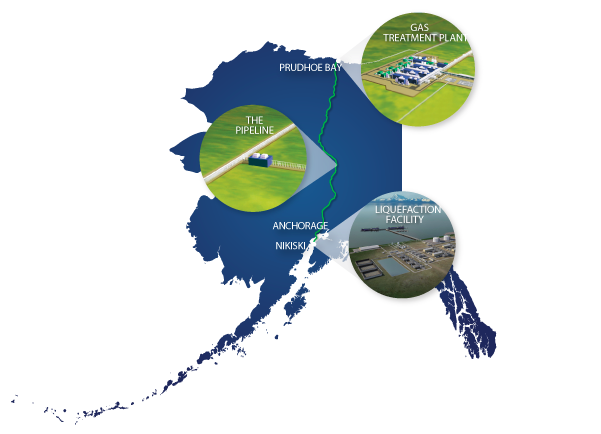
At the end of a press availability on Jan. 6 with Gov. Mike Dunleavy, the AGDC President Frank Richards said the state-owned agency has entered into a framework agreement with a qualified energy producing company for Alaska LNG, a proposed gasline from the North Slope, which will include a Nikiski export facility, a pipeline, and carbon capture components. A formal agreement is expected to be announced soon. But Richards didn’t say who the company was, at the time. That news leaked out the next day.

“I don’t understand why people treat these things as so secretive. It always comes out anyway. It’s pretty loose when a deal of this nature gets broken by the Landmine,” said Jeff Landfield, publisher.

But it’s early, and it’s all a stage-gated process, where each party meets certain goals before moving forward, in order to de-risk the project for all parties at the table. The gas itself is owned by the oil companies with leases on the North Slope, and for many years has been very useful right where it is, reinjected into the drained underground oil geologic caverns to force out more oil for the Trans Alaska Pipeline System.

“The terms of the framework agreement are being negotiated or have been negotiated; the next step is for both parties to create a legally binding development agreement that will move the project forward,” Richards explained.

Glenfarne Group is a global company based in New York City and Houston, Texas and is a developer, owner, operator, and industrial manager of energy and infrastructure assets, like the one that Alaska has been trying to get out off of the drawing boards for decades.

Glenfarne, founded in 2011 by Australian Brendan Duval, also owns companies in South and Central America. In 2022, Glenfarne Asset Company, LLC acquired Termonorte Colombia S.A.S. (the “Plant” or “Termonorte”), a power plant located near the port of Santa Marta in Colombia.

“The acquisition reinforces Glenfarne’s commitment to providing grid stability to Colombia and the entire Latin American region,” the company said. Read more about Glenfarne at its website.

The group appears to have raised $4 billion for the $44 billion Alaska LNG project, which would bring North Slope gas to tidewater at Nikiski, where it could be exported to Asian markets. Offtakes would allow gas to be delivered to communities on the Railbelt, from Fairbanks to the Kenai Peninsula.

Anchorage Assembly postpones 3% sales tax vote, but why pay for special election?

“There is nothing more permanent than a temporary sales tax.” – Anon

It’s tax season and Alaskans are starting to prepare for the April 15 federal tax deadline.

The Anchorage Assembly on Tuesday night delayed a public vote on whether to enact the Assembly’s proposed 3% “temporary” sales tax. It won’t be on the April 1 ballot.

Rather than drive fed-up residents to the polls right when people are calculating their federal tax returns, a time when liberal candidates favored by the Assembly majority might be rejected by voters, the Assembly will instead have a special election for the sales tax, at a date to be determined. Likely, it will come at a time when the public is distracted by fishing or holidays and won’t send in their ballots. Anchorage conducts all of its elections by mail.

With fewer people paying attention, the Assembly can assure a low turnout, which means that the municipal employees and unions will make up the majority of the voters, while the rest of Anchorage sits it out on a salmon stream somewhere in Alaska.

Special elections like this are designed for a certain outcome. City workers and their unions will want that sales tax to go through, because government workers always want more resources to have more government programs.

The Assembly is looking for revenues it can get outside of the tax cap, which it is now up against. Recently, it increased tariffs at the Port of Alaska — outside the tax cap. Most bonds on the municipal ballots have a caveat that all future costs related to a project, such as operation and maintenance, will also be outside the tax cap. The alcohol tax is outside the tax cap. The list of taxes the city leaders and voters have passed outside the cap is extensive.

Proponents have promised it will reduce property taxes, but they are challenged by a public that has little faith in government promised being kept.

The sales tax proposal by Assembly members Randy Sulte and Felix Rivera might generate $180 million annually, but would have significant administrative costs and mean additional revenue staff. The sponsors say the sales tax would be temporary.

Sales taxes never end up being temporary.

For example, Minnesota passed a temporary sales tax that was later temporarily increased to 6% in 1982, and was made permanent the next year. Another temporary increase to 6.5% in 1991 is still on the books today — 33 years of temporary sales tax that not only didn’t go away, but has crept higher.

The special election is estimated to cost taxpayers $200,000.

The resolution to delay the election passed 7-5, with Scott Myers, Mark Littlefield, Karen Bronga, George Martinez, and chairman Chris Constant voting against it, and Meg Zaletel, Felix Rivera, Daniel Holland, Randy Sulte, Kameron Perez-Verdia, Anna Brawley, and Zac Johnson voting in favor.

How it started, how it’s going: In November, Gov. Newsom called a special session to ‘Trump-proof’ California. It’s a cautionary tale for Anchorage.

After the election of Donald Trump as president, California Gov. Gavin Newsom, who is the Democrat leader in the failed never-Trump movement, immediately convened a special session to ask for $25 million to fight the Trump Administration.

Newsom has made a name for himself as the head of the resistance against Trump and although many thought he should replace Joe Biden this year as president, his political hands were tied. He has been a strong possibility to run for president in 2028.

Newsom said in November he needed the money to protect “California values,” which include being a sanctuary state for illegal immigrants and the child gender mutilation industry.

Newsom is now battling to preserve his political future, but he has not been helped by the slow federal government.

It wasn’t until late Wednesday that the Biden Administration announced it would send additional firefighting personnel and capabilities to California to assist in battling the series of out-of-control wildfires. When those assets will arrive is uncertain, but wind-driven fire weather is expected to remain until Friday in Southern California, where the footprint of the fires are small, but are many and are in urban areas that now look like war zones.

Newsom is being blamed for focusing on the wrong things, and not being ready for the fires, which have destroyed hundreds of homes and killed five people in the past week.

“Governor Gavin Newscum refused to sign the water restoration declaration put before him that would have allowed millions of gallons of water, from excess rain and snow melt from the North, to flow daily into many parts of California, including the areas that are currently burning in a virtually apocalyptic way,” Donald Trump wrote on Truth Social, the social media platform he started after the old Twitter management kicked him off of that platform.

Newsom says Trump mischaracterizes the complex water system in California. But as the leader of the anti-Trump movement, he and Los Angeles Mayor Karen Bass appear to be ineffective leaders and are fighting battles on two fronts: The disaster response and the political fallout for them both.

“Fire is spreading rapidly for 3 days — ZERO CONTAINMENT. Nobody has ever seen such failed numbers before! Gross incompetence by Gavin Newscum and Karen Bass….And Biden’s FEMA has no money — all wasted on the Green New Scam! L.A. is a total wipeout!!!” Trump posted on Thursday morning on Truth Social.

The left-leaning Los Angeles Times categorizes that as false, but in fact, the Inflation Reduction Act of 2022 authorized the Robert T. Stafford Disaster Recovery and Emergency Act to provide financial assistance for costs associated with low-carbon construction materials and net-zero energy projects. FEMA’s 2022-2026 Strategic Plan includes “whole of community in climate resilience” and encourages states to build climate-resilient communities. This is a vast expansion of the original Stafford Act, signed into law in 1988 and designed to provide a framework for the federal government to offer financial assistance to state and local governments when dealing with major disasters. It allows the president to declare emergencies and major disasters and to provide federal aid in situations like hurricanes, floods, earthquakes, fires, and other natural events, essentially supplementing state and local efforts to save lives and protect property.

Hundreds if not thousands of structures have burned and over 100,000 Los Angeles residents have been ordered to evacuate while their neighborhoods burn out of control. Opportunistic looters have snuck into the burned-out wealthier neighborhoods to take advantage of the evacuation, and only two have been arrested for looting.

With entire communities in the Los Angeles County area burned to the ground, Mayor Bass and Gov. Newsom have just watched as their political futures were also torched by the city and state governments’ inability to prioritize what is the first role of government: To protect citizens.

It’s a cautionary tale for the leaders in Anchorage, where hillside residents face some of the same conditions, with dry weather and high winds combining at times to create wildfire conditions. While the mayor and Assembly of the city focus on equity and diversity, crime has spun out of control in the city and never discuss hardening the hillside surrounding Anchorage against fires, which are increasingly started in homeless encampments that migrate from one greenbelt to another.

Just as in Pacific Palisades, the canyon neighborhood that burned in greater Los Angeles, many areas of the hillside in Anchorage have winding and narrow roads with limited access and no fire hydrants. The mayor and the Assembly of Anchorage, meanwhile, have made it their priority to remove the dam on the Eklutna River that serves as a reservoir for Anchorage’s water supply.

L.A. on fire: Hydrants stolen, mayor cut fire service budget, and left for Ghana on taxpayer dime

42

By KENNETH SCHRUPP | THE CENTER SQUARE and MUST READ ALASKA

 Hundreds of fire hydrants were stolen from the ground for scrap metal in advance of the blazes raging across Los Angeles, highlighting the local government’s challenges in maintaining basic order and infrastructure. 

“These fire hydrant thefts are yet another sign of how crime is out of control in Los Angeles County,” said Los Angeles District Attorney Nathan Hochman to The Center Square before his November election. “Thieves know they’ll face little or no consequences if they are caught, so they’re willing to risk the public’s safety for a small profit.”

Los Angeles Mayor Karen Bass, who has been away on a taxpayer-funded trip to Africa as a member of a Biden administration delegation, recently cut the fire department’s budget by $17.6 million. 

Upon her arrival back in the United States, Sky News asked Bass whether she regrets cutting the fire department’s budget, and if she feels she owes citizens an apology for being absent as the city burned. 

Bass ignored the questions, her eyes glued to the ground as she proceeded through the airport. 

Days before Bass left for Ghana, the National Weather Service’s Los Angeles Bureau warned of “extreme fire weather conditions.” 

The day before fires broke out, Bass shared a NWS warning, suggesting she may have been aware of the fire before her departure.

“There is an expected destructive and potentially life-threatening windstorm starting Tuesday morning through Wednesday afternoon,” said Bass. “Stay safe LA!”

On Wednesday, fire hydrants in Pacific Palisades lost their water pressure entirely. All water storage tanks in the area were dry. Water reservoir projects promised by the state government for years have not been built.

As of Wednesday evening the fires are zero percent contained.

Stay up with the Los Angeles Fire Department reports and maps at this link.