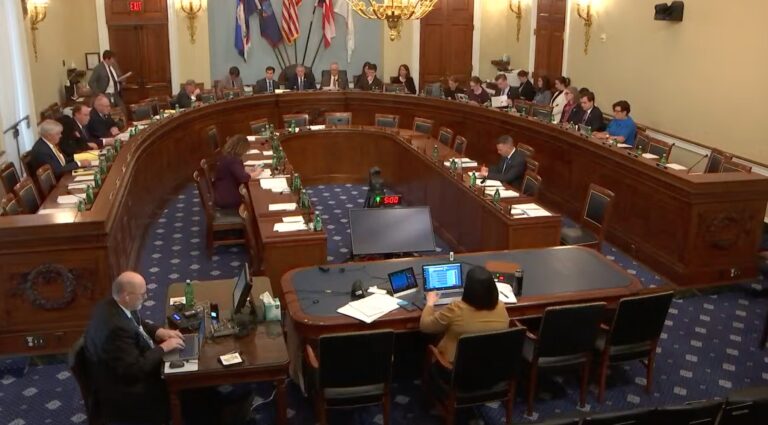
During Wednesday’s House Natural Resources Committee’s markup of the Gulf of America Act of 2025, which aimed to permanently rename the Gulf of Mexico to the “Gulf of America,” Democratic members proposed several amendments that were clearly intended as satirical jabs at the bill.
These included suggestions to rename the Gulf as the “Gulf of Ignorance,” and “The Gulf of America Should Rejoin the Paris Climate Accords,” and even an amendment to rename Earth itself “Planet Trump.”
Other mocking amendments included the “Gulf of Mexico Stays” and “Gulf of Corporate Greed.”
While the amendments were not seen as serious attempts to change the name, they did cause significant delays. The committee rejected all of them, and the bill moved forward with a 24-17 vote.
Early in his second term, President Donald Trump by executive order changed the name of the Gulf of Mexico. It is now officially the Gulf of America, and the bill debated this week seeks to make the change permanent.
“While Democrats tried to bog down today’s markup with nonsense amendments, committee Republicans took decisive action to advance a slate of legislation,” said Congressman Bruce Westerman, chairman of the committee. The committee also delisted the gray wolf from the Endangered Species Act list, and modernized the Endangered Species Act.
“We streamlined burdensome regulatory processes and advanced legislation to support local broadband and energy development. These legislative solutions and others put Americans first and represent the diverse array of issues we champion here on committee every day,” Westerman said.
An Instagram notice indicates that high school students across Alaska plan to walk out of classes on Friday, demanding more funding for schools with a higher base student allocation.
The walkout is planned for fourth period, around 1 pm, and media has been alerted, so the walkout photos and footage will be splashed across the websites of mainstream media in an effort to pressure lawmakers in Juneau.
The timing for the walkout coincides with the movement of House Bill 69, a school funding bill that would increase the per-student state funding, known as the BSA, by $1,000, costing the state about $250 million more per year. The Alaska Senate plans to consider the bill on the floor of the Senate on Friday, and the governor has already said he will veto it, if it passes.
The Heritage Foundation has launched an online database that allows parents and guardians to find classical schools that are alternatives to the declining quality of public schools in their region.
Just two schools in Alaska made the list so far: Holy Rosary Academy in Anchorage and Kenai Classical School in Soldotna. Both are Christian-based schools; Holy Rosary is Catholic while Kenai Classical School is nondenominational Christian.
The Classical Schools Database has more than 900 public, charter, and private schools on the list nationwide (Hawaii has the fewest on the list with just one). The database features schools that are committed to offering a classical liberal arts education to their students. These schools are committed to three core ideas:
Character and Intellectual Formation: Classical schools emphasize the development of both moral and intellectual virtues, viewing them as inseparable, to prepare students to uphold and preserve American principles and freedoms through knowledge, wisdom, and virtue.
Transmission of Wisdom: Classical schools focus on passing down the knowledge and insights of previous generations through great books, the liberal arts (trivium and quadrivium), and Western religious traditions.
Preparation for Lifelong Learning: These schools aim to equip students with the skills and habits needed for self-directed learning, such as logic, rhetoric, recitation, and Socratic seminars, fostering abilities in attention, memory, reasoning, and dialogue.
Holy Rosary Academy was “disassociated” from the Catholic Church as an official Catholic institution, a status that began in October 2021 when the Archdiocese of Anchorage-Juneau, under Archbishop Andrew Bellisario, revoked its Catholic school designation. That decision stemmed from the school’s refusal to comply with certain mandates from the archdiocese, including giving the archbishop authority over hiring, firing, curriculum, and health-related decisions, such as mask mandates. The school has opted to operate independently, identifying as a “Classical School in the Catholic Tradition.”
Holy Rosary Academy was returned to a partial restoration of ties in 2022, but the archdiocese did not fully reinstate its official Catholic status. Instead, it allowed limited cooperation, such as access to sacraments for students and families at local parishes. The academy maintains its classical curriculum and Catholic identity but does so without the official endorsement of the archdiocese.
The Alaska Senate Finance Committee dropped the accountability requirements out of an education funding bill and left it with just one simple thing: a $1,000 increase to the Base Student Allocation, the state’s funding formula for schools. The rate would go from $5,960 to $6,950 and is expected to pass the Senate as early as Friday.
Gov. Mike Dunleavy says he will veto the bill, which is now a committee substitute version of House Bill 69.
“The Senate’s new education bill is a joke! It does absolutely nothing to improve educational achievement,” Dunleavy wrote on X. “It does absolutely nothing to support our high-performing charter schools and our popular home schools. This is an obvious attempt to strong arm members of the legislature. This is an NEA teacher union dream! Hundreds of millions of dollars of new spending and no accountability called for. Welcome to Alaska: 51st in the nation in educational outcomes. In what world does one write a blank check with no expectations? Unless it is amended to address needed policies, if this lands on my desk, it’ll be vetoed immediately.”
It appears unlikely that the Senate, with so many Democrats and Democrat-voting Republicans, will add back in the provisions the governor wants, and in any case, with oil now in the mid-$60 per barrel, there is even less money than their was at the beginning of the session.
The cost for the $1,000 per student would be around $250 million a year, which would probably come from Alaskans’ Permanent Fund dividends and/or the Constitutional Budget Reserve.
The education spending bill passed the House on a vote of 24 to 16. To override the governor’s veto would take 40 votes from the House and the Senate.
The bill will be debated, possibly amended, and voted on during Friday’s Senate floor session.
Sen. Mike Shower, who serves as Senate Republican Minority Leader, said, ““Why are we doing this if we know it’s going to fail? We’re going to be right back where we started.”
Alaska’s natural gas going directly to Taiwan and bypassing communist China has caught the attention of the government of mainland China.
The Chinese government has issued a rebuke to Alaska Gov. Mike Dunleavy, condemning his recent visit to Taiwan and his direct negotiations with Taiwanese officials over a potential liquefied natural gas deal.
Taiwan’s state-owned oil and gas company CPC in March had signed a letter of intent to invest in the Alaska LNG export project and purchase liquefied natural gas from it, when the project moves to the production phase.
In a letter addressed to Dunleavy, Beijing, through its consulate in San Francisco, accused the governor of undermining the “one-China” principle and warned that such actions could jeopardize broader China-US relations, escalating tensions over a trade mission that secured a significant letter of intent for Alaska’s $44 billion LNG project.
“The Chinese side has noted with regret that Governor Mike Dunleavy is on a visit to Taiwan, scheduled to meet Lai Ching-te, Bi-khim Louise Hsiao, and Lin Chia-Lung, and visit the so-called Ministry of Foreign Affairs. This trip sends a very wrong signal to the ‘Taiwan independence’ separatist forces. The Chinese side is firmly opposed to this, and urges the State of Alaska and Governor Mike Dunleavy to correct such mistakes and avoid their recurrence.
“The Taiwan question is at the very center of China’s core national interests, the bedrock of the political foundation of China-US relations, and the first red line that must not be crossed in China-US relations. It remains the most important and most sensitive issue in China-US relations. Whether the US can properly handle Taiwan-related issues, and whether it can implement the commitment of not supporting ‘Taiwan independence’, have a direct bearing on China-US communication and cooperation in various fields, and even on the direction of China-US relations as a whole.
“The key to proper handling Taiwan-related issues is to adhere to the one-China principle in good faith. There is only one China in the world, Taiwan is part of China, and the Government of the People’s Republic of China is the sole legal government representing the whole of China. The one-China principle was reaffirmed in United Nations General Assembly Resolution 2758 in 1971. It is an overwhelming consensus of the international community and a basic norm governing international relations. It is also the political foundation on which China develops its relations with all other countries and the essence of the three joint communiqués between China and the United States; It should be a principle that the American government of any level should abide by.
“China is not against the State of Alaska conducting nongovernmental exchanges with Taiwan. However, Governor Mike Dunleavy’s visit of Taiwan and meeting with officials there in official capacity is obviously a visit of official nature, violating the one-China principle and undermining the political foundation of our bilateral relations. The Chinese side urges the State of Alaska to handle Taiwan-related issues prudently, stop infringing upon the one-China principle, and act according to the commitment made by the US government in the three joint communiqués.
“The Chinese Consulate General in San Francisco stands ready to enhance subnational people-to-people exchanges and pragmatic cooperation between China and the State of Alaska in all fields. We welcome more officials from Alaska to visit China to gain insight into a multifaceted and evolving China, and further deepen their understanding and friendship with China.
“The Consulate General of the People’s Republic of China in San Francisco avails itself of this opportunity to renew to the Office of the Governor of the State of Alaska the assurances of its consideration.”
The People’s Republic of China maintains that Taiwan is an inalienable part of its territory. The PRC asserts there is only one China, and Taiwan is a province of it, with the PRC as the sole legitimate government representing all of China.
This stance stems from the Chinese Civil War, which ended in 1949 with the Communist Party establishing the PRC on the mainland and the Nationalist government (Kuomintang) retreating to Taiwan, where it continued to claim legitimacy as the Republic of China.
Beijing views Taiwan’s separate governance as a temporary situation and considers reunification a core national interest. The PRC insists that Taiwan must eventually be integrated into the mainland, preferably through peaceful means but with the threat of force if necessary, as outlined in its Anti-Secession Law of 2005.
This belief drives China’s opposition to any actions — like official visits or agreements by foreign entities — that imply recognition of Taiwan as a separate state, as seen in its reaction to Gov. Dunleavy’s visit and signed agreement.
In 2017, former Gov. Bill Walker led a trade mission to China, which resulted in a joint development agreement with three Chinese state-owned entities — Sinopec, Bank of China, and China Investment Corporation — to finance, build, and buy gas from the $44 billion project. Walker dealt directly with the communist government and his deal was canceled by Gov. Dunleavy immediately after he became governor in 2018.
Sen. Mike Cronk of Tok has filed legislation addressing the impact of trawl and dredge fishing gear that makes substantial contact with the seafloor.
Senate Bill 161, “An Act relating to the use of certain trawl or dredge fishing gear in state water; and providing for an effective date,” also mandates a detailed study of its effects on marine ecosystems and fish habitats.
The bill amends Alaska Statute 16.10 by adding Section 16.10.135, which prohibits the use of bottom-contact trawl or dredge gear in state waters, as determined by the Department of Fish and Game. In Alaska, state waters extend three nautical miles offshore from the baseline of the coast, which is typically the low-water tide line along the shore.
This prohibition would take effect on Jan. 1, 2028, giving regulators and the fishing industry time to prepare. In the interim, the bill requires the Department of Fish and Game to conduct a comprehensive study on the health of seafloor ecosystems and fishery resources in state waters, with a report due to the Legislature by January, 2027.
The study would examine the impacts of bottom trawling and dredging on Alaska’s marine environments and fisheries. It will include data on bycatch, which are marine species unintentionally caught during fishing, over the past 10 years, broken down by species where possible. The report would also provide recommendations on whether such fishing gear should be permanently banned or restricted to ensure sustainable fish stocks and benefit Alaska’s residents.
Bottom trawling involves dragging heavy nets across the seafloor to catch fish, a method known for its efficiency but also for its ability to disturb marine habitats and capture unintended species, including those that are in short supply. Those dragging for pollock catch other species, like halibut, salmon, and crab.
The legislation would take effect immediately, except for the gear prohibition, which would be deferred until 2028. The outcome of the proposed study could shape future fishing regulations in Alaska.
“If you lived here, I’d know your name,” is the title of the book by Heather Lende, the Haines writer, NPR contributor, and former Alaska writer laureate, whose best seller is subtitled, “News from small-town Alaska.”
It seems that nobody in Haines knows a “Sarah Johnson.” She appears to be a nom de plume, rather than a real Haines resident.
Johnson has had a letter to the editor published in the Yukon News, telling Canadians to punish the Alaska border town of Haines because people in Alaska voted for Donald Trump for president.
Johnson does not show up on Alaska Division of Election voter rolls. Inquiries in Haines and a search of social media turned up nothing. But the Yukon News went ahead and printed her letter, which says, in its entirety:
To my friends and family in the Yukon.
The people of Alaska voted heavily in favour of Trump and his policies.
The town of Haines, Alaska relies on tourism from Canada to exist. Many of the residents of Haines will accept your Canadian Dollars with one hand while stabbing you in the back with the other.
This is an incredibly sad situation. I encourage the good people of the Yukon to boycott Haines as much as possible. In my opinion, the Maga’s are unable to feel empathy. They only seem to care when something affects them personally. Less income for them will do that.
Let us look forward to the day when we can all rejoice again together. Sarah Johnson Haines
Tourism and through-travel is indeed a significant part of the Haines economy, with 30% of the local jobs related to services for visitors who come via the Alaska Marine Highway System or cruise ships.
Many travelers also drive to Haines from northern parts of Alaska or the Lower 48, and take the ferry from there to Juneau or Skagway. Some Canadian tourists are no-doubt part of that mix, as Haines has a highway connecting it to Canada. There isn’t any solid data on Yukon tourists to Haines, but a few motorcycle clubs do make the journey each summer.
Events like the Southeast Alaska State Fair and the Alaska Bald Eagle Festival draw regional crowds that include Canadians, but the Yukon Territory is only home to about 45,000 people total, with most of them centered in Whitehorse.
Haines also is home to commercial fishing families, some mining families, and a goodly number of retirees: Haines has a population of around 1,781, with an average age of 49.2, significantly higher than the state median age of 35.9. About 25% of the residents of Haines are older than 65, compared to the state average of 13.6%. It’s a great retirement community.
In the age of fake news and tariffs, we now have people adopting fake identities and writing fake letters to the editor to gin up cross-border hatred. In this case, it appears a faker has taken Trump Derangement Syndrome to a new level.
Haines readers, if you know of this Sarah Johnson who resides in Haines, please let us know so we can update this story.
A US House resolution passed Wednesday that would ban federal district court judges from granting nationwide injunctions on some presidential executive orders.
House Resolution 1526 passed 218 to 214 with Congressman Nick Begich voting in favor of the bill, which is sponsored by Congressman Darrell Issa of California.
The bill says “no United States district court shall issue any order providing for injunctive relief, except in the case of such an order that is applicable only to limit the actions of a party to the case before such district court.”
“We took on the activist judges and their rogue rulings. Now it’s on to the Senate to send this to the desk of [Trump],” Rep. Issa wrote on X.
Earlier this week, the US Supreme Court ruled that district court does not have the jurisdictional authority to prevent President Donald Trump from deporting Venezuelan gangsters.
District judges appointed by Democrats have recently declared universal injunctions on Trump’s executive orders after lawsuits against those orders were filed in district courts. Republicans see this as a case of judicial overreach by judges who are granting relief far beyond those who are stakeholders in a lawsuit.
“It’s never been more obvious that parts of our federal judiciary have a major malfunction of judicial activism. Practically every week, we see yet another federal judge issuing yet another nationwide injunction in yet another gambit to stop President Trump from exercising his Constitutional Article II powers and carrying out the policy agenda he promised the American people he would make a reality,” Issa said in March.
“In only the latest example, US District Court Judge James Boasberg severely overstepped his authority and demonstrated the most critical shortfall of judicial temperament. By ordering planes containing dangerous illegal immigrants – that President Trump negotiated with a foreign country to let land – to turn around in midair makes a mockery of the important powers we assign to our federal judges. This isn’t even close to a legal disagreement involving standing, statute or precedent. It is the Trump Resistance in Robes,” he said.
“We have a crisis on the bench right now and not just with this or any single judge. My bill – The No Rogue Rulings Act of 2025 – won’t only deal with excesses like Judge Boasberg’s outrageous demands on the President and the Trump Administration. It is the comprehensive solution we need to ensure that this problem does not occur anywhere in our federal judiciary and resets the proper and appropriate balance in our courts. It has already passed the Judiciary Committee, and I look forward to this bill gaining the support of the full House, the Senate, and heading to President Trump’s desk,” he said.
House Speaker Bryce Edgmon explained that the Legislature is in a pickle because the House Finance Committee has not released the budget to the Rules Committee, and thus it can’t make it to the floor for a vote.
The Legislature is at a critical juncture, he said. The operating budget should already be in the hands of the Senate, but “now seems to be stuck in no-man’s land. The budget has not been transferred from the Finance Committeeee to the Rules Committee … Unfortunately because of extenuating circumstances in a whole realm of things, you could say everything from possible federal budget impacts to a global downturn and commodity prices, oil prices sort of slipping and sliding underneath us, and as crude is going down almost 14-15% in the last several days, not to mention that the spring revenue forecast that came out in March, which seems like an eternity ago, already really undercut our position from a year ago when oil was forecast to be $78 a barrel. Now, we’re looking at $68 a barrel going forward,” he said, as he introduced a press conference made up of leaders he handpicked when he became Speaker.
“And guess what? That $68 a barrel may be optimistic going forward in FY 26,” Edgmon continued.
Then he continued to talk about the need for more education funding and he blamed the governor for submitting a budget that has a legally mandated statutory Permanent Fund dividend, the House Republicans, the Senate, and seemingly everyone but himself, the leader of the Democrat majority.
“And we’d like to talk to you about that and be really honest with you and have the conversation that, ladies and gentlemen, we’re all in a pickle,” Edgmon said.
“It’s not just the House majority. It’s the House minority. It’s the governor. It’s the Senate majority. It’s the Senate minority,” he said, and continued to take no responsibility. “We are stymied because of the narrowness of the makeup of the House chamber.”
Speaker Edgmon then blamed the House minority for his majority’s inability to move forward on all its wants.
“I’ve [had] a number of conversations with minority members. Myself as well as others that have a concept … sort of set the pathway for working together. But at this juncture in house, you know, day 78, which is technically two-thirds of the way through the session … We have not had a cooperative relationship.”
The blame game continued:
“We have not, back in my memory since the early 80s, had such a sharply divided Finance committee with such difficult circumstances in front of them and it’s been a long time since we’ve had a House chamber that’s been closely divided — 21 and 19 — where one member essentially has veto power. We have a problem in front of us, folks, and that’s the purpose we’re here to talk with you about, and there are a number of pathways forward But the time is very limited and I’m gonna close before I turn it over to the Rules chair to once again implore the House minority.”
The budget imbalance began when the governor submitted a budget that was not fully funded.
But then, Rep. Andy Josephson, who chairs the Finance Committee, presented a revised budget that was also not funded, and he forgot to remove a portion of the Permanent Fund dividend. Now the budget requires rural members like Rep. Neal Foster and Nellie Jimmie to vote to strip a major portion of the dividend from their own constituents. They won’t do that. Rep. Josephson said that because they are rural, they get a pass.
The problem is not that the budget hasn’t been voted out of Finance, because it has. The problem is that the co-chairs won’t give the budget to Rep. Louise Stutes, who chairs Rules.
But Edgmon says it’s the House minority Republicans who are the problem.