Sen. Lisa Murkowski on Friday held forth on the floor of the Senate to talk about how Congress must stop President Donald Trump, who is trying to correct a trade imbalance. He raised the tariffs on China to 145%, and has a big negotiations going on with much of the world right now as he attempts to restart manufacturing in the United States, and stop the use of slave labor in China.
“To say that this has been a dizzying week in Washington, DC is probably an understatement,” she said.
“I think it’s time for Congress to reassert itself. We owe that to those that we represent, as well as to this institution, for the long-term good of the nation,” Murkowski wrote on X.
Those she represents voted for Trump by 13.1% in 2024. His net approval rating, according to Morning Consult polling, is net positive in 31 states. In Alaska, his net approval rating is +9, even with him restoring the name of Mount McKinley.
Earlier this week, Murkowski and three other Republicans wrote a letter in defense of the so-called “clean energy tax credits” in the Democrats’ Inflation Reduction Act, a climate change law, urging her colleagues in the Republican majority to not repeal them.
She is the de facto leader of the anti-Trump Republicans in a state where she is out of step with the majority of voters.
Here are her remarks on April 10, pushing back on anything Trump may try to do to fix the structural imbalance of the economy:
I think it’s time for Congress to reassert itself. We owe that to those that we represent, as well as to this institution, for the long-term good of the nation. pic.twitter.com/M464e8WTid
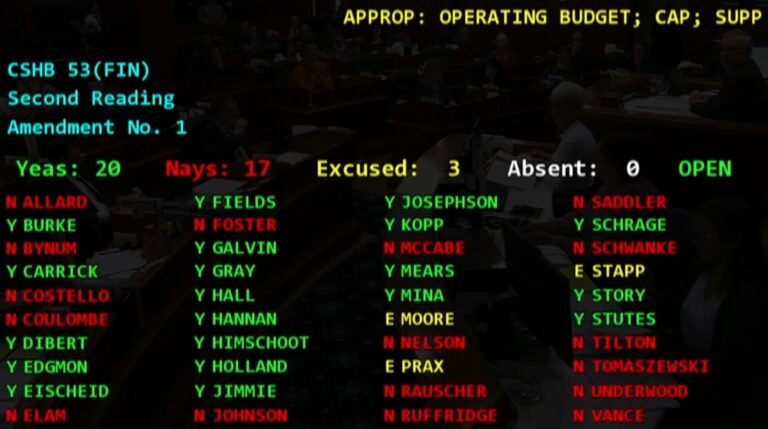
Three missing Republican House members was all it took for the Alaska House Democrats to take advantage of the situation and pass an amendment to the state operating budget that stripped over $1,900 from every Alaskan’s full Permanent Fund dividends.
The House Democrat-run majority, with two Republicans who belong to it, knew there were three Republicans who would missing on Friday afternoon, and so held the budget question until later in the day, and also made sure all Democrats were not on planes out of Juneau. Every single Democrat was present.
Missing were Republican Rep. Elexie Moore, Rep. Mike Prax, and Rep. Will Stapp, all who might have voted no. All three had excused absences, which gave Democrats the small window needed to shrink the PFD.
The amendment passed 20-17. They were able to pass with the majority of those present, not the full majority. Being absent is essentially a “no” vote.
For several weeks, the House has had “No-Floor Fridays,” which is a phrase for not having any bills for consideration. But this Friday was different. A full slate of bills was on the calendar, including, quite surprisingly, the operating budget, which had passed from the Finance Committee. The two rural Democrats on the Finance Committee were not in agreement to cut the PFD, and so because of errors made by Finance Chair Rep. Andy Josephson, the full dividend was in the final package.
The Democrats sat on the budget and then sprang into action with one amendment on Friday, with the knowledge the Republicans were short a few members.
Speaker Bryce Edgmon had already promised there would be no amendments to the operating budget until Monday, and then he went back on his word. Amendment No. 1 was the reduced PFD, and it was packaged and ready to go.
The House Democrat majority, in a press release, called it an “affordable and sustainable PFD of approximately $1,400.”
In actuality, that means the annual dividend paid to Alaskans as their share of oil will be used instead to pay for a $1,000 increase to the base per-student funding for school districts, which had already passed the House and Senate, but which the governor says he will veto. Proponents of the larger school budget say that schools are dealing with inflation, meaning they cost more to run.
Unacknowledged by those small-dividend proponents is that Alaskans, too, have been dealing with inflation, and that a tax on the dividend hurts the poorest Alaskans the most.
But the spin from the House Democrat-led majority was to blame it on the Republicans:
“The intention was to wait until Monday to begin the amendment process as would normally occur. However, after the events last night in the House Finance Committee made painfully clear, any attempts at finding middle ground would continue to come up short. With that in mind, it became clear that it was the only path forward to maintain funding for essential services, provide for a meaningful permanent BSA increase, and a healthy but sustainable PFD for Alaskans,” the Democrat-led majority wrote in a press release.
In the end, the Democrats cleverly outsmarted the Republican minority. Not a single Democrat left Juneau on Friday afternoon’s flight, because there was a game afoot, and they knew three missing Republicans were all they needed to shrink the dividend, rather than shrink the government.
Rep. Jamie Allard of Eagle River explained it well in a post on X: “Tonight on the House floor it was a contentious political maneuver by the Democrats to take the Permanent Fund Dividend (PFD). The Democrat Majority in the House went back on their word to delay amendments until Monday, they cut the dividend by more than 25%. As a member of House Finance Committee, their own Democrat members wouldn’t pass it out of finance. This was timed strategically to exploit the absence of several Republican Minority members who were excused. Thank you Representative Neal Foster for voting No to NOT reduce the PFD.”
The governor cannot add funds back to the reduced Permanent Fund dividend. By law, he is only allowed to veto, but cannot add funding that the Legislature cuts.
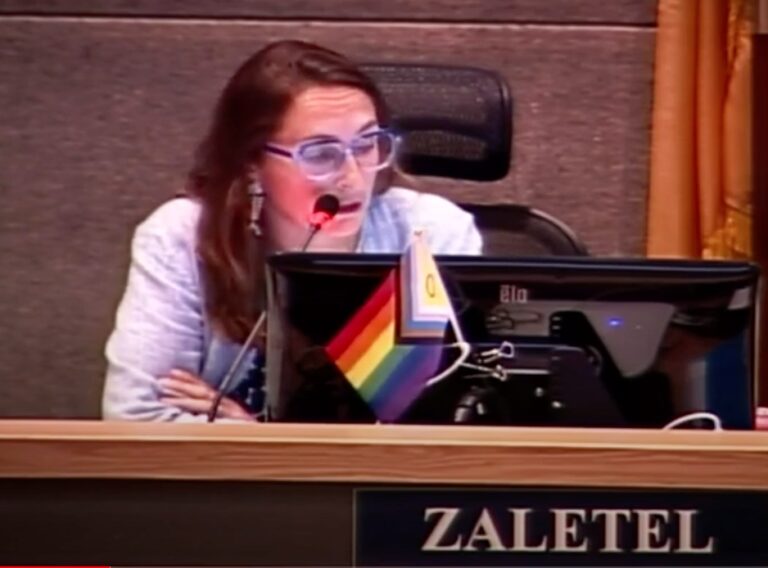
Anchorage Assemblywoman Meg Zaletel, whose day job is as the executive director of the Anchorage Coalition to End Homelessness, said that she will resign from the nonprofit later this year.
During her dual roles, the Anchorage Assembly has awarded millions of dollars to the agency, which is the coordinating group for many of the various charities who serve people living without secure shelter.
Zaletel, who is vice chair of the Assembly, is also leaving her position on the Assembly, as she did not run for reelection in April.
Last week, Must Read Alaskapublished the 2023 audit of her homelessness coalition, which revealed many flaws in financial management of the organization, some of which were serious.
Zaletel is also the subject of a lawsuit alleging wrongful termination by a former employee, who said the workplace environment was toxic and the organization was financially mismanaged.
Zaletel has been a polarizing figure in local politics, particularly because of her dual roles as appropriator and the head of a nonprofit that gets millions of taxpayer dollars and appears to have little to show for itself.
In fact, during her tenure, there has been a 54% increase in the homeless population of Anchorage, far from the organization’s goal of homelessness being “rare, brief, and one-time.”
Zaletel is also known for never putting her hand on her heart or saying the Pledge of Allegiance at the beginning of Assembly meetings. She has sponsored an ordinance, however, mandating that the woke “land acknowledgement” statement be posted prominently on the wall wherever the Assembly meets.
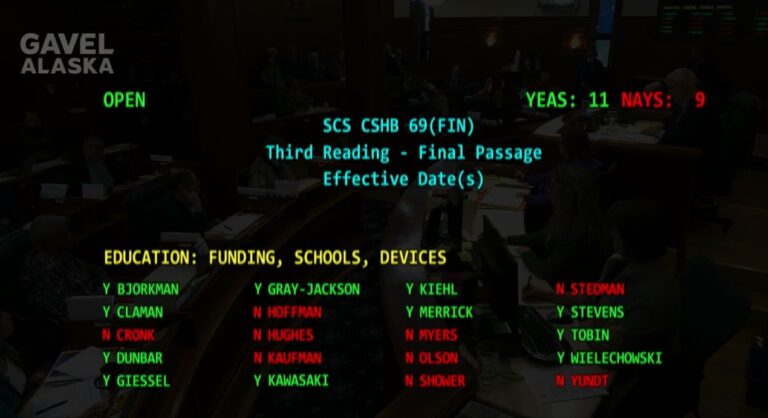
The Alaska Senate on Friday voted to add $1,000 per student to the Base Student Allocation, which is the funding formula used to help school districts around the state. It represents a 17% increase that will be locked in going forward.
Except for one little problem. Gov. Mike Dunleavy has already said he will veto House Bill 69, unless the spending amount comes down and some accountability measures on in place. The Senate stripped out every single bit of education policy that had been hoped for by the governor.
The House has concurred with the vote, 21-16.
So why would the Senate pass a bill that it knows is dead on arrival when it reaches the governor’s desk? It’s a chess move.
This vote was about elections and being able to later on say that a conservative legislator voted against education. The vote is meaningless, due to the pending veto, other than how it can be used in the 2026 election cycle by Democrats and their union supporters.
The veto by the governor could be overridden, but then the Legislature would have to find 40 votes to override, and that is a tall order, since the bill barely passed in the Senate.
Democrats Senators Donny Olson and Lyman Hoffman voted against the bill, as did Sen. Bert Stedman, a budget-minded Republican who often sides with Democrats.
Republicans Senators Cathy Giessel, Jesse Bjorkman, Kelly Merrick, and Gary Stevens, who caucus with Democrats, voted in favor of the $1,000 BSA increase.
Sen. Mike Shower, who leads the Republican minority and who urged a “no” vote, said that there is not enough revenue to cover the expenditure this year, with oil prices dropping. He indicated that the amount would have to come from the Permanent Fund dividend of every Alaskan or the Constitutional Budget Reserve.
“One of the reasons Alaskans are so disappointed and frustrated by their legislature is we talk, we debate, and then we do not act. “The READS Act is an example of when our legislature is effective,” Shower said. “We talked, researched, proposed legislation, passed legislation, enacted it, and now we are seeing terrific results for our students.”
“It is time the people of Alaska take back our education system from special interest groups,” said Sen. Mike Cronk. “The BSA number in this bill is not the real number for our school districts and was a political cover vote. It’s imperative that we are honest with all Alaskans and pass legislation that centers on our students.”
The Senate Republican Caucus said its goal is to work with the executive branch, the House, and the Senate Majority to draft bipartisan legislation that is free of ill-intended political motivations.
Gov. Dunleavy issued a statement late Friday:
“The Alaska Senate and House just passed a bill that hands out a blank check to school districts, taking your PFD to increase school funding by $250 million without a single reform or any accountability. While there is consensus that our school districts need additional funding, it was pointed out by a number of legislators that the price tag is way too high with falling oil prices and with no meaningful policy included. Our student test scores put Alaska almost dead last in the country compared to the other states. Alaskans deserve better than last-place outcomes and the same failed approach. The good news is the Legislature still has time to pass meaningful education policy reforms, as well as a reasonable increase in school funding.”
Mayor Suzanne LaFrance and her allies on the Anchorage Assembly are suddenly heartbroken over the closure of Carrs in Fairview. The store’s shutdown has prompted a wave of public statements lamenting the loss and emphasizing its historical significance.
Mayor LaFrance even claimed, “Fairview gave this business its start, supporting their growth and success for decades.”
While that sentiment acknowledges the community’s roots, it sharply contrasts with the prolonged inaction and neglect by city leaders that led to the store’s demise.
For years, Fairview residents and Carrs employees have endured escalating public safety concerns: open drug use, theft, assaults, and daily lawlessness. These issues didn’t arise overnight; they festered under the watch of present city Assembly members and Mayor LaFrance who had the power, resources, and responsibility to intervene. Despite an obvious, visible, and desperate need for help, those pleas were met with indifference.
Now, the sudden concern from official’s rings hollow. Where was this urgency when employees were being threatened? When residents felt unsafe just walking to get groceries? The city had every opportunity to act, and it didn’t.
Let’s call this what it is: political damage control.
For years, this Assembly and its allies weren’t focused on solving problems. They were consumed with destroying the Bronson administration. That obsession with political revenge came at the cost of public safety, economic stability, and community trust. And Fairview is the one left paying the price.
The closure of Carrs is more than just the loss of a neighborhood store. It’s the loss of trust in government and a painful reminder of what happens when leaders like Chris Constant, Daniel Volland, Meg Zaletel, Felix Rivera, and Mayor LaFrance prioritize optics and power over action and accountability.
Fairview didn’t need sympathy after the fact. It needed leadership before the collapse. And now, instead of cleaning up the mess, city officials are trying to rewrite the narrative. But the community isn’t fooled they lived it.
Anchorage doesn’t need more photo ops or press releases. It needs real leadership, real solutions, and the courage to put politics aside and fix what’s broken.
Until that happens, expect more closures, more chaos, and more heartbreak from the very neighborhoods that once carried this city forward.
The editor of Yukon News has removed a letter to the editor from the publication after learning that the letter writer used an assumed name, as she implored Canadians to boycott Haines due to Alaska’s support for President Donald Trump.
Editor Jim Eliot explained his decision today:
“As editor of the Yukon News I have made the decision to remove the letter entitled This Alaskan says Yukoners should boycott from the Yukon News website based on evidence that the writer used an assumed name.
“The contents of the letter remain one person’s opinion but that person has been unwilling to verify their real name or confirm their residency in Haines, Alaska now that that claim has faced scrutiny that I failed to apply before it was published. For this reason it violates our policy about unsigned letters and will also be retracted in print.
“I am thankful for those who brought this to my attention.
“In future the Yukon News will take additional steps to verify the identity of all letter writers to ensure that opinions can be expressed freely and openly so long as writers are willing to do so using their real names.”
The problem with the letter was first reported by Must Read Alaska, but it was Bob Bird of KRSM Radio in Kenai who was able to reach Eliot and bring the matter to his attention.
“Consider this a tag-team effort!” Bird said.
Must Read Alaska appreciates the readers in Haines who investigated the veracity of “Sarah Johnson,” the name associated with the letter that was promoting hatred between Canada and the US.
Must Read Alaska‘s comment policy is that people cannot use assumed names of real persons, as these are considered stolen identities. Most commenters at MRAK use a “handle.” Those who author opinion columns here must use their real names.
A real opportunity for Alaskan workers, customers, and businesses is happening. Lawmakers in Juneau overwhelmingly voted to pass a bill that would allow adults to work and serve alcohol in restaurants and breweries, among other workplaces.
That bill, Senate Bill 15, now goes to Gov. Mike Dunleavy for his consideration. As Alaskans that own and/or operate businesses large and small across our state, with decades of experience and contributions to the State we love to live and work in, we respectfully ask the governor for this bill to become law.
Right now, Alaska is one of less than a handful of states where someone over 18 but not 21 can vote, sign up for the military, take out loans for homes and cars worth hundreds of thousands of dollars, but cannot be trusted to pour a beer, serve a glass of wine, or hand a customer a cocktail.
Those adults are left stranded from the economic benefits that come from being a fully-fledged worker in hospitality. It is time Alaska changes its stance and get competitive for the young adults who will form the future of our industry.
Serving is one of the most rewarding positions young people can have. The financial reward for the hospitality industry is well-known, and the skills gained are reciprocal at virtually any dining and drinking establishment in the world (and that’s not an overstatement). We face a problem with the current age rules: a break in our workforce pipeline.
We have all seen the same story repeated in front of us for decades: a young high school graduate starts a summer job in Alaska, and loves working in hospitality, be it in a restaurant for a small business or working with tour operators up and down the state’s coast. That now adult goes out of state to college, or for a change of scenery, and discovers they inevitably can work in that other state as a server for a lot more money than back home. Most of us know how that story ends.
It is already hard enough convincing young people to come up and move back to Alaska. Depriving them as adults of opportunities in our local businesses, when virtually everywhere else in the country allows them three years of gaining skills and financial resources elsewhere, is a self-inflicting wound.
Some people are opposed to this bill because of the concern making access to alcohol greater means there is an increased risk of abuse. We understand and respect that, and can say our businesses, in an era when everyone has a cell phone camera that can snap a photo, have every reason to prevent those 18- to 20-year-olds from illegally drinking. To be clear, those same people, right now, can work in restaurants, handle alcohol in partially consumed drinks and clean them up, and be expected to not violate any laws in consuming them. Our businesses have strong reasons not to let people play around with those rules, as it could mean a business losing its license, or worse.
Alaskans’ history with alcohol deserves our attention to make sure we are not being reckless. But we must also be realistic: small businesses, especially restaurants in our towns and cities, have a lot of head winds. The costs to operate are continuing to rise, and finding good staff who want to make a career in hospitality is tough enough. Young adults need to develop the communicationskills and manage relationships, as well as handle stress, in a work environment that prepares them for success in whatever their chosen profession. Hospitality has for countless people been that springboard.
Now, there is a chance, a real window, where we can help young adult Alaskans be even more financially successful, trusted to handle responsibilities and be accountable for their actions, and foster a win-win-win for these young workers, the Alaskans and visitors who patronize our businesses, and our communities for having more gainfully employed adults. We share Gov. Dunleavy’s hope of Alaska being open for business, and ask his support of this important measure.
Patricia Jane “P.J.” Gialopsos is an Alaskan since 1979 who has owned and operated herfamily-run restaurant in Anchorage for over forty years.Ralph Samuels grew up in King Salmon, lives in Anchorage, and is vice president of HollandAmerica Princess of Alaska. Jay Ramras is a lifelong Alaskan that has started several very successful hospitality businesses,and currently owns and operates Pikes Landing in Fairbanks, a large hotel and restaurant.
The second iteration of the Must Read Alaska NewsletterQuestion of the Week included five new names for potential Alaska gubernatorial candidates. The poll closed Thursday morning and results were announced in Friday’s morning newsletter (subscribe here.)
For the second list of names, Sen. Shelley Hughes of Palmer emerged as the strongest Republican candidate, followed by Kenai Borough Mayor Peter Micciche, Mat-Su Borough Mayor Edna DeVries. Former Rep.
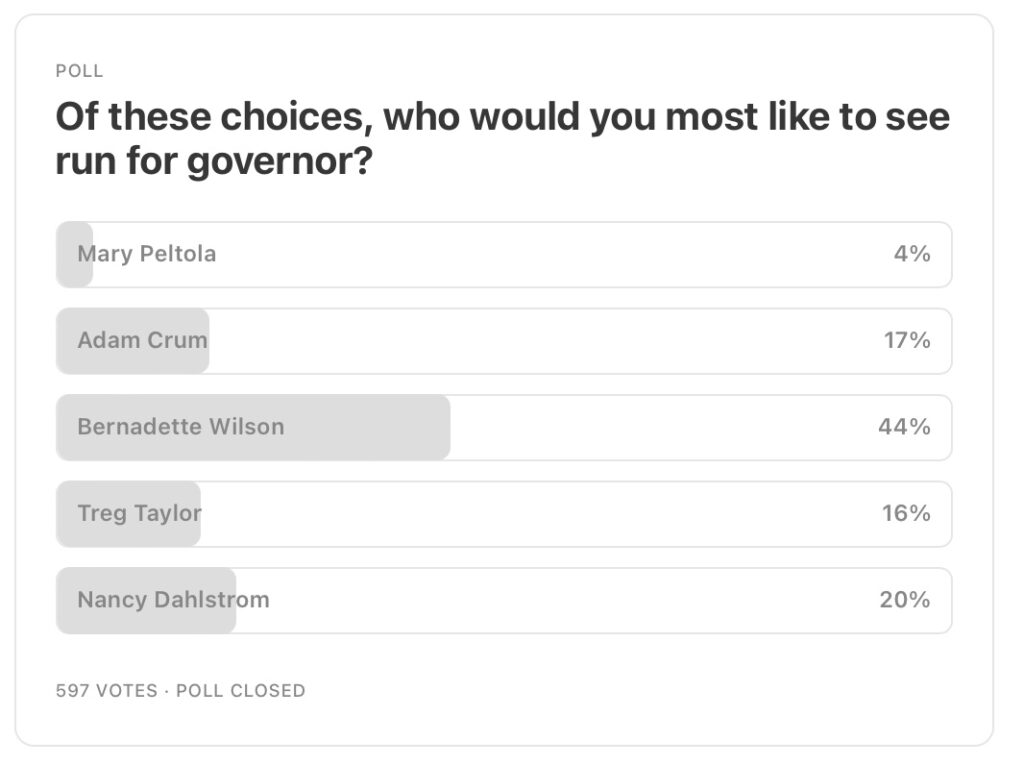
Mary Peltola, a Democrat, was the lowest vote-getter in this unscientific poll that represents the conservative base in Alaska. She was also the lowest in popularity in the first round of this particular question: “Of the following, who would you like to most see run for governor?”
A notable difference between the two polls was participation enthusiasm. The second poll had just 413 participants, while the poll from the week earlier had nearly 600. About 30% fewer readers took an interest in the second set of names.
In the first polled list of names, business leader Bernadette Wilson came away with 44% of the vote in a field that had Alaska Revenue Commissioner Adam Crum, State Attorney General Treg Taylor, Lt. Gov. Nancy Dahlstrom, and Peltola.
Question of the Week is a regular feature of the newsletter, which is sent three time a week. The newsletter goes out to 33,000 people and is typically opened by a third of the recipients, with the question posed in Monday and Wednesday editions, and results announced each Friday. The structure of the poll allows for just five options and has no “ranked-choice voting” scenario.
While this is a limited survey of views, it is a snapshot of where some of the leading prospects of governor in 2026 may stand with the activist super-voter base of conservatives, which makes up the majority of Must Read AlaskaNewsletter readers.
Bernadette Wilson, who has been active in helping numerous candidates get elected in recent years, comes out the leader among a strong field of well-known politicos in the first poll; Shelley Hughes, in legislative office since 2013, does well in the second poll, while former Sen. Natasha Von Imhof performs the worst of any of the Republicans in either poll.
No candidate has yet officially filed for governor, although the people mentioned in these two polls have indicated they are seriously considering running in 2026.
Democrat Colorado Gov. Jared Polis on Friday signed Senate Bill 25-003 into law, enacting a new “permit-to-purchase” system for certain semi-automatic firearms.
The signing ceremony was held behind closed doors with a selected group of gun control advocacy groups in attendance.
The new law establishes a framework that requires Coloradans to obtain a permit before purchasing specific semi-automatic firearm platforms, which are now subject to restrictions.
To qualify for the permit, applicants must complete a 12-hour educational course. The legislation also delegates oversight of the training requirements and permitting process to Colorado Parks and Wildlife, while placing additional permission responsibilities on local sheriff’s departments that now have the authority to sign off on the gun ownership.
The passage of SB 25-003 followed months of heated debate. Tens of thousands of Coloradans have voiced their opposition, but the state has gone Democrat in recent years, and Democrats are generally opposed to private gun ownership.
The first commercially successful semi-automatic rifle has been around since 1885. The Mannlicher Model 1885 was developed and patented by Ferdinand Mannlicher in Austria. Early semi-automatic pistols, like the Schönberger-Laumann, emerged around 1892, followed by designs such as the Borchardt C93 in 1893 and the iconic Luger in 1898. These have been in the hands of American citizens for over 140 years. But over the past few decades, Democrats have sought to take them away from civilians and allow only military and law enforcement to have such firearms.
Semi-automatic firearms are widely used in Alaska by hunters. For example, in subsistence hunting among Alaska Native communities, semi-automatics are useful for their reliability and speed when targeting seals, which often only surface briefly.