Monday, July 27, 2026
Home Blog Page 1609

Commissioner of Labor Drygas protests Fairbanks City Hall

3

AFTER HER APPEARANCE AT PROTEST, THE AFL-CIO GAVE GOV. WALKER ITS ENDORSEMENT

Alaska’s Commissioner of Labor and Workforce Development was in Fairbanks this week for the AFL-CIO convention, and took the opportunity to walk the picket line with union members protesting the City of Fairbanks.

Heidi Drygas held a sign that read “Fair Contracts Now,” with two dozen other union activists in a moment that was calculated to coincide with the AFL-CIO statewide convention in Fairbanks.

Vince Beltrami, president of the Alaska AFL-CIO, bellowed into the microphone that the union wanted the city to know that they were there. The bullhorn chanting continued between speeches from union officials demanding higher wages, more benefits, and better working conditions for city employees. It was loud.

The AFL-CIO drafted a resolution to boycott conventions in Fairbanks until the city negotiates in good faith with the Fairbanks Fire Fighters Association, the Public Safety Employees Association and the International Brotherhood of Electrical Workers.

Considering the city and the unions are negotiating actively right now, a visible presence at a protest by a sitting state commissioner is questionable from an ethical perspective, particularly since her paycheck comes from the people of Alaska. She was in Fairbanks ostensibly on the people’s business, representing the State at the big union convention.

AFL-CIO ENDORSES WALKER

The coveted endorsement of the AFL-CIO went to Gov. Walker today, perhaps helped along by the Labor commissioner’s Thursday enthusiasm for protest against the City of Fairbanks.

The endorsement was expected and foreshadowed by AFL-CIO President Beltrami several weeks ago in the media.

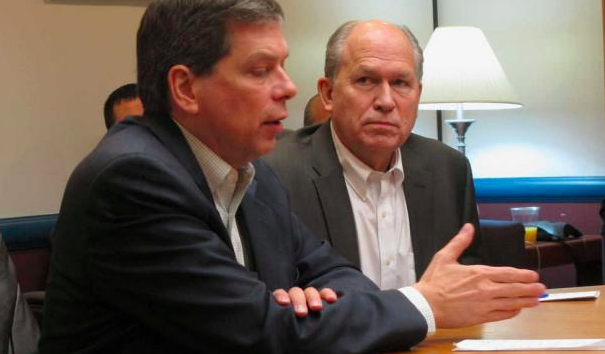
Mark Begich, the Democrat running for governor, had also attended the convention along with the governor and his entourage.

Both Walker and Begich spoke to the gathering of over 100 attendees before the vote was taken. This was clearly campaign business going on in Fairbanks, but the governor threw in a bill signing in Healy the day before to make sure he could write off the trip for himself and his staff, and so they could all attend the AFL-CIO convention on the the state’s dime.

Flying home from Fairbanks on Friday was a jubilant Walker and Mallott, a plane full of union leaders and executive staff from the Governor’s Office, including the governor’s Press Secretary Austin Baird, Deputy Chief of Staff Grace Jang, and Chief of Staff Scott Kendall. Also on the plane was Mark Begich without an entourage.

The governor’s campaign manager John-Henry Heckendorn was spotted in the airport lounge having drinks with Walker’s senior staff and on a flight to Anchorage on Friday.

Yesterday, Begich had won the endorsement from the Alaska Center for the Environment.

Today, Alaskans Together for Equality,  Alaska’s largest member-based statewide lesbian, gay, bisexual, transgender, and queer civil rights organization, announced its endorsement of Begich.

“The board considered the high stakes in this election and the looming threats against Alaskans’ civil rights. This is the first time Alaskans Together has endorsed a candidate for Governor,” the organization said in a release.

LeDoux’s absentee vote chase scheme raises eyebrows

THE PLOT THICKENS WITH APPEARANCE OF A MAN NAMED CHARLIE CHANG…

Rep. Gabrielle LeDoux showed up at the Division of Elections office on Gambell Street this morning to oversee the counting of 147-odd absentee ballots that will determine her fate.

But at the end of the day, the election workers were not quite ready finish verifying the ballots to be counted — they had spent all day whittling down whether the ballots were from legitimate voters, had the correct dates of birth and signatures, and whether the voters were registered in the district and could be counted for her race at all.

Further complicating the count is another 78 ballots that the Division of Election has mysteriously held back for further review because of anomalies or discrepancies that the Election Review Board will also need to look at on Monday.

It appears that at least 50 of them are legitimate ballots for that district. More will dribble in on Monday, if the past is any indicator, so the math will change.

There are the questioned ballots to be evaluated. That process of evaluation begins Monday as well.

The race for House District 15 was anything but expected. It’s a three-vote race result so far that has Rep. Gabrielle LeDoux, who had amassed over $100,000 in her campaign treasure chest, trailing behind newcomer Aaron Weaver, who spent less than $2,000.

LeDoux didn’t have to sweat the election, because her Republican opponent had simply disappeared after filing for office.

[Read: Gabrielle LeDoux fighting off win by an invisible candidate]

But by examining her campaign finances, it appears that toward the end of July, LeDoux wasn’t going to take any chances.

On July 19, LeDoux paid a man named Charlie Chang of Fresno, Calif. some $10,000 to go bounty hunting for votes in the low-turnout district.

She also bought him a plane ticket to come from Fresno to Anchorage to work on the get-the-vote project, although no additional travel and lodging expenses are accounted for on her report. It’s a good guess that he stayed with family.

Of course, vote bounty hunting is not illegal unless Chang was paying people for their absentee ballots. But to be fair, that is not what the above APOC report shows.

It shows that for $10,000 and an unknown amount of time, Chang was acting as a translator and strategist, and for getting the vote out among “various ethnic communities in Muldoon.” Chang’s mailing address is in Fresno, California, but he is also registered to vote in at a trailer park on Muldoon Road, where multiple absentee votes were received from three or four trailers.

From one trailer, there were seven ballots that were received by the Division of Elections. Five of them were deemed not to count, because the people were not were not registered in the district.

In fact, there were 23 Changs who requested who used one of two trailers for their addresses.

How many of those Chang-acquired votes are legitimate is part of the game for deciding which votes get counted among the universe of absentee ballots.

At the end of the day, no resolution on the election results could be determined, but the number of absentee ballots that appear to be accepted and ready to be counted is 73.

For those ballots that are deemed to be legitimate for the district race (some were rejected for the district race but could be counted for the statewide race) it appears the number is down to 63.

Fifty-seven of those are Republican ballots.

The race now stands at Aaron Weaver-294, and Gabrielle LeDoux-291. Splitting up the universe of 57 votes is crunch time for LeDoux.

LeDoux needs 31 of those 57 Republican ballots to win by one vote. It seems likely she’ll prevail, since she spent over $73,000 for the 291 votes that she got, including the $10,000 she gave to Charlie Chang to bag some votes for her.

Another unknown factor is how many questioned ballots there are. The Division has that number, but has not released it yet.


ACLU suing state over DOT’s sign crackdown

ALASKAN SAYS STATE IS SUPPRESSING POLITICAL SPEECH

The American Civil Liberties Union of Alaska and the group that calls itself “Dunleavy for Alaska,” joined with Alaska resident Eric Siebels to file a lawsuit against the State of Alaska over political signs.

The lawsuit seeks to immediately block enforcement of a state statute barring political signs near roadways and asks for those rules to be struck down as unconstitutional.

Siebels is a longtime Alaska resident who, in 2014, constructed a 4’ x 8’ sign on his property in Palmer, advocating for the candidacy of Gov. Bill Walker. The sign had flower baskets and flags on it and was visible from the roadway.

The State never objected to the sign, even though Gov. Sean Parnell was in office, and Walker was challenging him.

In 2018, Siebels requested a sign from the Dunleavy for Alaska group and installed it in the exact same place, with flower pots and flags on it.

In July, Siebels learned that the Department of Transportation had announced a crackdown on political signs near roadways, and that citizens would be facing fines and criminal sanctions if their political signs were visible from a roadway. Coincidentally, Siebels is a state employee who works for DOT at the Ted Stevens International Airport, where he is a maintenance foreman.

In August, Siebels saw DOT had done as promised, and had flagged political signs in his community, including ones near his property.

Siebels also observed that DOT’s crackdown was exclusively focused on political speech, and omitted any enforcement of other kinds of signs.

As an example, Mr. Siebels observed that all political signs along a roadway in Palmer had been flagged by DOT with survey tape, whereas an adjacent sign advertising that vegetables were for sale one mile away was not flagged.

Alaska Statute 19.25.105 prohibits outdoor advertising on or within 660 feet of state rights-of-way for interstate, primary, and secondary highways within Alaska.

The complainants say this statute effectively prohibits thousands of Alaskans from displaying political speech anywhere on their own property.

On. July 10, the Alaska Department of Transportation sent a notice to Dunleavy for Alaska threatening financial and criminal sanctions for posting political signs within the view of certain roadways.

DOT told media outlets that it was part of a planned sweep of signs near roadways.

By its own admission, the Department of Transportation did not remove any of Gov. Bill Walker’s campaign signs. The order to remove the signs came after the Walker campaign purchased a large order of Anchorage bus wrap signs for the Walker campaign, tying up alternative outdoor advertising.

DOT spokeswoman Shannon McCarthy said that of the 200 to 250 political signs tagged for removal in Anchorage as part of this sweep, only about 50 posed immediate safety concerns. Her statement made it clear the overwhelming majority of the removed signs posed little or no risk to the public.

“There is no right more fundamental to a democracy than the right of an individual to express their personal political views,” said ACLU of Alaska Executive Director Joshua A. Decker, in a news release. “That is why the U.S. Supreme Court has afforded political speech special protection. If the government wants to seize that right by barring Alaskans from displaying political signs on their own property, they need a more compelling reason than because somebody might see it.”

“We have been blown away by Alaskans’ passionate response to our signs. Everyone seems to want one,” said Dunleavy for Alaska Chairman Terre Gales. “We have taken a lot of pride in designing colorful and attractive signs that Alaskans will enjoy. For the state to step in and say you can’t put up that sign because it says ‘Dunleavy’ but can keep the sign next to it that says ‘Veggies for sale’ just seems arbitrary. It makes you wonder why it is really being done.”

The Dunleavy for Alaska group has spent over $50,000 on signs, and that expenditure is known by the Gov. Bill Walker campaign, as they can check the financial records to see what the investment is.

According to the Dunleavy for Alaska group, the signs are in high demand, with over 100 requests for them in the past week alone:

The group says it has distributed at least 1,000 yard signs to Alaska voters in over 100 different communities statewide.

The group says it’s given directions to its volunteers and sign vendor to install signs only on private property, and only with the property owner’s consent.

Since the crackdown began, DOT has flagged and confiscated several Dunleavy for Alaska signs.

On Aug. 10, the group contacted DOT to recover its signs, but was told to come back on Aug. 13. Then, the state agency said that the group would have to pay $200 per sign to recover them. DOT prohibited the group’s representatives from entering the “sign graveyard” area where the signs were stored to count how many signs had been confiscated.

One of the exhibits the complainants are using is a photo from the Anchorage Daily News, which shows the sign graveyard and that only political speech signs have been targeted by the State.

(Anchorage Daily News photo is an exhibit in the lawsuit).

Read the complaint here:

Complaint for Injunctive and Declaratory Relief for the Vindication of Constutitional Rights

Gabrielle LeDoux fighting off the win by an invisible candidate

6

A man who spent not a penny on voter outreach, who raised $2,600 for his campaign and spent little of it, went on to beat the reigning Rules chairman of the Alaska State House of Representatives.

At least those are the results on Wednesday, before all the absentee ballots are counted.

It’s Aaron Weaver-294 and Gabrielle LeDoux-291. LeDoux was stunned on Election night as she stood watching results come in at the Dena-ina Center in Anchorage. She did not join fellow Republicans at the Election Central party at the Aviator Hotel.

Aaron Weaver didn’t ever think he could win against LeDoux, and didn’t want to waste the money of those who donated to his campaign. He felt she had too many resources at her disposal: Unions, her own prodigious fundraising ability, and her lobbyist connections. Plus, this is a district that just doesn’t turn out to vote.

Then came election night. Weaver didn’t watch television or the election results until a friend called him late Tuesday night and told him he had better turn on the news.

You could have blown him over with a feather. LeDoux had raised more than $104,000 and spent more than $73,000 on her campaign. But Weaver was practically beating her by the time the fourth of five precincts came in. By the time all were reported, he was three votes ahead.

In other words: LeDoux, the current matriarch of the Musk Ox Republicans, spent $250 a vote, and is still three votes short of tying Weaver.

The absentees votes will be counted Friday under the watchful eye of Alaska Republican Party Executive Director Josh Walton.

How many absentee ballots are there? 147 received but that had not been opened on Wednesday.

This race can’t be called just yet, but it’s a clear shot over the bow of the Musk Ox Coalition and shows that longevity as a Musk Ox Coalition member (one who puts the Democrats in charge) is always fragile in Alaska politics.

Walker uses election results to pitch for cash

2

ELECTION PROVIDES GOVERNOR WITH A MESSAGE: “IT’S CLOSE, SO SEND MONEY”

Mike Dunleavy had an historic landslide victory in the primary on Tuesday, but Gov. Bill Walker thinks otherwise. He thinks it’s close.

And he wasted no time using the results of the primary to raise cash.

In a letter to potential supporters, Walker wrote Wednesday:

“This election will be very close. Our records show that you have not donated this year.  After spending more than $600,000 in outside dollars to deliver a message of unsustainable dividends and unspecific spending cuts, our leading opponent has mustered little more than one third of the electorate.”

This electorate? It the same one Walker would not face in the primary.

Walker had first agreed to run in the Democrat primary, but then ran from it in June when Begich joined, and went on to collect  5,000 signatures to appear on the General Election ballot.

The signatures Walker gathered represent less than 5 percent of the electorate that took part on Tuesday, but give him equal standing on the ballot with those who participated in the primary. Gov. Walker is attempting to make history by being elected a second time as a no-party candidate.

Mike Dunleavy, the presumed leading opponent, garnered 39,193 votes in Tuesday’s semi-closed ballot, while his nearest competitor, Republican Mead Treadwell, earned 20,230 votes.

The electorate is made up of 566,790 registered voters, thanks to the increase brought by the automatic voter registration. Turnout in the Tuesday election was 18.20 percent, with just 103,175 voting.

Of those who voted, Dunleavy attracted 38 percent of the entire vote, in spite of the fact that Alaskans registered as Democrats, Libertarians, Independence Party, or members of other political parties are not able to cast the Republican ballot in the primary. Mark Begich, the lone Democrat, came in second with 29,806 votes. Anyone can vote the Democrats ballot.

Dunleavy and Begich, victors on their respective tickets, gobbled up 67 percent of the vote, in spite of the fact that the Treadwell name was on the Republican ballot. Treadwell has run for statewide office three times and is a well-known name. He is a former lieutenant governor.

While Treadwell lost the primary, some of those Treadwell votes will go to Dunleavy in the General Election, with an unknown percentage of the remainder peeling off for Begich or Walker.

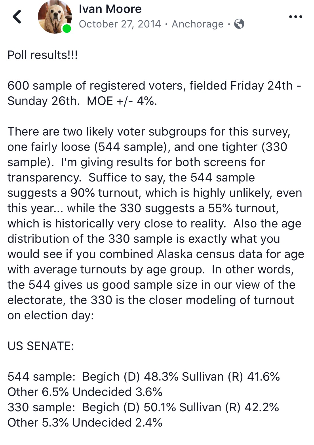
In July, Gov. Bill Walker released poll data that showed he likely has 28 percent of the vote to Begich’s likely 22 percent of the vote.  That poll was not viewed as credible, but an attempt to lessen Begich’s resolve to remain in the race. Walker faces an uphill battle as the least popular governor in America who is running for re-election.

Also in July, Harstad Strategic Research posted different results in a poll it did for Begich, which showed both Begich and Walker tied at 28 percent, and Dunleavy at 32 percent in a three-way race. Undecided/other voters totaled 12 percent in that poll.

Trust lost: Can journalism be saved?

0

By CRAIG MEDRED
CRAIGMEDRED.NEWS

Leave it to the venerable Associated Press to arrive late to one of the most disturbing trends of these times – the deconstruction and reshaping of the business of news – and then to somehow get the history wrong and some of the context as well.

“In a chaotic media landscape, with traditional guideposts stripped away by technology and new business models, the old lines between journalism and commentary are growing ever fuzzier,” the AP reported last week in a story with a very rose-colored view of the past.

The fuzziness is not new.

Take it from the late Walter Cronkite of CBS Evening News, the television anchor once branded the “most trusted man in America”:  

“Tonight, back in more familiar surroundings in New York, we’d like to sum up our findings in Vietnam, an analysis that must be speculative, personal, subjective. Who won and who lost in the great Tet Offensive against the cities? I’m not sure. The Vietcong did not win by a knockout but neither did we….

“To say that we are mired in stalemate seems the only realistic, if unsatisfactory conclusion….It is increasingly clear to this reporter that the only rational way out then will be to negotiate, not as victors, but as an honorable people who lived up to their pledge to defend democracy, and did the best they could.”

One couldn’t get much deeper into the blend of journalism and commentary than to suggest how the country should end a war.

But then journalism has always been deep into opinion in its many forms: theNew Journalism” of the 1960s and 70s with it “subjective perspective,” the news analysis that followed, and the rise of “interpretative journalism that eventually culminated in the Pulitzer Prize competition adding a category for “explanatory journalism” in 1985.

[Read more at CraigMedred.news]

Upsets and unknown outcomes: The races we watched

7

RESOUNDING MESSAGES SENT BY REPUBLICAN VOTERS

The Republican primary produced a few surprises in some Republican stronghold districts that are typically decided by the primaries:

Rep. George Rauscher of District 9 swept his three-way race with more than 50 percent of the vote. Musk Ox Republican Jim Colver got only 28 percent, and Pam Goode 22 percent. This was a race that many Republican political analysts thought could be closer, due to the massive influx of union political money into the Colver campaign.

Rep. DeLena Johnson held on to her House District 11 seat in decisive fashion, fending off a challenge from Edna DeVries, 59-41.

Former Rep. Nancy Dahlstrom, House District 13, won a three-way primary with  41.38 percent of the vote. This is the seat being vacated by Rep. Dan Saddler, who did not advance in the primary for Senate Seat G.

Kelly Merrick won House District 14 in a three-way race that put Jamie Allard in second and Eugene Harnett in third. That seat is the one being vacated by Rep. Lora Reinbold, who won the nomination for Senate Seat G, Eagle River, 58-42 over Rep. Dan Saddler.

Rep. Gabrielle LeDoux, a Musk Ox Republican, lost on election night in District 15, although she is down by only three votes. She could reverse that loss once the absentees and questioned ballots are counted, but considering her opponent, Aaron Weaver, did nothing at all on his campaign, this is a devastating outcome for the head of what are considered the turncoat Republicans. A recount is almost certain.

Sara Rasmussen scored a solid win over former Rep. Liz Vazquez in District 22, 54-46. She will face “nonpartisan” Rep. Jason Grenn in the General Election, along with Democrat Dustin Darden.

Connie Dougherty, District 23, won against Forrest McDonald, 53-47. She’ll face Chris Tuck, a well-funded union representative who belongs to the Democrats.

One of the biggest winners of the night on the Republican primary side was Rep. Chuck Kopp, District 24, who won nearly 71 percent of the vote against challenger Steve Duplantis.

Rep. Charisse Millett lost to Josh Revak, who took the District 25 race by 57-43. Millett wrote to Revak this morning: “Congratulations Josh! Let me know how I can help! We have the best District in the State – do good work. God bless you and your family.” While this district still could go to Democrat Pat Higgins, it’s been held by Millett since 2008. She faced a well-funded Revak, whose family friend poured $30,000 into defeating Millett with an independent attack campaign on her record.

Laddie Shaw upset the three-way race in House District 26, with a whacking 43 percent of the vote, while Joe Riggs and Al Fogle split the remainder. While Riggs and Fogle were the subject of sign-war drama, Shaw worked the doors as a retired Navy SEAL.

Wayne Ogle and Benjamin Carpenter in House District 29 are just three votes apart after all precincts were counted. They are vying for the seat being vacated by Rep. Mike Chenault.

Sen. Peter Micciche of District O trails this morning by 12 votes, with challenger Ron Gillham surprising the senator who has served since 2013. That outcome could still go either way after all the absentee and questioned ballots are counted. A recount is almost certain.

Dunleavy’s historic landslide

UNPRECEDENTED MARGIN FOR CONTESTED PRIMARY IN ALASKA

Primary voters who chose the Republican ballot gave Mike Dunleavy more than 39,193 votes on Tuesday, with more than 98 percent of the votes counted.

He becomes the nominee with a wide margin over his nearest competitor, Mead Treadwell, who received 20,230 votes.

It was a stunning 62-32 victory for the former Wasilla senator.

Beyond the raw numbers, the Dunleavy victory was an unprecedented margin in a contested gubernatorial primary in Alaska, said Tuckerman Babcock, chairman of the Alaska Republican Party.

“I’ve never seen anything like it,” he said.

On the Democrats’ ballot, Mark Begich was the only contender, and he eased through the night with 29,886 votes.

How that sets Dunleavy, Begich, and Gov. Bill Walker up in a three-way primary will be the discussion of the week in political circles in Alaska.

Gov. Bill Walker can claim he has at least 5,000 votes coming out of the primary  — those 5,000 are represented by signatures he submitted on a petition on Monday that will allow him to go to the General Election as a lone wolf, without a party organization of volunteers behind him. He will have to instead rely on his family and paid staff to advance his campaign.

Begich, on the other hand, now will get the support of the national Democratic Party, including the coveted funds that come from the Democratic Governors Association, which could be in the millions.

Of the 103,175 people who voted in the primary, Republican candidates received 64,754 votes, and Democrats got 38,421 votes. The main primary on the Democrats’ ballot was in the congressional race, where Alyse Galvin won with 55 percent of the vote to Demitri Shien’s 23 percent.

The best way to become governor of Alaska is to win the Republican primary, and to do so with commanding fashion puts Dunleavy in a strong position to succeed in November, whether there is a three-way race or a two-way.

Dunleavy hits the campaign trail to Soldotna today, while speculation swirls about whether Walker or Begich can muscle each other out of the race. They have until Sept. 4 to do so. Widespread pressure on Begich to drop out will only intensify in the days ahead. But so far, he has exhibited no signs of buckling.

The scene at the Aviator Hotel was upbeat, where hundreds of Republicans gathered to watch the results come in. Early in the night, when only 17 percent of the votes had been counted, Dunleavy leapt to a 30 point lead and stayed above that range the rest of the night. The ultimate outcome was never in question.

Kevin Meyer won the night for the lieutenant governor’s race, and now he and Dunleavy will form a ticket. Meyer took 36 percent of the vote to Edie Grunwald’s 27 percent.

Participants — many who had worked on various legislative campaigns — were in the mood to celebrate the victories and marvel at the upsets. At midnight, Treadwell walked through the mostly empty ballroom and spoke to those who remained, as the staff was clearing the tables.

“The whole race was about Alaskans saying ‘listen to us,’ said Dunleavy campaign manager Brett Huber. “The issues that carried were burning public issues of the Permanent Fund, reducing the cost of government, and Alaskans just want a governor who won’t break their trust.”

“Alaskans spoke loud and clear tonight,” Dunleavy said. “They want a government where leaders honor their promises. Restoring the trust of the people in their elected officials is crucial to our ability to turn this state around. Tonight’s victory belongs to the thousands of ordinary, working Alaskans who want leaders who say what they mean, and mean what they say.”

RESEARCHER NAILS THE OUTCOME

Dittman Research issued a prediction on Tuesday morning, which was embargoed until 8 pm when polls closed. The prediction was within one point of the ultimate outcome. Dittman predicted a 29 point margin of victory, which is nearly exactly where it ended last night:


BACK ON THE TRAIL

Fresh off his historic, landslide primary victory, Dunleavy hits the trail today for the Kenai Peninsula. He will be at Industry Appreciation Day on Saturday on the green strip in Kenai, from noon-3:30 pm.

First things first for new governor

16

BY ART CHANCE
SENIOR CONTRIBUTOR

I’m going to visualize Mike Dunleavy being Governor.

Dunleavy has no Executive Branch experience. I don’t know who around him has any, but there can’t be many.

In Frank Murkowski’s administration, we used up pretty much every nominal Republican who was at least marginally competent to accept a political appointment. We caught hell for firing so many selfless Democrat public servants, but we actually only replaced about 30 percent of the appointees.

If Knowles had won in 2006, he would have found most of his second term administration sitting there waiting for the return of the king.

Sarah Palin came in, and all the Murkowski appointees who hadn’t chosen to leave rather than work for her — I among them — got fired.

She replaced a few of them with some of her buddies but mostly Palin tried to run her government with a bunch of Knowles holdovers; what could go wrong?

Sean Parnell was so desperately afraid of the Sarah Palin tweet-in-the-night that he pretty much left her government, which was Knowles’ government, in place. Then he wondered why he was leaked, thwarted, sabotaged, and ultimately defeated by the Anchorage Daily News and its gaslighting National Guard phony scandal.

When Dunleavy wins, he’ll be awash in resumes from bright young lads and lasses who’ve always been dedicated Republicans and supported him to the hilt, or so they’ll say.

The first step is to see if they gave you any money. I’ve been around enough wannabe Republican appointees to know that the vast majority only want the appointment so they can parlay it into a lobbying contract and they couldn’t care less if the Governor that appointed them gets re-elected so long as they can get a lobbying contract.

The irony here is that the people who are most likely to be loyal to a Dunleavy administration are the merit system employees in State government, most of whom probably voted for one of the Democrats.

The government of Alaska was built by New Deal Era Democrats to be run by New Deal Era Democrats and employ the maximum number of Democrats. There is absolutely no way a Republican governor can fill all the politically appointed positions in State government with loyal and competent Republicans, and you can’t appoint the guy that did yeoman duty putting out signs for you as the head of a major division in State government.

But here is the rub for a Republican; you can’t run the government with holdovers. If you are to have a prayer of effectively running the government, you absolutely must fire everyone that you have a legal right to fire as your hand comes off The Bible.

The Hermaphrodite Administration (Bill Walker) fired everyone left from Palin/Parnell who’d ever had a Republican thought.

Consequently, almost everyone in the government in a position of any authority was hired or promoted by Knowles or by someone who was hired or promoted by a person hired or promoted either in Knowles or Walker. There are a very few relatively apolitical subject matter experts that it would be a shame to lose, but fire them anyway, let them miss a paycheck or two, and hire them back once they realize who is boss. The rest of them can lose their waterfront houses, boats, airplanes, vacation homes, and bedwarmers.

It is going to be lonely in State government when they’re all gone and you really don’t have much of a talent pool to draw on; there are really not a lot of competent, loyal Republicans who want to be a public employee, even a high-level one, when they grow up.

Find some good people to run the major areas where you must make changes.

In the rest of the government, go to the merit system employees who were direct reports to the appointees who are now unemployed.   The vast majority of them will keep things running and not give you any trouble.   It is far more trouble to fix something than to keep it running, so they’ll keep it running. You give them acting status and the pay of their former boss and most of them will behave and work productively. There’ll be a few ideologues and malcontents who’ll do something stupid, and you’ll just have to fire them. Yes, you can fire public employees, even unionized public employees.

Now the lobbyists and players who’ll flock to you once you’re elected will tell you that you can’t do this; that it will be too disruptive.

The reality is that the very hardest thing you could do would be to stop the government from running. The only major thing that will be disrupted are the contacts lists belonging to those lobbyists and players.

Art Chance is a retired Director of Labor Relations for the State of Alaska, formerly of Juneau and now living in Anchorage. He is the author of the book, “Red on Blue, Establishing a Republican Governance,” available at Amazon. He only writes for Must Read Alaska when he’s banned from posting on Facebook. Chance coined the phrase “hermaphrodite Administration” to describe a governor who is simultaneously a Republican and a Democrat. This was a grave insult to hermaphrodites, but he has not apologized.