Thursday, May 7, 2026
Home Blog Page 1583

GOP to pursue write-in campaign against LeDoux

3

Although Gabrielle LeDoux may have won her re-election, she may face a write-in campaign in the November General Election.

Tuckerman Babcock, chairman of the Alaska Republican Party, said that the write-in could be for either LeDoux’s primary challenger, Aaron Weaver — or if Weaver chooses otherwise, another candidate, such as Jake Sloan, who had run for the office briefly but withdrew.

Babcock will be meeting with Weaver and District 15 Republican officials tomorrow to discuss the next steps.

LeDoux’s election is under a cloud of suspicion as some of the ballots voted in her district have been sent to the criminal division of the Department of Law for investigation of possible fraud.

LeDoux, the incumbent for House District 15, now leads by 113 votes, with 26 votes being considered suspect due to residency or other legitimacy issues.

“The Alaska Republican Party does not acknowledge Gabrielle LeDoux as a Republican candidate,” Babcock said.

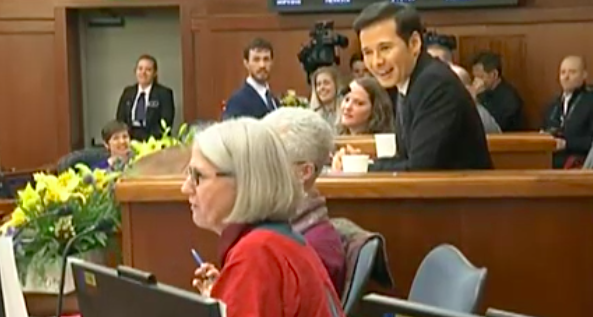
Rep. Paul Seaton, Gabrielle LeDoux, and Louise Stutes listen as a Republican Party official explains why they are being sanctioned and targeted for removal by the Alaska Republican Party, during a state central committee meeting last year.

Last year, the Alaska Republican Party voted to remove all support from LeDoux and to actively seek her removal. The party asked her to change her registration from Republican to something else, because the party believed she was a turncoat.

LeDoux issued a statement to the Anchorage Daily News that defended her efforts to bring in the votes for her candidacy in District 15, and denied doing anything illegal.

Sen. Lisa Murkowski successfully ran a write-in campaign against Joe Miller in 2010, and in Juneau, Sally Rue won as a write in candidate for the Juneau Board of Education in 1992.

KTVA FINDS MANY IRREGULARITIES

KTVA crews went to some of the addresses where votes were sent from in Muldoon, and found plenty of irregularities, including addresses that simply do not exist.

Read the KTVA report here.

If LeDoux is found to have participated in voter fraud, she could be disbarred from the Alaska Bar Association and also face legal penalties.

Ben Carpenter to replace Mike Chenault in House District 29?

2

IT LOOKS LIKE 13 VOTES ADVANTAGE FOR CARPENTER

After absentee, early, and questioned votes were counted in the House District 29 race, it appears Ben Carpenter has the edge over Kenai Borough Assemblyman Wayne Ogle.

But it’s only by 13 votes. The official count has not been announced; this calculation comes from a review of the most recent tapes from the Division of Elections.

And with just 10 votes, there could be a recount.

At the end of Election Day, Ogle had 1,222 votes to Carpenter’s 1,219 votes in the Republican Primary, a three-vote margin.

With all the absentee, early, and questioned ballots in, the current count appears to be 1,367 for Carpenter to 1,354 for Ogle, according to an analysis of the Election Division’s tapes in Juneau, where the district’s remaining outstanding votes were counted this afternoon.

Carpenter is recently retired from the Alaska National Guard, where he was a special staff officer in the commanding general’s office. He is also a U.S. Army and Air Force veteran. He and his wife grow peonies at their Nikiski home and property.

A 1993 graduate of Nikiski High School, Carpenter served in Iraq and Afghanistan and in Turkey and Kuwait with the Air Force.

He is president of the Alaska Peony Market Cooperative and ran for House after Mike Chenault announced his retirement earlier this year.

The winner of the Republican primary will face Shawn Butler, a Democrat, in November. Butler is a retired U.S. Army officer who teaches at the University of Alaska and lives in Hope.

Micciche pulls ahead in absentee count

5

In one of the closest races in the Alaska Republican Primary, Sen. Peter Micciche has fended off a challenge by newcomer Ron Gillham by what appears to be 72 votes.

After absentee, early, and questioned ballots were counted in the District O race, Micciche had 2,930 votes to Gillham’s 2,858.

Voters who were unhappy with the way the Permanent Fund dividend has been decided and an abundance of crime in Alaska gave several incumbents a punishing election season, and Micciche early on said he felt he was in a tough primary battle.

Gillham, who works on an oil rig in Cook Inlet, was ahead by 9 votes on Election night, but Micciche had run an effective absentee ballot push, and that pulled him out of reach today. Micciche has held the seat since 2013 representing the Kenai Peninsula.  He was previously the mayor of Soldotna, and a member of its city council.

The absentee ballots were counted in Juneau and results were not available until late in the day.

There was no Democrat in the race, so this result decides the Senate Seat O election.

Ben Carpenter to replace Mike Chenault in House District 29?


Can this candidate be saved?

1

Democrat Rep. Scott Kawasaki, running for Senate Seat A against Sen. Pete Kelly, and needs volunteers, according to his recent announcement. He’s having a volunteer rally in Fairbanks on September 1.

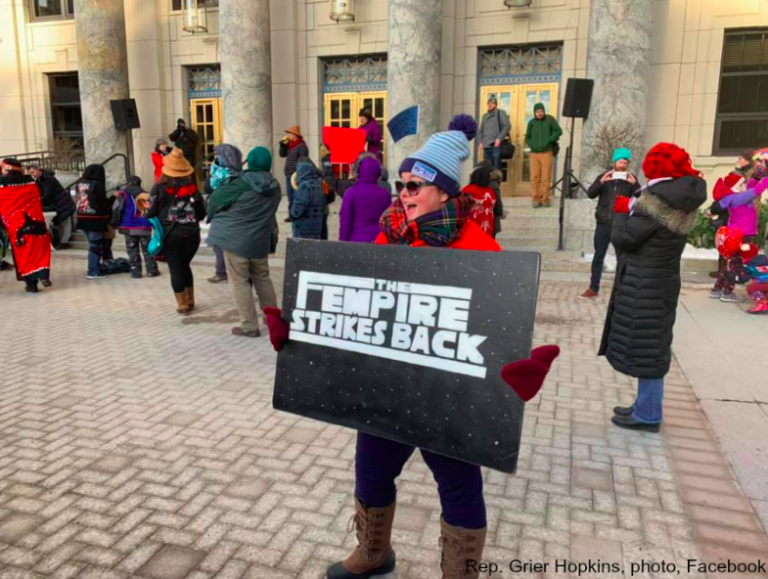
We took one look at this flyer and identified an immediate volunteer need.

(And it’s not just the design of the “resistance” raised fists and lightning bolts on a black background that’s a problem. There’s a significant spelling issue.)

Criminal investigation underway; LeDoux now up by 87 votes

DISTRICT 15 ELECTION IRREGULARITIES SENT TO DEPARTMENT OF LAW

Rep. Gabrielle LeDoux appears to have won her primary re-election.

The Aug. 28 count of absentee ballots has yielded 142 for LeDoux, and 33 for her Republican opponent, Aaron Weaver.

All things counted, she’s 87 votes ahead. That’s not counting 26 suspect ballots. All of those votes went to LeDoux but are not being included at this point.

100 votes is what LeDoux paid a man named Charlie Chang, from Fresno, Calif., to get for her as insurance for her election. She paid Chang $10,000 and plane tickets to and from Fresno to work over the Hmong vote in Muldoon.

[Read: LeDoux’s vote-getting scheme raises eyebrows]

[Read: Division of Elections: Irregularities in District 15]

District 15 primaries are low-turnout events, and this one was no different, so she wanted insurance to make sure nothing happened to bump her from office.

Yet on election night, she trailed Aaron Weaver by 3 votes, 294 to 291. But that was before all the absentees came in.

During the counting of absentee ballots, so many irregularities were discovered, that the Division of Elections has forwarded on information to the State Department of Law’s criminal division.

There were absentee ballots being requested by dead people, and phone numbers given on absentee ballots that were non-functioning. People voted who didn’t live in the district. People told the Division of Elections that they hadn’t voted, although ballots had been turned in in their name.

The tape showing the absentee count for District 15.

The Department of Law isn’t saying much, other than there is evidence of voter fraud.

IS CHANG A PART OF THE FRESNO DEMOCRATIC PARTY?

Chang was given the $10,000 vote bounty by LeDoux in late July to bring in the absentee votes throughout the Hmong community in District 15, where LeDoux serves as a House representative. The check went to his Sierra Vista address in Fresno.

Chang is a former president of the California Minority and Women’s Contractors Association, a now-defunct nonprofit registered to his address at 8437 N Sierra Vista, Fresno, California 93720.

But is he also the same Charlie Chang who is a Democrat activist in Fresno, the head of the Fresno Democratic Party’s Hmong Committee? Must Read Alaska found the group’s website, which shows:

Mission Statement

We, as Democrats, are devoted to advancing equal rights for all Hmong people regardless of age, race, gender, sexual preference, religion, national origin or economic status. We support the Democratic Party and those Democratic candidates who support our mission.

We will strive to realize these goals:

  • To educate the Hmong community and others about the significant differences between the two major parties on issues of concern to this community.
  • To encourage, empower and inspire Hmong to run for political office.
  • To encourage members of the Hmong community to support and vote for Democratic candidates, especially Hmong Candidates who are committed to defeating prejudice.
  • To lead the Central Valley Hmong Democrats to improve its record on issues of importance to our community.
  • To work for the nomination of Hmong Democratic candidates at local, state and national levels of government  who will be fully supportive of the struggle against bigotry and intolerance.
  • To provide manpower, resources, guidance and training to support and provide Hmong political candidates the best experiences and opportunity.
  • To provide Hmong elders and non-English speakers the support they need during elections.
  • To work with other groups and individuals to promote these goals.

President: Dr. Charlie Chang
559-470-4788
[email protected]

Meets third Thursday of each month at 6 p.m.
Democratic Party HQ
1035 U St., Fresno

Mueller and the political assassination of Ted Stevens

11

By FRANK MCQUEARY
SENIOR CONTRIBUTOR

It is the 10th anniversary of the political assassination of the late Sen. Ted Stevens, which occurred two years before his untimely death in a plane crash on Aug. 9, 2010.

I have been watching the coverage of the “Russian collusion investigation” and the trial of Paul Manafort.

A picture is starting to take shape:

If you were in Alaska in 2007 and 2008 you had a ringside seat to see the Federal Bureau of Investigation and the Department of Justice fabricate a criminal case against US Senator Ted Stevens.

The head of the FBI at the time was Robert Mueller.

While ultimately cleared of all charges, the case against him cost Stevens his seat in the US Senate in 2008.

The heart of the DOJ/FBI prosecution was the allegation that Stevens had failed to disclose over $250,000 worth of work on his Girdwood “chalet”.  It was $250,000 of work ostensibly done by his friend Bill Allen’s company, VECO, in addition to the $180,000 which Stevens had paid for the so-called improvements.

Events would eventually make it obvious that Stevens overpaid by $80,000 or more and should have been suing to get some of his money back.

But the FBI/DOJ team had a different narrative they were selling.

On July 30, 2007 they hired a locksmith and invited news and TV crews to observe their “raid” on Sen. Stevens home.

The Anchorage Daily News, in the person of Rich Mauer, as well as reporters from Anchorage TV station Channel 2 and commentator-for-hire Shannon (Shannyn) Moore were there by invitation.

What this intrepid band of reporters failed somehow to notice was that there was no way that $180,000 much less the alleged additional $250,000 from VECO, had been spent on upgrading Ted’s rather modest chalet.

Nor did they see any incongruity in the FBI, normally religiously silent about ongoing investigations, inviting them to what became a show and tell.

Nor, it is worth noting, have any of these intrepid souls had the moral courage to set the record straight by admitting that they were duped by the investigators.

But why would Sen. Stevens’ friend Bill Allen testify to something which was patently untrue?

Undisclosed by the FBI/DOJ team were several salient facts:

Bill Allen was in the process of selling his company, VECO, to CH2MHill for net cash proceeds somewhere in the neighborhood of $432,000,000.

The majority of those proceeds were allowed to flow through to Allen family members and trusts as well as several minority owners. Only the $70,000,000, which was to go directly to Bill Allen, was impounded by the DOJ pending his cooperation in the prosecution of Sen. Stevens.

Also undisclosed was the fact that Allen, once named Alaskan of the Year, now drunken and brain-damaged from a motorcycle accident, was himself under investigation by the Anchorage Police Department for illicit sexual relations with a minor, and that the investigation was being quashed by the FBI/DOJ.

The carrot for Allen’s cooperation was the release of his $70,000,000; the stick was the frozen investigation of Allen’s own corrupt criminal acts.

Ultimately the illegal prosecution of Sen. Stevens was thrown out, first by Judge Emmett Sullivan, and then by Eric Holder.

But it cost Stevens his seat in the US Senate.

In July of 2008, just months before the elections, a DC jury convicted Stevens. Using the suborned false testimony of Bill Allen, hiding evidence of Stevens’ innocence, the FBI and DOJ had piled on charges and leaked so much false and damaging evidence to the “press” that the Washington DC jury returned a conviction.

But all this was only part of the story. In Florida, a minor league Democrat named Vic Vickers, packed up his household goods and headed to Alaska. He changed his registration to Republican, filed to run for US Senate and proceeded to spend a million dollars on “campaign” ads that said little, other than “Stevens is a crook.”

And, in Washington DC, the Democratic National Committee, then under Chuck Schumer’s leadership, was grooming Mark Begich to replace Stevens. In Alaska Begich was cautious in his criticism of Stevens because of Stevens’ popularity. In DC where his financial and political support was based he was vicious in attacking Ted.

Apologists in the years since Stevens’ conviction was overturned have tried to paint the indictment as the work of the Bush Administration and the exoneration as the work of the Obama administration.

The reality is that it was an entrenched bureaucracy which was putting its thumb on the scales of justice.

When whistleblower Special Agent Chad Joy revealed just some of the improprieties and illegal activities on the part of the FBI/DOJ, you would have expected that heads would have rolled. But the only one in the FBI to suffer much more than a slap on the wrist was Chad Joy, the whistleblower who went public and revealed the ethical lapses on the part of both the FBI investigation and the DOJ prosecution.

Needless to say his career in a bureaucracy run by Robert Mueller did not thrive. One year later he was no longer with the FBI His partner, Mary Beth Kepner, who was found guilty of a myriad of ethical and legal lapses, was still with the FBI years later.

Similarly in the DOJ not much happened to the malfeasants. Only Nicholas Marsh suffered a self-imposed penalty when he committed suicide.

It was during this period of time under Mueller’s leadership at the FBI that Mueller first partnered with DOJ’s Andrew Weissman. Weissman had promulgated the practice of intimidating witnesses and soliciting false testimony, hiding evidence and procuring high-profile convictions, which were later overturned on appeal, but not before lives were ruined and in some cases lost. When his brutal and dishonest practices had been focused on racketeers and crime lords, no one seemed to care about his tactics.

In the summer of 2008 when I and others had encouraged Stevens to mount a vigorous campaign and proclaim his innocence loudly and broadly, the former federal prosecutor explained that he had to walk a very narrow path because under the RICO statutes that were being used, any public comments he made concerning the investigation could be interpreted by the DOJ/FBI investigators as “obstruction” and could lead to new charges.

Ultimately Stevens did hire a campaign manager in August of 2008. It was too little, too late. Many former supporters were either intimidated by the aggressive manipulation of facts by the FBI or convinced of Stevens’ guilt by the staged display and leaking of information about the investigation to sympathetic media.

Stevens ultimately lost the election by a mere 3,000 votes in spite of the false “conviction” and the overwhelmingly negative coverage in the Anchorage Daily News by the rabidly anti-Stevens reporter Rich Mauer.

Mark Begich, with the help of Chuck Schumer and the DNC went on to become Alaska’s Junior Senator, just in time to provide the 60th vote for Obamacare and vote in lockstep with Obama’s redistribution agenda.

In April of 2009 Judge Emmet G. Sullivan dismissed the ethics conviction of Ted Stevens. In a 14 minute diatribe he said that he had never seen “mishandling and misconduct like I have seen” in the Stevens trial. He then appointed a special counsel to determine if the prosecutors themselves should face criminal charges themselves.

A powerful US Sen. Stevens was the bureaucratic cabal’s first major political victim. But now it is after a bigger fish, the president of the United States.

Frank McQueary is a life-long Alaskan and political activist and student of Alaska history.

Update: Aaron Weaver now up by 9 votes over LeDoux

3

BALLOT COUNTING MACHINE BROKE ON ELECTION DAY

In the North Muldoon precinct of District 15, a ballot counting machine broke on Aug. 21, and 13 ballots could not be counted.

Those ballots were put into an envelope and sent to Juneau for counting, which is standard procedure.

The result of that count put Aaron Weaver up by 9 votes over Rep. Gabrielle LeDoux.

That’s six votes more than Weaver had on Election night, when he led LeDoux by three votes.

But there are many more ballots to be counted.

As of Monday afternoon in the Republican primary, 179 votes from absentee by mail, absentee in person, and special needs voters need to be counted and will likely be counted on Tuesday.

Also there are seven early votes and 10 questioned ballots that need to be counted by the Division.

The Division of Election is said to be concerned about 10-20 ballots that have doubts surrounding them.

[Read: Division of Elections finds irregularities in ballots from Gabrielle LeDoux race]

[Read: Gabrielle LeDoux’s absentee vote scheme raises eyebrows]

Aaron Weaver this afternoon told Must Read Alaska, “I have the upmost trust in the Division of Elections. They are consummate professionals. If they find anomalies I know they will take appropriate action. The integrity of our elections is paramount and is what makes our republic work. What’s most important is that the people have confidence that their vote matters.”

LeDoux spent over $73,000 for her campaign, including a $10,000 check to a California man named Charlie Chang in late July to get out the vote among minorities in the district.

Aaron Weaver, Gabrielle LeDoux

Weaver spent less than $2,000 on his campaign and realized he was outgunned from the start, and was surprised when he pulled ahead of LeDoux on Election night.

Division of Elections: ‘Irregularities’ in ballots from District 15

7

ABSENTEE BALLOTS FROM PHANTOM VOTERS IN GABRIELLE LEDOUX DISTRICT

The Alaska Division of Elections has announced it found irregularities in the House District 15 absentee ballots, enough to call for a series of measures to ensure that voters have confidence in the results.

“This is the first time we have had corruption that the Division of Elections has identified,” said Tuckerman Babcock, Alaska Republican Party chairman. “It looks like it’s as bad as anyone thought it was.”

A press release from the Division was sent this afternoon, explaining the problems:

The Division of Elections, in preparing for the 2018 primary election and in its initial review of absentee ballot applications, discovered some irregularities that prompted a second round of review of all absentee ballots from House District 15. This review only involves the application and the ballot envelope. The division will not be reviewing and counting the votes until tomorrow.

One irregularity was a high number of absentee ballots from House District 15 returned as undeliverable. In every election, some absentee ballots mailed out by the division are returned by the post office as undeliverable. The division makes efforts to contact those voters and get them new ballots, but there are always some voters the division is never able to reach. What raised suspicions in this election cycle is that of those voters that the division was not able to reach over 50 percent (40 out of 70) were from House District 15. 

Another irregularity was seven absentee ballot applications received for House District 15 from people whom state records indicated were deceased. For these applications, the division did not send ballots to those persons.

The division’s second round of review of absentee ballots from House District 15 revealed that there is no reason to be concerned about the vast majority of absentee ballots from the district. The division reviewed various records and confirmed that most absentee voters had long voting histories at their addresses and their signatures matched division records over many years. 

But other ballots raised concerns that the person identified as the voter either did not actually vote the ballot or was no longer living in House District 15. The division has been diligently investigating those concerns.

After identifying all such ballots, the division attempted to contact the voters on the phone to confirm whether they actually voted and where they were living.  Some of the phone numbers were no longer in service or no one picked up the phone. Among the voters that the division was able to reach, some confirmed that they had indeed voted, but two of the voters contacted said they had not voted in the 2018 primary election. The division will not count the ballots voted in those two voters’ names.

In light of the remaining questions over some of the ballots and the close race between two candidates in the Republican primary in House District 15, the division will do the following when it counts absentee ballots for House District 15:

* All absentee ballots from the district will be kept with their envelopes rather than commingled. This will ensure that any votes later identified as improper can be subtracted from the vote totals. 

* The division will first count the absentee ballots that do not raise authenticity concerns and then determine the candidates’ vote totals including those ballots.

* The division will then count the absentee ballots that do raise authenticity concerns, but about which the division does not currently have evidence to merit rejection, to see if those votes would affect the outcome of the primary election.

* The division will have a provisional count on the election completed tomorrow, but the final count will not be certified until Saturday.

* The division will continue to evaluate the legitimacy of those ballots until the deadline for certification of the election result on Saturday.

When there are questions about a ballot, the Alaska Supreme Court has said the law favors counting the ballot so that voters will not be disenfranchised without good reason. For this reason, the division will not reject ballots without clear evidence that the voter identified on the ballot did not vote the ballot or that the ballot is otherwise improper. 

“The integrity of our elections is vital to our democracy,” said Division of Elections Director Josie Bahnke. “The division will continue to look into this matter throughout the week and remove any ballots that we determine should not be counted.”

The division briefed the candidates and the Alaska Republican Party today on the matter. The division will certify the election results on Saturday, September 1 as required by statute. A candidate or group of voters may request a recount or file an election contest if they wish to challenge the result in court. Any challenge will need to be resolved quickly because the division needs to know the winner of the primary in time to print ballots for the general election.


Update: Aaron Weaver now up by 9 votes over LeDoux